Terraformation’s 10-slide deck is an unconventional fundraising document that prioritizes philosophical alignment and macro-problem framing over traditional business metrics. The company raised $40,000,000 in 2019 by arguing that the climate crisis is a scalability problem, not a technology problem. The deck positions reforestation as a 'proven technology' that avoids the R&D risks of carbon capture hardware. While it lacks a team slide, financial projections, or a specific ask, it excels at refuting common objections regarding land and water availability. The deck relies heavily on the 'Sili…
Key takeaways
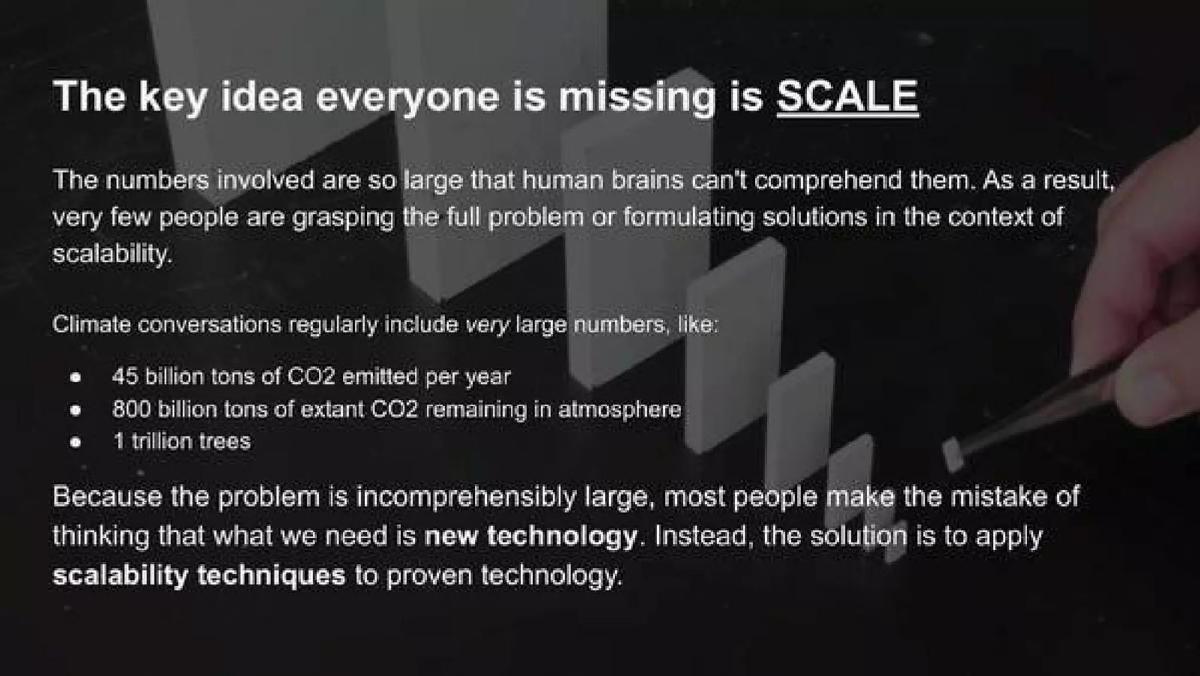
- The deck identifies 45 billion tons of CO2 emitted per year as a scale problem that human brains struggle to comprehend (Slide 3).
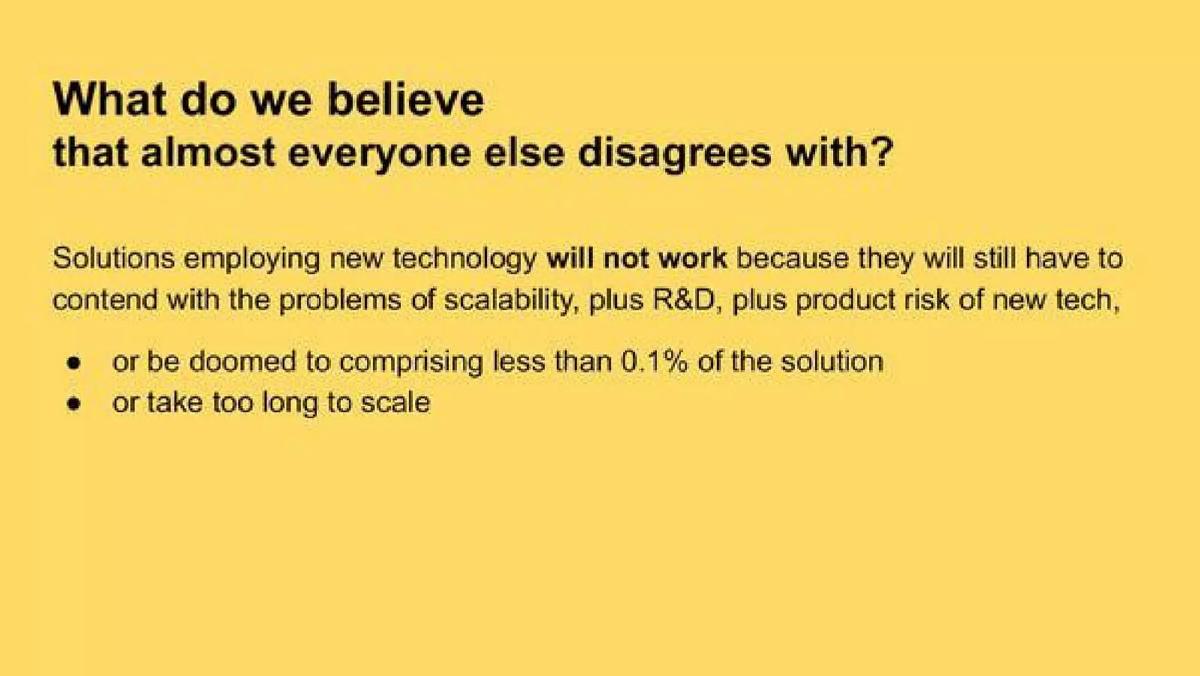
- It explicitly argues against new technology, stating that R&D and product risk make new tech solutions too slow to scale (Slide 4).
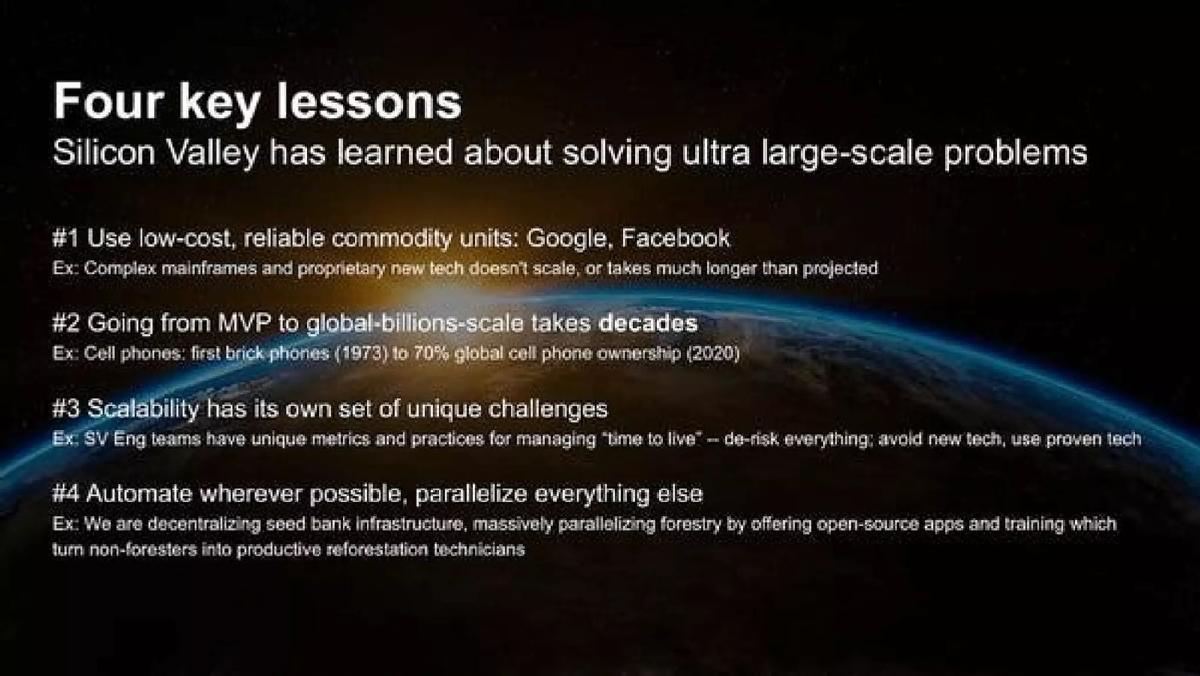
- The company applies four Silicon Valley lessons to forestry, including the use of low-cost commodity units and parallelization (Slide 5).
- Trees are framed as 'self-replicating carbon sequestration machines' that run on water and sunlight (Slide 7).
- The deck addresses the primary objection of land and water scarcity by proposing solar-powered desalination (Slide 9).
- It claims that reforestation begins removing CO2 the same month an investment is made, bypassing the lab-to-product cycle (Slide 10).
- The deck completely omits a team slide, despite the company raising $40M (Slide 1-10).
- There is no specific financial 'Ask' or use of funds slide included in this 10-slide sequence (Slide 1-10).
The Philosophy of Hyperscaling Nature
Terraformation’s pitch deck is a rare example of a narrative-heavy, data-light presentation that successfully secured a massive $40,000,000 round. In an industry often obsessed with proprietary hardware and complex chemical engineering, Terraformation took a contrarian stance: the technology already exists in the form of trees, and the only missing ingredient is the Silicon Valley playbook for scale. The deck is structured not as a business plan, but as a logical proof intended to shift the investor's worldview from 'we need new tech' to 'we need better deployment of old tech.'
Slides 1-3: Framing the Macro Problem
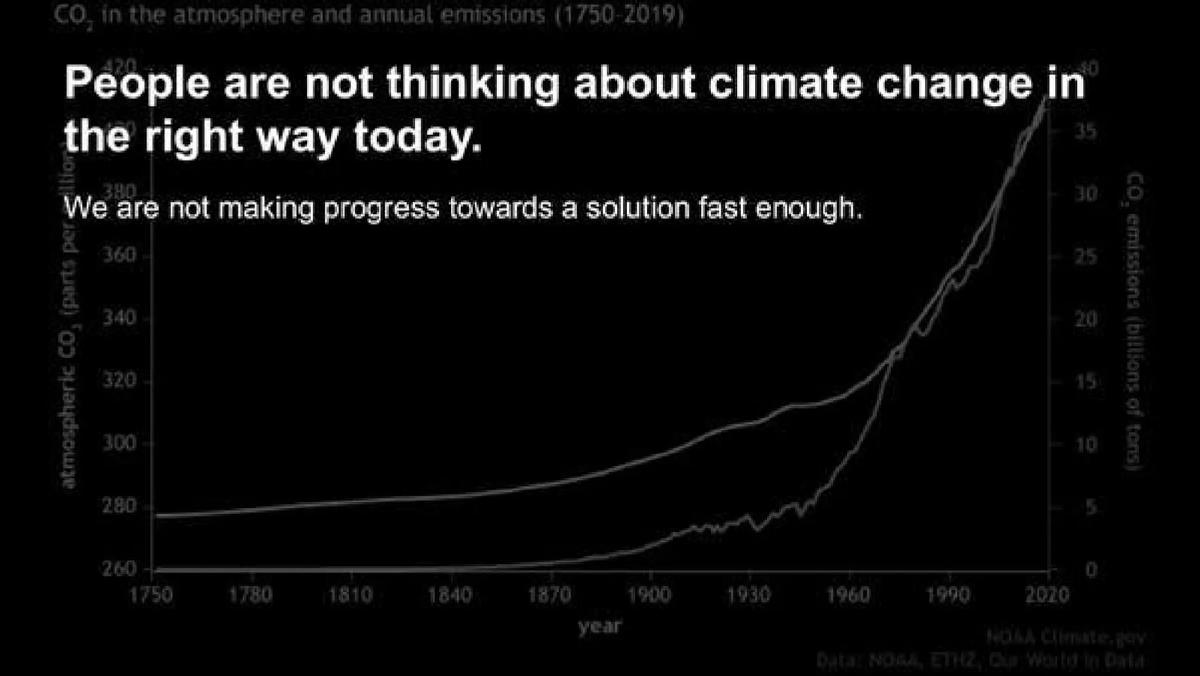
Slide 1 introduces the mission: "Hyperscaling forest restoration to solve climate change." The use of the word "hyperscaling" is a deliberate nod to software growth patterns, signaling that this is not a traditional non-profit tree-planting initiative. Slide 2 presents a stark graph of atmospheric CO2 and annual emissions from 1750 to 2019, with the headline "People are not thinking about climate change in the right way today." This sets the stage for a 'secret' or unique insight that the founders possess.
Slide 3 identifies that secret: "The key idea everyone is missing is SCALE." It lists three daunting figures: 45 billion tons of CO2 emitted annually, 800 billion tons of extant CO2 in the atmosphere, and the need for 1 trillion trees. The slide argues that because these numbers are so large, people mistakenly look for new technology when they should be looking for "scalability techniques to proven technology." This is a classic venture capital framing technique—identifying a massive market (or problem) and explaining why current solutions are fundamentally flawed.
Slides 4-5: The Contrarian Insight and the SV Playbook
Slide 4 asks the Peter Thiel-inspired question: "What do we believe that almost everyone else disagrees with?" The answer provided is that new technology will not work because of R&D risk, product risk, and the time required to scale. It suggests that new tech will either be "doomed to comprising less than 0.1% of the solution" or simply take too long. This is a direct attack on the Direct Air Capture (DAC) industry, positioning Terraformation as the pragmatic alternative.
Slide 5 outlines "Four key lessons" from Silicon Valley. These include using low-cost commodity units (citing Google and Facebook), acknowledging that global scale takes decades, managing "time to live" metrics, and automating/parallelizing everything. Specifically, it mentions decentralizing seed bank infrastructure and using open-source apps to train non-foresters. This slide is crucial because it translates a biological problem into an engineering and operations problem that a tech investor can understand and value.
Slides 6-8: The Solution as a Machine
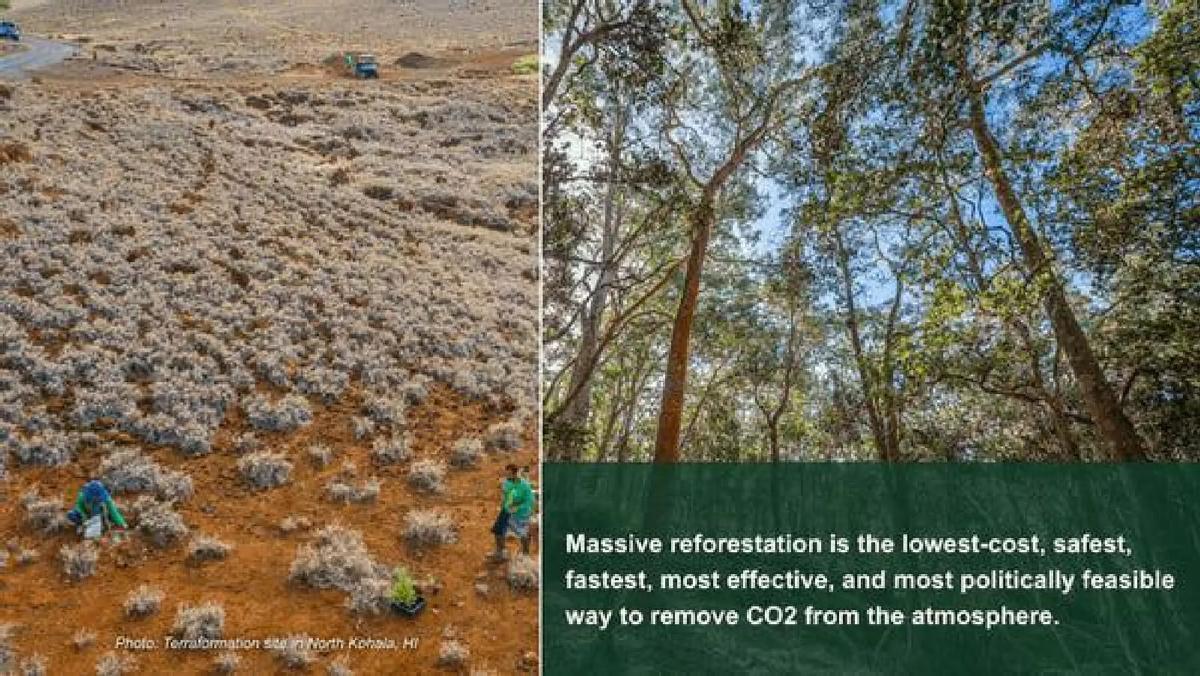
Slide 6 provides visual evidence of a Terraformation site in North Kohala, HI, claiming that reforestation is the "lowest-cost, safest, fastest, most effective, and most politically feasible way" to remove CO2. Slide 7 is perhaps the most famous slide in the deck. It uses a stylized graphic of a tree made of circuit board traces and poses a hypothetical: if a founder invented a "self-replicating carbon sequestration machine" that ran on water and sunlight and produced food, investors would be clamoring for the Series A. The punchline is that this machine is a tree. This re-framing is designed to strip away the 'low-tech' stigma of forestry.
Slide 8 addresses the "Why is this not being pursued?" question. It tackles the skepticism head-on, stating that the common belief that there isn't enough land or water is "the wrong way to think." It encourages investors to focus on solving the specific bottlenecks (X and Y) rather than abandoning the solution entirely.
Slides 9-10: Solving the Bottlenecks and the Return
Slide 9 gets specific about the "X and Y" bottlenecks: land and freshwater. It showcases photos of solar panels and desalination equipment, stating that "Solar prices are low enough to make low-emissions desalination economically possible at large scale." It also notes that desalination is a good fit for intermittent solar power. This slide is the only one that shows industrial equipment, grounding the high-level philosophy in physical reality.
Slide 10 concludes with "Scale and Return." It emphasizes that reforestation bypasses the "lab -> product -> scale" sequence, allowing for immediate action ("that same month"). It characterizes the capital as an "investment, not a consumption tax," promising a "huge" return in the long term. However, the slide is notably vague on how that return is generated, leaving out any mention of carbon markets or specific revenue streams.
What Works in This Deck
The Narrative Reframing: The deck’s greatest strength is how it rebrands a tree as a "self-replicating machine." By doing so, it moves the conversation away from environmentalism and toward industrial scaling. This is highly effective for attracting venture capital that might otherwise view tree planting as a philanthropic endeavor rather than a scalable business.
Addressing Objections Early: The deck anticipates the two biggest criticisms of mass reforestation—land and water—and provides a technological answer (solar desalination) before the investor even has to ask. This builds credibility and maintains the momentum of the pitch.
The Silicon Valley Language: By using terms like "commodity units," "parallelization," and "MVP to global-billions-scale," the founders speak the language of their target audience. They aren't pitching to foresters; they are pitching to the people who funded the internet.
What is Missing from This Deck
The Team Slide: There is no mention of who is running the company. While the catalogue facts state the company raised $40M, a standard pitch deck requires a team slide to prove the founders have the operational capacity to execute a plan this ambitious. In this case, the founder's background (Yishan Wong) likely filled this gap in person, but the deck itself is incomplete without it.
Business Model and Unit Economics: The deck mentions a "huge return" but never explains the business model. How does Terraformation make money? Do they sell carbon credits? Do they sell the desalination tech? Do they own the land? The lack of a slide explaining the flow of capital is a glaring omission for a $40M raise.
Competition: There is no competitive landscape slide. While the deck argues against "new technology" generally, it doesn't address other reforestation startups or established carbon offset providers. It assumes a vacuum that doesn't exist in the climate tech market.
The Ask: The deck ends without a specific financial ask or a roadmap for how the $40M will be spent. There is no timeline for milestones or projections for how many trees will be planted by a certain date.
What a Founder Should Copy
The 'Secret' Insight: Founders should emulate how Terraformation identifies a widely held belief (we need new tech for carbon capture) and systematically argues against it. This creates a "why now" and "why us" narrative that is very compelling.
Visual Simplicity: The deck is not cluttered. It uses large text, clear headers, and high-quality imagery. Each slide focuses on one single idea, which is a best practice for keeping an investor's attention during a presentation.
Analogous Scaling: If you are working in a 'low-tech' or physical industry, copy how Terraformation uses analogies from high-growth industries (like software) to explain their scaling strategy. It helps investors visualize the path to a billion-dollar outcome in a sector they might not be familiar with.
Final Summary
Terraformation's deck is a masterclass in high-level strategic positioning. It successfully raised $40M by selling a vision of a world where nature is scaled with the efficiency of a software network. However, it is an outlier. Most founders cannot afford to omit a team slide, a business model, or a clear financial ask. This deck worked because it likely served as a visual aid for a founder with a significant track record, focusing on the 'why' because the 'who' was already established. For the average startup, this deck provides a great template for narrative framing, but it must be supplemented with the hard data and operational details that are missing here.
Frequently asked questions
- How does Terraformation justify using trees instead of high-tech carbon capture?
- Terraformation argues on Slide 4 that new technology solutions are doomed to fail because they face R&D risks and take too long to scale. They position trees as a 'proven technology' that is already localized into thousands of variants. By avoiding the 'lab to product' sequence, they claim they can start removing carbon immediately, whereas hardware solutions might take decades to reach a meaningful scale.
- What is the company's solution to the lack of freshwater for new forests?
- On Slide 9, the deck highlights solar-powered desalination as the key to unlocking land and freshwater bottlenecks. They argue that because solar prices have dropped significantly, low-emissions desalination is now economically viable at scale. Furthermore, they note that desalination can tolerate the intermittent nature of solar power, making it a perfect match for large-scale reforestation projects in arid regions.
- Why is there no team slide in a $40M pitch deck?
- While the deck omits a team slide, the company was founded by Yishan Wong, the former CEO of Reddit. In high-profile raises like this, the founder's reputation often precedes the deck, allowing the presentation to focus entirely on the vision and the 'secret' or 'contrarian' insight rather than biographical validation. However, for most founders, omitting a team slide is a significant risk.
- What does the deck mean by 'parallelizing' forestry?
- Slide 5 explains that they intend to 'massively parallelize' forestry by offering open-source apps and training. This approach is designed to turn 'non-foresters into productive reforestation technicians.' By decentralizing the infrastructure (like seed banks) and providing the software tools, they aim to enable thousands of independent groups to plant trees simultaneously, mirroring how software companies scale.
- Does the deck explain how investors actually make money?
- Not explicitly. Slide 10 mentions that reforestation 'eventually pays a return, a huge one in the long term,' and characterizes the spend as an 'investment, not a consumption tax.' However, it does not detail the mechanics of that return—whether through carbon credits, timber, land value appreciation, or other ecosystem services. The deck focuses on the efficacy of carbon removal rather than the unit economics of the business.