Localeikki presents a seed-stage pitch for a mobile platform designed to help business travelers find local running and cycling routes. The deck highlights a clear pain point—the 'hotel treadmill'—and backs it with specific market data, including $12 billion in annual trail sport gear spending. With 4,200 downloads in 60 days and content across 49 states, the startup demonstrates early product-market fit within a niche community. However, the deck is notably thin on monetization strategy and competitive defensibility beyond a single acquisition mention (MapMyRun). The $300,000 ask is modest,…
Key takeaways
- The problem is framed through relatable user frustrations like 'hotel treadmills' and wasted search time (Slide 1).
- The market opportunity is quantified at 460 million business person-trips and a $244 billion industry spend (Slide 3).
- Product traction is shown via 4,200 downloads in 60 days and a 16% month-over-month growth rate (Slide 5).
- User engagement is high, with 60% of the user base contributing content to the platform (Slide 5).
- The team leverages a strong advisory board including executives from Netflix and Deloitte Corporate Travel (Slide 6).
- Future milestones focus on technical integrations, specifically the Concur Travel Itinerary API (Slide 7).
- The financial ask is a $300,000 seed round, following a previous raise of $135,000 (Slide 9).
- The deck lacks a dedicated business model or revenue slide, leaving the path to profitability unexplained.
The Problem: The 'Hotel Treadmill' Trap
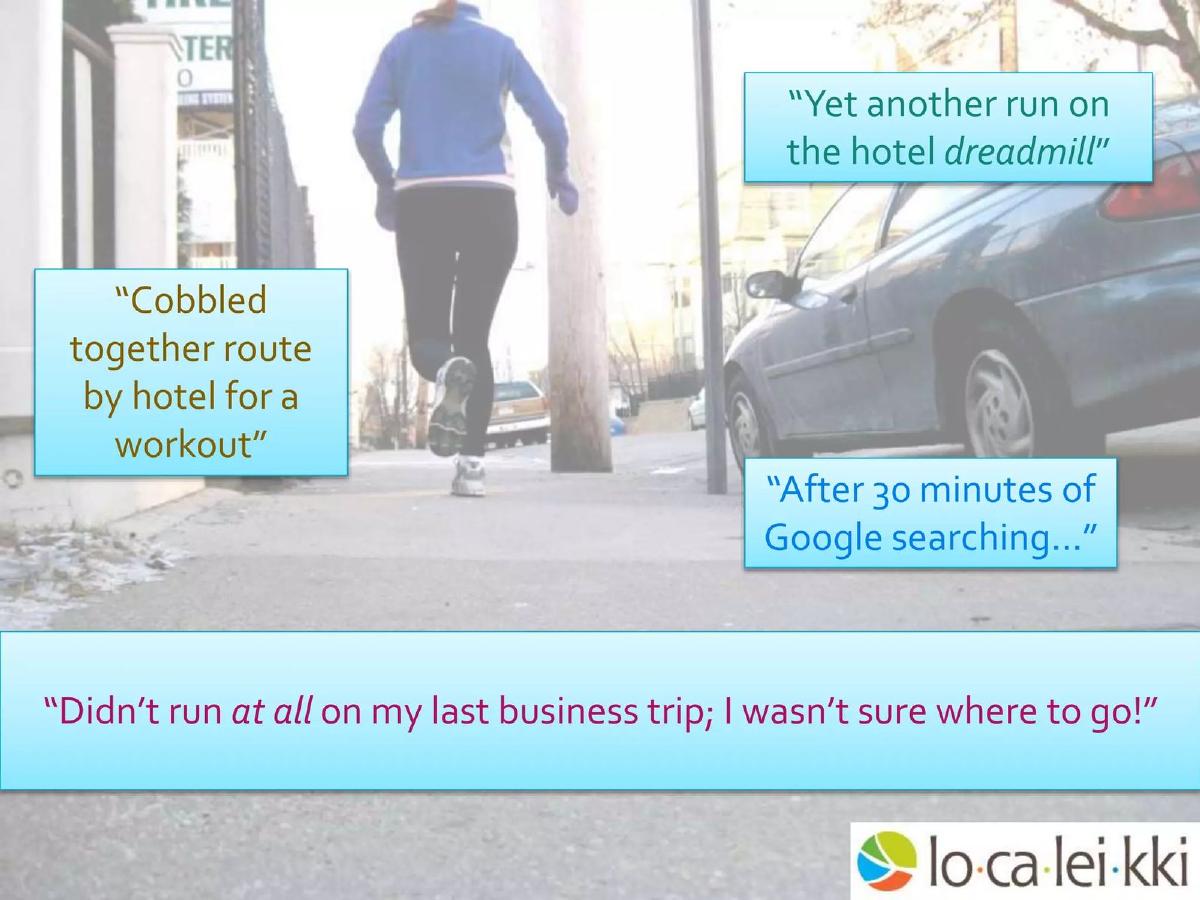
Localeikki opens its deck not with a corporate mission statement, but with a series of user quotes that define a very specific, relatable pain point for active professionals. Slide 1 uses phrases like "Yet another run on the hotel treadmill" and "After 30 minutes of Google searching..." to establish that current solutions are inefficient. By focusing on the emotional and logistical frustration of the traveler, the founders immediately narrow their target audience to the high-value business traveler who prioritizes health.
Slide 1: The User Frustration
The imagery shows a runner on a city street, overlaid with quotes about the difficulty of finding routes. This slide effectively sets the stage for a solution that saves time and improves the travel experience. It identifies that the current 'status quo' is either a boring treadmill session or a 'cobbled together route' that may not be safe or enjoyable.
Slide 2: The Active Traveler’s Solution
Slide 2 introduces the concept: "Coordinate your fitness & travel plans through local recreation recommendations from people like you." The visual is a simple map showing a flight from the East Coast to San Diego with a notification welcoming the user and suggesting three nearby trails. This implies a geo-fenced, proactive notification system, positioning the app as a concierge rather than just a static directory.
Market Opportunity: The Intersection of Two Giants
The deck moves quickly into the macro-environment, attempting to prove that this niche is large enough to support a venture-scale business. Slide 3 focuses on the "Intersection of recreation & travel industries."
Slide 3: Market Data
The founders provide four key data points to validate the market size:
53.2 million (19%) Americans run, totaling 4.6 billion outings. · $12 billion annual spend on trail sport gear. · 460 million person-trips for business. · Business travel total spend: $244 billion.
Analysis: While these numbers are large, the deck doesn't explicitly calculate a Bottom-Up TAM (Total Addressable Market). It shows the two circles of the Venn diagram but doesn't define the exact revenue potential of the overlap.
Slide 4: Industry Landscape
Slide 4 is a visual representation of the competitive landscape. It features logos for Yelp, Google, and MapMyRun. Notably, it mentions that MapMyRun was "Acquired by UnderArmour for $150 million." This is a classic signaling tactic to show investors that exits in this space are possible and have a precedent. However, it fails to explain how Localeikki differentiates itself from Google or Yelp, other than the implication of being 'niche-specific.'
Traction and Product: The MVP Phase
One of the strongest parts of this deck is the transparency regarding early metrics. Slide 5, titled "The MVP," provides a snapshot of a product that is already in the hands of users.
Slide 5: Early Stage Product & Engagement
The metrics listed are specific and encouraging for a seed-stage company:
4,200 downloads in the last 60 days. · 16% month-over-month user growth over the past 6 months. · Content coverage in 49 out of 50 states (802 metro areas). · 24% of traffic returns within 7 days. · 60% of users have contributed content. · 75 Brand Ambassadors nationwide.
Analysis: The 60% contribution rate is the standout metric here. In social or community-driven apps, getting users to move from 'lurkers' to 'contributors' is notoriously difficult. This suggests a highly engaged, passionate core user base.
Slide 6: The Starting Line-up
The team slide introduces Tracy McMillan and Taylor Thomas. Rather than standard corporate titles, they list their expertise: "running, health behavior, planning" and "cycling, sales & community." The strength of this slide lies in the Board and Advisors section. Having Mike Kail (VP of IT-Ops at Netflix) and Brian Nichols (Deloitte Corporate Travel) provides significant credibility in both the tech and travel sectors.
The Road Ahead: Milestones and The Ask
The final third of the deck focuses on what the company will do with new capital. Slide 7, "The Future," lists near-term milestones that are technical and growth-oriented.
Slide 7: Near-term Milestones
Achieving density in key business travel cities. · A UX/UI redesign. · Increasing 7-day retention to 50%. · Integration of the Concur Travel Itinerary API.
Analysis: The mention of Concur is a critical strategic hint. Concur is a dominant player in corporate expense and travel management. Integrating with them suggests Localeikki wants to be where the business traveler already is, rather than fighting for standalone app attention.
Slide 8: The Value in Data
Slide 8 consists of a single image of a group of runners with the title "The value in data." This is a 'placeholder' slide that likely accompanied a verbal explanation of their monetization strategy (e.g., selling user behavior data to gear brands or travel providers). As a standalone slide in a PDF, it is the weakest in the deck because it explains nothing about the actual data strategy.
Slide 9: The Ask
The financial request is clear and concise: Raising $300,000 . It also notes that $135,000 has been previously raised. This is a very small seed round by modern standards, suggesting a lean operation focused on hitting specific product milestones rather than aggressive, expensive user acquisition.
Slide 10: Contact Information
The deck concludes with a standard contact slide featuring the logo, email, and social handles. The logo uses a segmented circle design, mirroring the colors used throughout the deck, maintaining brand consistency.
What is Missing from the Localeikki Deck?
While the deck is clean and professional, several critical components are absent, which would likely be raised in a Q&A session with an investor:
Business Model: There is no slide explaining how the company generates revenue. Is it a freemium model? Are there affiliate links for gear? Is it a B2B play for corporate wellness? · Unit Economics: There is no mention of Customer Acquisition Cost (CAC) or Lifetime Value (LTV). While early for a seed round, some indication of how they plan to scale profitably is missing. · Defensibility: Beyond the 'community' aspect, the deck doesn't explain what stops a larger player like Strava or AllTrails from simply adding a 'Business Travel' filter to their existing, much larger databases. · Use of Funds: While they ask for $300,000, they don't provide a breakdown of how that money will be spent (e.g., 50% engineering, 30% marketing, 20% ops).
Founder Takeaways: What to Copy
Use Relatable Quotes: Starting with the 'hotel treadmill' problem is excellent. It creates an immediate 'aha' moment for anyone who has traveled for work. Founders should aim to capture the "voice of the customer" early in the deck.
Focus on Engagement Over Raw Downloads: Localeikki’s 60% content contribution rate is a much more powerful metric than their 4,200 downloads. It proves the product has 'hooks' that turn users into active participants.
Strategic Advisor Alignment: The team didn't just pick big names; they picked names relevant to their specific hurdles (IT Ops for scale, Deloitte for travel industry access). This shows strategic thinking about their gaps.
Specific Technical Integrations: Mentioning the Concur API shows that the founders understand the ecosystem they are entering. It moves the conversation from "we are a fun app" to "we are a piece of the travel infrastructure."
Frequently asked questions
- What is the primary problem Localeikki is solving?
- Localeikki addresses the difficulty active travelers face when trying to maintain their fitness routines in unfamiliar cities. Slide 1 highlights that travelers often spend 30 minutes searching for routes only to end up on a 'hotel treadmill' or not running at all because they aren't sure where to go safely or effectively.
- How much traction does the app have?
- According to Slide 5, the MVP has seen 4,200 downloads in the most recent 60-day period. It reports 16% month-over-month user growth over the last six months and has crowdsourced content covering 802 metro areas across 49 U.S. states.
- Who is on the leadership team?
- The core team consists of Tracy McMillan, focusing on running and health behavior, and Taylor Thomas, focusing on cycling and sales. They are supported by a board member from Netflix and advisors from Deloitte, McMillan Running, and Competitor Group (Slide 6).
- What are the company's immediate goals?
- The 'Future' slide (Slide 7) outlines goals to reach 50% user retention within 7 days, complete a UX/UI redesign, and achieve content density in key business travel cities. A major technical milestone is the integration of the Concur Travel Itinerary API.
- How does Localeikki plan to make money?
- The deck does not explicitly state a business model. While it mentions the 'value in data' (Slide 8) and 'trail sport gear spend' (Slide 3), there are no details on subscription fees, advertising, or lead generation for travel providers.