LLense addresses the inefficiency of modern streaming, where Americans spent 110 hours scrolling through catalogs in 2024. The company positions itself as a B2B SaaS platform that uses a proprietary multimodal engine to analyze video at the scene level, extracting data on characters, actions, and moods. By transforming video from a 'black box' into a searchable index, LLense targets a $200B annual market including streamers, broadcasters, and educational institutions. While the deck highlights strong technical backing from the Mila AI ecosystem and early pilots, it lacks specific financial pr…
Key takeaways
- Americans spent 110 hours scrolling through streaming catalogs in 2024, representing nearly 5 full days of lost time (Slide 2).
- Major platforms like HBO Max, Disney+, and Paramount+ regularly pull titles because they are hard for users to find in the 'attention economy' (Slide 3 and 4).
- The core technical value proposition is a proprietary multimodal engine that extracts semantic context including actions, objects, and mood (Slide 7).
- LLense targets a global video and media market worth over $200B annually (Slide 8).
- The business model relies on SaaS licensing and usage-based pricing for API and dashboard access (Slide 8).
- The technology was developed within the Next AI ecosystem and supported by scientists at Mila (Slide 9).
- The founder brings over 15 years of experience across media, gaming, and monetization (Slide 9).
- The deck omits a specific funding 'ask,' detailed team bios, and a roadmap for future development (Slide 10).
Executive Summary: The Search for Meaning in Media
LLense enters the market at a time when 'streaming fatigue' has become a documented consumer phenomenon. The deck positions the company not as a consumer-facing app, but as the underlying 'semantic layer' for the media industry. By using AI to look inside the video file—rather than just reading the title and genre—LLense promises to unlock the hidden value of deep catalogs. The narrative is built on the premise that content fails not because of quality, but because of invisibility.
Slide 1: Title and Vision
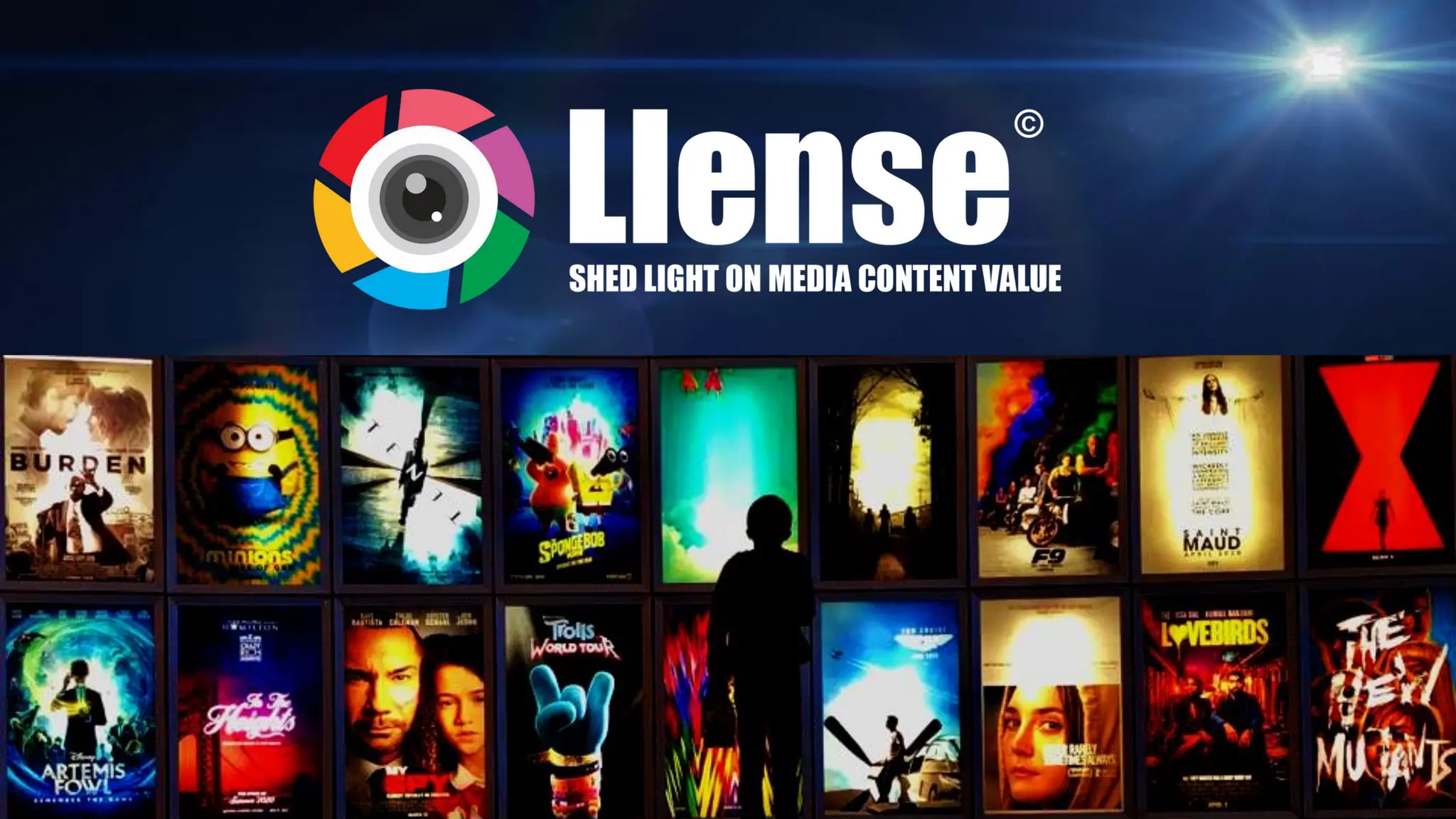
The cover slide introduces the company name, LLense , with the tagline "SHED LIGHT ON MEDIA CONTENT VALUE." The imagery features a collage of movie posters (including Minions , F9 , and Artemis Fowl ) with a silhouette of a viewer in the foreground. This immediately establishes the sector: film and television media.
Slide 2: The Quantified Problem
Slide 2 provides a striking hook: "In 2024, Americans spent 110 hours just scrolling through streaming catalogs." The slide emphasizes that this is "nearly 5 full days lost" to sifting through options rather than watching stories. This sets a clear emotional and statistical baseline for the inefficiency LLense intends to solve.
Slide 3: The Industry Consequence
This slide highlights the business-side pain point. It notes that HBO Max, Disney+, and Paramount+ regularly pull major titles, including Westworld , Legendary , Minx , Sesame Street , Willow , and Guilty Party . By showing these specific posters, the deck illustrates that even high-budget, recognizable content is being removed from platforms.
Slide 4: The 'Why' Behind Content Failure
Slide 4 uses the metaphor of a needle in a haystack. It argues that content is being pulled "not because they were bad... but because no one could find them!" It concludes that in the current attention economy, content just needs to be hard to find to fail. This bridges the gap between the consumer's wasted time and the platform's wasted investment.
Slide 5: The Gap Analysis
This slide compares "Why Great Content Gets Lost" against "What Viewers Actually Want." On the problem side, it lists:
Content is a black box: Platforms can't see inside the video. · Metadata is shallow: Titles and genres don't reflect mood or story. · Algorithms struggle: They optimize for engagement, not emotional relevance.
On the solution side, it posits that viewers want content that matches their mood and discovery that feels personal and intentional.
Slide 6: The 'What If' Moment
Slide 6 acts as a transition, asking: "What if every scene, every moment of your content could be instantly searchable, recommendable, and ready to monetize?" It shows a mock-up of an AI search bar asking, "What are you in the mood to watch?" This begins the shift from problem to solution.
Slide 7: The Solution - LLense AI
LLense defines its product as an AI that "analyzes every scene and extracts who's there, what's happening, how it feels." Key features listed include:
Automatic generation of rich, searchable metadata. · Extraction of semantic context : actions, objects, mood, and setting. · Creation of a "living, breathing index" of a media catalog.
A visual on the right shows a scene tagged with "Character: Emma," "Action: Running through crowd," and "Mood: Tense."
Slide 8: The Business Model and Market
LLense identifies as a "B2B SAAS PLATFORM FOR THE VIDEO AND MEDIA INDUSTRY." Stated facts include:
Market Size: Over $200B annually. · Who They Serve: Global streamers, broadcasters, educators, and brand storytellers. · Business Model: SaaS licensing, usage-based pricing for API/dashboard access, and monthly licensing. · Delivery: Self-serve SaaS to full enterprise/white-label deployments.
Slide 9: Traction and Technical Foundation
This slide aims to build credibility. It states that LLense was "Developed in Next AI ecosystem and supported [by] top AI scientists at Mila." It mentions a proprietary multimodal engine and early pilots for broadcasters and academic archives. It also notes the founder has "15+ years in media, gaming, and monetization." A demo screenshot shows the engine analyzing a scene from the Barbie movie, generating a word cloud of objects like "Sandal," "High-Heels," and "Margot-Robbie."
Slide 10: The Call to Action
The final slide states they are "looking for partners who see the opportunity." It provides contact information for Nicolas Lee (nlee@llense.com) and displays logos for the NEXTAI and CENTECH accelerator programs. It invites the reader to "build the semantic layer of media together."
What LLense Does Well
The deck excels at defining a relatable, high-stakes problem. By citing the 110 hours spent scrolling and the specific high-profile shows pulled from streaming services, LLense makes the 'discovery' problem feel urgent and expensive. The distinction between 'shallow metadata' and 'semantic context' is a strong technical differentiator that helps non-technical investors understand the product's value. The inclusion of the Mila AI ecosystem and Next AI accelerator logos provides necessary institutional credibility for an AI-heavy startup.
What is Missing from the Deck
The most glaring omission is a specific Ask . The deck concludes by looking for "partners," but does not specify if they are raising a Seed or Series A round, how much capital they need, or what the milestones for that capital would be. Additionally, the Team slide is minimal; while it mentions a founder with 15 years of experience, it does not name the rest of the core team or their specific backgrounds in AI development. There is also no Competitive Landscape slide, which is critical in the crowded AI-video analysis space where companies like VideoGorillas or various AWS/Google Cloud native tools operate. Finally, the deck lacks Financial Projections or unit economics, leaving the "usage-based pricing" model as a theoretical concept rather than a proven revenue driver.
Founder Takeaways: What to Copy
Founders should emulate the way LLense uses specific industry examples to prove their point. Instead of saying "streaming services lose money," they listed the exact shows that were cancelled or pulled, which grounds the pitch in reality. The Problem/Solution comparison on Slide 5 is also a best-practice layout, clearly mapping technical features (multimodal engine) to user desires (mood-based discovery). Lastly, the use of a visual demo (the Barbie movie analysis on Slide 9) is an effective way to show, rather than just tell, how the AI functions in a real-world scenario.
Frequently asked questions
- What specific problem is LLense trying to solve?
- LLense is tackling the 'discovery crisis' in digital media. According to the deck, current streaming algorithms optimize for engagement rather than emotional relevance, and metadata is often too shallow (limited to titles and genres). This leads to 'endless scrolling' for consumers and forced content removals for platforms because valuable titles remain hidden and unmonetized.
- How does the technology work according to the slides?
- LLense uses an AI-driven multimodal engine to analyze video content scene-by-scene. It extracts 'semantic context'—which includes identifying who is in the scene, what actions are occurring, and the overall mood. This data is converted into a searchable index, allowing platforms to offer 'intentional discovery' based on how a viewer feels or specific scene elements.
- What is the target market and business model?
- The company targets the $200B global video industry, specifically streaming services, broadcasters, production studios, and academic archives. The business model is a B2B SaaS play featuring monthly licensing fees and usage-based pricing for API access. They offer various delivery options, from self-serve SaaS to full enterprise white-label deployments.
- What evidence of traction does LLense provide?
- The deck cites participation in the Next AI and CENTECH accelerator programs. It also mentions that the technology is supported by AI scientists at Mila and that early pilots have been developed for broadcasters and academic archives. A visual demo on slide 9 shows the engine tagging a scene from the 'Barbie' movie with labels like 'Margot Robbie,' 'High-Heels,' and 'Sandal.'
- What key information is missing from the pitch deck?
- The deck is missing several standard fundraising components: a specific dollar amount for the 'ask,' a detailed breakdown of the management team beyond a single founder mention, a competitive analysis, and a financial roadmap or use-of-funds slide. It functions more as a product-market fit narrative than a complete investment memorandum.