Little Journey’s 12-slide deck is a masterclass in establishing a clear link between patient psychology and institutional bottom lines. While many healthcare startups focus solely on clinical efficacy, Little Journey highlights the massive operational costs of 'failed' procedures—citing £1,206 per on-the-day cancellation and $8M in lost daily revenue for delayed clinical trials (Slide 3). The company demonstrates significant early traction, including a partnership with the LEGO Foundation and adoption by 100+ healthcare organizations (Slide 2). By framing their solution as a 'pick and mix' mo…
Key takeaways
- The deck identifies a specific financial pain point: £1,206 in wasted resources for every on-the-day hospital cancellation (Slide 3).
- Traction is validated through high-tier partnerships, specifically mentioning the LEGO Foundation and 100+ global healthcare organizations (Slide 2).
- The product is positioned as a global solution, already localized into 16 languages including English, Portuguese, Spanish, Dutch, and French (Slide 2).
- Market expansion is clearly mapped by correlating the number of product modules to Total Addressable Market (TAM) growth in Life Sciences and Healthcare (Slide 6).
- Social proof is heavily leveraged, citing a 4.7-star App Store rating from over 450 reviews and a 97% family satisfaction rate (Slide 4).
- The problem slide bifurcates the impact into two distinct revenue streams: Healthcare (hospitals) and Clinical Trials (pharmaceutical sponsors) (Slide 3).
- The solution is modular, allowing organizations to 'pick and mix' from five core areas including Medication Gamification and Personalisation Tools (Slide 5).
- Clinical trial delays are quantified as a massive market opportunity, with 80% of trials delayed and $8M in revenue lost per day of delay (Slide 3).
Little Journey: Bridging the Gap Between Pediatric Anxiety and Clinical Efficiency
Little Journey’s Seed deck is a focused, 12-slide presentation that successfully raised $3.1M in 2024. The company operates at the intersection of HealthTech and Patient Experience, specifically targeting the pediatric market. The deck is notable for its clean design and its ability to turn 'soft' patient outcomes into 'hard' financial metrics that appeal to institutional investors.
Slide 1: Title and Mission
The opening slide introduces the brand with a friendly, child-centric aesthetic. The tagline, "Supporting all children to better health through personalised care," immediately establishes the mission. It also includes call-to-actions for the App Store and Google Play, signaling that the product is live and accessible to the public, rather than just a conceptual prototype.
Slide 2: Traction and Global Progress
Slide 2 is a 'momentum' slide. It lists several key achievements that de-risk the investment:
100+ healthcare organisations working with them globally. · NHS Best Practice: Acknowledged by the Association of Anaesthetists of Great Britain & Ireland. · 16 Languages: Demonstrating immediate scalability beyond the UK market. · LEGO Foundation Partnership: A high-profile strategic partnership that provides massive brand equity.
This slide effectively communicates that the company has already moved past the 'idea' phase and has achieved significant institutional buy-in.
Slide 3: The Problem (The Financial Cost of Anxiety)
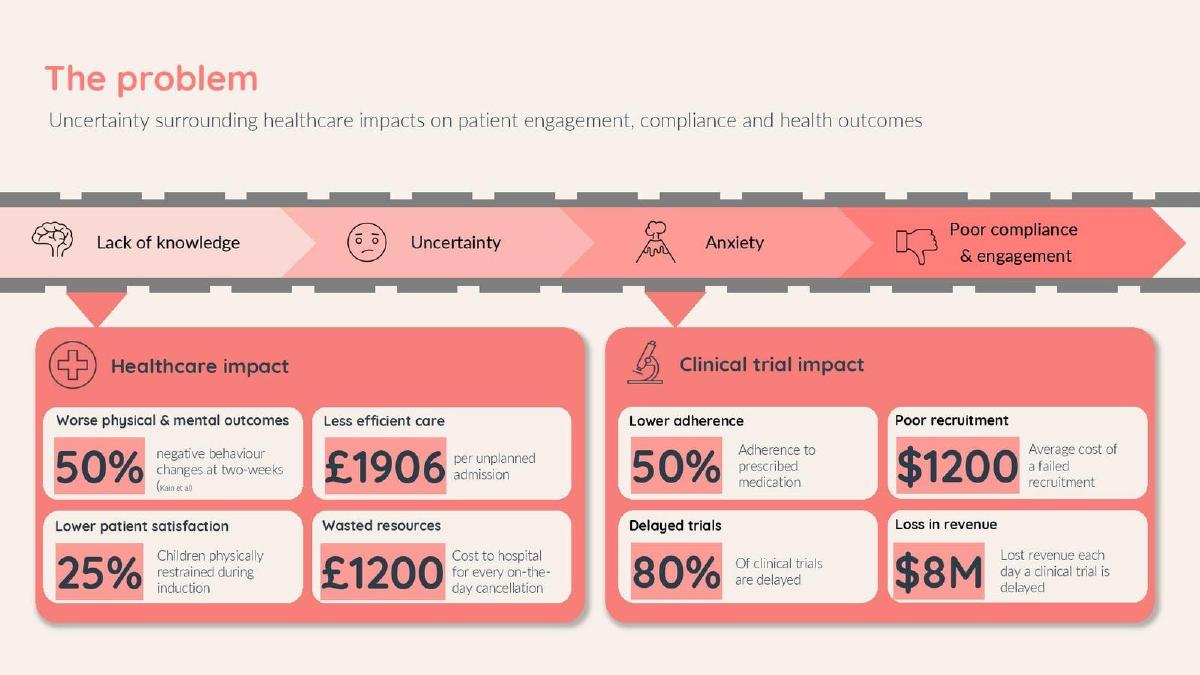
This is arguably the most important slide in the deck. It breaks down the 'Problem' into two distinct verticals: Healthcare Impact and Clinical Trial Impact . By doing this, Little Journey shows investors they have two massive, independent revenue streams. The figures are specific and painful: £1,206 lost per on-the-day cancellation and $8M in lost revenue for every day a clinical trial is delayed. This slide transforms a 'nice-to-have' app into a 'must-have' operational efficiency tool.
Slide 4: Family Feedback and Social Proof
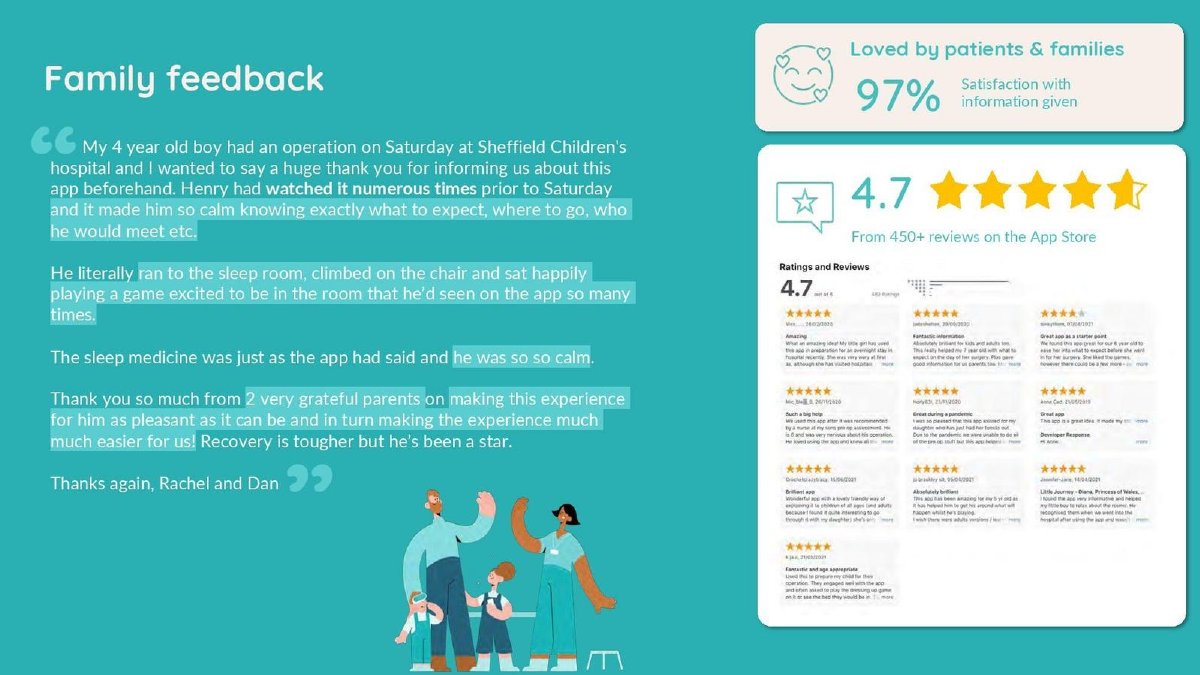
After establishing the financial pain, Slide 4 focuses on the user experience. It features a long testimonial from a parent ('Rachel and Dan') whose 4-year-old son used the app before surgery. The quote "He literally ran to the sleep room... excited to be in the room that he'd seen on the app" is a powerful emotional hook. The slide also highlights a 97% satisfaction rate and a 4.7-star rating from 450+ reviews, proving that the product actually works for its end users.
Slide 5: The Modular Product Offering
Slide 5 explains the 'How.' Little Journey isn't just one app; it is a platform of modules. The five modules listed are:
Preparation & Support: For healthcare procedures. · Clinical Trial Information: Engaging families in research. · Medication Gamification: Driving adherence through virtual worlds. · "A Little About Me": A personalization tool for clinicians. · PREM & Feedback System: A GDPR-compliant data capture tool.
This modularity is a key selling point for B2B sales, as it allows for a 'land and expand' strategy within large hospital networks or pharmaceutical companies.
Slide 6: TAM and Market Expansion
The final slide in the provided set visualizes the Total Addressable Market (TAM). It uses two bar charts to show how the market size increases as the product scales. For Life Sciences, the TAM grows from $3.7bn to $7.5bn as more modules are added. For Healthcare, the TAM grows from $1.3bn to $7.4bn as the number of supported procedures increases from 2 to 25. This provides a clear roadmap for how the company intends to become a billion-dollar enterprise.
What Works in the Little Journey Deck
1. Quantifying the Intangible: The greatest strength of this deck is its ability to put a price tag on patient anxiety. Most founders in this space focus on 'making children happy.' Little Journey focuses on 'saving hospitals £1,200 per cancellation.' That shift in framing is why they raised $3.1M.
2. Dual-Market Strategy: By targeting both public healthcare (NHS/hospitals) and private Life Sciences (Clinical Trials), they have a balanced risk profile. If hospital budgets are tight, pharmaceutical companies—who lose $8M a day on delays—will still pay for efficiency.
3. High-Tier Validation: Mentioning the LEGO Foundation and the Association of Anaesthetists provides immediate credibility that most Seed-stage startups lack. It suggests that experts in both play-based learning and clinical medicine have vetted the solution.
What is Missing from the Little Journey Deck
1. The Team Slide: The provided slides do not include a team overview. In a Seed round, the pedigree of the founders (especially in healthcare, where clinical expertise is required) is a critical factor for investors. Without knowing if the founders are doctors, psychologists, or career tech entrepreneurs, it is hard to judge the 'founder-market fit.'
2. The Competition: There is no mention of other patient engagement platforms or how Little Journey differs from generic hospital prep videos or brochures. A competitive matrix would have helped define their unique moat.
3. Unit Economics and Revenue: While the TAM is large, the deck doesn't show the current Average Contract Value (ACV) or the cost to acquire a new hospital partner. Investors at the Seed stage usually want to see the beginnings of a repeatable sales motion.
4. The Ask: The deck ends without a clear 'Ask' slide. We know from publisher reports that they raised $3.1M, but the deck itself should ideally state how much they are looking for and, more importantly, what milestones that money will buy (e.g., 'Expanding to 50 procedures' or 'Entering the US market').
Founder's Playbook: What to Copy
Use 'The Problem' to Sell 'The Solution': Copy the structure of Slide 3. If your product improves a 'soft' metric (like happiness, wellness, or engagement), you must find the 'hard' metric it correlates to. Find the cost of the status quo and put it in big, bold numbers.
Modularize Your Roadmap: Slide 6 is an excellent way to show market expansion. Instead of just saying 'the market is big,' show how your specific product development (adding modules or procedures) unlocks specific segments of that market. It makes your growth projections feel grounded in product reality rather than just optimistic guessing.
Leverage Third-Party Logos: If you have a partnership, even a pilot, with a recognizable brand like LEGO or a national body like the NHS, put it on Slide 2. Don't wait until the end of the deck to show your best traction; use it to build momentum early.
Frequently asked questions
- What is the primary problem Little Journey solves?
- Little Journey addresses the uncertainty and anxiety children face during healthcare procedures. According to Slide 3, this anxiety leads to poor compliance, which results in tangible losses: 50% negative behavior changes in children, £1,906 per unplanned admission, and $1,200 for every failed clinical trial recruitment. They solve this by providing a digital platform that prepares families for what to expect.
- How does Little Journey generate revenue?
- While the deck doesn't explicitly detail pricing tiers, Slide 5 explains a modular B2B model. Healthcare organizations and Life Sciences companies can 'pick and mix' from modules like 'Preparation & Support,' 'Clinical Trial Information,' and 'Medication Gamification.' This suggests a SaaS or per-module licensing fee structure targeting large institutional buyers.
- What is the company's current market reach?
- As of the Seed round, the company is working with over 100 healthcare organizations globally (Slide 2). Their app is available in 16 languages and has received over 450 reviews on the App Store with a 4.7-star rating. They have also secured a partnership with the LEGO Foundation, providing significant brand and distribution credibility.
- How large is the total addressable market (TAM)?
- Slide 6 projects a massive TAM that grows as they add modules. For Life Sciences, they estimate a current TAM of $3.7bn, growing to $7.5bn with four modules. For Healthcare, they estimate a current TAM of $1.3bn (supporting 2 procedures), growing to $7.4bn as they expand to support 25 different medical procedures.
- Is there a clinical validation for their approach?
- Yes. Slide 2 notes that the Association of Anaesthetists of Great Britain & Ireland has named Little Journey as 'best practice' in the NHS for children coming for surgery. Slide 3 also references clinical data (Kain et al.) to support their claims regarding negative behavior changes in unprepared pediatric patients.