Which customer quotes and reviews persuade investors in a pitch deck: named and titled sources, a concrete result, and a count behind the rating.
Testimonial Slide: Real Pitch Deck Examples
Fourteen testimonial, review and rating slides, shown in full, compare which customer quotes an investor can treat as evidence and which read as decoration.
TL;DR
A testimonial persuades investors when they can tell who said it, whether that person is a paying customer, and what changed for them. The strongest example below (Counterpart) quotes four named people with job titles at named insurance firms, which an investor could call. Canix adds how many licences each quoted customer holds, and one quote names the competitor it replaced. The weakest are anonymous ("– Patient") or put the word "love" in the headline and then show only logos (Meya). One more use is worth copying: AtoB quotes one-star reviews of its competitors as evidence of the problem. Before quoting a customer, get their permission, and prefer one quote with a result over five compliments.
Testimonial slides from real pitch decks
Each example shows the exact stored slide above its analysis and links to the full teardown. Quotes and ratings are reproduced as shown on the slides; we have not contacted the people quoted or checked the review counts. Stage and year are given only where the slide states them.
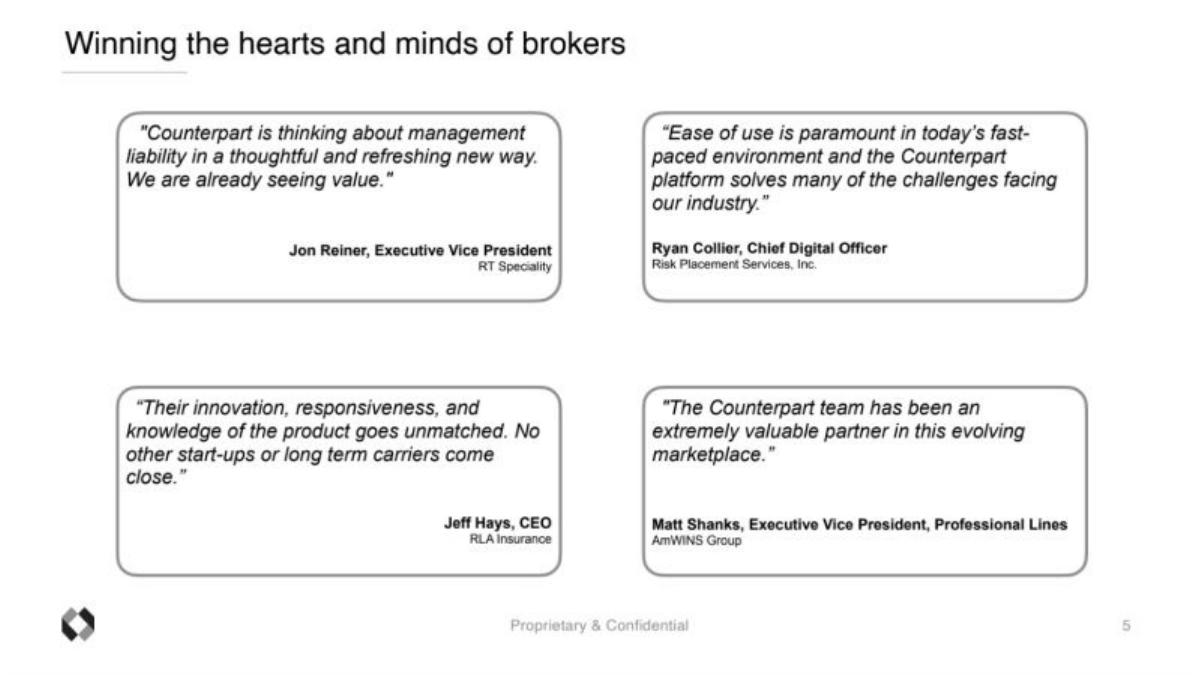
Counterpart testimonial slide — slide 5
Management liability insurance sold through brokers. Stage and year are not stated on the slide.
Counterpart deck, slide 5. Exact stored slide matched to this analysis.
Our analysis: Brokers are Counterpart's sales channel, so quotes from senior people at broker firms are evidence the channel works. Every quote can be traced to a person.
Evidence and limitation: The quotes are about attitude ("refreshing", "valuable partner") rather than volume. Add one number per firm, such as policies placed, or say which firms are already sending business.
What a founder can adapt: Quote the people who decide whether your product gets sold or bought, with name, title and company.
Supporting analysis
What the deck claims: "Winning the hearts and minds of brokers": four quotes, each attributed by name, title and firm, for example "Counterpart is thinking about management liability in a thoughtful and refreshing new way. We are already seeing value." (Jon Reiner, Executive Vice President, RT Specialty) and "Their innovation, responsiveness, and knowledge of the product goes unmatched. No other start-ups or long term carriers come close." (Jeff Hays, CEO, RLA Insurance).
Presentation choice: Brokers are Counterpart's sales channel, so quotes from senior people at broker firms are evidence the channel works. Every quote can be traced to a person.
When it does not fit: The quotes are about attitude ("refreshing", "valuable partner") rather than volume. Add one number per firm, such as policies placed, or say which firms are already sending business.
Operations software for licensed cannabis growers. Stage and year are not stated on the slide.
Canix deck, slide 5. Exact stored slide matched to this analysis.
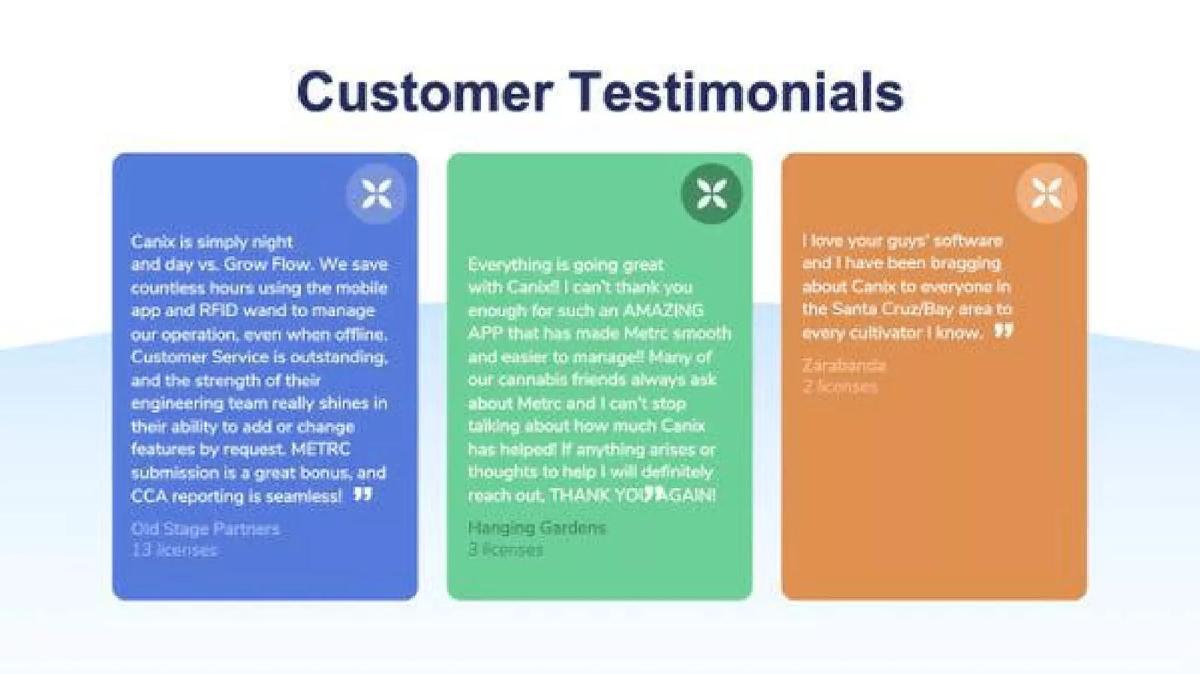
Our analysis: The licence count tells investors how big each customer is, and the largest customer gives the most specific quote: a named competitor replaced, time saved, and the compliance tasks it handles.
Evidence and limitation: Quotes are attributed to companies, not people, and "countless hours" has no number. Add the speaker's role and one measured result.
What a founder can adapt: Label each quote with a size measure that matters in your market (seats, locations, licences, spend).
Supporting analysis
What the deck claims: "Customer Testimonials": three quotes labelled by customer and licence count. Old Stage Partners (13 licenses): "Canix is simply night and day vs. Grow Flow. We save countless hours using the mobile app and RFID wand … METRC submission is a great bonus, and CCA reporting is seamless!" Hanging Gardens (3 licenses) and Zarabanda (2 licenses) praise the app and say they recommend it to other growers.
Presentation choice: The licence count tells investors how big each customer is, and the largest customer gives the most specific quote: a named competitor replaced, time saved, and the compliance tasks it handles.
When it does not fit: Quotes are attributed to companies, not people, and "countless hours" has no number. Add the speaker's role and one measured result.
Home monitoring device and software. Stage and year are not stated on the slide.
Minut deck, slide 4. Exact stored slide matched to this analysis.
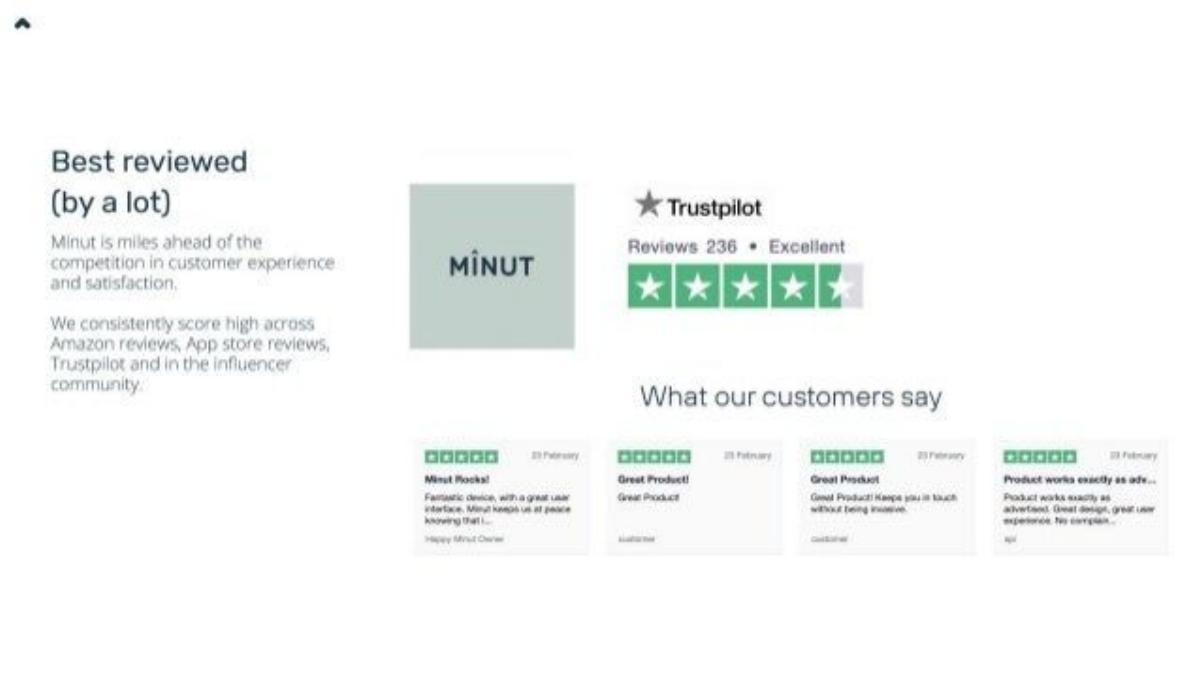
Our analysis: A public rating with a review count is harder to cherry-pick than hand-selected quotes, and anyone can check it on the review site.
Evidence and limitation: The headline claims Minut is ahead of competitors but shows no competitor ratings, and the Trustpilot panel has no date. Put competitors' ratings beside yours and date the screenshot.
What a founder can adapt: For consumer or small-business products, show the rating, the number of reviews and the platform.
Supporting analysis
What the deck claims: "Best reviewed (by a lot)": "Minut is miles ahead of the competition in customer experience and satisfaction. We consistently score high across Amazon reviews, App store reviews, Trustpilot and in the influencer community." A Trustpilot panel shows "Reviews 236 • Excellent" with four five-star review cards under "What our customers say".
Presentation choice: A public rating with a review count is harder to cherry-pick than hand-selected quotes, and anyone can check it on the review site.
When it does not fit: The headline claims Minut is ahead of competitors but shows no competitor ratings, and the Trustpilot panel has no date. Put competitors' ratings beside yours and date the screenshot.
Fuel cards and payments for trucking fleets. Stage and year are not stated on the slide.
AtoB deck, slide 6. Exact stored slide matched to this analysis.
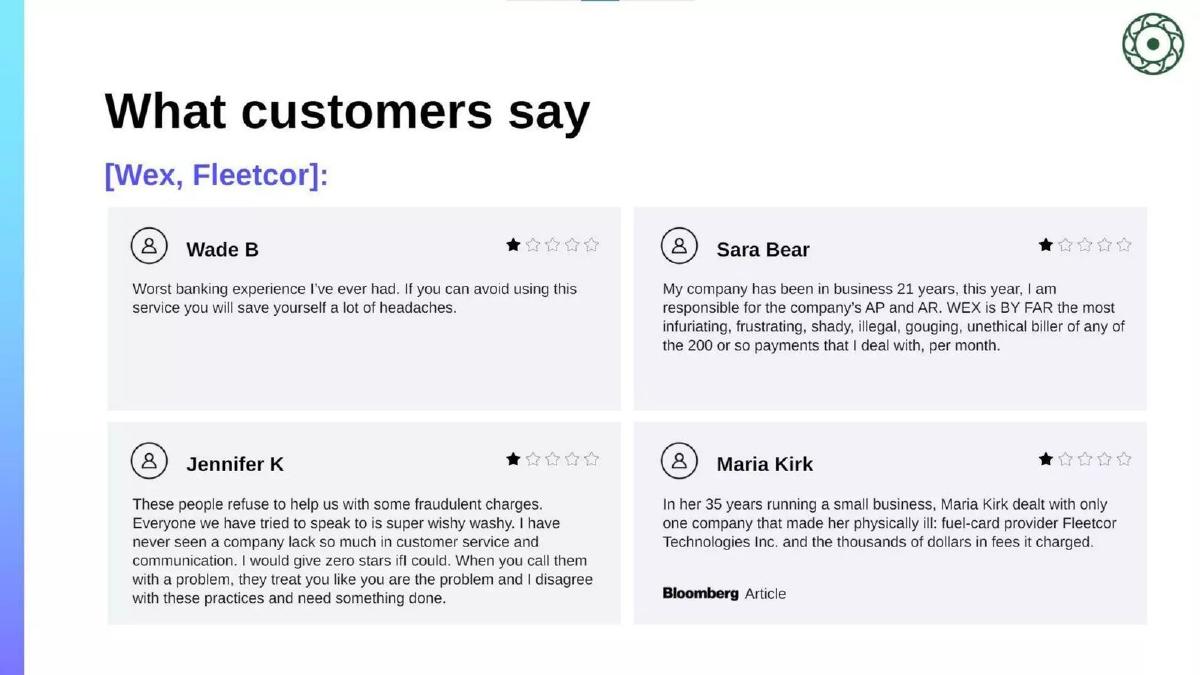
Our analysis: This turns testimonials around: other companies' customers describe the problem in their own words, which is more convincing than the founder describing it.
Evidence and limitation: The slide doesn't say where the reviews come from (except the Bloomberg piece) or when they were posted. Name the review site and date, and follow it with your own customers' view.
What a founder can adapt: If incumbents' customers complain publicly, quote a few reviews as evidence of the problem, with the source.
Supporting analysis
What the deck claims: "What customers say [Wex, Fleetcor]": four one-star reviews of the incumbents, for example "Worst banking experience I've ever had. If you can avoid using this service you will save yourself a lot of headaches." (Wade B), plus an excerpt about a small-business owner and Fleetcor fees credited to a Bloomberg article.
Presentation choice: This turns testimonials around: other companies' customers describe the problem in their own words, which is more convincing than the founder describing it.
When it does not fit: The slide doesn't say where the reviews come from (except the Bloomberg piece) or when they were posted. Name the review site and date, and follow it with your own customers' view.
Updates for families of hospital patients; deck prepared for a crowdfunding campaign. Stage and year are not stated on the slide.
Medifies deck, slide 6. Exact stored slide matched to this analysis.
Our analysis: The quote explains a real use case (family members in different places) in the customer's words, which a product description can't do as well.
Evidence and limitation: "– Patient" is anonymous, and "will definitely be using" is an intention, not use. Add a first name and location with permission, and a usage number (patients or families served).
What a founder can adapt: Choose a quote that shows why someone needs the product, not only that they liked it.
Supporting analysis
What the deck claims: "Testimonial": "I absolutely loved Medifies! I think it's a great thing being as my mom is in Wisconsin & my 19 yr old at college. I will definitely be using Medifies at my next surgery!" – Patient, beside stock-style photos of families.
Presentation choice: The quote explains a real use case (family members in different places) in the customer's words, which a product description can't do as well.
When it does not fit: "– Patient" is anonymous, and "will definitely be using" is an intention, not use. Add a first name and location with permission, and a usage number (patients or families served).
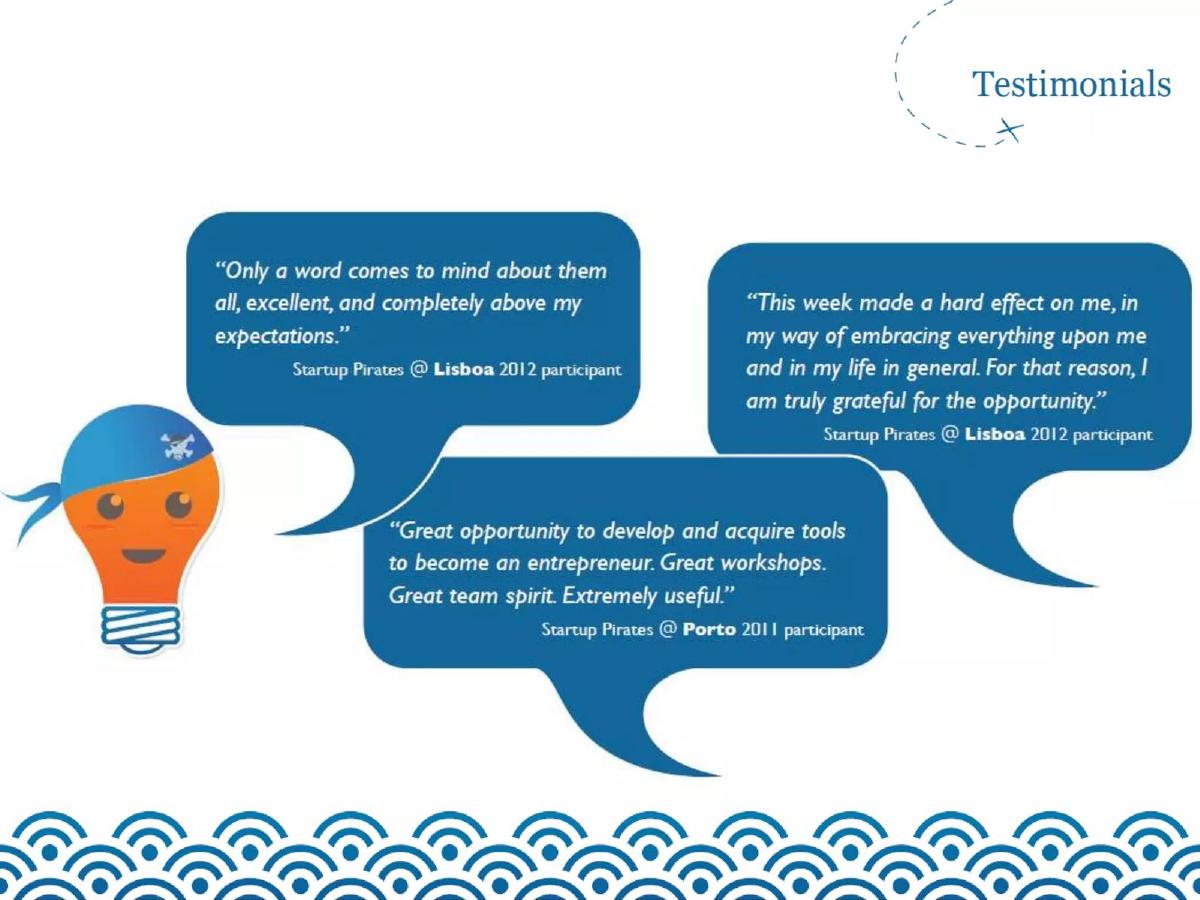
Entrepreneurship programme; quotes are credited to 2011 and 2012 participants in Lisbon and Porto.
Startup Pirates deck, slide 4. Exact stored slide matched to this analysis.
Our analysis: Crediting the programme edition and year dates each quote, which most testimonial slides don't do.
Evidence and limitation: No participant is named and the quotes give no result, such as companies started or funding raised afterwards. Add one named participant with what they did next.
What a founder can adapt: Treat this as a slide to improve on. Keep the dates, but replace general praise with outcomes.
Supporting analysis
What the deck claims: "Testimonials": three speech bubbles, for example "Great opportunity to develop and acquire tools to become an entrepreneur. Great workshops. Great team spirit. Extremely useful." Each is credited as "Startup Pirates @ Lisboa 2012 participant" or "@ Porto 2011 participant".
Presentation choice: Crediting the programme edition and year dates each quote, which most testimonial slides don't do.
When it does not fit: No participant is named and the quotes give no result, such as companies started or funding raised afterwards. Add one named participant with what they did next.
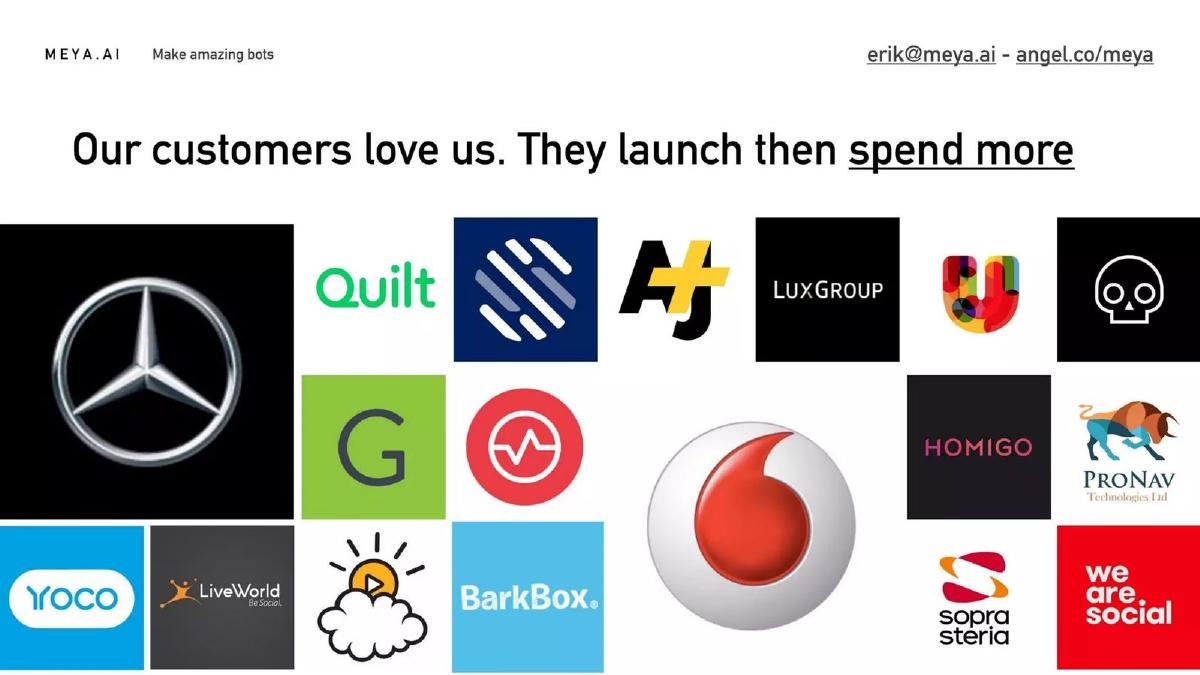
Chatbot-building platform. Stage and year are not stated on the slide.
Meya deck, slide 6. Exact stored slide matched to this analysis.
Our analysis: "They launch then spend more" is a strong claim about expansion revenue, and the logos show well-known companies in the customer base.
Evidence and limitation: Neither "love" nor "spend more" is supported on the slide. Add one quote from a named customer and a net revenue retention figure or spend growth for a typical account.
What a founder can adapt: Treat this as a slide to improve on. If customers spend more after launch, show it as a number.
Supporting analysis
What the deck claims: "Our customers love us. They launch then spend more" above a grid of customer logos, including Mercedes-Benz, Vodafone, BarkBox, Yoco, Sopra Steria and LuxGroup. There are no quotes.
Presentation choice: "They launch then spend more" is a strong claim about expansion revenue, and the logos show well-known companies in the customer base.
When it does not fit: Neither "love" nor "spend more" is supported on the slide. Add one quote from a named customer and a net revenue retention figure or spend growth for a typical account.
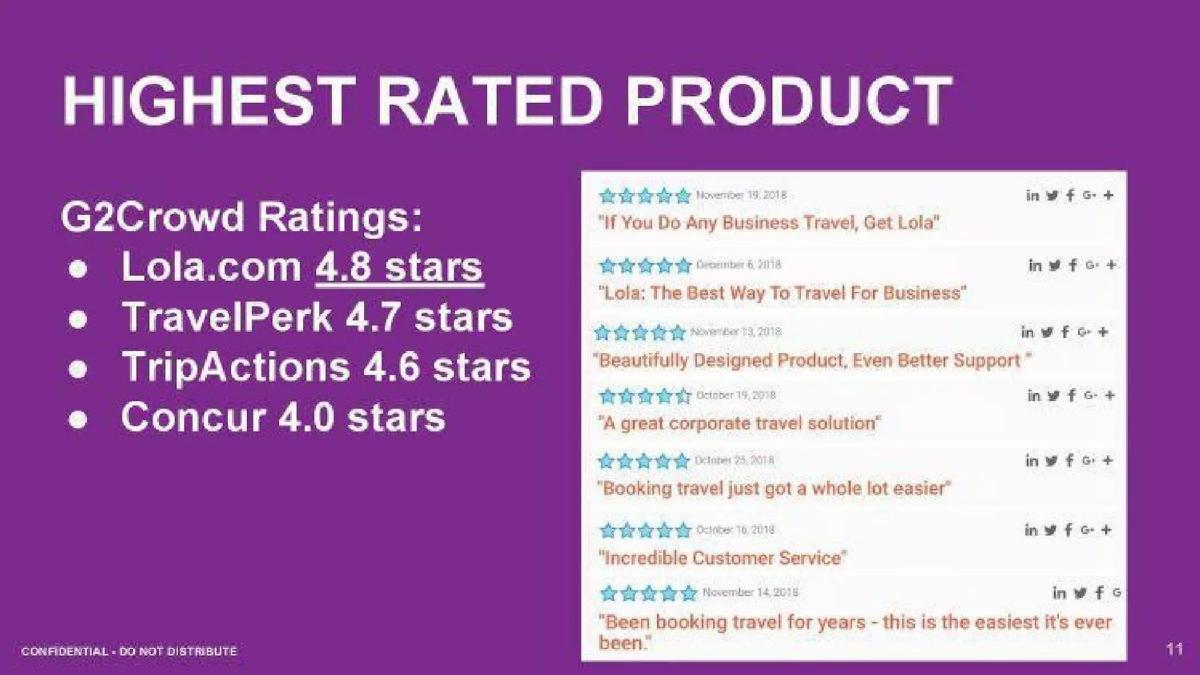
Corporate travel booking software. Stage and year are not stated on the slide.
Lola deck, slide 11. Exact stored slide matched to this analysis.
Our analysis: G2 is a business-software review site that buyers use, and putting competitors' scores from the same site beside Lola's makes the comparison like for like.
Evidence and limitation: The slide doesn't give review counts or a date for any of the scores, so investors can't tell whether 4.8 rests on a handful of reviews. Add both.
What a founder can adapt: If you compare ratings, take every score from the same platform on the same day, and name the rivals.
Supporting analysis
What the deck claims: A G2 rating of 4.8 for Lola shown beside the G2 ratings of competing travel tools.
Presentation choice: G2 is a business-software review site that buyers use, and putting competitors' scores from the same site beside Lola's makes the comparison like for like.
When it does not fit: The slide doesn't give review counts or a date for any of the scores, so investors can't tell whether 4.8 rests on a handful of reviews. Add both.
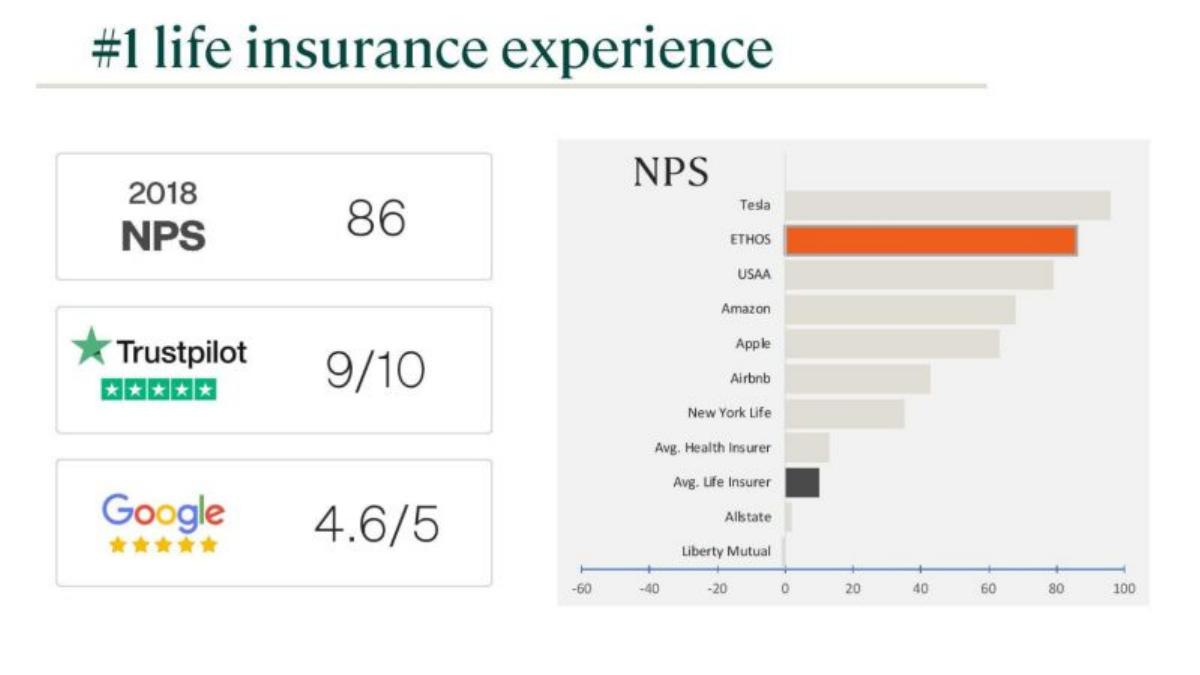
Online life insurance. Stage and year are not stated on the slide.
Ethos deck, slide 9. Exact stored slide matched to this analysis.
Our analysis: It combines a company survey (NPS) with two public review sites, so one weak source doesn't carry the whole slide.
Evidence and limitation: Tesla and Apple scores come from other surveys of other customers, so the comparison flatters rather than informs. Give the NPS sample size and survey date, and compare with other insurers if you compare at all.
What a founder can adapt: Show at least one third-party rating beside any self-reported score.
Supporting analysis
What the deck claims: An NPS of 86 set beside benchmark NPS figures for Tesla and Apple, with Trustpilot and a Google rating of 4.6.
Presentation choice: It combines a company survey (NPS) with two public review sites, so one weak source doesn't carry the whole slide.
When it does not fit: Tesla and Apple scores come from other surveys of other customers, so the comparison flatters rather than informs. Give the NPS sample size and survey date, and compare with other insurers if you compare at all.
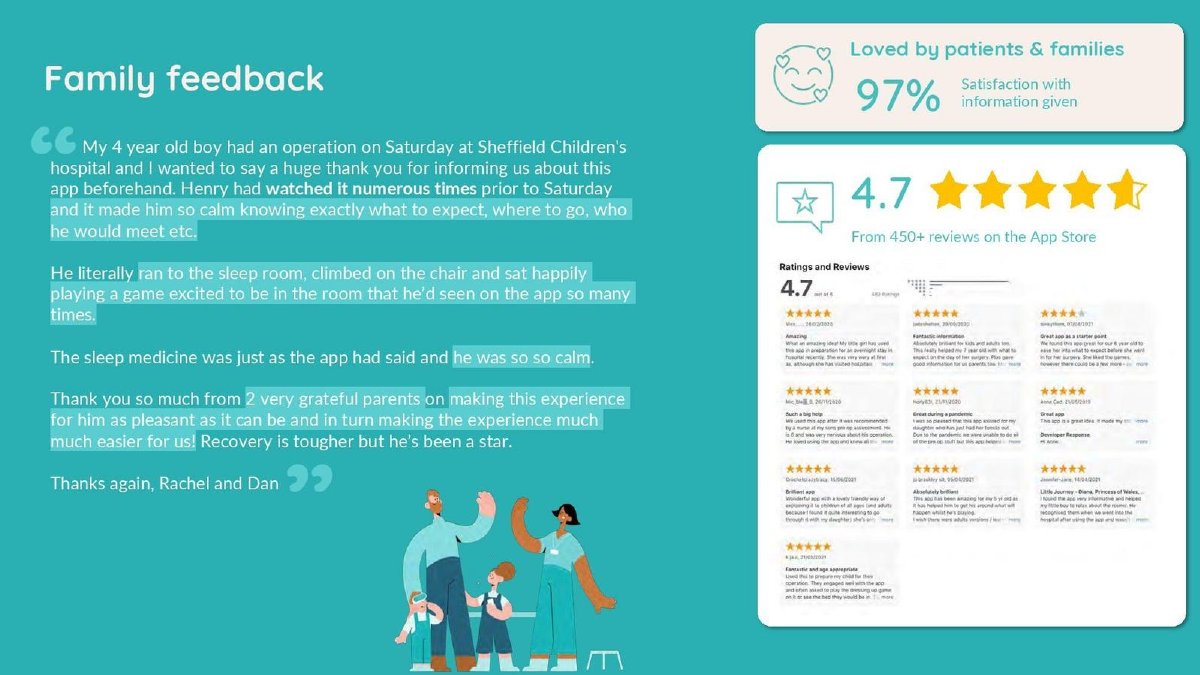
App that prepares children for hospital visits. Stage and year are not stated on the slide.
Little Journey deck, slide 7. Exact stored slide matched to this analysis.
Our analysis: It gives both the score and the count, which is the minimum an investor needs to weigh a rating.
Evidence and limitation: 450 reviews is a modest base, and the slide gives no date. Say when the figure was taken and, if usage is much larger than the review count, give usage too.
What a founder can adapt: Always pair the score with the number of reviews.
Supporting analysis
What the deck claims: An App Store rating of 4.7 from 450+ reviews.
Presentation choice: It gives both the score and the count, which is the minimum an investor needs to weigh a rating.
When it does not fit: 450 reviews is a modest base, and the slide gives no date. Say when the figure was taken and, if usage is much larger than the review count, give usage too.
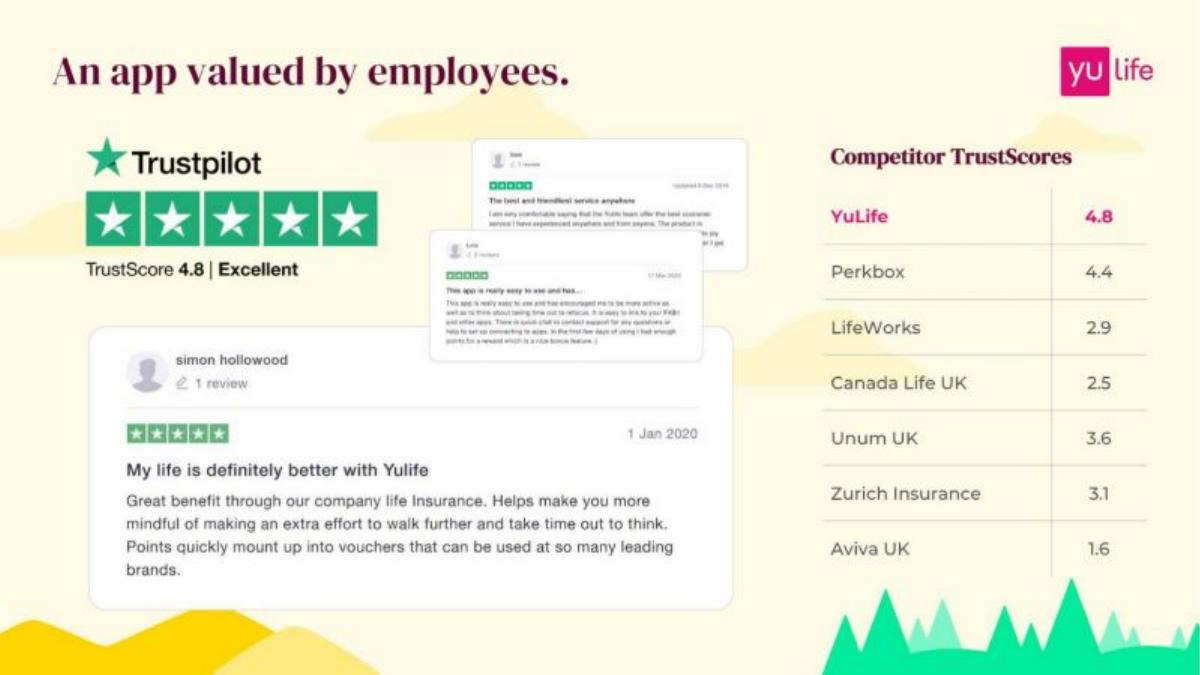
Group life insurance with a wellbeing app. Stage and year are not stated on the slide.
YuLife deck, slide 23. Exact stored slide matched to this analysis.
Our analysis: Six named rivals on one platform is the most checkable comparison in this guide: an investor can look each one up.
Evidence and limitation: No review counts or date are shown. A rival with thousands of reviews and a 4.2 may be stronger evidence than a newcomer's 4.8 from a few hundred.
What a founder can adapt: Name every competitor you rate yourself against.
Supporting analysis
What the deck claims: A Trustpilot rating of 4.8 for YuLife beside the Trustpilot ratings of six named competitors.
Presentation choice: Six named rivals on one platform is the most checkable comparison in this guide: an investor can look each one up.
When it does not fit: No review counts or date are shown. A rival with thousands of reviews and a 4.2 may be stronger evidence than a newcomer's 4.8 from a few hundred.
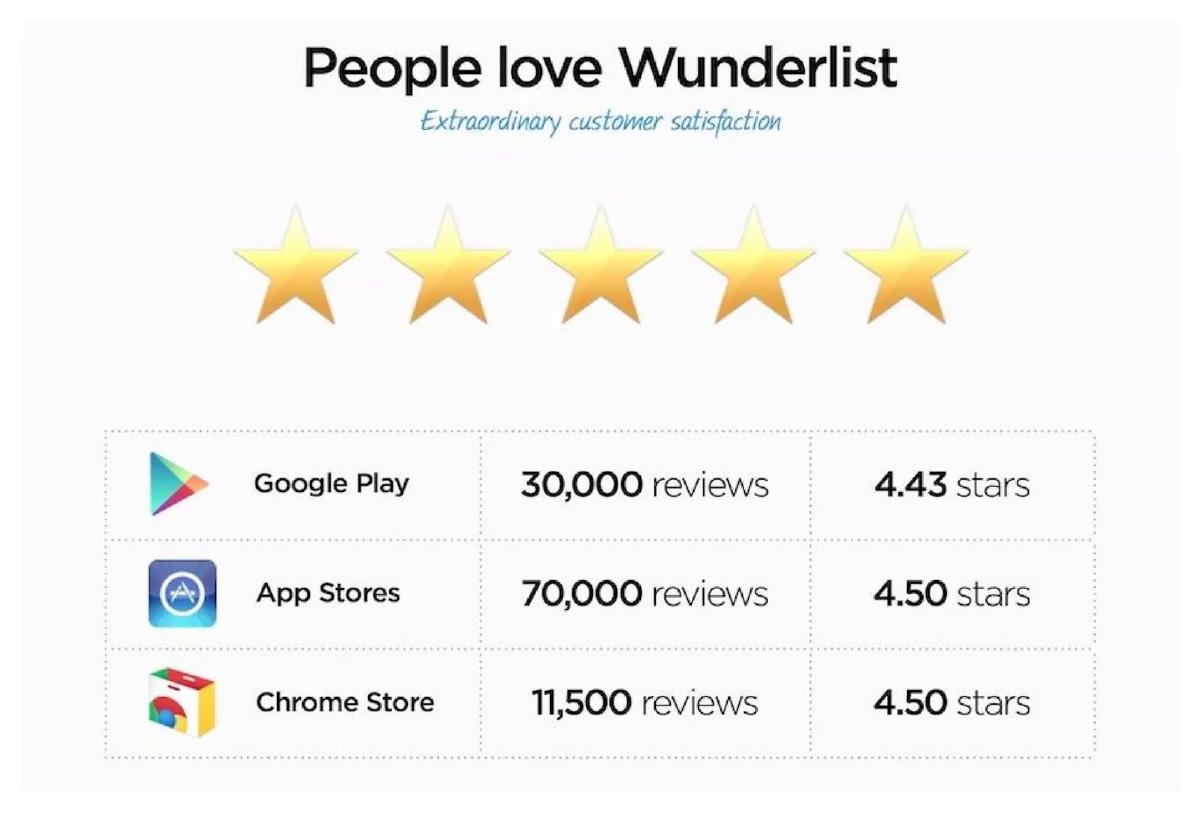
To-do list app. Stage and year are not stated on the slide.
Wunderlist deck, slide 8. Exact stored slide matched to this analysis.
Our analysis: These are the largest review bases in the guide, and giving two decimal places with the count shows the founder isn't rounding up.
Evidence and limitation: "App Stores" (plural) doesn't say which stores are combined, and there is no date. Split by store and date the figures.
What a founder can adapt: When you have a large review base, lead with the count; it is the most persuasive part.
Supporting analysis
What the deck claims: Google Play: 30,000 reviews, rated 4.43. App Stores: 70,000 reviews, rated 4.50.
Presentation choice: These are the largest review bases in the guide, and giving two decimal places with the count shows the founder isn't rounding up.
When it does not fit: "App Stores" (plural) doesn't say which stores are combined, and there is no date. Split by store and date the figures.
Check your slide against each column. The more boxes a quote ticks, the more weight an investor can give it.
Example
Source named
Customer size or type
Concrete result
Checkable
Counterpart
Yes: person, title, firm
Type: brokers
No: attitude
Yes
Canix
Company only
Yes: licence counts
Partly: hours saved, competitor replaced
Partly
Minut
Review site
Consumers
No
Yes: 236 Trustpilot reviews
AtoB
First names; Bloomberg
Competitors' customers
Problem, not result
Partly
Medifies
No: "Patient"
Consumer
Use case only
No
Startup Pirates
Edition and year only
Participants
No
No
Meya
No quotes
Logos
Claimed: spend more
No
Lola
G2
Business buyers
No
Partly: no counts or date
Ethos
Trustpilot, Google; own NPS
Consumers
No
Partly: NPS benchmarks not comparable
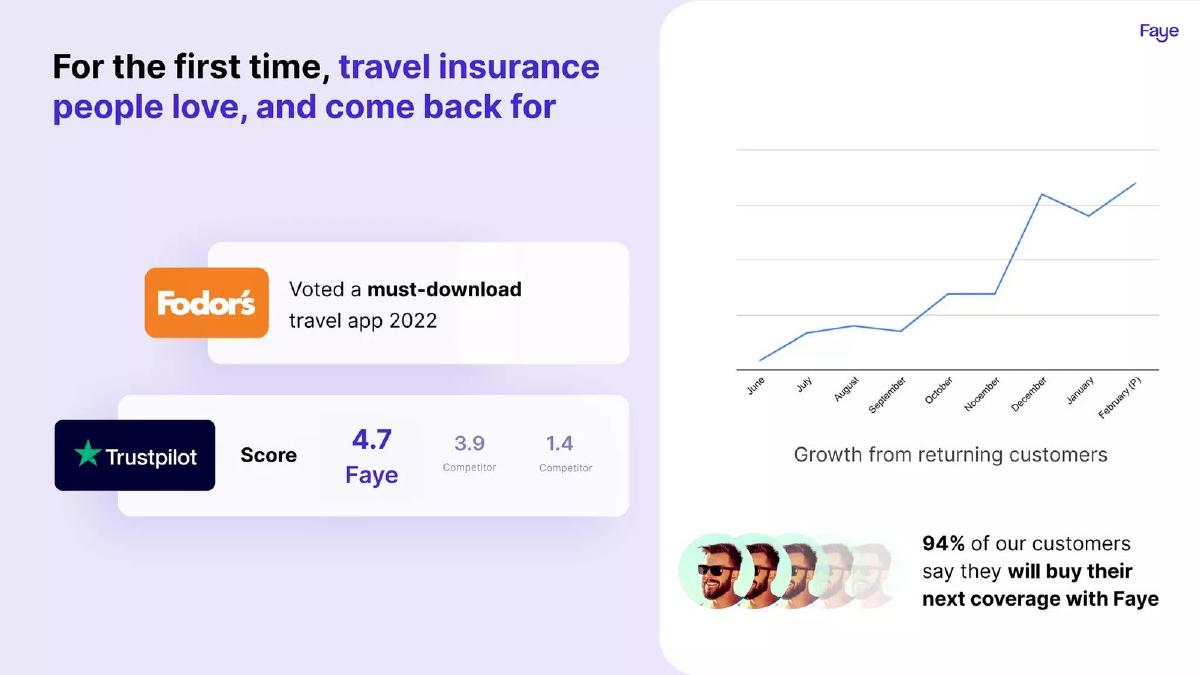
Faye
Trustpilot
Consumers
No
No: rivals unnamed
Little Journey
App Store
Families
No
Yes: 450+ reviews
YuLife
Trustpilot
Consumers
No
Partly: six named rivals, no counts
Wunderlist
Google Play, app stores
Consumers
No
Yes: 30,000 and 70,000 reviews
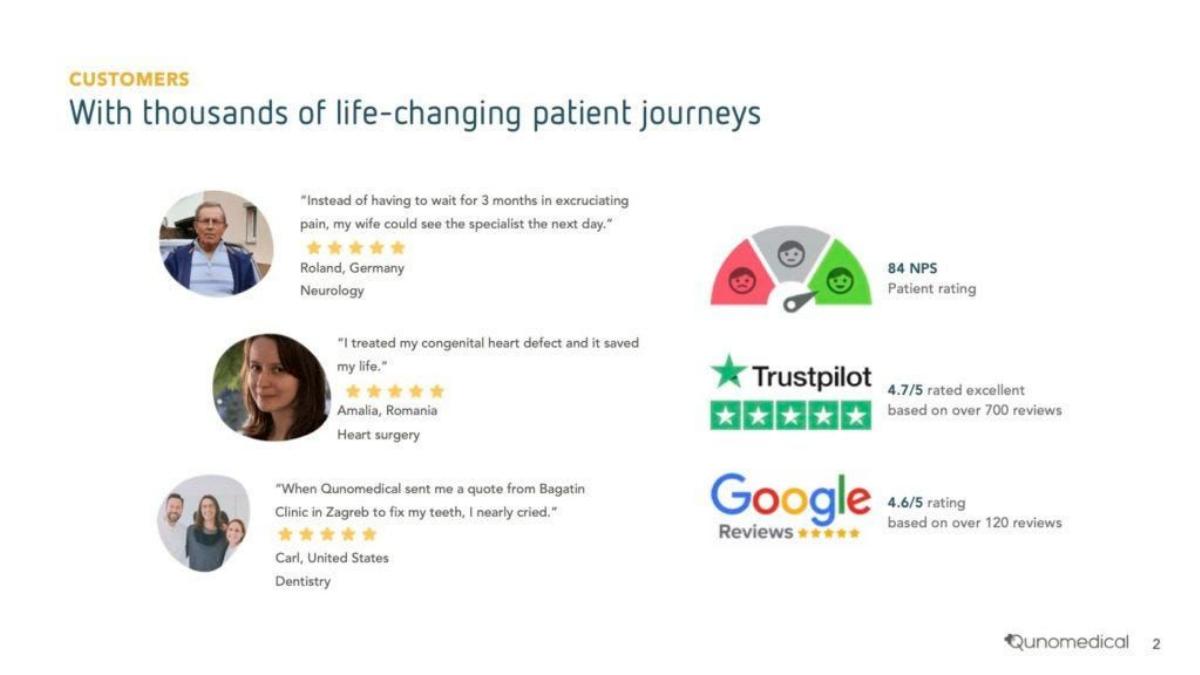
Qunomedical
Trustpilot, Google; own NPS
Patients
No
Yes: 700+ and 120+ reviews
Key Takeaways
Name and title every quote. Counterpart gives each quote a person, a title and a company; "– Patient" (Medifies) gives investors nothing to check.
Show how big the customer is. Canix labels each quote with the customer's number of licences (13, 3, 2), so investors can see that the largest customer is the most specific.
A result beats praise. Canix's "we save countless hours" and "night and day vs. Grow Flow" say what changed; "AMAZING APP" doesn't.
Ratings need the count and the source. Minut shows Trustpilot, 236 reviews, rated Excellent. Its claim of being "miles ahead of the competition" has no comparison on the slide.
Competitors' bad reviews can prove the problem. AtoB quotes one-star reviews of Wex and Fleetcor, and cites a Bloomberg article.
A star rating means little without the number of reviews behind it. Wunderlist pairs 4.43 with 30,000 Google Play reviews; Little Journey's 4.7 rests on 450+ App Store reviews, a much smaller base.
Comparing your rating with competitors' is only fair if the platform and date match. YuLife and Lola name the rivals and the site; Faye's competitors are unnamed, so the comparison can't be checked.
Choose and write your testimonial
Pick one to three quotes. For each, answer these prompts.
Who. Name, title and company. Do you have their permission to use all three?
Size. How big a customer are they (spend, seats, locations), and do they pay?
Result. What changed for them, with a number and a time period?
Replaced. What did they use before you?
Call. Would they take a reference call from an investor?
Copyable framework: "[Before: what they used or struggled with]. Since switching to [Company], we [result with number] in [period]." — [Name], [Title], [Company] ([size: e.g. 13 locations], customer since [year])
Illustrative example 1 — written by us
Before: "Amazing app, we love it!" — Customer
After: "We used spreadsheets for compliance reporting. Since switching to [Company], it takes [2 hours] a month instead of [2 days]." — [Name], [Operations Director], [Company] ([13 sites], customer since [2021])
What improved: Our illustrative rewrite, not any company's text. It names the speaker, gives the customer's size, and states a measured before-and-after; bracketed values are placeholders.
Testimonial slide or customer slide?
The customer logo guide covers who your customers are and how many there are. A testimonial slide answers a different question: do customers actually value the product, in their own words? Use it when you have few logos to show, sell to small businesses or consumers whose names mean little to investors, or need buyers in a trusted industry to vouch for you.
Keep it to one slide, and put the strongest quote on the traction or customer slide if you don't have room for more. Investors may ask to speak to the people quoted, so only quote customers who have agreed and would take the call.
Using review-site ratings on a testimonial slide
A rating from a public review site (Trustpilot, G2, Google, the App Store or Google Play) is different from a hand-picked quote: the founder didn't choose which customers spoke. That makes it useful evidence, but only when the slide gives enough to check it. Investors look for four things: which platform, how many reviews, what date the figure was taken, and, if competitors are shown, whether their scores come from the same platform on the same date.
The review count matters most. A 4.8 average from 40 reviews can move a lot with a handful of new ones; a 4.5 from 70,000 reviews (Wunderlist's App Store figure) is stable. A rating with no count can't be weighed at all. The date matters because ratings change, and investors may open the review page during diligence. If the live number is lower than the slide, the founder has to explain the gap.
Net Promoter Score (NPS) is often shown beside ratings, as Ethos and Qunomedical do. NPS comes from the company's own survey, so it is a company-reported figure, not a third-party one. Say how many people answered and when. Comparing your NPS with famous brands (Ethos sets its 86 beside Tesla and Apple) tells investors little, because those benchmarks come from different surveys of different customers.
Review sites have known weaknesses: companies can invite only happy customers to review, and some platforms let businesses respond to or flag reviews. None of the slides below say how reviews were collected. If yours were invited from all customers rather than a selected group, saying so makes the rating more credible.
Common mistakes
Anonymous quotes. "– Customer" can't be checked, so investors discount it.
Praise without a result. Say what changed, with a number.
"Love" in the headline, no quote on the slide. Support the claim on the slide itself.
Ratings without count, source or date. Give the platform, number of reviews and date.
Comparing ratings with unnamed competitors. Name the rivals and use the same platform and date for every score.
Benchmarking NPS against famous brands. Their scores come from other surveys; compare with your own category or not at all.
Quoting without permission. Investors may call the people you quote.
Diagnostic checklist
Each quote has a name, title and company, used with permission.
The customer's size or type is shown.
At least one quote states a measured result.
Ratings show the platform, review count and date.
Headline claims are supported on the slide.
The people quoted would take a reference call.
Any competitor ratings come from the same platform and date, with rivals named.
Any NPS shows the number of respondents and the survey date.
Frequently asked questions
Should I put Trustpilot or App Store ratings in my pitch deck?
Yes, if the rating is good and rests on enough reviews to be stable. Give the platform, the score, the number of reviews and the date, as Qunomedical and Little Journey do. Investors may check the live page, so use a figure you can stand behind.
How many reviews does a rating need before it's worth showing?
There is no fixed number, but investors weigh a rating by its count. A few dozen reviews can swing with a handful of new ones; thousands (Wunderlist's 30,000 and 70,000) are stable. Whatever the count, show it.
Is NPS the same as a review rating?
No. NPS comes from your own survey, so it is company-reported; a review-site rating comes from a public platform. Show NPS with its sample size and date, and ideally beside a third-party rating.
Can I compare my rating with competitors'?
Yes, if every score comes from the same platform on the same date and the competitors are named, as YuLife does with six rivals. Unnamed competitors (Faye) make the comparison impossible to check.
How we chose these examples
Corpus: published pitch deck teardowns on StartupFundraising.com. Founder-uploaded private decks are excluded.
Selection (2026-09-24): we searched extracted text of slides 2–6 for testimonial, "what customers say", "love us" and similar wording where a stored slide image exists, and selected seven slides built around customer voice (quotes, reviews or ratings). Excluded: Kibin (a critique of a competitor's website, not testimonials), Sempre Health (deck already used in another guide), Fat Joe's and Bliinx ("love us" headlines listing product benefits, not customer voice), Compass Pathways (quote text unreadable in the extracted slide).
Overlap check: the customer logo guide covers who customers are and how many, with named quotes as one of several approaches (Hadean). This guide covers only customer voice (quotes, public reviews and ratings) and what makes it credible. The two guides link to each other.
Review: all seven stored slide images were inspected on 2026-09-24 and matched to company, deck and slide number (editorial model review). No person has yet completed an editorial review of this page.
Update (2026-10-01, v2): we searched the full extracted corpus for review-site ratings (Trustpilot, G2, App Store, Google Play, NPS beside ratings) and added seven private-startup slides: Lola p11, Ethos p9, Faye p15, Little Journey p7, YuLife p23, Wunderlist p8 and Qunomedical p3. None of these pages is used in another guide. Each figure was checked against an image rendered from the original deck PDF on 2026-10-01. Excluded: Lunar p10 (no original deck file available to verify the slide image); listed companies and SPAC decks per our corpus rules.
All ratings, review counts and NPS figures in the added examples are company claims as printed on the slides; none gives a date or collection method, and we have not checked the live review pages. Review of the v2 additions: editorial model review (AI), not a person.
Quotes, ratings and review counts are reproduced from the slides and have not been independently verified. We make no claim that any slide caused a fundraising outcome.