The Ethos Series C pitch deck is a lean, 16-slide presentation that prioritizes narrative momentum over technical density. It begins with stark, emotional statistics regarding family bankruptcy and parental loss to establish the moral urgency of its mission. The deck then pivots to a direct comparison between the 'painful' 15-week traditional insurance process and Ethos’s 10-minute digital alternative. Traction is demonstrated through unlabeled but steep growth curves for both 'Families Protected' and revenue. Notably, the deck highlights a high Net Promoter Score (86) to prove that life insu…
Key takeaways
- The deck uses emotional hooks early, citing that 70% of US families go bankrupt within 3 months of losing a breadwinner (Slide 3).
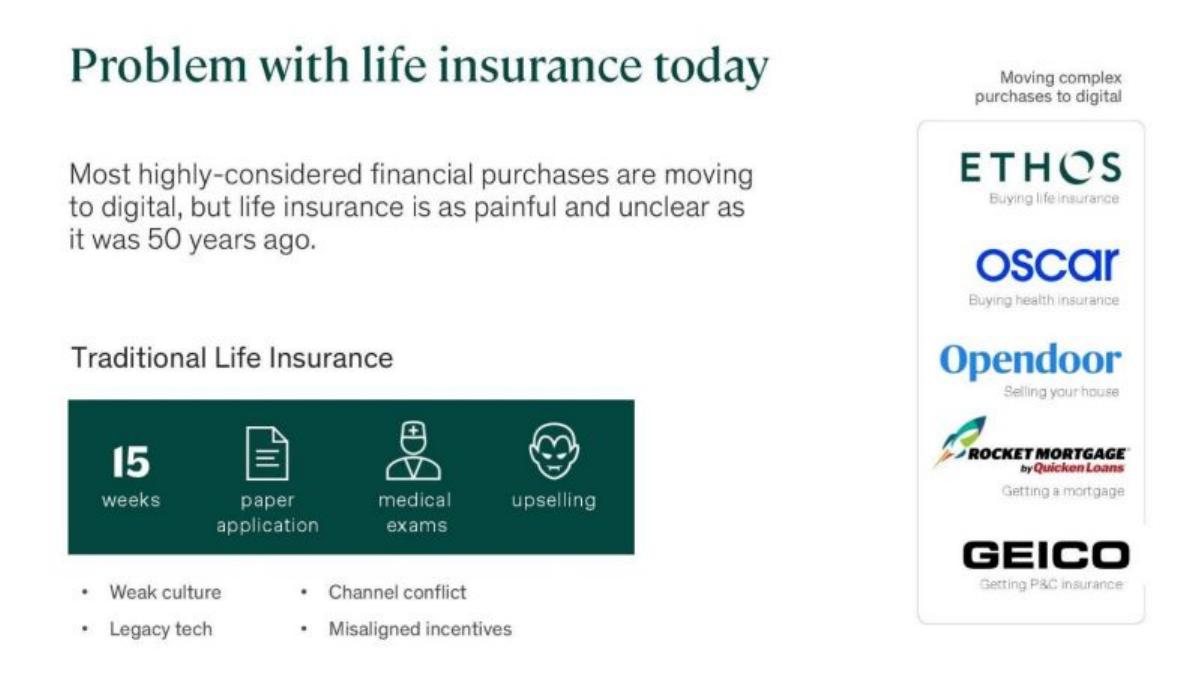
- Ethos positions itself alongside successful 'complex to digital' disruptors like Oscar, Opendoor, and Rocket Mortgage (Slide 6).
- The core value proposition is a speed-to-market advantage: 10 minutes for Ethos versus 15 weeks for traditional insurers (Slide 8).
- Customer satisfaction is a key differentiator, with Ethos claiming an NPS of 86, significantly higher than the average life insurer (Slide 9).
- The company emphasizes market expansion, stating that most applicants were not 'looking' for life insurance before finding Ethos (Slide 12).
- Retention data is presented as a 'prediction model' with placeholders (XX%, YYY), suggesting this version of the deck was sanitized for public viewing or used as a template (Slide 13).
- The team slide leverages massive social proof by displaying logos from Goldman Sachs, Sequoia, and Google Ventures alongside executive bios (Slide 14).
- The deck lacks a specific 'Ask' slide or detailed financial projections, focusing instead on historical growth velocity (Slides 10-11).
The Narrative Arc: From Tragedy to Technology
The Ethos pitch deck is a masterclass in establishing a 'moral' mission before introducing a business model. In an industry as dry as life insurance, Ethos chooses to lead with the human cost of being uninsured. This approach serves two purposes: it creates immediate emotional buy-in and frames the company not just as a fintech play, but as a social safety net.
Slides 1-5: The Emotional Hook and Mission
Slide 1 introduces the brand with the tagline: "Life insurance, the human way." The minimalism here is intentional, signaling a departure from the cluttered, fine-print world of legacy insurance providers.
Slides 2 and 3 deliver the 'shock' statistics. Slide 2 states that "5% of US kids lose a parent before age 15," and Slide 3 follows up with the devastating business case: "70% of US families go bankrupt within 3 months of losing the breadwinner." By leading with bankruptcy and loss, Ethos defines the 'Problem' not as a lack of software, but as a lack of financial security for vulnerable families.
Slide 4 defines the market size: "10 million Americans buy individual life insurance each year." This establishes the TAM (Total Addressable Market) without needing a complex spreadsheet. Slide 5 then presents the mission: "to protect the next million families," accompanied by a high-quality photo of a mother and child, reinforcing the emotional stakes.
Slides 6-8: The Product Disruption
Slide 6 is a critical positioning slide. It explicitly links Ethos to other successful 'complex-to-digital' pioneers. By placing their logo alongside Oscar (health insurance), Opendoor (real estate), and Rocket Mortgage (finance), Ethos tells investors: "We are doing for life insurance what these unicorns did for their respective sectors." It also lists the failures of traditional insurance: 15 weeks of waiting, paper applications, and medical exams.
Slide 7 introduces the 'Ethos Solution.' The bullet points are a direct rebuttal to the legacy pain points: apply in 10 minutes, instant policy approval, usually no medical exams, and no commissioned salespeople. This last point is vital—it suggests an ethical alignment with the customer that traditional brokers lack.
Slide 8 provides a side-by-side comparison of the 'Spectacular product experience.' It breaks down the Ethos 3-step process (Signup, Underwriting, Approval) against the 6-step legacy process (Agent meetings, medical exams, snail mail). The contrast between "10 minutes" and "15 weeks" is the deck's strongest value proposition.
Slides 9-11: Traction and Velocity
Slide 9 focuses on customer delight, a rarity in insurance. It claims a 2018 NPS of 86 . To put this in perspective, the slide includes a bar chart showing Ethos outperforming Amazon, Apple, and Airbnb, while the "Avg. Life Insurer" languishes near a score of 10. This data point is used to prove that Ethos has solved the 'distribution' problem by creating a product people actually like.
Slides 10 and 11 show growth. Slide 10 tracks the "# of Families Protected" over 13 months, and Slide 11 shows "Spectacular Revenue Growth" over the same period. Both slides use bar charts with steep upward trajectories. However, it is important to note that no actual numbers are provided on the Y-axis . For a Series C pitch, the actual numbers would have been disclosed in the room, but their omission here emphasizes the rate of growth over the absolute figures.
Slides 12-13: The Growth Engine and Retention
Slide 12 describes the "Customer acquisition machine." It claims that "Word of Mouth is our largest channel" and that Ethos is actually "growing the market" by reaching people who weren't looking for insurance. This is a powerful claim—it suggests Ethos isn't just fighting for market share; it's creating new demand.
Slide 13 covers retention. It features a "Cohort Retention Rate" graph that shows a steady climb. Interestingly, this slide contains placeholders: "Predicted cohort 5-yr retention is XX%" and "Drivers of Churn: 1. XXX." This suggests that this specific version of the deck was used for broad distribution or as a template, with the sensitive data reserved for a data room.
Slide 14: The Team and Social Proof
The team slide is a 'who's who' of Silicon Valley pedigree. Founders Peter Colis and Lingke Wang are noted as prior founders of Ovid Corp with Stanford MBAs. The executive bench includes veterans from Uber, Facebook, Instagram, and MunichRe . The right side of the slide is dedicated to investor logos: Sequoia, Accel, GV, and Goldman Sachs . At the Series C stage, this level of social proof is often more persuasive than the product slides themselves.
What Ethos Does Well
The deck excels at comparative positioning . By constantly contrasting their 10-minute process with the 15-week legacy process, they make the traditional insurance industry look obsolete. They also successfully move the conversation away from 'actuarial tables' and toward 'user experience,' which is where tech valuations are won. The use of NPS scores (Slide 9) is a brilliant way to quantify 'brand love' in a commodity industry.
What is Missing
As a Series C deck, there are notable omissions, likely due to confidentiality:
Unit Economics: There is no mention of Customer Acquisition Cost (CAC) or Lifetime Value (LTV), which are the lifeblood of fintech valuations. · Specific Financials: The revenue and growth charts (Slides 10-11) lack denominations. · The Ask: There is no slide detailing how much they are raising or what the use of funds will be. (We know from catalogue facts it was $60M, but it's not in the slides). · Regulatory/Underwriting Depth: The deck skims over the 'how' of their instant underwriting. For a Series C, investors would typically require deep dives into their reinsurance partnerships and risk models.
Founder's Summary: What to Copy
Founders should emulate Ethos’s emotional framing . Don't just sell a faster process; sell the avoidance of bankruptcy for families. Additionally, the 'Disruption Map' on Slide 6 is a perfect way to borrow credibility from other successful startups. If you are disrupting a legacy industry, show the logos of companies that have already successfully disrupted adjacent industries to prove the 'inevitability' of your model. Finally, use NPS and customer reviews (Slide 9) to prove that your 'boring' B2C product has 'viral' consumer appeal.
Frequently asked questions
- How much did Ethos raise with this deck?
- According to the catalogue facts, Ethos raised $60 million in a Series C round in 2019. The deck itself focuses on the growth and mission rather than the specific terms of the raise.
- What is the primary problem Ethos is solving?
- Ethos identifies the 'painful and unclear' nature of traditional life insurance. Slide 6 notes that the legacy process takes 15 weeks, involves paper applications, medical exams, and 'misaligned incentives' like upselling, which Ethos replaces with a 10-minute digital process.
- How does Ethos acquire customers?
- Slide 12 states that 'Word of Mouth' is their largest channel. They also claim to 'grow the market' by reaching people who were not actively searching for life insurance, utilizing a highly diversified mix of marketing channels.
- Is there a detailed financial breakdown in the deck?
- No. Slides 10 and 11 show bar charts for 'Families Protected' and 'Revenue Growth,' but the Y-axis lacks specific dollar amounts or unit counts. This is common in later-stage decks shared publicly to protect sensitive competitive data.
- Who are the key investors mentioned?
- Slide 14 features logos for Sequoia, Accel, Google Ventures (GV), Goldman Sachs, and Stanford University, indicating a high level of institutional backing from top-tier venture capital firms.