Algowork presents a highly analytical early-stage deck focused on solving the disconnect between academic study and professional reality. The company proposes a platform for one-day job shadowing to help students validate their career paths before graduation. Unlike many polished seed decks that hide behind vague projections, Algowork leans heavily into raw data, showing exact conversion funnels from their landing page tests and a granular breakdown of their $34,288 monthly burn rate. While the market sizing slide is notably underdeveloped, the deck excels at demonstrating a 'concierge' appro…
Key takeaways
- The company identified a specific disconnect between college majors and resulting careers as the core problem (Slide 2).
- Primary research included interviews with 40 students aged 18-35 from institutions like UC Berkeley, SF State, and CCA (Slide 3).
- The solution is defined as a 'one day shadowing experience' to provide experiential career insight (Slide 11).
- Algowork is seeking a seed investment of $620,000 to reach a beta launch within 18 months (Slide 7).
- The team provides transparent landing page conversion data, showing a 1.3% sign-up rate from 3,014 initial views (Slide 13).
- Gross monthly burn is precisely calculated at $34,288, with $33,450 allocated to 'Activities' (Slide 16).
- The business model relies on two revenue streams: school subscriptions and direct student payments for tours (Slide 10).
- A 'Business Molecule' diagram simplifies the relationship between the target audience, the problem, and the shadowing solution (Slide 11).
Introduction: The Experiential Career Gap
Algowork enters the EdTech and HRTech space with a specific focus on the 'experience gap.' Their deck, which spans 53 slides in its full version, is a study in early-stage validation. Rather than relying on broad industry trends, the founders present a narrative built on direct student interviews and live web traffic experiments. The core value proposition is simple: bridging the gap between college and the workforce through short-term, experiential shadowing.
Slides 1-3: Problem Identification and User Research
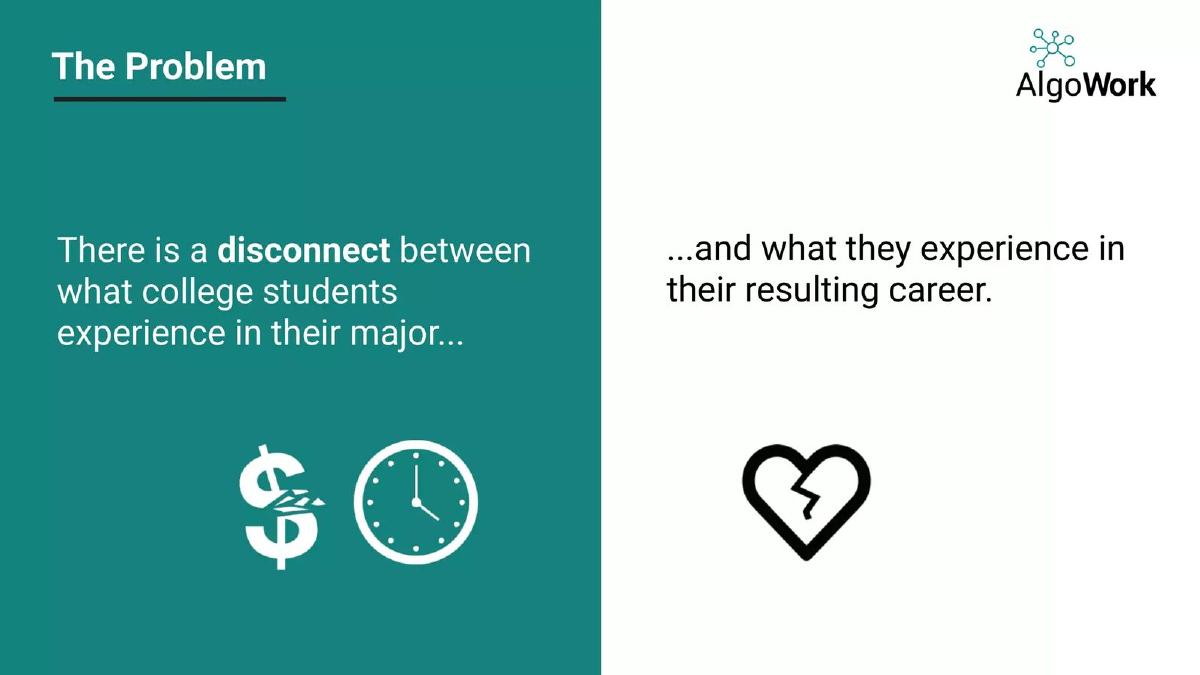
The deck opens with a clear mission statement: 'Bridging the gap between college and the workforce.' Slide 2 defines the problem as a 'disconnect' between the academic experience and the reality of a resulting career, using icons for money, time, and a broken heart to signify the cost of choosing the wrong path.
Slide 3 is a highlight of the deck. Instead of claiming to 'know' the market, the founders list exactly who they talked to: 40 students aged 18-35. They break this down by institution, including high school students, community colleges in San Francisco and Santa Cruz, and major universities like UC Berkeley, UC Davis, and SF State. This level of specificity builds immediate credibility regarding the team's understanding of their target demographic.
Slides 4-5: Market Sizing and Competition
Slide 4 , titled 'Market Sizing,' is one of the weaker points in the presentation. It lists '$1.8 million' and '123,000 College Students' with a source citation for IBISWorld. These figures seem remarkably low for a venture-scale pitch and likely represent a very narrow sub-segment (perhaps a specific local geography) rather than the Total Addressable Market (TAM). Usually, investors expect to see billions in potential reach.
Slide 5 places Algowork on a 2x2 competitive matrix. The axes are 'Theoretical vs. Experiential' and 'Exploratory vs. Committed.' Algowork positions itself in the top-right quadrant (Exploratory and Experiential). They list competitors like Wade & Wendy and career coaches in the 'Theoretical' half, while internships and service years are placed in the 'Committed' half, suggesting that Algowork is for students who want to explore without a long-term commitment.
Slides 6-7: The Concierge Model and Financial Roadmap
Slide 6 shows a 'Concierge' photo of two people in an office setting. This suggests the founders are manually facilitating these shadowing experiences to learn the workflow before building a fully automated platform. This 'Do Things That Don't Scale' approach is highly regarded in early-stage investing.
Slide 7 outlines the 'Run Rate + Market Plan.' The company is asking for a seed amount of $620,000 . The 18-month timeline is broken into four phases: First 6 months (Validate Markets), 6-11 months (Wizard of Oz & Building), 12-14 months (Alpha Launch), and 14-18 months (Beta Launch). Notably, they project becoming cash positive in the final phase with +$84,000 , though they also show a cumulative cash negative position of over $600,000 leading up to that point.
Slides 10-12: Business Model and Product Features
Slide 10 utilizes a standard Business Model Canvas (BMC). Key takeaways here are the revenue streams: 'Schools buy subscriptions for students' and 'Students pay for a tour.' Their cost structure includes engineering, office supplies, lawyers, and employee salaries. Slide 11 introduces the 'Business Molecule,' a simplified diagram linking the People (College students) to the Problem (difficulty knowing what a career is like) and the Solution (one-day shadowing).
Slide 12 details the product features: Connect (direct connection to professionals), Learn (preparation details and biographies), and Experience (suggested questions and supplies). The slide includes a mock-up of a sign-up field, emphasizing the call to action: 'Get started on your dream career!'
Slides 13-15: The Reality of the Funnel
Slides 13 and 15 are perhaps the most honest slides in the deck. They show the actual conversion funnels from their marketing efforts. On Slide 13 , they show that 3,014 people saw their posts, leading to 322 page views (10.7%) and 40 sign-ups (1.3%). Slide 15 shows a different test with 2,230 views resulting in only 5 'double opt-ins' (0.2%). While these numbers are low, presenting them transparently shows a data-driven culture. Slide 14 supports this with a 'Hockey Stick' traffic graph from October to December 2017, showing a peak of unique visitors followed by a plateau, which they use to visualize their initial traction.
Slides 16-18: Burn Rate and Research Summary
Slide 16 provides a granular look at costs. The Total Monthly Gross Burn Rate is $34,288 . This is split between Activities ($33,450), Partners ($420 for legal fees), and Resources ($418 for AWS, Squarespace, and Intuit). This level of detail is rare in seed decks and helps investors understand exactly how the $620k ask was calculated.
Slide 17 clarifies the 'Partners' category, identifying them as legal entities, universities for subscriptions, and companies willing to provide shadowing opportunities. Finally, Slide 18 summarizes their research findings: students like their majors but don't always like the resulting career, and they often don't know what skills they are lacking for the workforce.
What Algowork Does Well
Primary Research: The team didn't just read reports; they interviewed 40 specific students across diverse California campuses. · Financial Transparency: Providing a specific monthly burn rate ($34,288) and a clear 18-month roadmap for a $620k raise is excellent. · Honest Metrics: Including a funnel that shows a 0.2% conversion rate is brave. It shows the founders are looking at real data, not just vanity metrics. · Concierge Validation: Using a 'Wizard of Oz' approach (manual fulfillment) to test the concept before heavy engineering spend is a smart capital allocation strategy.
What is Missing from the Algowork Deck
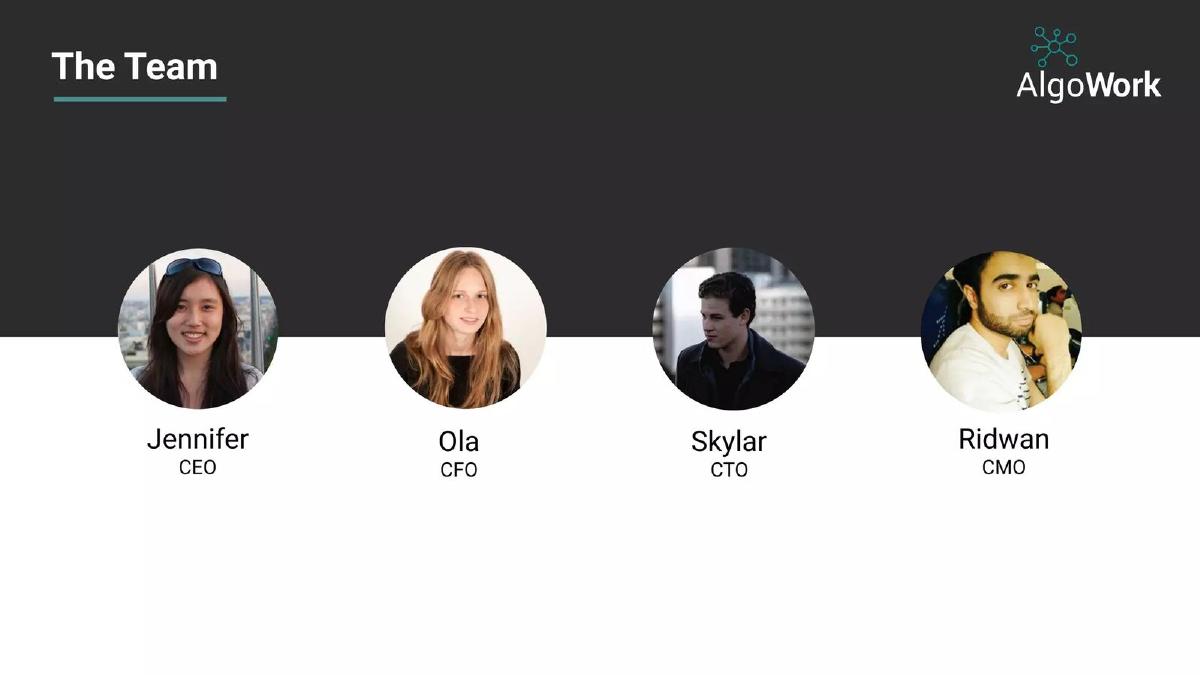
Team Slide: The provided slides do not include a team background slide. We see small headshots on the cost slide, but no names, titles, or prior experience are listed. · Scalable Market Size: The $1.8M market figure on Slide 4 is confusingly small. A pitch deck needs to demonstrate how this becomes a $100M+ revenue business. · Professional Side of the Marketplace: The deck focuses heavily on the student (demand) side. It lacks detail on why professionals or companies would want to host students (supply side incentives). · Unit Economics: While we see the burn rate, we don't see the LTV (Lifetime Value) vs. CAC (Customer Acquisition Cost) projections for a single student or university subscription.
Founder Takeaways
Founders should emulate Algowork's Slide 3 . If you are in the early stages, showing a list of the specific types of people you have interviewed carries more weight than a generic 'market trends' slide. Additionally, the use of a Business Model Canvas (Slide 10) and a detailed burn breakdown (Slide 16) shows a level of operational maturity that investors look for in first-time founders. However, avoid the mistake on Slide 4 —always ensure your market sizing reflects the total potential of your vision, not just your immediate pilot group.
Frequently asked questions
- What is Algowork's primary product offering?
- Algowork offers a platform that connects college students with professionals for one-day job shadowing experiences. As detailed on Slide 12, the features include direct connections to professionals, preparation materials about the company and guide, and a list of suggested questions and supplies to maximize the experience.
- How much capital is Algowork raising and what is the timeline?
- According to Slide 7, the company is seeking a seed amount of $620,000. This capital is intended to fund an 18-month roadmap, progressing from market validation and 'concierge' testing to a full beta launch in the final four months of the period.
- What evidence of market demand does the deck provide?
- The deck provides raw funnel metrics from landing page tests. Slide 13 shows that out of 3,014 people who saw their posts, 40 signed up (a 1.3% conversion). Slide 15 shows a second test where 2,230 views resulted in 13 sign-ups and 5 'double opt-ins,' representing a 0.2% final conversion rate.
- Who is the target customer for Algowork?
- The Business Model Canvas on Slide 10 identifies college students, high school students, and parents as primary segments. However, the revenue model suggests a B2B2C approach where schools and universities buy subscriptions for their students, alongside a direct-to-consumer model where students pay per tour.
- How does Algowork plan to spend its seed funding?
- Slide 16 breaks down a monthly burn of $34,288. The vast majority ($33,450) is dedicated to 'Activities,' which includes engineering, marketing, and sales salaries. Smaller amounts are allocated to partners/legal ($420) and resources like AWS and Intuit ($418).