Aliat’s investor deck positions the company as a specialized Professional Employer Organization (PEO) designed to level the playing field for small businesses. By aggregating employees, Aliat offers 'large enterprise' amenities, specifically focusing on stabilizing healthcare costs through a partnership with Cigna. The deck is unusually long at 51 slides, suggesting it may serve as both a sales tool and an investor presentation. While it provides granular detail on website analytics and recruitment service tiers, it lacks a traditional team slide or a specific financial 'ask' in the provided…
Key takeaways
- The company targets a market of over 28 million small businesses in the US that lack large-enterprise amenities (Slide 2).
- Aliat defines its mission through six distinct lenses: Business, National, Economic, Social, Organic, and Human objectives (Slide 3).
- The service model covers five core administrative pillars: HR, Workers' Compensation, Safety & Risk Management, Benefits, and Payroll (Slide 5).
- Website analytics show a modest digital footprint with 14,456 users and a 65.41% bounce rate (Slide 6).
- Marketing efforts include Marketo integration with a 38% open rate and a 23% click-to-open rate on email campaigns (Slide 6).
- The 'Recruiter Elite' add-on introduces a $2,000 one-time charge for a 'Top Performer Profile' (Slide 7).
- A central competitive advantage is the 'Freedom to Fly Guarantee,' promising 0% renewal increases by Phase 4 of the program (Slide 8).
- The deck positions Aliat as a 'leading PEO' utilizing a population health-management model to control medical cost trends (Slide 8).
Executive Summary: The PEO as a Small Business Equalizer
Aliat’s investor deck is a deep dive into the world of Professional Employer Organizations (PEOs). The presentation is built on the premise that small businesses are the engine of the US economy—producing 16 times more patents per employee than large firms—yet they are systematically disadvantaged by administrative burdens and healthcare costs. The deck positions Aliat not just as a service provider, but as a strategic partner that allows business owners to 'do what you love' while Aliat handles the 'rest.'
Slide 1: Title and Brand Identity
The cover slide introduces the Aliat logo, featuring a hummingbird icon and the tagline: "Do what you love. We’ll do the rest." The imagery of a person working on a laptop in a bright, modern office setting reinforces the focus on white-collar administrative relief. The branding is clean, using a professional palette of navy blue, orange, and green.
Slide 2: The Market Problem
Slide 2, titled "Why Small Businesses?", establishes the TAM (Total Addressable Market) and the pain points. It cites that there are over 28 million small businesses in the US, accounting for 60% of all jobs and 98% of all U.S. exporters of goods. The core conflict is stated clearly: these businesses face escalating healthcare costs and regulatory pressures without the 'amenities' enjoyed by large enterprises. This slide successfully creates a sense of scale and urgency.
Slide 3: Strategic Objectives
This slide uses a hexagonal graphic to outline six objectives: Business, National, Economic, Social, Organic, and Human. While many decks stick to financial goals, Aliat attempts to show a holistic impact. The 'National Objective' is particularly interesting, claiming to provide 'superior affordable healthcare that’s stabilized over time,' which they argue leads to a healthier national workforce. This suggests the company views its mission as a systemic fix for the US healthcare crisis as it relates to small business employment.
Slide 4: Technology & Systems Transition
Slide 4 serves as a section break, titled "Technology & Systems." The background imagery features circuit-like icons for laptops, mobile devices, and data, signaling that while PEO work is service-heavy, Aliat relies on a tech stack to deliver its solutions. However, the slide contains no specific data about proprietary software or platform architecture.
Slide 5: Building a Business Case
Using a whiteboard aesthetic, Slide 5 illustrates the 'Prospective Company' at the center of five administrative spokes: Human Resources, Workers’ Compensation, Safety & Risk Management, Benefits Administration, and Payroll Administration. At the bottom, it lists the five outcomes Aliat promises: Profitability, Productivity, Time, Liability, and Cost. This is a classic 'functional' slide that defines exactly what is in the box for a customer.
Slide 6: Website and Marketing Analytics
Slide 6 provides a surprisingly granular look at the company's digital performance. It shows 14,456 users and 33,490 pageviews. The 'Top Cities' list includes Portland, New York, and Seattle, suggesting a West Coast bias or origin. The Marketo YTD analytics are a highlight here, showing a 38% open rate and a 0.9% bounce rate on email campaigns. For an investor, this slide demonstrates that the company is tracking its acquisition funnel, even if the absolute numbers (like 144 LinkedIn followers) are still in the early stages of growth.
Slide 7: Product Tiers and Add-Ons
This slide breaks down the 'Recruiter Pro' and 'Recruiter Elite' packages. It moves Aliat from a pure PEO into a recruitment agency model. The 'Recruiter Elite' tier is particularly detailed, mentioning 'advanced psychometric recruiting algorithms' and a '$2,000 one-time charge' for a Top Performer Profile. This slide is crucial for understanding the company's unit economics and how they upsell basic PEO clients into higher-margin consulting services.
Slide 8: The Competitive Advantage (Healthcare)
Slide 8, "Competitiveness," introduces the 'Freedom to Fly Guarantee.' This is the deck's strongest value proposition. It outlines a four-phase journey for healthcare renewals. Phase 1 (Nest) involves joining the marketplace, while Phase 4 (Fly) guarantees a 0% renewal increase. In an era of double-digit insurance hikes, a 0% guarantee is a powerful hook for both customers and investors. It also mentions a partnership with CIGNA, lending institutional credibility to their claims.
Slide 9: Competitor Comparison
The final slide in this selection is a high-level comparison grid. It lists six categories: Benefits & Wellness, HR, Payroll, Compliance, Pricing, and User Experience. Rather than a checklist comparing themselves to specific rivals like Zenefits or ADP, it directs the viewer to a URL (myaliat.com/compare). While this keeps the slide clean, it misses an opportunity to show a direct feature-set advantage on the page.
What Works in This Deck
Specific Value Proposition: The 'Freedom to Fly' healthcare guarantee is a concrete, measurable benefit that addresses a top-three pain point for every small business owner. By putting percentages (5-7%, 3-5%, 0%) on the slide, Aliat moves past vague promises of 'savings' into a specific financial product.
Transparency in Marketing: Including a slide with raw Google Analytics and Marketo data is rare in early-stage decks. It shows a level of operational honesty and suggests the management team is data-driven, even if the social media following is currently small.
Clear Service Scope: The whiteboard graphic (Slide 5) makes it impossible to misunderstand what Aliat does. It defines the boundaries of their service, which is essential in the crowded and often confusing HR-tech/PEO space.
What Is Missing from the Provided Slides
The Team: There is no mention of the founders, their backgrounds in HR or insurance, or the executive leadership. In a service-heavy business like a PEO, the 'who' is as important as the 'what.'
Financial Performance and Ask: While we see marketing metrics, we don't see revenue, EBITDA, or growth rates. More importantly, the 'Ask' slide is missing—investors need to know how much capital is being raised and what it will be used for (e.g., geographic expansion, tech development, or sales hiring).
Unit Economics: The deck mentions a $2,000 fee for one specific add-on, but it doesn't explain the core PEO pricing model (e.g., PEPM - Per Employee Per Month). Understanding the LTV (Lifetime Value) vs. CAC (Customer Acquisition Cost) is vital for this business model.
Founder's Playbook: What to Copy
The Phased Guarantee: If your business model relies on long-term retention, use a phased approach like the 'Freedom to Fly' model. It gives the customer a reason to stay for years to reach the '0% increase' tier, effectively lowering churn through a structured incentive program.
Outcome-Based Objectives: Slide 3’s breakdown of objectives (Human, Economic, Social) is a good way to frame a company's mission for ESG-conscious investors without losing sight of the 'Business Objective' (removing administrative burden).
Granular Service Tiers: Don't just say you offer 'Recruiting.' Slide 7 shows how to break a service down into specific tasks (salary research, phone screening, offer letters). This builds value in the mind of the buyer and justifies the price point.
Final Thoughts
Aliat’s deck is a comprehensive, if slightly long, explanation of a complex service business. It excels at identifying the 'enemy' (healthcare costs and admin burden) and presenting a structured solution. To be a truly effective fundraising tool, the missing financial and team components would need to be as robust as the marketing and service slides provided here. The 51-slide total length suggests this deck may be used more for sales and onboarding than for a quick-hit investor pitch, but the core components of a strong PEO business case are present.
Frequently asked questions
- What is Aliat's primary business model?
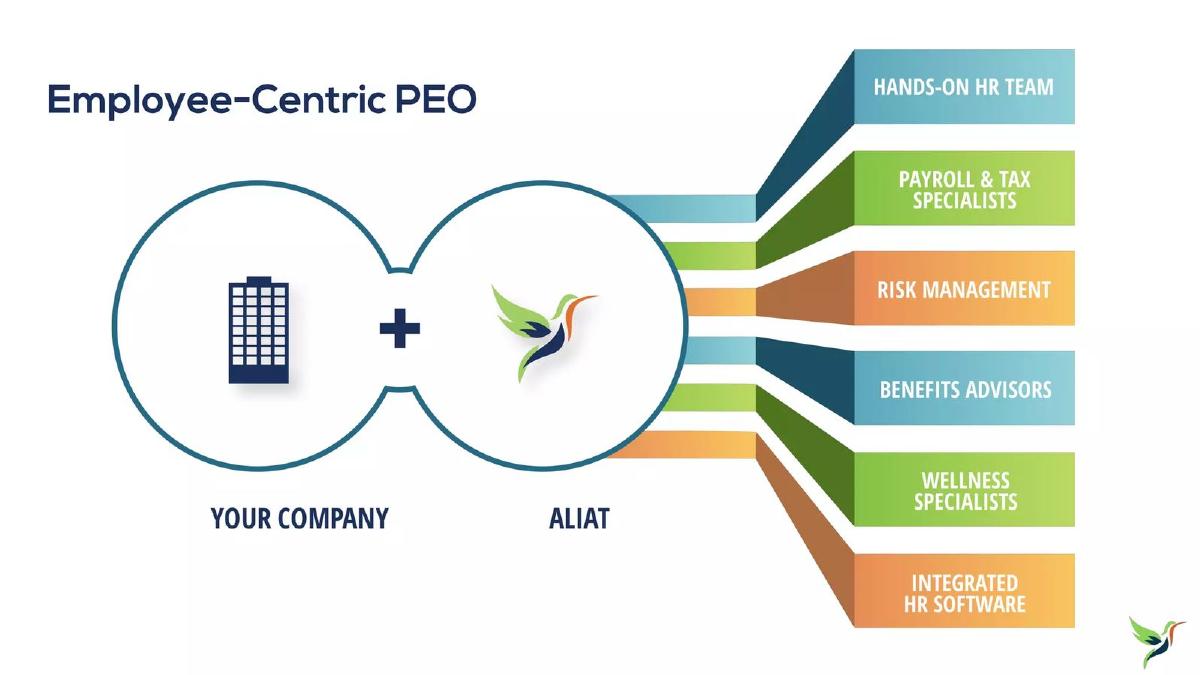
- Aliat operates as a Professional Employer Organization (PEO). It provides a '360-degree back-office support' system for small and mid-sized businesses. This includes managing Human Resources, payroll, risk management, and employee benefits. By co-employing workers, Aliat allows small firms to access healthcare rates and administrative systems typically reserved for large corporations.
- How does Aliat differentiate its healthcare offering?
- The deck highlights a partnership with CIGNA and a proprietary 'Freedom to Fly Guarantee.' This program is structured in four phases: Nest, Hatch, Grow, and Fly. It guarantees specific renewal increase caps, starting at 5-7% in Phase 2 and reaching a 0% renewal increase guarantee by Phase 4, addressing the volatility of healthcare costs.
- What additional revenue streams does the company have beyond PEO services?
- Aliat offers specialized recruitment tiers called 'Recruiter Pro' and 'Recruiter Elite.' These are 'Add-Ons' that include services like salary research, phone screening, and psychometric testing. The Elite tier includes a $2,000 charge for a 'Top Performer Profile' and $50 credits for job postings, indicating a diversified service-based revenue model.
- What does the provided data say about their digital traction?
- Slide 6 provides a snapshot of YTD analytics. The website saw approximately 14,500 new users with an average session duration of 1 minute and 41 seconds. Their social media presence is relatively small, with 144 LinkedIn followers and 652 Twitter followers. However, their email marketing shows high engagement, with a 38% open rate on nearly 28k sent emails.
- Is there a clear investment ask in the deck?
- Based on the 9 slides provided from the 51-slide deck, there is no specific financial ask, valuation, or use of proceeds slide. The deck focuses heavily on the 'why' and the 'how' of the service delivery rather than the capital requirements of the business itself.