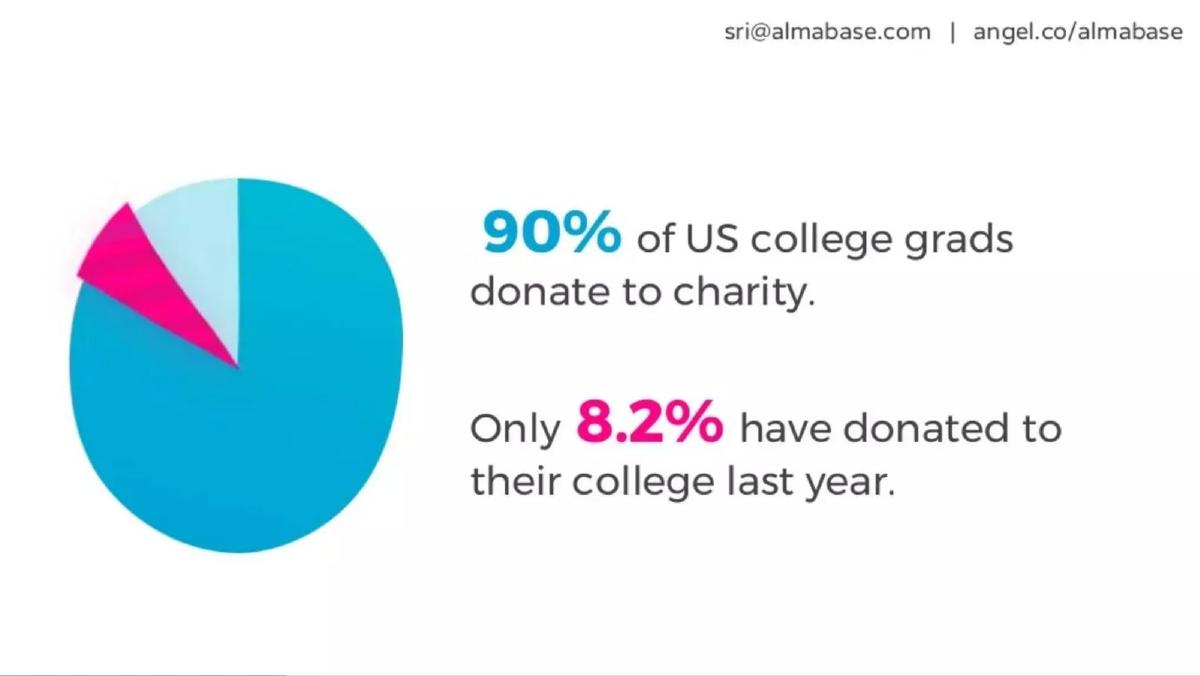
Almabase’s 2014 pitch deck is a textbook example of how to lead with traction when the product category is established but underserved. The deck identifies a specific market inefficiency: while 90% of US college grads donate to charity, only 8.2% donate to their alma mater. Almabase positions itself as the bridge for this gap, showcasing $200,000 in ARR and 1 million alumni reached within just eight months of operation. The deck avoids technical jargon, instead using clear visual metaphors for 'outdated data' and 'low engagement' to justify its all-in-one platform approach. While it lacks a f…
Key takeaways
- The deck identifies a massive discrepancy between general donor behavior (90% give to charity) and alumni giving (8.2%), as shown on Slide 4.
- Traction is the centerpiece of the narrative, highlighting $200K ARR achieved in just 8 months on Slide 11.
- The platform has already scaled to reach 1M alumni, providing significant social proof early in the deck on Slide 11.
- The problem is visualized through a messy Excel spreadsheet on Slide 8, representing the 'outdated data' schools currently struggle with.
- The solution is positioned as an 'All In One' hub covering CRM, social media sync, and online donations on Slide 9.
- Market size is defined by current spending, noting that schools currently spend $6B in this category on Slide 17.
- The team slide (Slide 18) emphasizes domain expertise, noting the founders started an alumni association 8 years prior.
- The deck utilizes a progressive reveal of customer logos across Slides 12 through 16 to demonstrate breadth across private, public, and international schools.
The Traction-First Approach to EdTech
The Almabase pitch deck from 2014 is a lean, visually-driven presentation that prioritizes market evidence over theoretical features. In a sector like EdTech, where sales cycles are notoriously long and bureaucratic, Almabase uses its early revenue and user numbers to prove that they have cracked the code of institutional sales. The deck follows a classic problem-solution-traction arc, but it does so with a minimalist aesthetic that keeps the focus on the numbers.
Slides 1-4: The Macro Problem and the Giving Gap
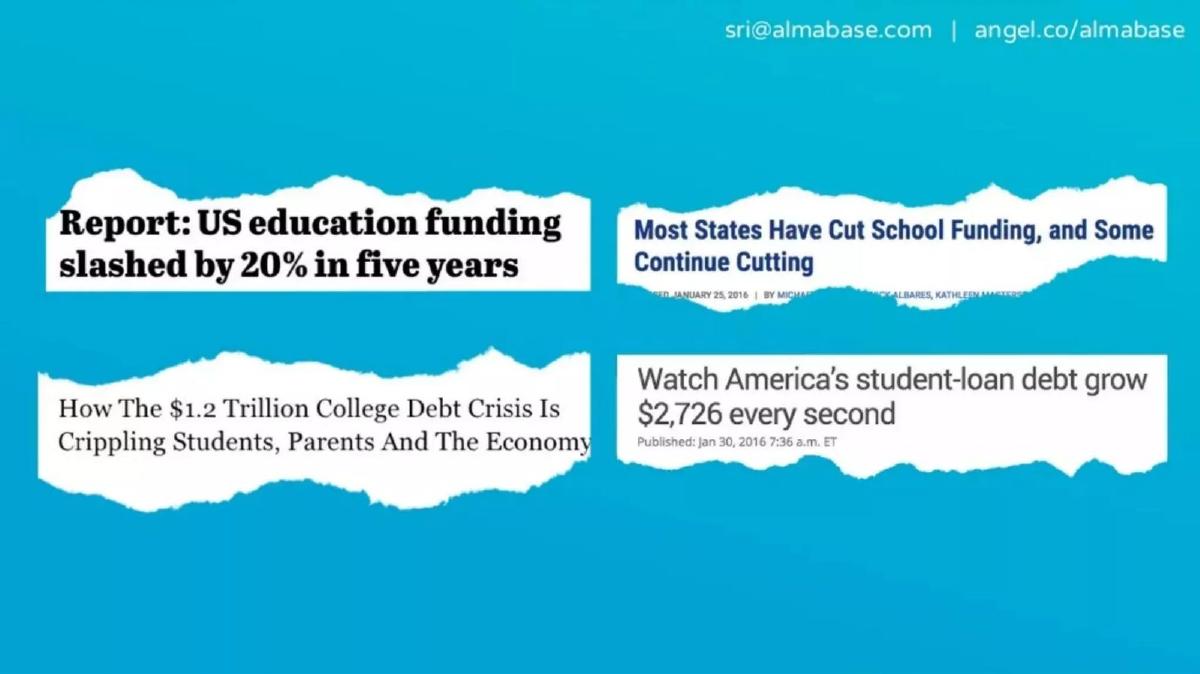
The deck opens with a simple title slide (Slide 1) defining the company as an "all-in-one platform for alumni engagement." This immediately sets the stage for a horizontal software play. Slide 2 uses a collage of news headlines to establish the macro-economic pressure on schools: US education funding is being slashed, and student debt is rising. This creates a sense of urgency—schools need new revenue streams because traditional funding is drying up.
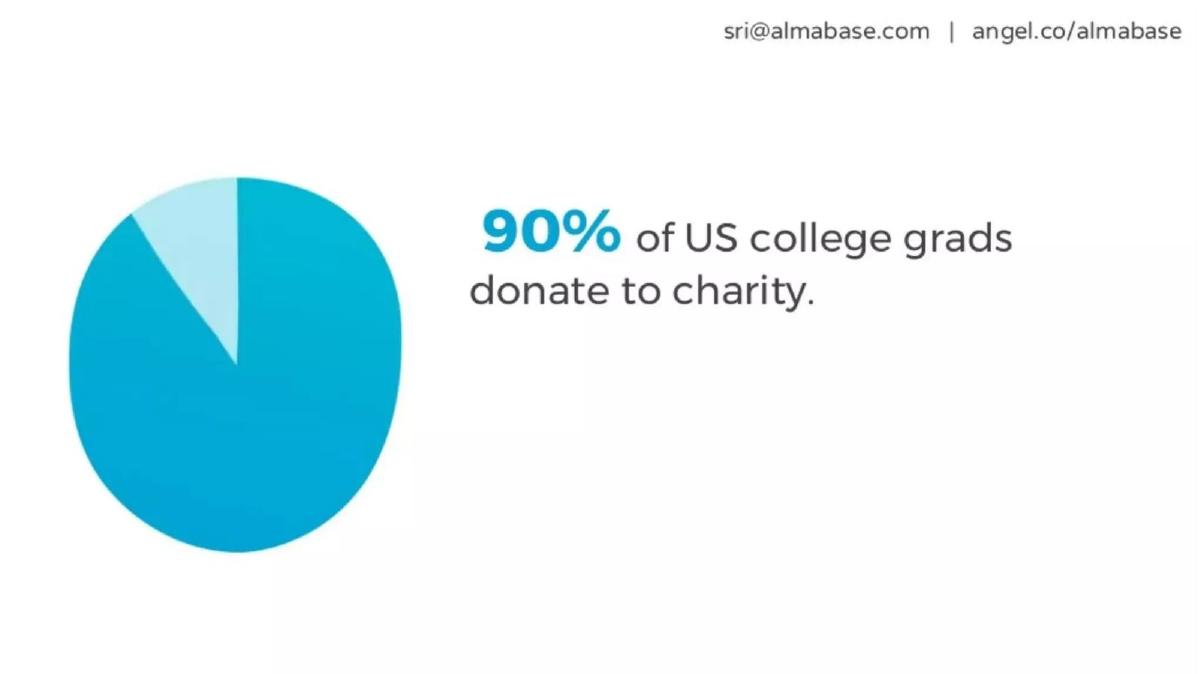
Slides 3 and 4 present the most compelling data point in the deck. Slide 3 states that 90% of US college grads donate to charity . Slide 4 then reveals the 'gap': Only 8.2% have donated to their college last year . This 81.8% discrepancy represents a massive untapped market. By framing the problem this way, Almabase isn't just selling software; they are selling a way to capture a share of the billions of dollars alumni are already giving to other causes.
Slides 5-8: Visualizing the Friction
Slides 5, 6, and 7 use icons to identify the technical hurdles: a disconnected plug for "Outdated Data" and a question mark for "Low Engagement." These are the symptoms of the problem. Slide 8 provides the 'villain' of the story: a screenshot of a messy, color-coded Excel spreadsheet. This is a highly effective tactic in B2B SaaS pitching. By showing the current, manual process that their target customers use, they make the need for a modern CRM feel visceral. Every administrator looking at that slide recognizes the pain of managing thousands of rows of alumni data manually.
Slides 9-11: The Solution and Explosive Growth
Slide 9 introduces the "All In One" solution. It uses a concentric circle diagram to show how Almabase integrates CRM, Social Media Sync, Communications, Events, Career Services, Mentorship, Networking, and Online Donations. This slide argues that the current market is fragmented and that Almabase is the unifying layer. Slide 10 makes a bold claim: the platform can "Increase donations by upto 5X."
Slide 11 is the 'money slide.' It presents the company's traction: $200K ARR and 1M Alumni reached "In just 8 months." For a startup in 2014, reaching $200,000 in annual recurring revenue in less than a year is exceptional. This slide validates the entire preceding argument. If the problem wasn't real, they wouldn't have the revenue; if the solution didn't work, they wouldn't have the alumni engagement numbers.
Slides 12-17: Market Breadth and Size
Slides 12 through 16 are a masterclass in building social proof. Instead of cluttering one slide with 50 logos, the deck uses a progressive reveal. Slide 13 shows Private Schools, Slide 14 adds Public Schools, Slide 15 adds Higher Ed, and Slide 16 adds Worldwide institutions. This sequence proves that the product is not a niche tool for one type of school but a global solution for all educational tiers. Slide 17 defines the market size not by a vague TAM (Total Addressable Market) but by actual current behavior: "Schools currently spend $6B" in this category.
Slides 18-19: The Team and the Wrap-up
Slide 18 introduces the founders, Sri Maneru (CEO) and Kalyan Varma (CTO). The key takeaway here is their founder-market fit: they "Co-founded the alumni association 8 years ago." This tells investors that they aren't just developers looking for a market; they are practitioners who have lived the problem for nearly a decade. The deck ends on Slide 19 by repeating the traction metrics ($200K ARR / 1M Alumni), ensuring that the final impression left on the investor is one of success and momentum.
What Works in the Almabase Deck
The Giving Gap Argument: The comparison between the 90% general donation rate and the 8.2% alumni donation rate is a brilliant way to quantify the opportunity. It suggests that the money is already there; the schools just lack the tools to collect it.
Traction as Validation: Leading with $200K ARR in 8 months is the strongest possible move. In the EdTech space, where many companies struggle to get past the pilot phase, showing six-figure revenue early on is a massive differentiator.
Visual Metaphors: The use of the Excel spreadsheet (Slide 8) to represent the status quo is much more effective than a bulleted list of technical shortcomings. It illustrates the 'mess' that the founders are promising to clean up.
What is Missing from the Almabase Deck
The Ask: The most significant omission is a clear funding request. There is no mention of how much money is being raised, the terms of the round, or what the specific milestones for the next 18 months will be. While this might be intentional for a deck shared on AngelList, it leaves a gap in the narrative regarding the company's capital needs.
Unit Economics: While the deck shows impressive top-line revenue ($200K ARR), it doesn't mention Customer Acquisition Cost (CAC) or Lifetime Value (LTV). In a market like education, where sales costs can be high, investors would eventually want to see how these numbers scale.
Competitive Landscape: The deck implies that the competition is "Excel spreadsheets" and "fragmented tools," but it doesn't name specific competitors like Raiser's Edge or Graduway. Acknowledging the existing players and explaining why Almabase wins would strengthen the case for sophisticated investors.
What Founders Should Copy
The Progressive Logo Reveal: If you have customers in different segments, don't just dump their logos on one slide. Use the Almabase method of showing one segment at a time to demonstrate the breadth of your product's appeal.
Focus on the 'Why Now': Slide 2's use of headlines about funding cuts provides a clear 'Why Now' for the product. Founders should always link their solution to a current, painful external pressure that makes their product a 'must-have' rather than a 'nice-to-have.'
Domain Expertise: Highlight your history with the problem. The fact that the founders had been working in alumni relations for 8 years before starting the company (Slide 18) gives them instant credibility that a purely technical team would lack.
Final Analysis
The Almabase deck is a highly effective fundraising tool because it stays focused on the most important thing: evidence of product-market fit. By showing that they have already captured revenue and a large user base in a short period, they mitigate the perceived risk of the EdTech sector. While the deck could benefit from more detailed financial and competitive analysis, its core message—that there is a massive gap in alumni giving and Almabase is already successfully filling it—is delivered with clarity and impact.
Frequently asked questions
- How much did Almabase raise with this deck?
- According to catalogue facts, Almabase raised $100,000 in 2014. This was likely a pre-seed or seed-stage bridge round given the $200K ARR mentioned in the deck, which suggests they were already generating significant revenue relative to the amount raised.
- What is the primary problem Almabase solves?
- The deck identifies two main pain points for educational institutions: outdated alumni data and low engagement. Slide 8 uses an image of a complex, color-coded spreadsheet to illustrate the manual, inefficient way schools currently manage alumni relations, leading to the 8.2% donation rate cited on Slide 4.
- Who are the target customers for this platform?
- Almabase targets a broad spectrum of educational institutions. Slides 13-16 show logos for private schools, public schools, higher education institutions, and international schools, indicating that the software is versatile enough for K-12 and university-level alumni management.
- Is there a clear financial 'Ask' in the deck?
- No. The 19-slide deck concludes with a summary of traction and contact information but does not specify the amount of capital being sought, the valuation, or the intended use of funds. This is common in decks used for introductory meetings rather than final investment committee reviews.
- What is the 'All-in-One' value proposition mentioned?
- Slide 9 illustrates that Almabase replaces fragmented tools by combining CRM, social media sync, communications, events, career services, mentorship, networking, and online donations into a single ecosystem. This reduces the friction of managing multiple disconnected databases.