StuDocu’s Series B deck is a concise, data-heavy presentation that prioritizes traction and business model efficiency over narrative fluff. Raising $50M in 2021, the company demonstrated a massive scale-up to 12.8 million Monthly Active Users (MAU) with a lean team of just 48 full-time employees. The deck excels at illustrating a self-sustaining content loop where users either pay or contribute documents to gain access, resulting in an 86% gross margin. While the deck lacks a specific 'Ask' slide or detailed financial projections, the strength of its existing KPIs—including a 140% YoY sales g…
Key takeaways
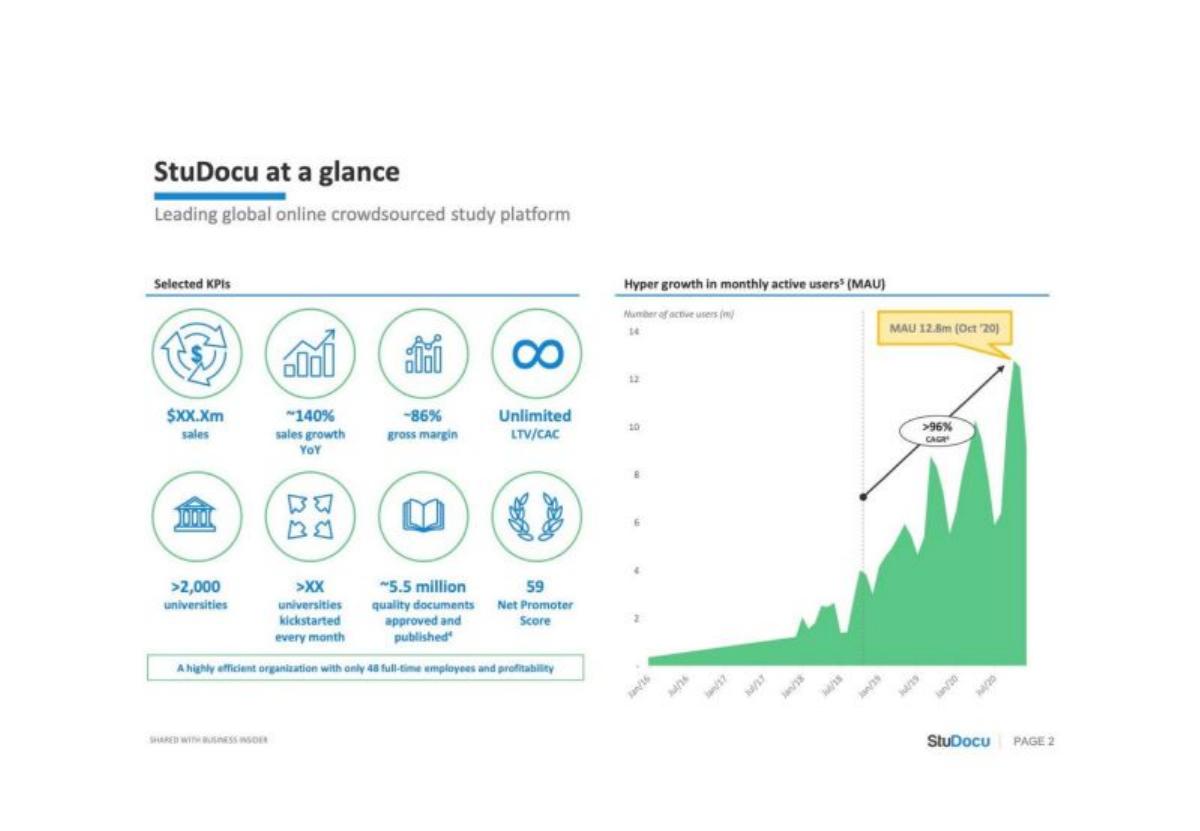
- The company reached 12.8 million Monthly Active Users as of October 2020, representing a >96% CAGR since 2016 (Slide 2).
- StuDocu operates with extreme capital efficiency, maintaining only 48 full-time employees despite its global scale (Slide 2).
- The business model is highly effective, boasting an 86% gross margin and what the company describes as 'Unlimited LTV/CAC' (Slide 2).
- The content library consists of ~5.5 million quality documents approved and published, serving over 2,000 universities (Slide 2).
- A unique freemium model drives the platform: 80% of content is free, while 20% is Premium, accessible by either paying a fee or uploading study resources (Slide 8).
- User engagement is validated by a Net Promoter Score (NPS) of 59, which is significantly high for a crowdsourced platform (Slide 6).
- The leadership team includes founders from TU Delft and executives with experience at Amazon, Uber, and Just Eat (Slide 10).
- The deck explicitly positions StuDocu as the 'Spotify for educational content,' emphasizing the transition from fragmented paper-based notes to a digital library (Slide 7).
StuDocu: The Lean Machine of EdTech
StuDocu’s Series B pitch deck is a masterclass in showing, not telling. In just 12 slides, the company justifies a $50M raise by leaning heavily into its massive user growth and lean operational structure. By the time an investor reaches the final slide, the message is clear: StuDocu has built a self-scaling content engine that requires minimal human intervention to dominate the global student market.
Slide 1: Title Slide
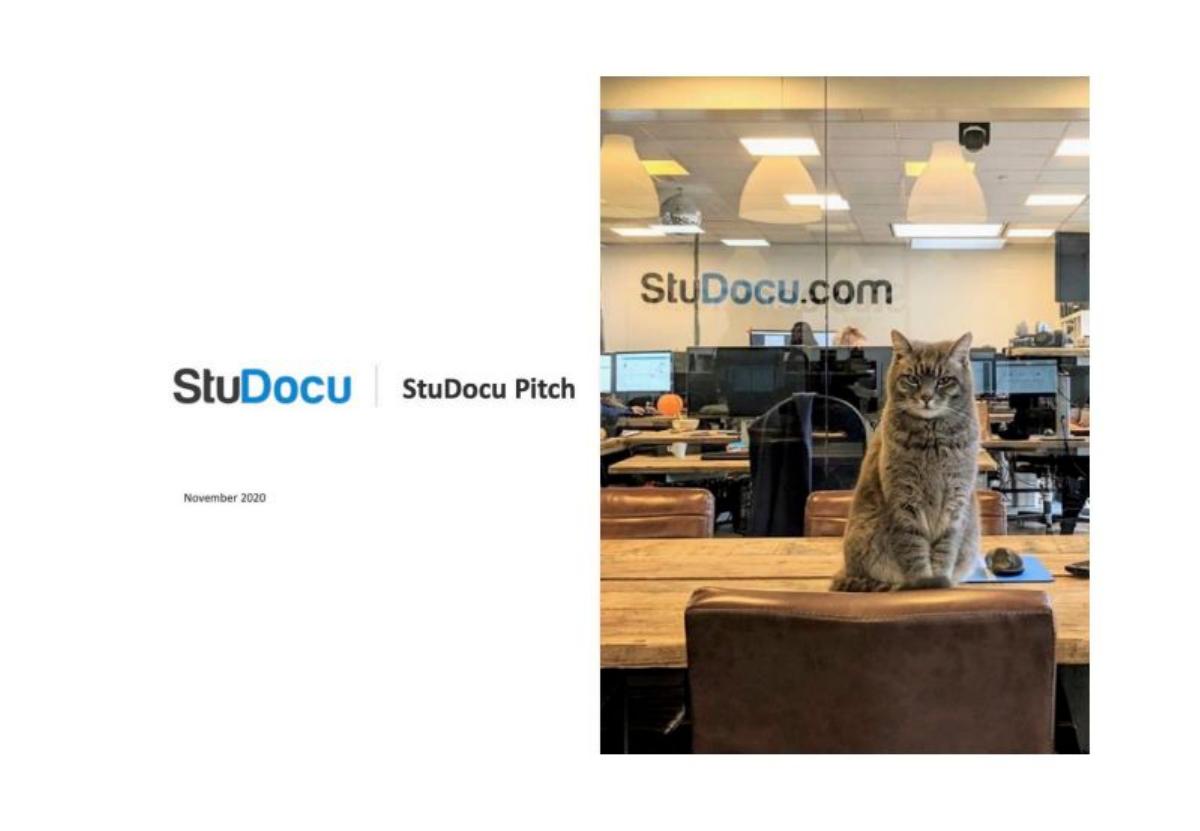
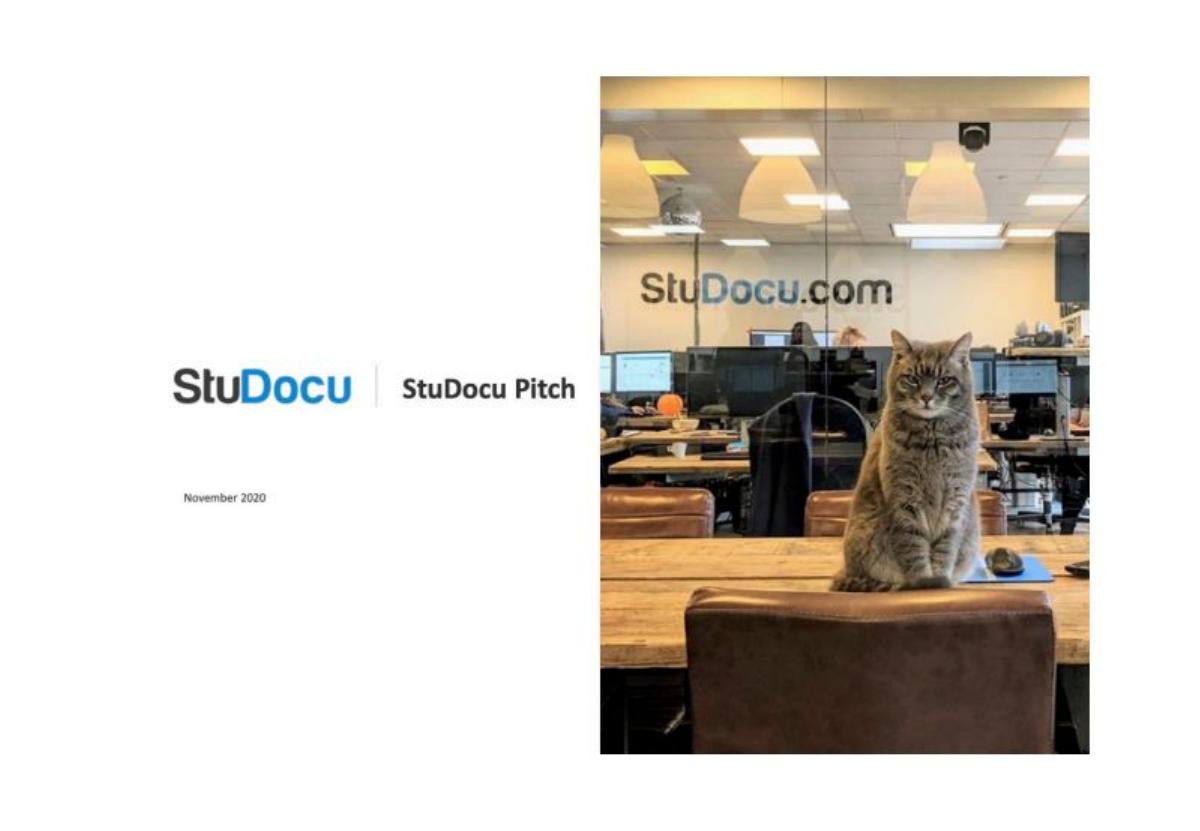
The deck opens with a minimalist title slide featuring the StuDocu logo and the date, November 2020. The most notable element is the full-page photo of a cat sitting on a desk in their office. This sets a casual, 'tech-startup' tone but quickly pivots to serious business in the subsequent slides.
Slide 2: StuDocu at a Glance
This is the 'money slide.' It presents eight key icons that define the company’s health. The most impressive figures include 140% sales growth YoY, an 86% gross margin, and a 59 Net Promoter Score. The slide also highlights a 'Hyper growth' chart showing Monthly Active Users (MAU) climbing from near zero in 2016 to 12.8 million by October 2020, representing a CAGR of over 96%. A small text box at the bottom emphasizes their efficiency: 'only 48 full-time employees and profitability.'
Slide 3: Helping Students Excel
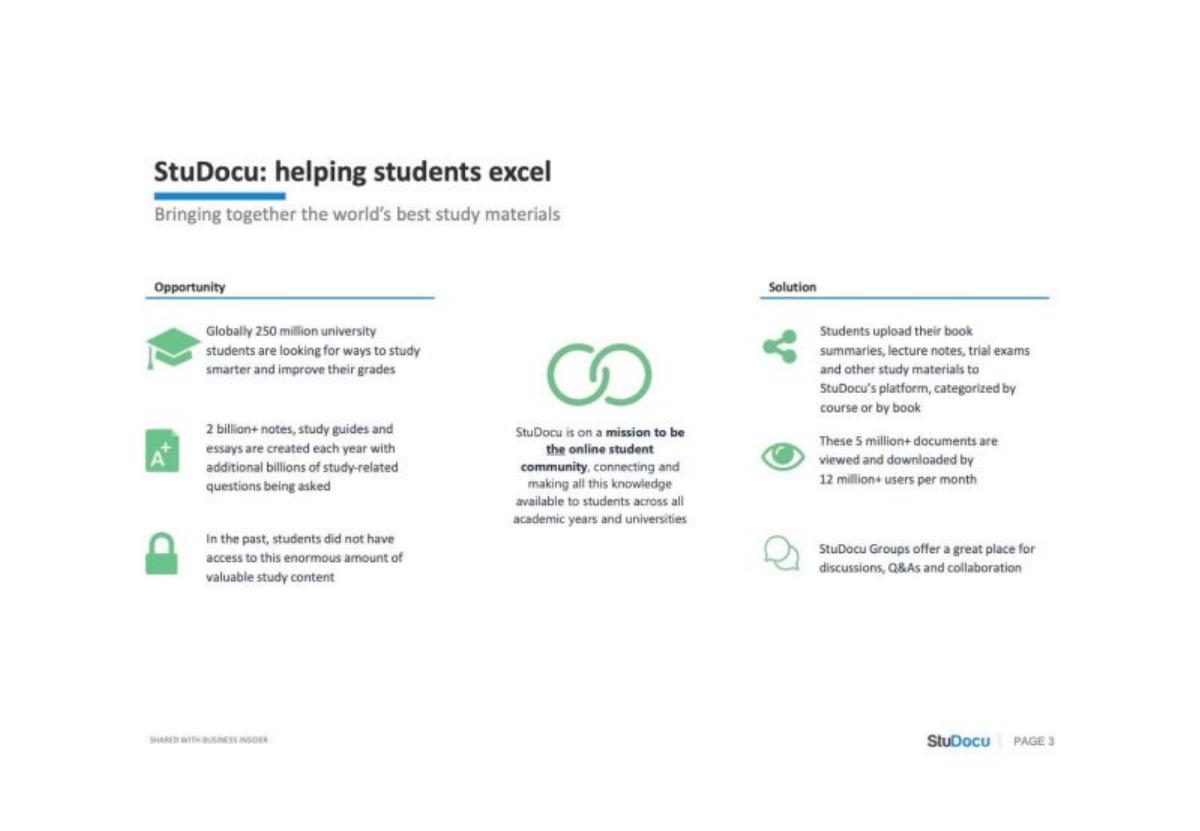
This slide defines the opportunity and the mission. It cites a global market of 250 million university students and notes that 2 billion+ notes and study guides are created annually. The 'Solution' side of the slide explains the crowdsourced model: students upload summaries and trial exams, which are then categorized by course or book. It claims 12 million+ users per month are downloading these materials.
Slide 4: Product Snapshot – Desktop Viewer
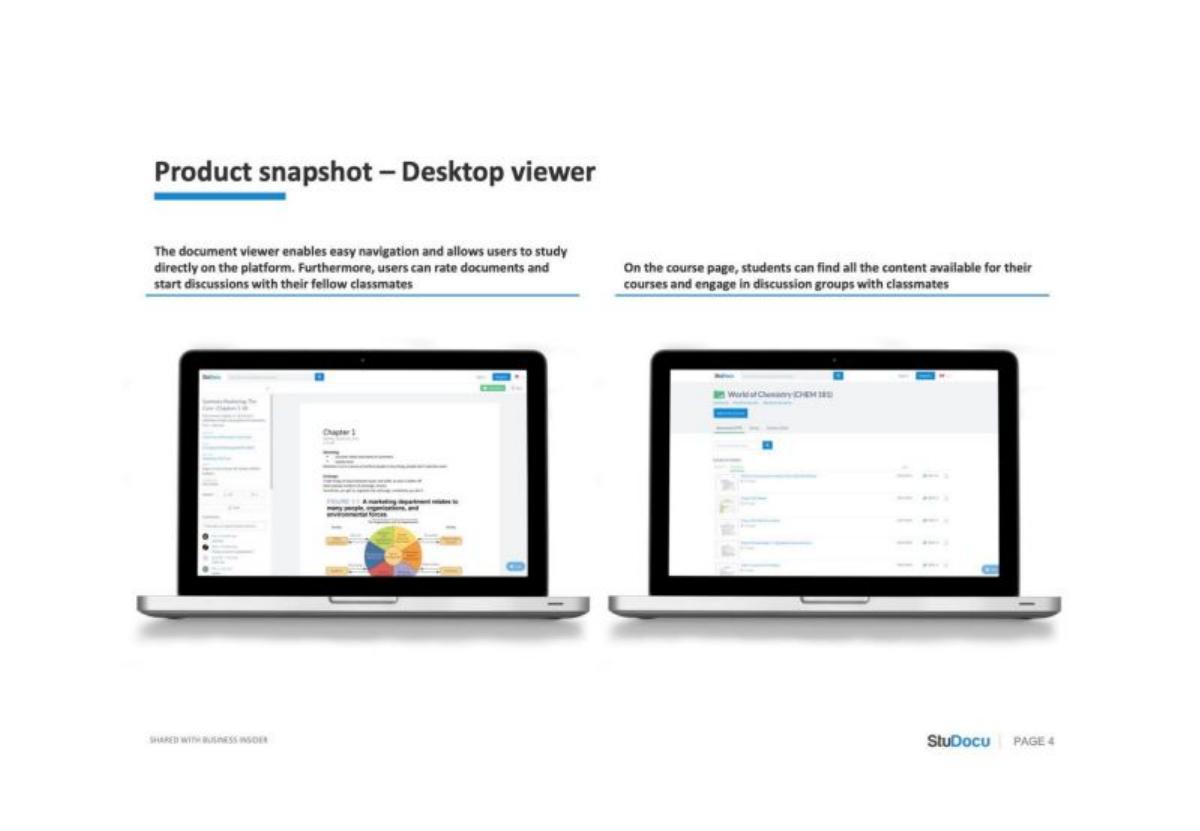
StuDocu uses this slide to show the user interface. It highlights two main views: the document viewer, where users can read, rate, and discuss content, and the course page, which aggregates all available content for a specific university course. The UI appears clean and focused on readability.
Slide 5: Product Snapshot – App
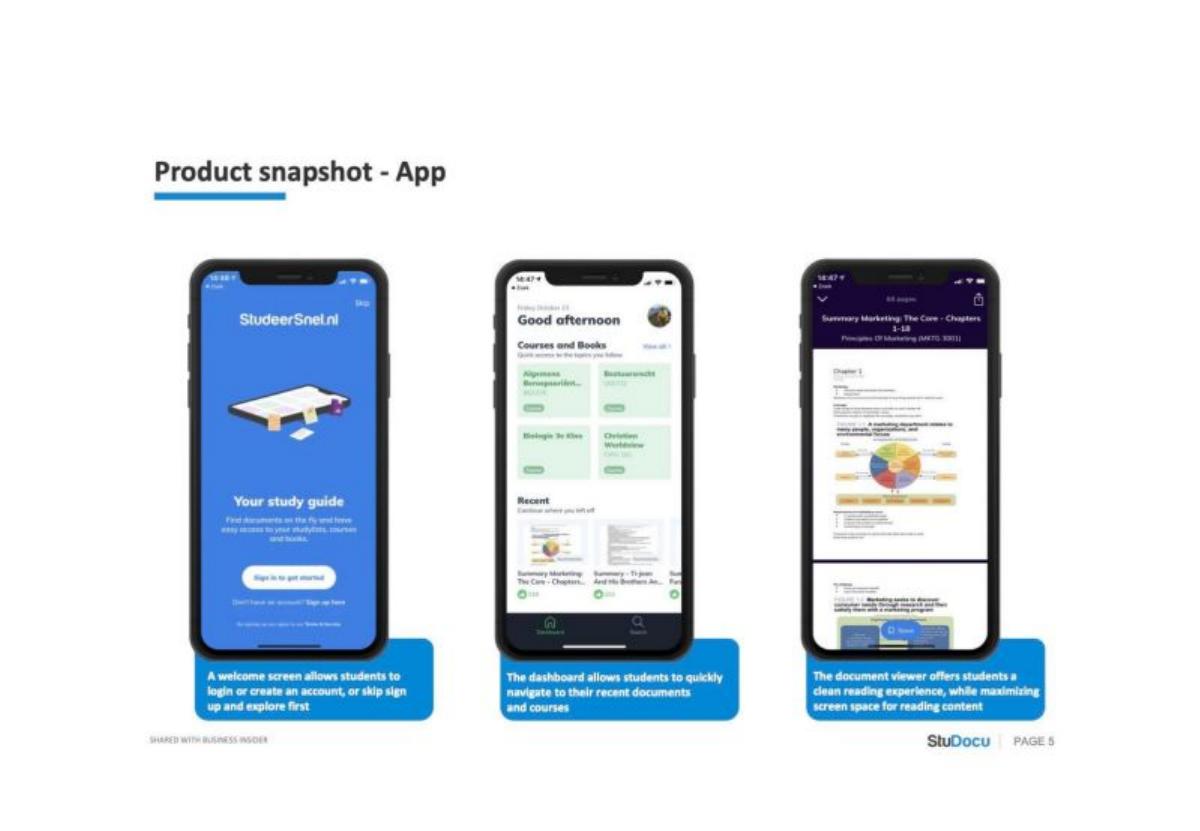
Recognizing the mobile-first nature of students, this slide showcases the iOS and Android applications. It highlights a 'welcome screen' for exploration, a 'dashboard' for navigating recent documents, and a 'document viewer' optimized for small screens. The emphasis here is on the 'clean reading experience.'
Slide 6: Unique Selling Propositions
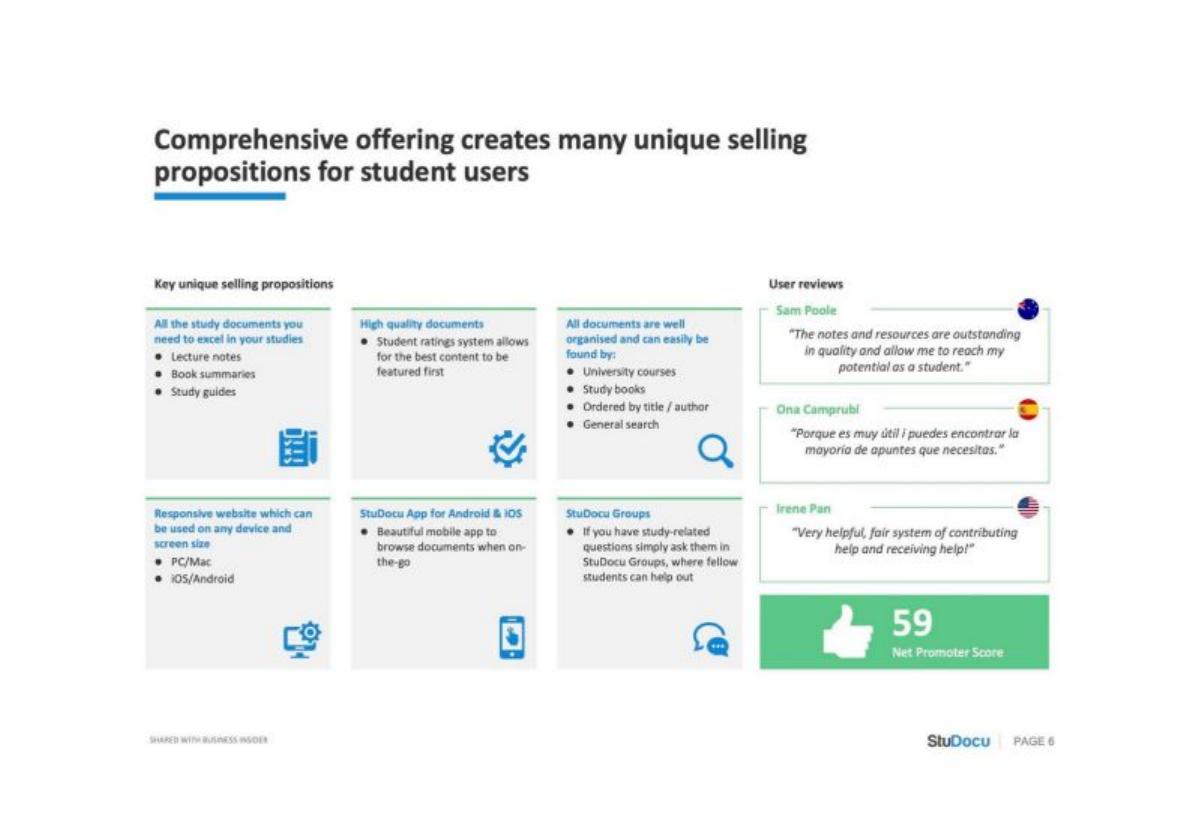
This slide breaks down why students use the platform. It lists high-quality documents (vetted by a ratings system), organization by university/book, and the 'StuDocu Groups' for Q&A. It also includes three user reviews from different countries (Australia, Spain, USA) to demonstrate global reach, alongside a repeat of the 59 NPS score.
Slide 7: The Category Creator
StuDocu uses a comparison framework to position itself alongside giants. It compares the 'Old Way' (manual, fragmented) to the 'New Way' (digital, accessible). It explicitly aligns StuDocu with Spotify (transforming the music landscape) and LinkedIn (disrupting workforce talent search). The goal of this slide is to convince investors that StuDocu is the definitive winner in the 'educational content' category.
Slide 8: The Business Model
This slide explains the 'friendly' freemium model. 80% of content is free. For the 20% that is 'Premium,' students have a choice: upload study resources or pay a subscription fee. The deck reveals an interesting split: 50% of premium users upload content, while 50% pay. Subscription prices are listed as $6.99 per month (billed quarterly) or $4.99 per month (billed annually).
Slide 9: Network Effects
A simple circular diagram illustrates the StuDocu flywheel: Content drives Traffic, Traffic drives Monetisation, and Monetisation drives Continuous Reinvestment, which leads back to more Content. This slide reinforces the idea that the business becomes more valuable and harder to compete with as it grows.
Slide 10: Leadership Team
The team slide features four key executives. Marnix Broer (CEO) and Lucas van Houten (CTO) are co-founders who started the company during their studies. The 'future growth' hires include Reynald Fasciaux (COO), formerly of Amazon and Uber, and Rasmus Wolff (CDO), formerly of Just Eat and GetYourGuide. This mix of original founders and seasoned 'scale-up' executives is a classic Series B configuration.
Slide 11: Vision and Values
The final content slide uses a concentric circle diagram to explain the 'Why' (Help students excel in life), 'How' (Set knowledge free), and 'What' (Notes, Groups, Tutoring). It also lists five company values, including 'Be an A+ Student' and 'Gezellig & One Love,' giving a nod to the company’s Dutch roots.
Slide 12: External Source Credit
The final slide is a promotional graphic for bestpitchdeck.com and does not contain company-specific information.
What StuDocu Does Exceptionally Well
The StuDocu deck is a masterclass in efficiency signaling . By stating on Slide 2 that they have 12.8 million MAUs but only 48 employees, they are telling investors that their technology does the heavy lifting. This is the 'holy grail' for venture capitalists: a high-margin business that scales without a linear increase in headcount.
Furthermore, the dual-path monetization model on Slide 8 is brilliant. Most freemium models only offer a 'pay or leave' choice. By allowing students to 'pay' with content (uploads), StuDocu solves their biggest problem (content acquisition) while simultaneously offering a path for students who cannot afford a subscription. This creates a virtuous cycle where the users who don't pay are still providing immense value to the platform.
What Is Missing from the Deck
Despite its success, the deck has several notable omissions that are common in 'teaser' or 'sanitized' versions of Series B decks:
The Ask: There is no slide detailing how much capital they are raising or how they intend to spend it. (We know from the catalogue listing it was $50M, but it isn't on the slides). · Detailed Financials: While they mention an 86% gross margin, there are no P&L statements, burn rate figures, or specific revenue numbers (Slide 2 uses '$XX.Xm' placeholders). · Competitor Analysis: While they compare themselves to Spotify and LinkedIn, they completely ignore direct competitors in the EdTech space like Chegg or Course Hero. Investors would certainly ask how StuDocu differentiates itself from these established players. · Future Roadmap: Slide 11 hints at 'Tutoring' and 'Recruitment' in the 'What' section, but there is no detailed product roadmap or timeline for these expansions.
Founder Takeaways: What to Copy
Founders should look at Slide 2 as the gold standard for a 'Traction' slide. Instead of burying metrics in paragraphs of text, StuDocu uses clean icons and bold numbers to hit the investor with the most important facts immediately. If your growth chart looks like the one on Slide 2, make it the centerpiece of your deck.
Another takeaway is the Category Creator slide (Slide 7) . If you are building a marketplace or a platform, don't just compare yourself to your direct rivals. Compare your business model to successful companies in other industries. By calling themselves the 'Spotify for educational content,' StuDocu makes their value proposition instantly understandable to any investor, regardless of their familiarity with EdTech.
Frequently asked questions
- How does StuDocu monetize its user base?
- StuDocu uses a 'friendly' freemium model. According to slide 8, 80% of content is free to view online. For the 20% that is Premium, users have two choices: they can either pay a subscription fee ($4.99/month billed annually) or upload their own study resources. Interestingly, the deck notes that roughly 50% of users choose to upload content while the other 50% pay the fee, creating a dual stream of revenue and new content.
- What are the core metrics driving the Series B valuation?
- The primary drivers are hyper-growth and efficiency. Slide 2 highlights 140% YoY sales growth, an 86% gross margin, and a leap to 12.8 million MAUs. The fact that this scale was achieved with only 48 employees suggests a highly automated, scalable infrastructure that appeals to Series B investors looking for proven unit economics.
- How does StuDocu handle content quality control?
- Slide 6 mentions a 'Student ratings system' that allows the best content to be featured first. Slide 2 also specifies that the 5.5 million documents on the platform are 'approved and published,' implying a moderation or verification layer exists to filter the crowdsourced uploads before they become available to the wider community.
- What is the 'Unlimited LTV/CAC' claim on slide 2?
- While 'unlimited' is a bold marketing term, it refers to the viral nature of the platform. Because students can gain access by uploading content (which then attracts more students via SEO and peer sharing), the cost to acquire a customer (CAC) becomes negligible compared to the long-term value (LTV) of the data and potential subscription revenue they generate.
- Who is the target audience for StuDocu?
- The deck identifies a global market of 250 million university students (Slide 3). The platform is already active in over 2,000 universities, providing lecture notes, book summaries, and study guides. The inclusion of 'StuDocu Groups' on slide 6 suggests they are also targeting the collaborative, social aspect of higher education beyond just document retrieval.