Blue Studios utilized a 10-slide pitch deck in 2019 to secure $1.3 million in pre-seed funding. The deck focuses heavily on the 'why' and the 'who,' utilizing high-quality photography to illustrate the user experience rather than dense technical specifications. By identifying a $4 billion market opportunity in mobile e-learning with a 31% CAGR, the founders positioned their $9.99 monthly subscription as an accessible entry point for families. While the deck is notably light on financial projections, churn data, and a specific 'ask' slide, it successfully communicates a clear go-to-market stra…
Key takeaways
- The company defines its mission on slide 1 as teaching STEM skills to one billion kids.
- Revenue is generated through a single, clear price point of $9.99 per month as shown on slide 4.
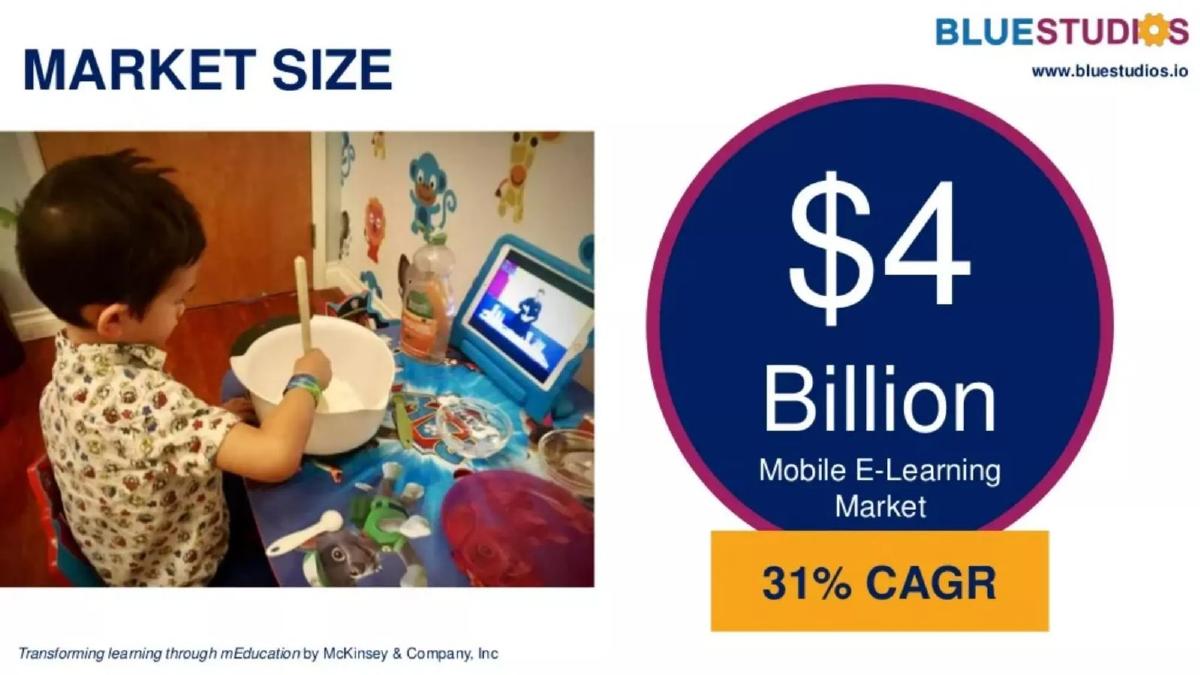
- The market size is identified on slide 6 as a $4 billion mobile e-learning market with a 31% CAGR.
- The go-to-market strategy on slide 7 relies on 'skill-based influencers' with established audiences across YouTube, Twitter, and Instagram.
- The team slide (slide 8) highlights significant corporate and social sector experience, including JPMorgan Chase and the Obama Foundation.
- The deck contains no financial projections or historical revenue growth charts.
- There is no 'Ask' slide detailing how much capital is being raised or how it will be spent.
- The deck uses a high ratio of imagery to text, focusing on the emotional 'experience' of the product (slide 3).
The Vision and the Mission
The Blue Studios deck is a masterclass in brevity, clocking in at just 10 slides. In an era where decks often bloat to 20 or 30 pages of dense data, this 2019 pre-seed deck relies on the power of narrative and visual proof. The company, which eventually raised $1.3 million, leads with a mission that is both massive and easy to understand: teaching STEM skills to a billion children.
Slide 1: Title and Mission
The cover slide is clean, featuring a high-resolution photo of a child engaged with a tablet. The branding is prominent, but the most important element is the sub-headline: "Our Mission: Teach a billion kids STEM skills." This sets a high-level 'North Star' for the pitch. It tells investors immediately that this is an impact-driven, scalable platform play rather than a niche content play.
Slide 2: The Founder's 'Why'
Slide 2 is a personal touchpoint. It features a grainy, vintage photo of co-founder Kelley Cambry from 1988. There is no text other than her name and the date. This is a classic storytelling technique used to establish 'founder-market fit.' It implies that the founder has been interested in technology or education since childhood, creating a sense of inevitability and passion that data alone cannot convey.
Slide 3: The Value Proposition
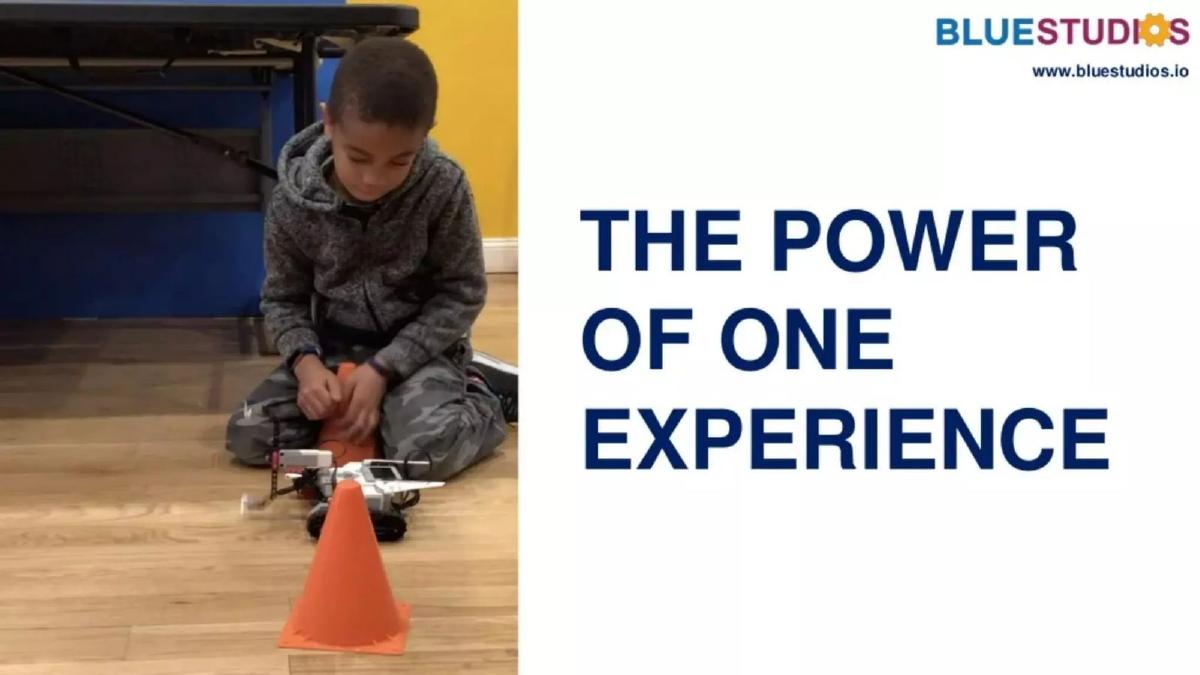
Slide 3 features the text "THE POWER OF ONE EXPERIENCE" alongside a photo of a child building a robotic device. This slide functions as the 'Problem/Solution' bridge. It suggests that a single engaging STEM experience can change a child's trajectory. It moves the conversation from 'software' to 'experience,' which is a higher-value proposition in the education space.
The Business of Education
After establishing the emotional and mission-driven core of the company, the deck shifts into the mechanics of the business. However, it remains remarkably light on text, choosing to highlight single, impactful numbers.
Slide 4: The Revenue Model
Slide 4 is perhaps the most direct slide in the deck. It features a mother and two children performing a science experiment at a kitchen counter, guided by a laptop. A large blue circle contains the text: "Parents pay us a $9.99 per month subscription." This removes all ambiguity about how the company makes money. It is a straightforward B2C SaaS (Software as a Service) model for education.
Slide 5: Product in Action
Slide 5 contains no text at all. It is a full-bleed photo of a child pouring liquid into jars, presumably following a Blue Studios lesson. This slide serves as a 'Product' slide. Instead of showing a UI/UX wireframe or a feature list, it shows the result of the product: a child engaged in hands-on learning. For a pre-seed round, showing the physical manifestation of a digital product is a strong way to prove the concept is real.
Slide 6: Market Opportunity
Slide 6 provides the macro-economic justification for the investment. It identifies the "Mobile E-Learning Market" as a "$4 Billion" opportunity. Crucially, it cites a "31% CAGR" (Compound Annual Growth Rate). By citing McKinsey & Company at the bottom of the slide, the founders borrow institutional authority to validate their growth projections. This slide tells investors that even if Blue Studios only captures a small slice of the pie, the pie itself is growing rapidly.
Growth and Execution
The final third of the deck focuses on how the company will actually win the market and who is steering the ship.
Slide 7: Go-To-Market Strategy
Slide 7 introduces the concept of "SKILL-BASED INFLUENCERS." This is a sophisticated take on customer acquisition. Rather than relying solely on expensive Facebook or Google ads, Blue Studios identifies creators who already have the attention of their target audience. The slide showcases three examples:
Nano Girl: 4.2K YouTube subscribers and 33.5K Twitter followers. · Austin Millz: 6.3K YouTube subscribers and 111K Instagram followers. · Baking With Ryan: 37K YouTube subscribers and 163K Instagram followers.
This strategy suggests a low Customer Acquisition Cost (CAC) by leveraging the 'trust' these influencers have already built.
Slide 8: The Team
For a pre-seed deck, the team slide is often the most important. Blue Studios leans heavily on corporate pedigree. Co-founder Kelley O. Cambry is associated with JPMorgan Chase & Co., American Express, and General Assembly. Co-founder Emile Cambry, Jr. brings a mix of media and social impact experience, citing HBO, JPMorgan Chase & Co., the Obama Foundation, and the University of Chicago. The presence of logos from Howard University and Northwestern Kellogg further bolsters the academic and professional credibility of the leadership.
Slide 9: The Vision
Slide 9, titled "OUR VISION," shows a high-tech television studio branded as "BLUE STUDIOS LIVE." This indicates that the company's ambitions go beyond simple recorded videos; they aim to create a live, interactive media empire for children's education. It frames the company as a 'media-tech' hybrid rather than just a content library.
Slide 10: Closing
The final slide repeats the cover image and the mission statement. It serves as a backdrop for the Q&A portion of a pitch. It reinforces the brand and the website URL, ensuring the last thing an investor sees is the face of the target customer and the primary goal of the company.
What Works in This Deck
The primary strength of the Blue Studios deck is its visual clarity . By using high-quality photography of children and parents actually using the product, the founders make the abstract concept of "STEM education" feel tangible. They avoid the common mistake of over-explaining the technology and instead focus on the user outcome .
The business model simplicity is also a major plus. At the pre-seed stage, investors are looking for a clear path to revenue. A $9.99 monthly subscription is a well-understood model that allows for easy calculation of potential unit economics once the company begins to scale.
Finally, the influencer-led growth strategy is highly relevant for the 2019 market. It shows that the founders understand where their audience lives (YouTube and Instagram) and have a plan to reach them that doesn't involve just burning venture capital on traditional advertising.
What Is Missing From This Deck
While the deck is aesthetically pleasing, it is functionally incomplete by modern standards. The most glaring omission is the Ask Slide . There is no mention of how much money is being raised, the valuation cap, or the specific milestones the founders intend to hit with the capital. This information may have been delivered verbally, but its absence in the document makes it harder for the deck to stand alone as a fundraising tool.
There is also a total lack of Competitive Analysis . The STEM education space is crowded, with players ranging from Kiwico to Khan Academy. Investors would naturally want to know how Blue Studios differentiates itself from these incumbents beyond just having "influencers."
Lastly, there are no Financials or Metrics . Even at the pre-seed stage, investors appreciate seeing a basic 'burn' rate or a projection of how many subscribers are needed to reach break-even. The deck relies entirely on the 'size of the prize' (the $4B market) rather than the 'efficiency of the machine.'
What a Founder Should Copy
Founders should emulate the one-idea-per-slide rule used here. Slide 4 is the perfect example: it doesn't try to explain the revenue model, the churn rate, and the payment processor all at once. It just says the price. This allows the investor to focus on the core fact without being distracted by secondary details.
The Team Slide layout is also worth copying. Instead of long paragraphs of text, they used recognizable logos of prestigious institutions. This allows an investor to 'scan' the slide in three seconds and immediately grant the founders a high level of credibility based on their past associations.
Finally, the use of Mission-Driven Imagery is excellent. Every photo in this deck reinforces the idea that Blue Studios is about the child's experience. If you are building a B2C product, your deck should look like your product feels. Blue Studios succeeded in making a pitch deck that feels like an educational brand.
Frequently asked questions
- What is the primary business model for Blue Studios?
- Based on slide 4, Blue Studios operates on a direct-to-consumer subscription model. Parents pay a flat fee of $9.99 per month for access to the platform's STEM content. The deck does not mention tiered pricing, annual discounts, or B2B school licensing, suggesting a focused initial strategy on household acquisition.
- How does Blue Studios plan to acquire new users?
- The strategy is detailed on slide 7, focusing on 'Skill-Based Influencers.' The deck highlights three specific creators with combined followers ranging from 4.2K to 163K across platforms like YouTube and Instagram. By partnering with these creators, Blue Studios intends to tap into pre-existing communities interested in science, music, and baking.
- What market segment is Blue Studios targeting?
- Slide 6 explicitly targets the 'Mobile E-Learning Market.' They value this market at $4 billion and note a Compound Annual Growth Rate (CAGR) of 31%. The imagery throughout the deck suggests a focus on young children (K-8) and their parents as the primary decision-makers.
- Is there any mention of Web3 in this pitch deck?
- No. While the company's current catalogue description mentions building tools to onboard families into Web3, this 2019 pitch deck is strictly focused on STEM education and e-learning. This indicates a significant pivot or expansion of the product roadmap after this initial funding round.
- What is missing from the Blue Studios pitch deck?
- The deck is missing several standard components: a formal 'Ask' slide (valuation and round size), a competition slide, a detailed product roadmap, and any financial performance data (MRR, CAC, or LTV). It functions more as a vision and team summary than a comprehensive business plan.