Bohemian Guitars' 2012 seed deck is a masterclass in visual storytelling for a physical product. The company sought to disrupt the stagnant electric guitar market by introducing instruments made from recycled oil cans, inspired by South African street musicians. The deck effectively communicates strong early traction, citing a $300k run rate and $350k in backorders on slide 5. Investors were likely swayed by the impressive 70% margins and a low $18 customer acquisition cost (CAC) compared to a $185 profit per unit. While the deck lacks a detailed financial forecast or a specific 'ask' slide,…
Key takeaways
- The company claims a $300,000 run rate and $350,000 in backorders, indicating significant unfulfilled demand (Slide 5).
- Bohemian Guitars operates with 70% margins, which is exceptionally high for hardware and musical instruments (Slide 5).
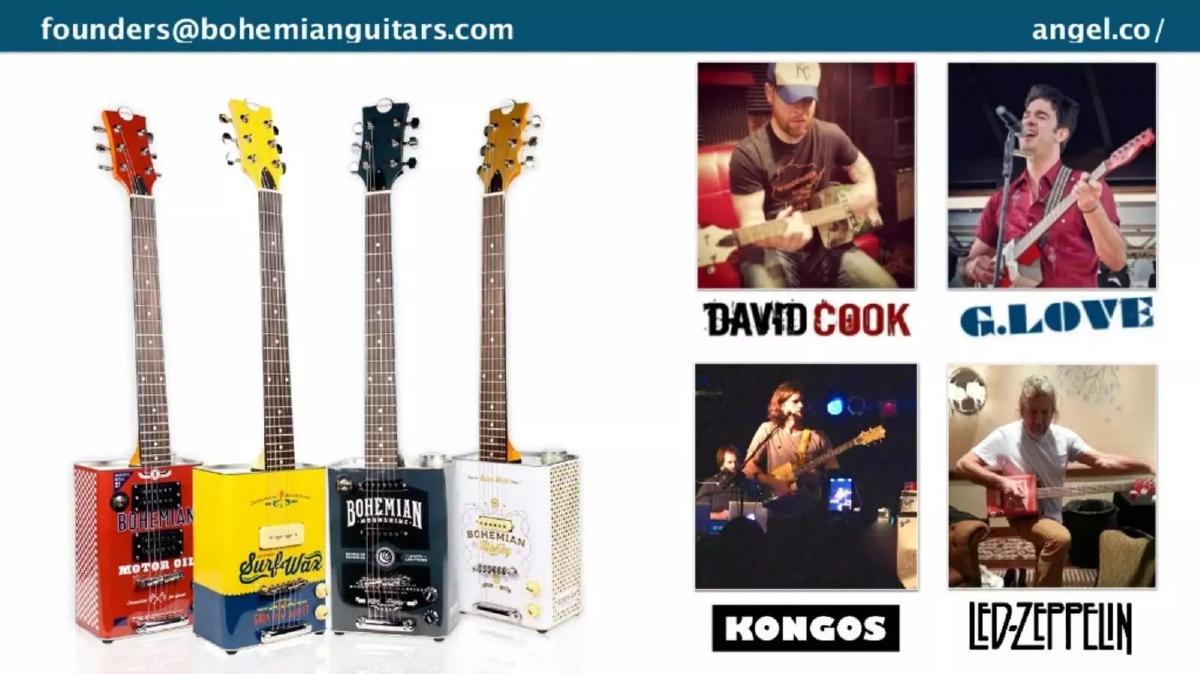
- The brand leverages significant social proof with photos of David Cook, G. Love, Kongos, and Led Zeppelin using the guitars (Slide 4).
- The total addressable market is defined as 50 million guitarists worldwide, with a focus on the 'collector' mentality (Slide 7).
- Unit economics are highly favorable, showing that $45 in ad spend generates $185 in profit (Slide 10).
- The company has secured a retail partnership or interest from Urban Outfitters, a key demographic match for their aesthetic (Slide 5).
- The 'Build-A-Boho' feature outlines a 5-step customization process to drive higher engagement and potentially higher AOV (Slides 8-9).
- The deck omits a formal 'Ask' slide, failing to specify the amount of capital being raised or the intended use of funds.
The Aesthetic of Disruption: Bohemian Guitars Teardown
Bohemian Guitars entered the market in 2012 with a product that was visually arresting and economically compelling. At a time when the electric guitar market was dominated by legacy brands like Fender and Gibson, Bohemian offered a sustainable, stylish, and affordable alternative. This 12-slide deck focuses heavily on the 'cool factor' and the impressive unit economics of their upcycled instruments.
Slide 1: Title and Media Validation
The cover slide establishes the brand identity immediately with the 'Real. Far. Out.' tagline. More importantly, it features a heavy-hitting row of media logos including Forbes, BBC, TechCrunch, USA Today, Uncrate, Guitar Player, and the Wall Street Journal. For a seed-stage company, this level of press coverage serves as immediate third-party validation of the product's marketability.
Slide 2: The Inspiration
Slide 2 provides the origin story, citing 'South African Street Musicians' as the inspiration. By showing a young musician with a homemade tin-can instrument, the founders connect their brand to a sense of authenticity and global culture. This positions the company as more than just a manufacturer; it is a brand with a narrative.
Slide 3: Market Stagnation
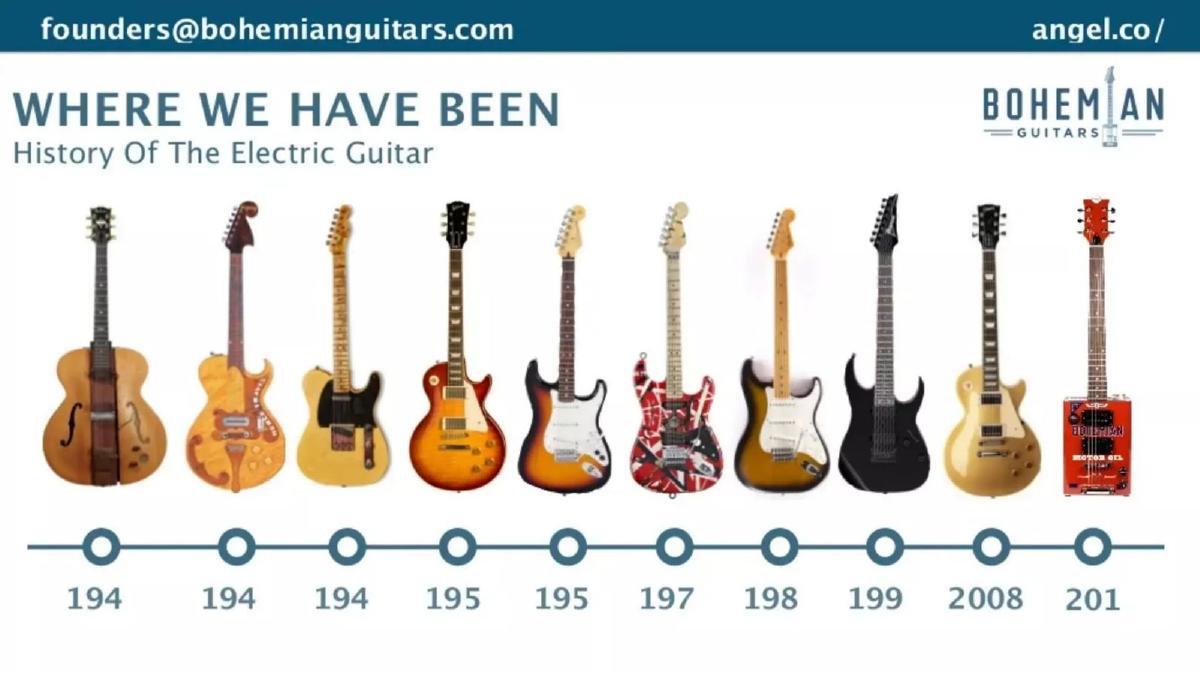
Slide 3 , titled 'Where We Have Been,' shows a timeline of the electric guitar from 1941 to 2012. The visual argument is clear: guitar design has barely changed in 70 years. By placing the Bohemian oil-can guitar at the end of this timeline, they frame themselves as the next logical step in the evolution of the instrument.
Slide 4: Social Proof and Artist Endorsements
For a musical instrument brand, artist adoption is the ultimate currency. Slide 4 displays four prominent artists using the product: David Cook, G. Love, Kongos, and a member of Led Zeppelin. This slide proves that the guitars are not just decorative novelties; they are professional-grade instruments used by world-class musicians on stage.
Slide 5: Traction and Margins
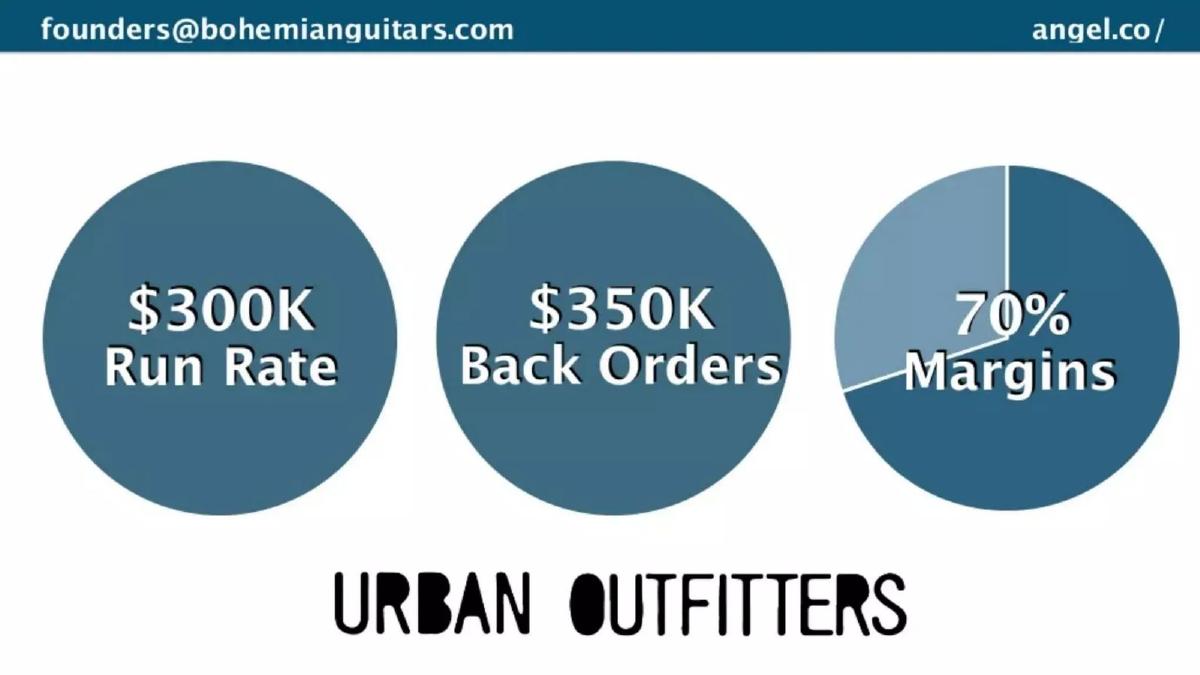
This is the 'money slide.' Slide 5 presents three critical data points: a $300K Run Rate , $350K in Back Orders , and 70% Margins . The backorder figure is particularly powerful as it demonstrates that demand is currently outstripping supply—a perfect justification for raising capital to scale manufacturing. The mention of Urban Outfitters at the bottom suggests a major retail partnership is already in play.
Slide 6: Manufacturing Readiness
Slide 6 shows a warehouse floor filled with guitar necks and bodies. The text 'Established Manufacturing & Distribution' is intended to de-risk the investment. It tells the investor that the 'hobbyist' phase is over and the infrastructure to handle large-scale orders is already in place.
Slide 7: Total Addressable Market (TAM)
The deck defines the TAM as 50 Million Guitarists Worldwide on Slide 7 . They also include a humorous quote: 'Man, I promised my wife I wouldn't bring home another guitar but...' This speaks to the 'collector' nature of the hobby. Bohemian isn't just trying to sell a first guitar; they are selling a unique addition to an existing collection.
Slides 8-9: The Build-A-Boho Platform
Slides 8 and 9 detail the 'Build-A-Boho' customization engine. This is a crucial part of their e-commerce strategy. By allowing customers to pick their product (Guitar, Strap, Amp, Case) and then customize the body, neck paint, hardware, and electronics, Bohemian increases customer engagement and likely increases the Average Order Value (AOV) through upgrades.
Slide 10: Cost Per Acquisition (CPA)
Slide 10 breaks down the unit economics of their marketing. They claim that for every $45 in ad spend , they make $185 in profit . They also show a transition from a $45 spend to an $18 figure (presumably the optimized CPA). These numbers suggest a highly scalable and profitable customer acquisition model.
Slide 11: The Team
Slide 11 introduces the 'Bro-hemians,' Shaun Lee and Adam Lee. While the slide is light on professional biography, it reinforces the 'lifestyle' brand image. Shaun is labeled the 'Mad Genius' and Adam the 'CEO.' In a seed deck, investors often look for deeper resumes, but the traction shown in previous slides does much of the heavy lifting here.
Slide 12: Conclusion
The final slide repeats the most impressive metrics: the $300K Run Rate , $350K in Back Orders , and the Urban Outfitters logo. It serves as a final reminder of the company's current momentum.
What Works in This Deck
Visual Product Focus: The product is the star. The deck uses high-quality photography to show that these are beautiful, desirable objects. For a D2C brand, the 'unboxing' potential and aesthetic appeal are primary drivers of growth.
Strong Unit Economics: A 70% margin in hardware is rare and highly attractive to investors. Combined with the 10x return on ad spend (in terms of profit), the business model looks very healthy on paper.
Validation: The mix of high-tier media logos and legendary artist endorsements (Led Zeppelin) provides a level of credibility that is difficult for most startups to achieve at the seed stage.
What Is Missing
The Ask: There is no slide stating how much money the company is raising, at what valuation, or what the milestones for the next 18 months will be. This is a significant omission for a fundraising deck.
Financial Projections: While the current run rate is mentioned, there is no forward-looking chart showing how the investment will accelerate revenue over the next 3-5 years.
Competitive Landscape: The deck assumes that Bohemian is in a category of its own. While their design is unique, they still compete for the 'disposable income' of guitarists who might otherwise buy a Squier or an Epiphone. A slide addressing their price-point advantage or specific competitive moat would have been useful.
What a Founder Should Copy
The Traction Slide: Slide 5 is a perfect example of how to use 'Big Circles' to highlight key wins. It doesn't clutter the page with spreadsheets; it just gives the investor three reasons to say yes.
The Evolution Narrative: Using a timeline (Slide 3) to show how a market has stagnated is a classic and effective way to frame your product as the 'future.' It creates a sense of inevitability.
Social Proof Placement: Putting media logos on the first slide and artist endorsements on the fourth slide ensures that the investor is 'primed' to believe the claims made in the rest of the deck.
Conclusion Bohemian Guitars' deck is a lean, visually-driven presentation that relies on the strength of the product and early market pull. By focusing on high margins and unfulfilled demand, they created a compelling case for a seed investment in a traditionally difficult sector like hardware manufacturing.
Frequently asked questions
- How much did Bohemian Guitars raise with this deck?
- According to the catalogue facts, Bohemian Guitars raised $279,200 in 2012 during their Seed round. The deck itself does not state a specific funding goal or 'ask' amount, which is a common omission in decks used for rolling notes or early-stage angel conversations.
- What is the core product innovation?
- The core innovation is the use of upcycled oil cans as the body for electric guitars. Slide 2 attributes the inspiration to South African street musicians. This design provides a unique aesthetic and acoustic profile while allowing for the 70% margins mentioned on slide 5.
- Who are the founders of Bohemian Guitars?
- The company was founded by Shaun Lee and Adam Lee. Slide 11 identifies Shaun Lee as the 'Mad Genius' (likely the product/design lead) and Adam Lee as the CEO. The deck does not provide their professional backgrounds or previous experience.
- What is their customer acquisition strategy?
- Slide 10 highlights a very efficient paid acquisition model. They claim a $45 ad spend results in an $18 acquisition cost (suggesting high conversion or viral lift) and yields $185 in profit. This implies a nearly 10x return on ad spend (ROAS) in terms of profit.
- What retail presence does the company have?
- Slide 5 and Slide 12 prominently feature the Urban Outfitters logo. While the slide doesn't detail the specifics of the contract, it suggests that Bohemian Guitars has moved beyond a pure D2C model into high-traffic lifestyle retail.