Boodskap is an IoT platform designed to lower the barrier to entry for complex connected systems, claiming to enable solution building in under 30 minutes. The deck focuses heavily on the versatility of its 'True NoCode' approach, listing eight primary market niches including Industrial IoT, Healthcare, and Smart Cities. While the presentation relies significantly on stock iconography to describe its 'Strategic Advantages,' it provides concrete evidence of traction through two specific case studies: RIOT Wireless (50,000 devices) and VitalProbe (10,000 devices). The financial model is transpa…
Key takeaways
- The platform claims to enable the creation of IoT solutions in under 30 minutes using a no-code interface (Slide 1).
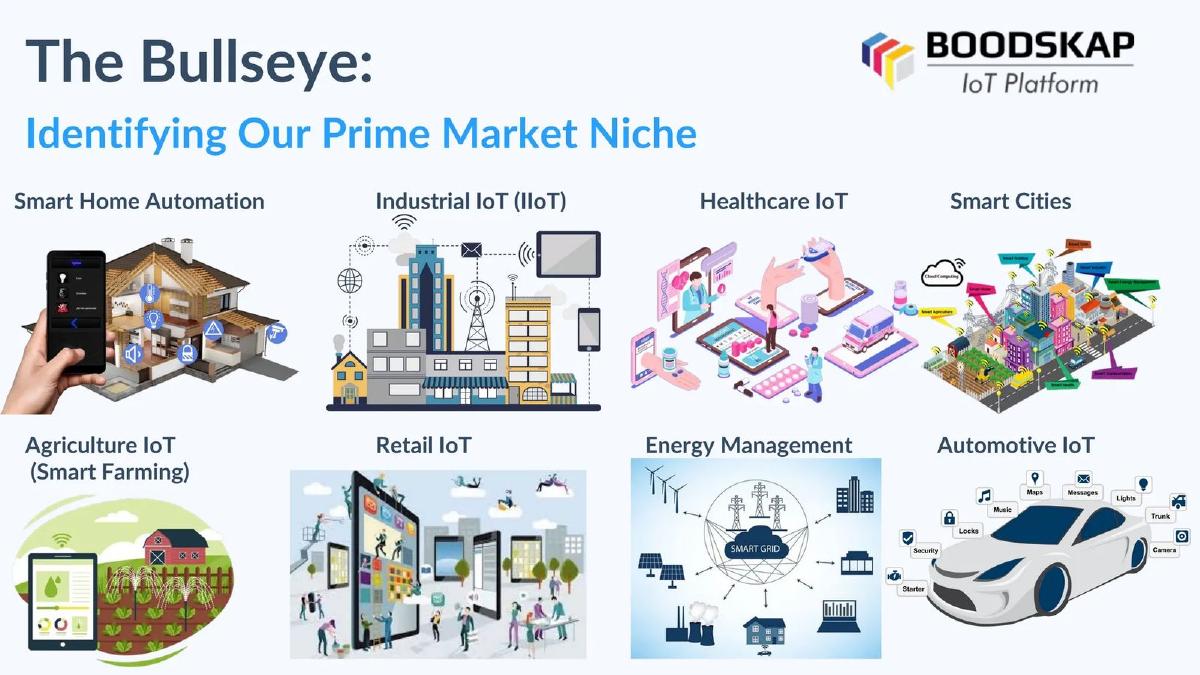
- Boodskap identifies eight core market niches, ranging from Smart Home Automation to Automotive IoT (Slide 3).
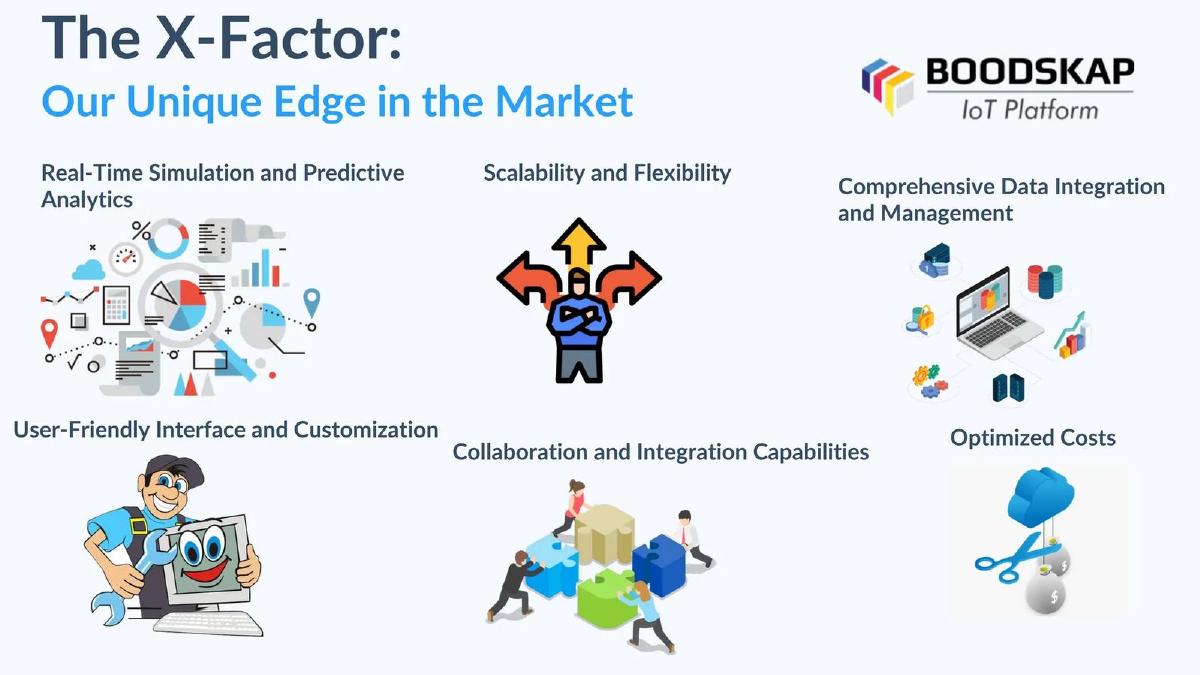
- The company lists 'Proprietary Technology' and 'Network Effects' as strategic advantages, though these are presented as high-level concepts rather than technical specifications (Slide 4).
- Traction is demonstrated through RIOT Wireless, which uses the platform to monitor 50,000 remote tanks (Slide 5).
- VitalProbe is a second key customer, utilizing the platform for remote patient monitoring across 10,000 devices (Slide 5).
- The deck reports a 75% growth in monitoring and a 50% growth in support and customization services (Slide 5).
- Pricing is structured into four tiers: Basic (₹0), Standard (₹14,999), Professional (₹38,999), and Enterprise (₹118,999) per month (Slide 7).
- The company maintains physical addresses in both Tamil Nadu, India, and Dallas, Texas (Slide 6).
Slide-by-Slide Analysis
Slide 1: Title and Value Proposition
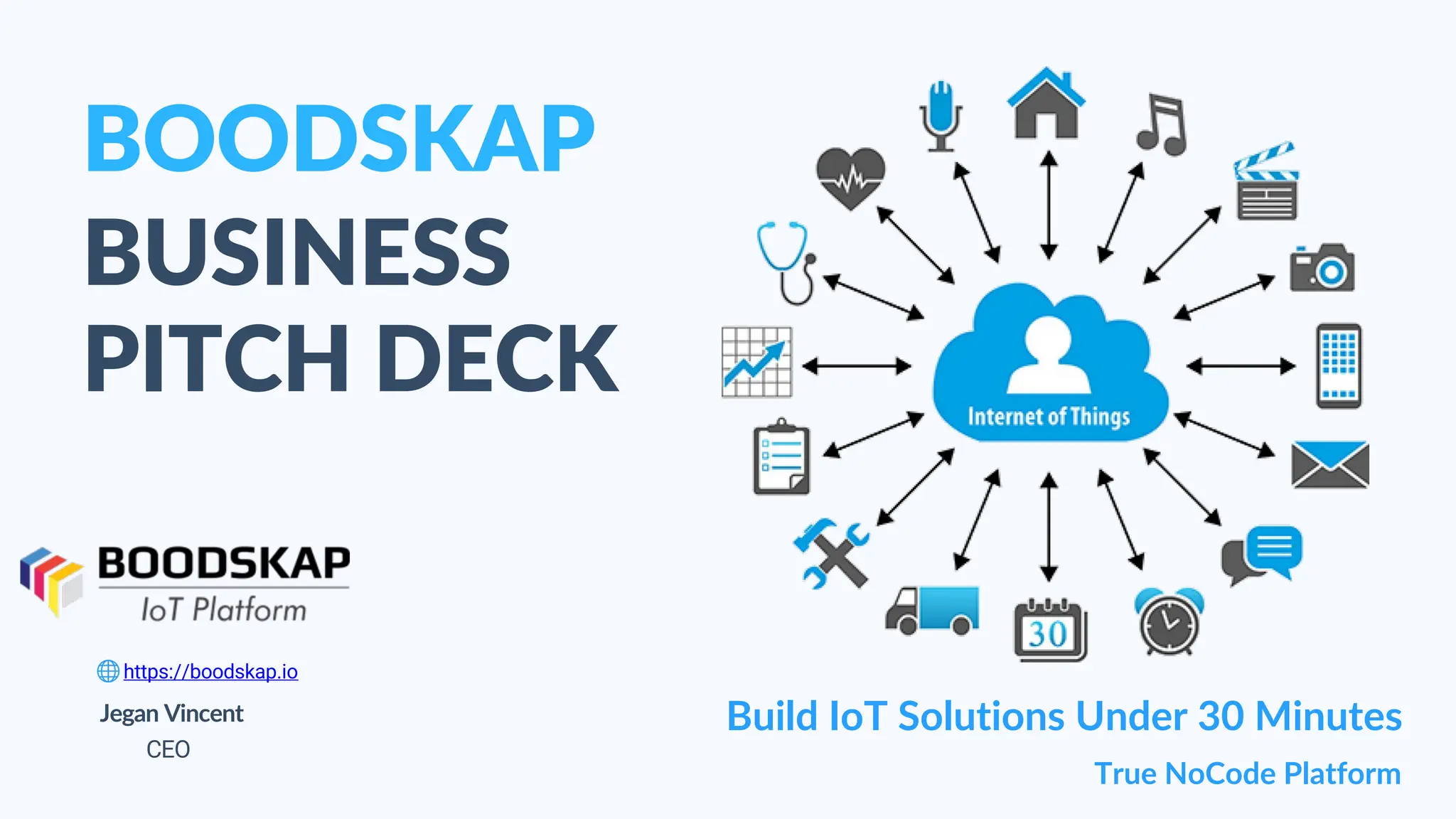
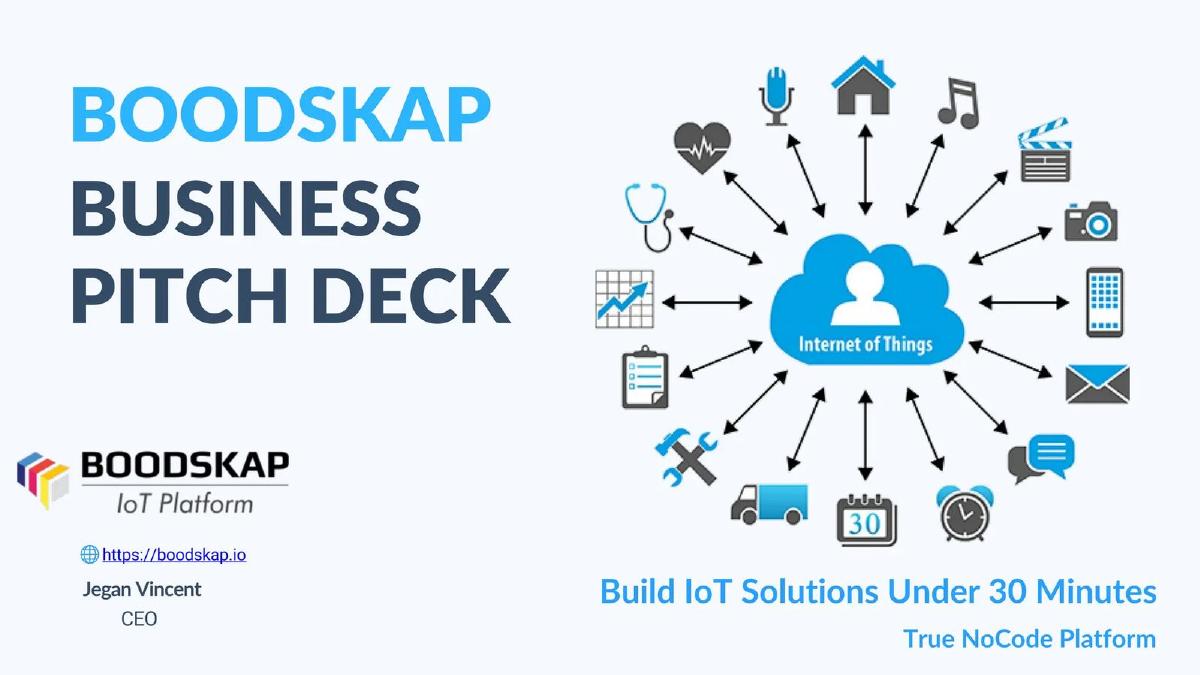
The cover slide introduces Boodskap as an 'IoT Platform' with a very specific time-based value proposition: 'Build IoT Solutions Under 30 Minutes.' It identifies the product as a 'True NoCode Platform.' Jegan Vincent is listed as the CEO. The visual uses a hub-and-spoke diagram connecting various icons (home, heart rate, tools, logistics) to a central cloud, signaling the breadth of the platform's connectivity.
Slide 2: Solutions in Motion
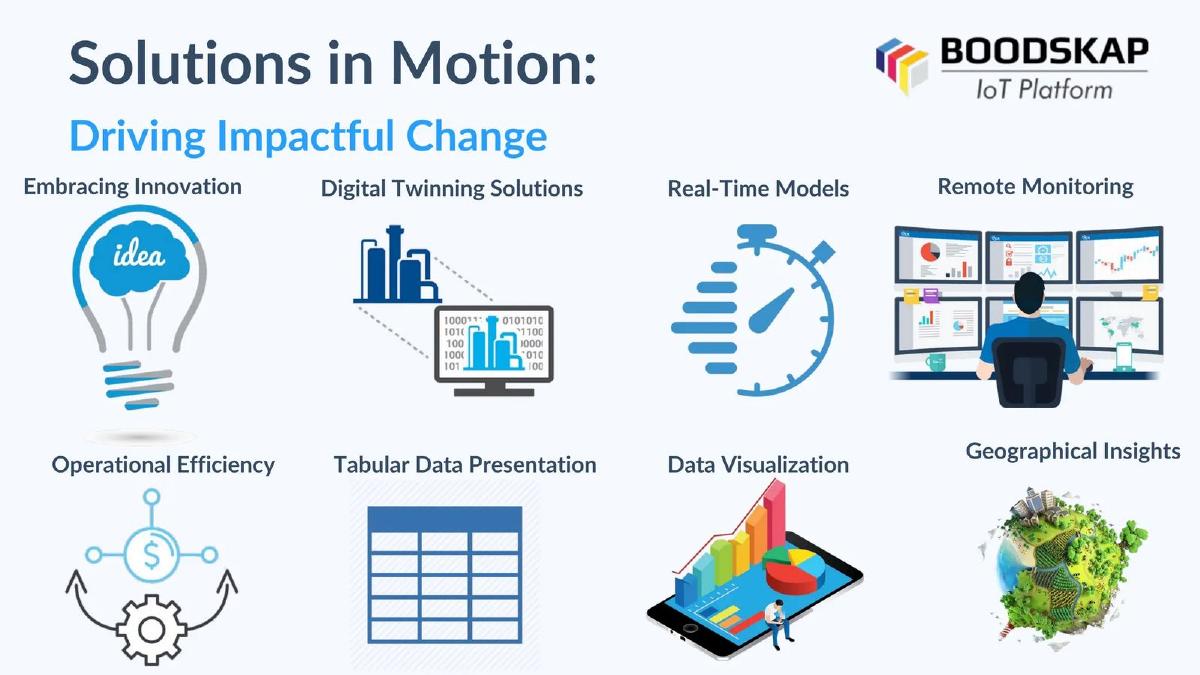
This slide outlines the functional capabilities of the platform through eight categories: Embracing Innovation, Digital Twinning Solutions, Real-Time Models, Remote Monitoring, Operational Efficiency, Tabular Data Presentation, Data Visualization, and Geographical Insights. The slide relies heavily on generic icons. The mention of 'Digital Twinning' is the most significant technical detail here, suggesting the platform can create virtual replicas of physical systems.
Slide 3: The Bullseye: Market Niches
Boodskap identifies its target markets. The list is expansive, covering eight distinct sectors: Smart Home Automation, Industrial IoT (IIoT), Healthcare IoT, Smart Cities, Agriculture IoT, Retail IoT, Energy Management, and Automotive IoT. While this demonstrates the platform's versatility, it lacks a 'beachhead' strategy, suggesting the company is pursuing a horizontal platform play rather than a vertical-specific solution.
Slide 4: Strategic Advantages
This slide lists six 'Game-Changing Benefits': Proprietary Technology, User Experience and Design, Network Effects, Exclusive Partnerships, Data Advantage, and Operational Excellence. These are standard business goals, but the slide provides no evidence or specific details to support these claims. For example, 'Exclusive Partnerships' are mentioned, but no partners are named on this slide.
Slide 5: Performance Pulse
This is the most data-rich slide in the deck. It provides concrete proof of concept through two customers. RIOT Wireless is cited as monitoring 50,000 remote tanks using various protocols (Satellite, LoRA, GSM, NBIoT). VitalProbe is cited in the healthcare space with 10,000 devices monitoring patient vitals via BLE, WiFi, and GSM. The slide also includes a bar chart for 2024 and percentages indicating +75% growth in monitoring and +50% in support/customization services.
Slide 6: Contact and Locations
The 'Thank You' slide provides operational details. Boodskap has a dual-presence strategy with an address in Tamil Nadu, India, and an address in Dallas, Texas. This suggests a global sales approach or a split between engineering (India) and headquarters/sales (USA). A summary box reiterates the ability to 'create digital twins on the fly.'
Slide 7: Pricing Tiers
The final slide in the provided sequence is a detailed pricing table. It shows four tiers: Basic, Standard, Professional, and Enterprise. Key metrics for pricing include the number of data points (ranging from 10,000 to 100,000), number of users, and number of dashboards. All paid plans charge a flat rate of ₹80 per device per month. The Enterprise plan at ₹118,999/month includes 24/7 support and a dedicated phone line.
What Boodskap Does Well
Specific Traction Metrics: Unlike many early-stage decks that speak in generalities, Boodskap names specific customers (RIOT Wireless and VitalProbe) and provides the exact number of devices connected (50,000 and 10,000 respectively). This validates that the platform can handle significant scale.
Clear Pricing Model: The inclusion of a detailed pricing slide (Slide 7) is rare in pitch decks but highly effective. It shows the company has moved past the 'discovery' phase of its business model and has a standardized way to quote and bill customers. The ₹80/device/month fee provides a clear unit of value.
Time-to-Value Claim: The 'under 30 minutes' claim on the title slide is a bold, quantifiable promise. In the complex world of IoT, where deployments often take months, this positioning sets a high bar for ease of use and speed.
Weaknesses and Omissions
Missing Team Slide: The deck provides the name of the CEO but offers no background on the leadership team. Investors in the IoT space typically look for deep expertise in hardware protocols, cloud architecture, or specific industry verticals. The absence of a team slide is a significant gap.
Lack of Competitive Landscape: The IoT platform market is extremely crowded, with giants like AWS IoT and Azure IoT, as well as specialized players like Particle or Balena. Boodskap does not explain how its 'NoCode' approach differs from or beats these established competitors.
No Funding Ask: The deck does not state how much capital the company is seeking, what the valuation expectations are, or how the funds will be allocated (e.g., R&D, sales expansion, or infrastructure).
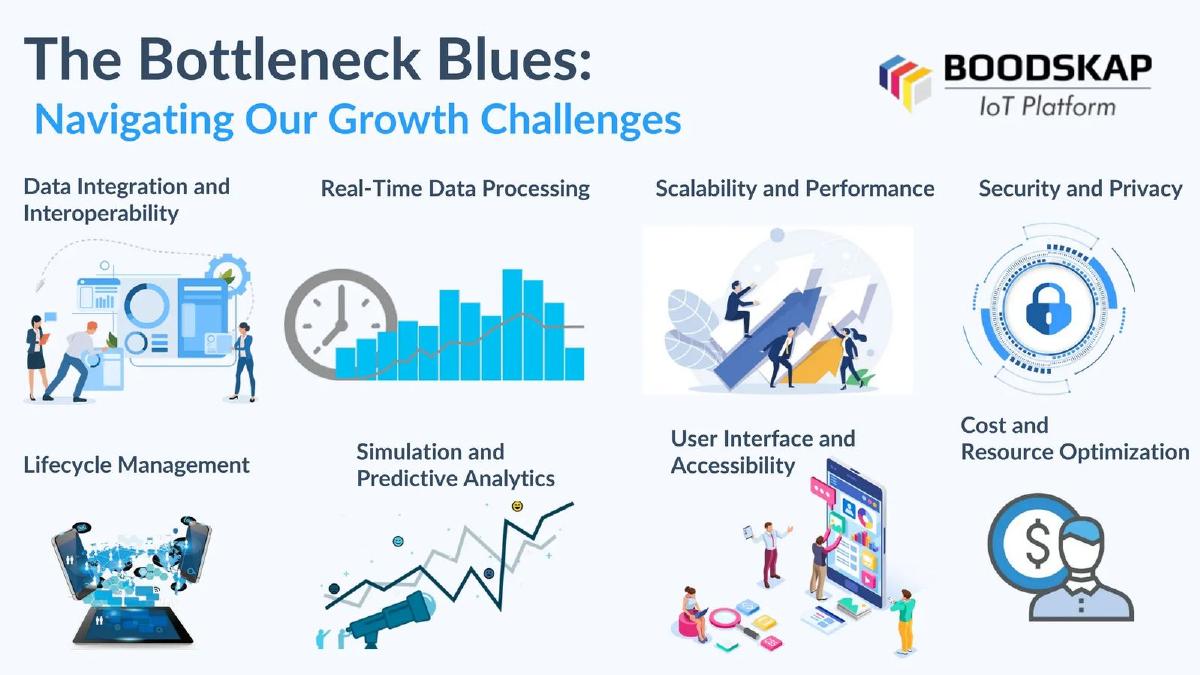
Over-reliance on Stock Graphics: Slides 2, 3, and 4 are composed almost entirely of generic clip art and icons. This makes the platform feel less 'real' than it actually is, especially given the impressive traction numbers shown on Slide 5. Screenshots of the actual 'NoCode' interface would be far more persuasive than icons of lightbulbs and gears.
Founder Takeaways
Lead with the Numbers: The most impressive part of this deck is the 50,000-device deployment for RIOT Wireless. Founders should consider moving these 'traction' slides earlier in the deck to immediately establish credibility before diving into abstract 'strategic advantages.'
Show, Don't Tell the Product: If you claim to be a 'True NoCode' platform, you must show the interface. A single screenshot of a drag-and-drop workflow or a digital twin dashboard is worth more than a dozen icons representing 'Operational Efficiency.'
Define the 'Why Now': The deck explains what the product does and who it is for, but it doesn't explain why this is the right time for Boodskap. Is there a shift in LoRA availability? A sudden drop in sensor costs? A gap left by a competitor? Adding a 'Market Opportunity' or 'Why Now' slide helps create urgency for investors.
Standardize the Visual Language: The jump from the clean, icon-heavy slides to the text-heavy pricing table is jarring. Maintaining a consistent design language throughout the deck helps maintain a professional narrative flow.
Frequently asked questions
- What is Boodskap's primary value proposition?
- Boodskap positions itself as a 'True NoCode Platform' that allows users to build IoT solutions in under 30 minutes. The core focus is on speed and accessibility, specifically highlighting 'Digital Twinning' capabilities that allow users to create virtual models of physical assets on the fly.
- How does Boodskap monetize its IoT platform?
- The company uses a tiered SaaS model. According to Slide 7, they offer a Basic Plan (free), a Standard Plan (₹14,999/mo), a Professional Plan (₹38,999/mo), and an Enterprise Plan (₹118,999/mo). Each plan includes a base number of device licenses, with additional devices costing ₹80 per month.
- What evidence of market traction does the deck provide?
- Slide 5 highlights two major implementations. RIOT Wireless uses Boodskap to monitor 50,000 remote tanks via Satellite, LoRA, and GSM. VitalProbe uses it for healthcare monitoring of 10,000 devices tracking heart rate and SpO2. The slide also notes a 75% increase in monitoring activity.
- Which industries is Boodskap targeting?
- The deck identifies a broad 'Bullseye' market niche on Slide 3, including Smart Home Automation, Industrial IoT (IIoT), Healthcare IoT, Smart Cities, Agriculture IoT (Smart Farming), Retail IoT, Energy Management, and Automotive IoT.
- What information is missing from this pitch deck?
- The deck lacks several standard venture components. There is no team slide detailing the founders' experience, no competitive matrix comparing Boodskap to other IoT platforms, no financial projections beyond current pricing, and no specific 'Ask' slide detailing how much money is being raised or how it will be spent.