Bolt’s Series D pitch deck is a concise, 12-slide presentation that prioritizes network utility and merchant ROI over technical specifications. Dated July 2021, the deck centers on the 'Holy Grail' of a unified commerce account, claiming to increase shopper conversion from 49% to 75% for its network members (Slide 5). With 5.6 million one-click shoppers and 180% year-over-year growth (Slide 7), Bolt positions itself as a critical infrastructure layer for independent retailers like Forever 21 and Lucky Brand (Slide 9). Notably, the deck concludes with a focus on 'Conscious Culture,' signaling…
Key takeaways
- The deck positions Bolt as 'The ubiquitous checkout,' aiming to be the single account for all of commerce (Slide 1, 3).
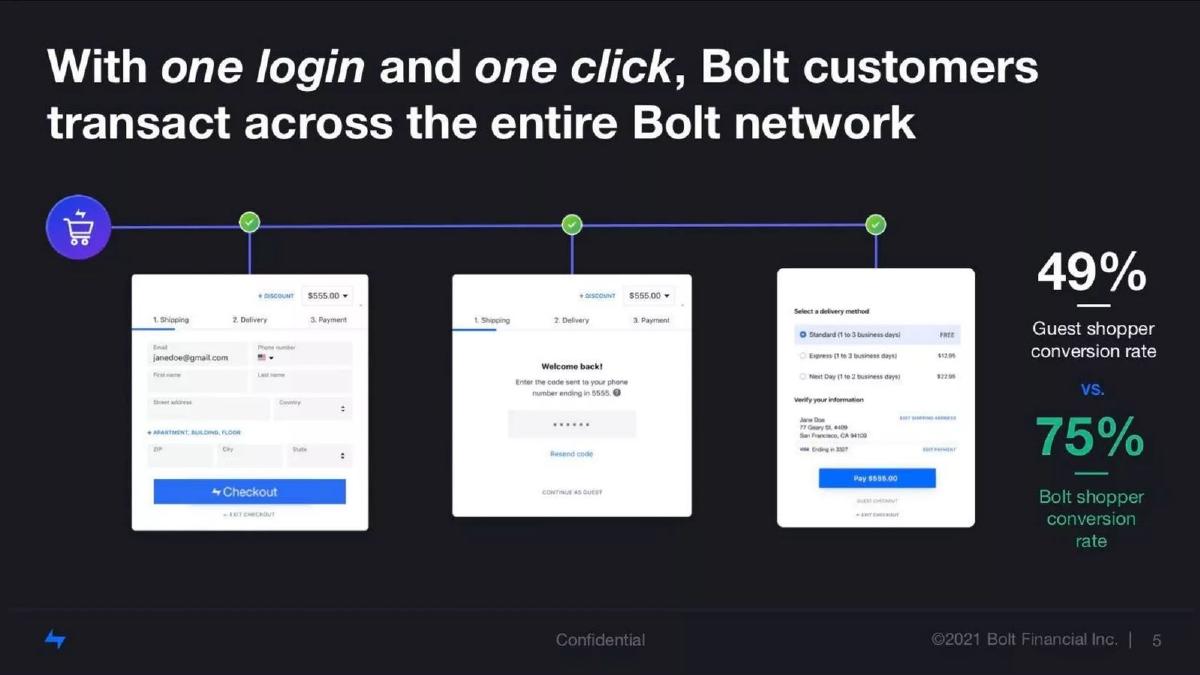
- Bolt claims a significant conversion advantage, stating a 75% conversion rate for Bolt shoppers versus 49% for guest shoppers (Slide 5).
- Network growth is a primary metric, with 5.6 million one-click shoppers and 180%+ year-over-year growth cited (Slide 7).
- The platform demonstrates impact on merchant metrics beyond conversion, including a 50% higher conversion rate and 38% faster completion time compared to guest checkout (Slide 7).
- Merchant adoption is validated through a logo wall featuring brands like Forever 21, Lucky Brand, and Swiss Gear (Slide 9).
- The deck includes a placeholder for Gross Merchandise Value (GMV), listed as '$XB GMV Live with Bolt,' suggesting this was a dynamic or sensitive figure (Slide 9).
- Bolt allocates a full slide to its 'Conscious Culture' initiative and the conscious.org movement, featuring founder Ryan Breslow (Slide 11).
- The presentation lacks a traditional team slide, detailed financial projections, or a specific 'Ask' slide in the provided 6-slide sample.
Bolt Series D: Selling the Network Effect
The Bolt Series D pitch deck, dated July 2021, is a high-level strategic document designed to justify a multi-billion dollar valuation by focusing on network density and merchant ROI. Unlike early-stage decks that must explain the 'how' of the technology, this deck assumes the technology works and focuses entirely on the 'what'—specifically, what happens to a merchant's bottom line when they join the Bolt ecosystem. The narrative moves quickly from a broad vision of 'ubiquity' to hard conversion data, ending with a unique focus on corporate culture.
Slide 1: Title and Vision
The deck opens with a minimalist title slide. It features the Bolt logo and the tagline: "The ubiquitous checkout." The date is marked as July 2021. The use of the word "ubiquitous" is a deliberate choice for a Series D company; it signals that the company is no longer in the experimentation phase but is now focused on total market saturation. The footer contains a confidentiality notice and identifies the entity as Bolt Financial Inc.
Slide 3: The Holy Grail of Commerce
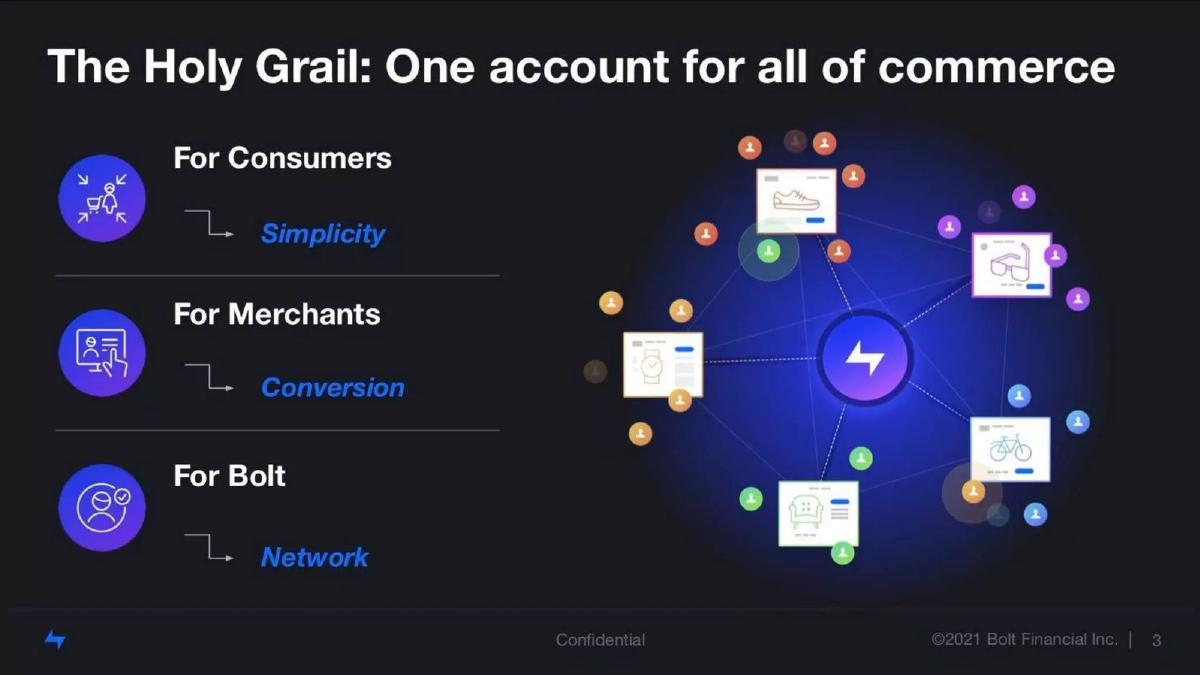
Slide 3 introduces the core thesis of the company: "One account for all of commerce." Bolt breaks down the value proposition into three distinct pillars: Simplicity for consumers, Conversion for merchants, and Network for Bolt. The right side of the slide features a network visualization showing various product categories—shoes, glasses, bicycles, furniture—connected to a central Bolt hub. This slide establishes Bolt not just as a tool, but as a platform that sits between the consumer and the fragmented world of independent e-commerce.
Slide 5: The Conversion Gap
This is arguably the most important slide in the deck for a prospective investor. It visualizes the user journey: "With one login and one click, Bolt customers transact across the entire Bolt network." It shows a three-step process: entering an email/phone, receiving a code, and clicking 'Pay.' The data on the right is the 'hook': a 49% Guest shopper conversion rate versus a 75% Bolt shopper conversion rate . By showing a 26-percentage-point increase in conversion, Bolt makes a mathematical case for its necessity. If a merchant uses Bolt, they theoretically capture a significantly higher portion of their existing traffic.
Slide 7: Growth and Merchant Metrics
Slide 7 focuses on traction and secondary benefits. Bolt claims 5.6 million one-click shoppers and 180%+ Year-over-Year growth . The slide then connects this network growth to four specific merchant metrics:
50% higher conversion rate vs. guest checkout. · 39% more likely to repurchase vs. guest checkout. · 23% higher Average Order Value (AOV) among retailers using Bolt. · 38% faster completion time vs. guest checkout.
These figures are designed to show that Bolt doesn't just help complete a single sale; it improves the quality of the customer relationship and the efficiency of the transaction.
Slide 9: Adoption and Scale
Slide 9 serves as the 'Social Proof' slide. It features a logo wall of 24 merchants, including high-profile brands like Forever 21, Lucky Brand, Swiss Gear, and Milk Makeup . At the top of the slide, there is a blue box that reads "$XB GMV Live with Bolt." The use of a placeholder '$XB' suggests that the specific Gross Merchandise Value was either updated in real-time during pitches or was redacted for the public version of the deck. Regardless, the slide communicates that Bolt is capable of handling enterprise-scale retail volume.
Slide 11: Conscious Culture
The final slide in the sample is an outlier for a traditional fintech deck. It focuses on "Conscious Culture" and the website conscious.org . It features a Fast Company article titled "This fintech startup thinks it can help companies build conscious business cultures," alongside a photo of founder and then-CEO Ryan Breslow. This slide suggests that Bolt is positioning itself as a thought leader in organizational design, perhaps as a way to attract talent or to differentiate its brand in a crowded payment processing market.
What Works in This Deck
The focus on a single metric: Bolt understands that for merchants, the only metric that truly matters is conversion. By placing the 49% vs. 75% comparison (Slide 5) front and center, they create a compelling 'why' that requires very little explanation. Any investor can understand the value of a 26% increase in sales for a retailer.
Network Effect Visualization: Slide 3 and Slide 7 do an excellent job of explaining why Bolt becomes more valuable as it grows. By highlighting the 180% growth in the shopper network, they are telling investors that the 'moat' is widening. Every new shopper added to the 5.6 million makes the platform more attractive to the next merchant, and vice versa.
Clean Design: The deck uses a dark theme with high-contrast text and simple iconography. It avoids the 'wall of text' trap, ensuring that the key figures—like the 38% faster completion time—are the first things an observer sees.
What is Missing
The Team: In the provided 6-slide sample, there is no team slide. While Ryan Breslow appears on Slide 11, the lack of a slide detailing the executive leadership or engineering pedigree is a notable omission for a Series D round, where execution capability is a primary concern for investors.
Financials and Unit Economics: The deck mentions GMV and growth percentages, but it does not disclose revenue, take rates, or burn rates. While these are often reserved for a data room, a Series D deck usually includes at least a high-level summary of the path to profitability or current revenue scale.
Competitive Landscape: There is no mention of competitors like Shopify Pay, PayPal, or Apple Pay. Bolt presents itself in a vacuum, which is a common strategy for market leaders but leaves the question of 'defensibility against incumbents' unanswered in the slides.
What Founders Should Copy
Use 'Before and After' Data: Founders should emulate Slide 5. If your product improves a process, don't just say it's 'better'—show the specific delta between the current status quo (Guest Checkout) and your solution (Bolt Shopper). Hard percentages are the most persuasive language in fundraising.
Quantify the Secondary Benefits: Bolt doesn't stop at conversion. They also highlight AOV and repurchase rates (Slide 7). Founders should look for these 'ripple effect' benefits in their own data. If your software saves time, does that time saved lead to more sales? If your tool reduces churn, does it also increase referral rates? Quantifying these secondary wins makes the ROI look even larger.
Lead with the Vision, End with the Culture: Bolt starts with the 'Holy Grail' (Slide 3) and ends with their 'Conscious Culture' (Slide 11). This bookends the technical and financial data with a human element. For late-stage companies, showing that you have a unique and scalable way of managing people can be just as important as showing you have a scalable way of managing code.
Frequently asked questions
- What is the primary value proposition Bolt presents to merchants?
- Bolt focuses almost entirely on conversion and efficiency. According to Slide 5 and Slide 7, Bolt claims to increase the conversion rate from 49% (guest) to 75% (Bolt shopper). It also highlights a 50% higher conversion rate overall, a 38% faster completion time, and a 39% higher likelihood of repurchase compared to standard guest checkouts. The goal is to prove that joining the Bolt network directly increases a merchant's top-line revenue.
- How does Bolt define its 'Network Effect'?
- Bolt defines its network effect as 'One account for all of commerce' (Slide 3). The logic is that as more consumers join the network (5.6 million as of Slide 7), they can use their saved credentials across any merchant in the Bolt ecosystem. This creates 'Simplicity' for consumers, 'Conversion' for merchants, and a growing 'Network' for Bolt, making the platform more valuable with every new participant.
- Which major retailers are using Bolt according to the deck?
- Slide 9 displays a logo wall of merchants using the platform. Notable brands include Forever 21, Lucky Brand, Badgley Mischka, Swiss Gear, Milk Makeup, and Polywood. The slide also includes a placeholder for Gross Merchandise Value (GMV), indicating that the total volume processed through these partners is a key metric for their Series D valuation.
- What is the 'Conscious Culture' mentioned in the deck?
- Slide 11 highlights Bolt's commitment to 'Conscious Culture,' a movement led by founder Ryan Breslow. It references a 'Conscious Culture Pledge' and a playbook for building business cultures that bridge 'humanity with execution.' This inclusion suggests that Bolt views its internal operating philosophy and public-facing values as a competitive advantage or a key part of its brand identity during fundraising.
- What critical startup metrics are missing from this pitch deck sample?
- The provided slides omit several standard components: there is no slide detailing the founding team's background, no explicit 'Ask' or use of funds, no competitive landscape analysis, and no detailed financial breakdown or unit economics. While the source listing mentions a $393M Series D, the deck itself focuses on vision and macro-traction rather than the specifics of the round's terms.