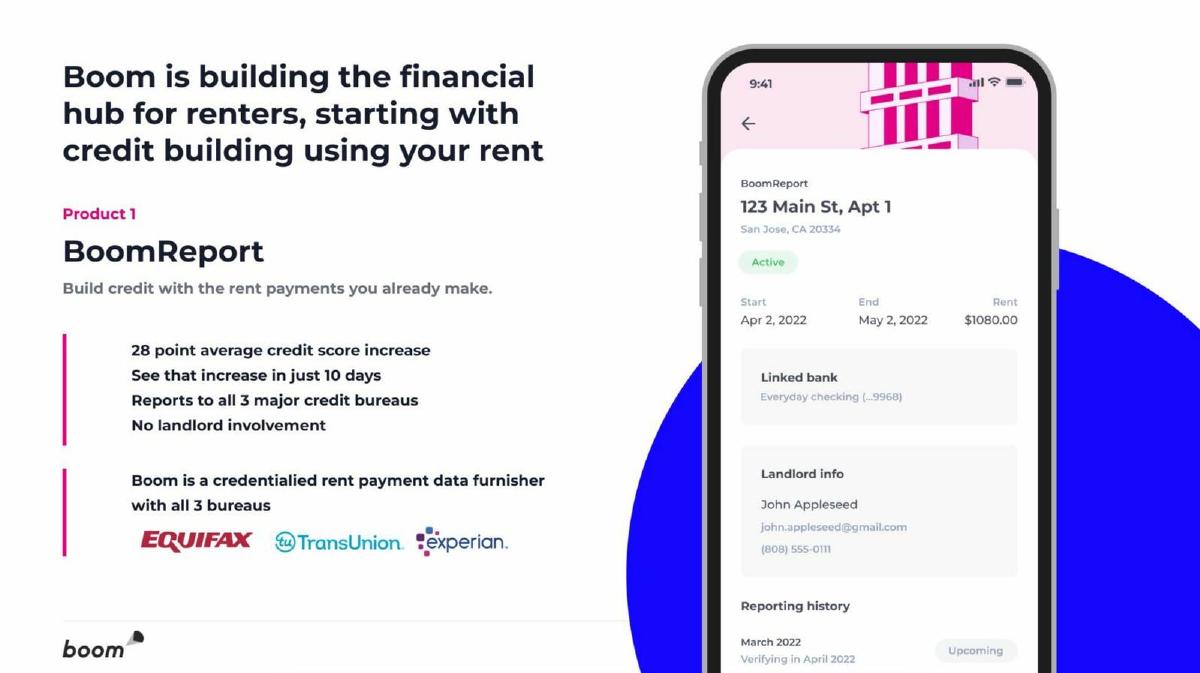
Boom's pitch deck is a concise 14-slide presentation that successfully navigated the 2024 seed market by focusing on two critical pillars: efficient distribution and high-signal social proof. The deck highlights a scalable affiliate network that delivers a 3.0x LTV:CAC ratio, with a revenue per referral of $45.60 against a $15.00 acquisition cost. By positioning rent reporting as a 'hook' product, Boom demonstrates a clear path to expansion into broader financial services like BoomSplit. The presentation concludes with a powerful investor slide featuring founders from Plaid, Cash App, and Coz…
Key takeaways
- The deck reports a specific LTV:CAC ratio of 3.0x, driven by a $15.00 cost per converted referral (Slide 4).
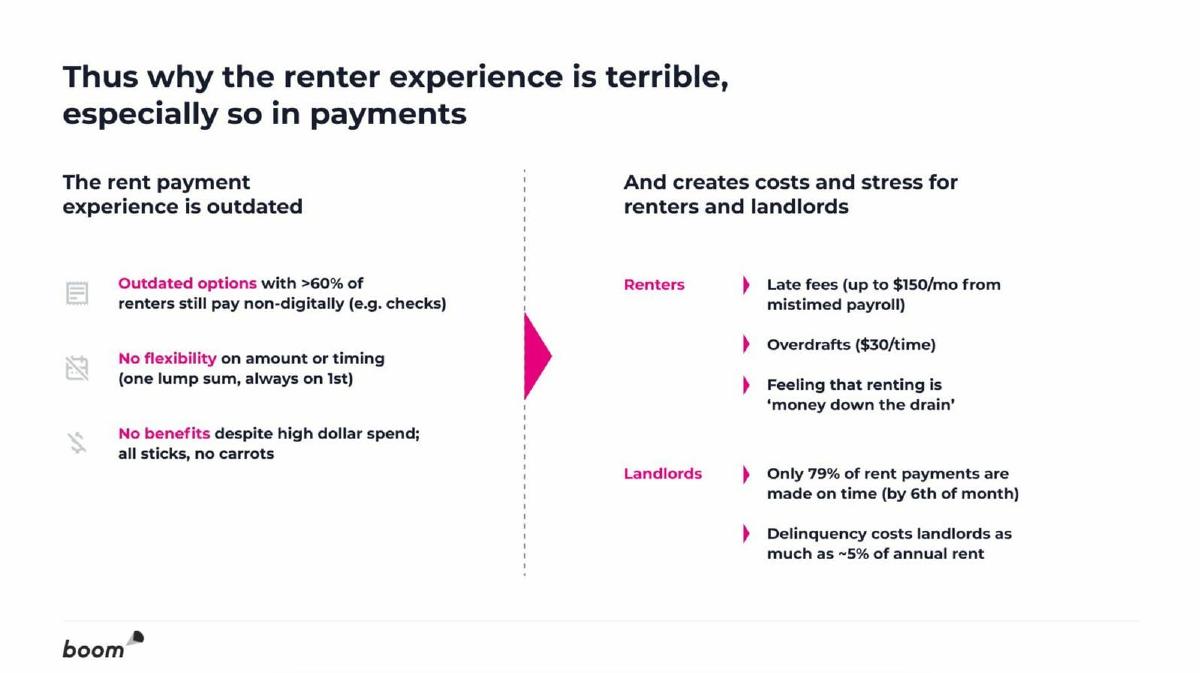
- Boom identifies that >60% of renters still pay non-digitally, representing a significant modernization opportunity (Slide 3).
- The company uses BoomReport as a 'hook' product to achieve a 15% conversion rate into secondary products like BoomSplit (Slide 4).
- Delinquency costs for landlords are cited as being as high as ~5% of annual rent, providing a B2B value proposition alongside the B2C focus (Slide 3).
- The affiliate network is already operational with 170+ partners onboarded at the time of the deck's creation (Slide 4).
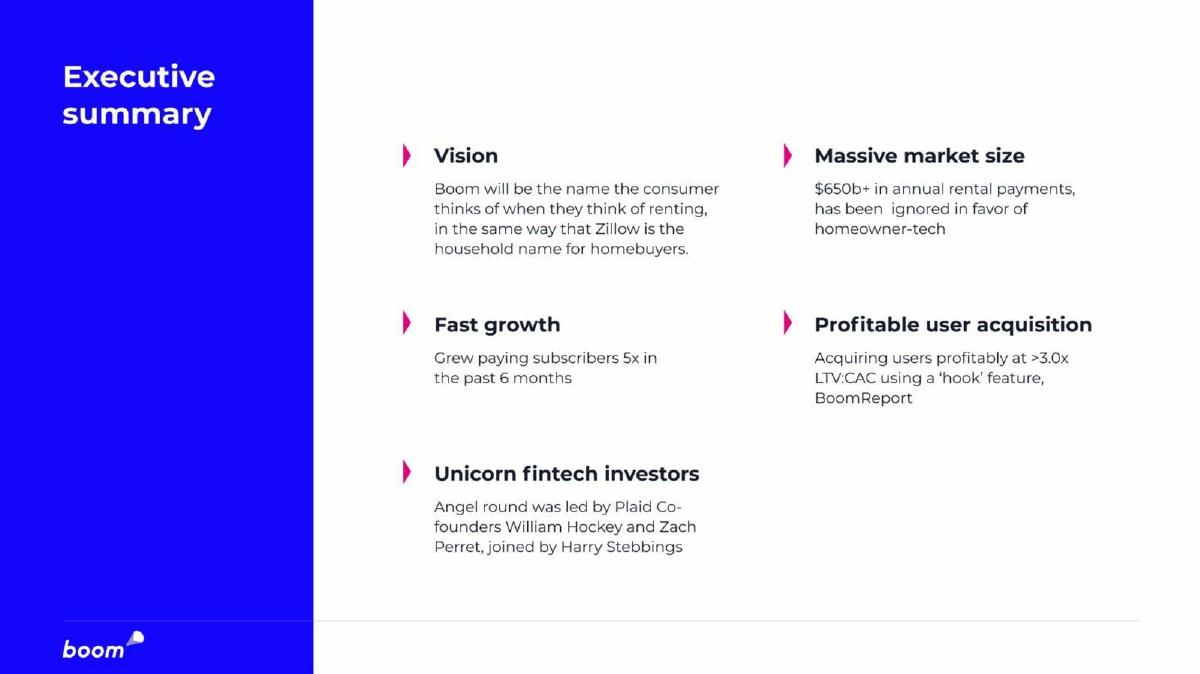
- Boom leverages an elite investor roster including the co-founders of Plaid, William Hockey and Zach Perret, to establish industry authority (Slide 7).
- The product roadmap focuses on data accumulation, including linked bank accounts and income levels, to drive viral growth (Slide 4).
- Customer testimonials explicitly mention competitors like Flex, positioning Boom as a superior alternative in terms of service and price (Slide 6).
Boom Pitch Deck Teardown: The $4.5M Seed Round
Boom, a North American fintech startup, raised $4.5M in 2024 to transform the rental payment landscape. Their deck is a lean, 14-slide presentation that prioritizes unit economics and social proof over flashy design. In an era where fintech valuations have faced scrutiny, Boom’s ability to demonstrate a 3.0x LTV:CAC ratio was likely the catalyst for their successful Seed round.
Slide 1-2: The Mission and Vision
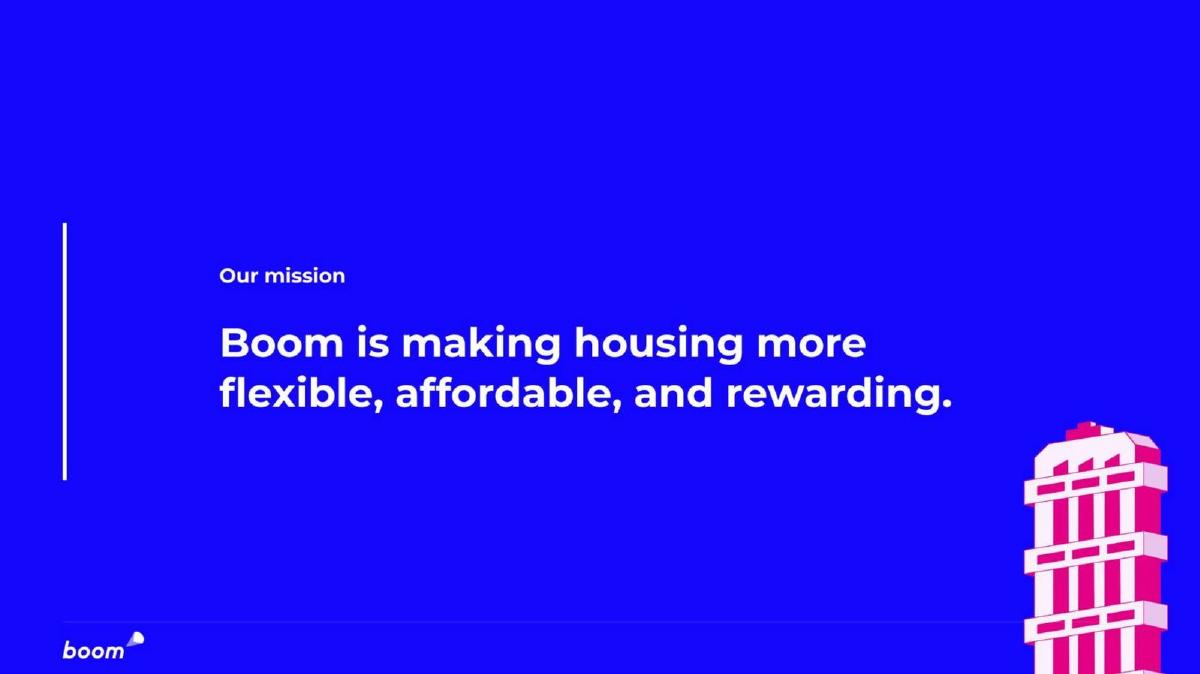
The deck opens with a minimalist title slide featuring the tagline "Flexible and Rewarding Rent." This is immediately followed by Slide 2, which defines the mission: "Boom is making housing more flexible, affordable, and rewarding." These slides are standard but effective, establishing the company's focus on the intersection of housing and personal finance (Fintech).
Slide 3: Quantifying the Renter Experience
Slide 3 serves as the 'Problem' slide, and it is data-heavy. Boom breaks the problem down into two categories: the outdated experience and the resulting costs. The slide claims that ">60% of renters still pay non-digitally (e.g. checks)" and that there is "no flexibility on amount or timing."
The most compelling part of this slide is the quantification of pain. For renters, this includes late fees of "up to $150/mo" and overdrafts of "$30/time." For landlords, the deck notes that "only 79% of rent payments are made on time" and delinquency costs can reach "~5% of annual rent." By addressing both sides of the marketplace, Boom demonstrates a comprehensive understanding of the ecosystem's inefficiencies.
Slide 4: The Unit Economics Flywheel
This is arguably the most important slide in the deck. It details the "Boom Affiliate Network" and provides transparent unit economics. Boom reports a "Revenue per referral" of "$45.60" against a "Cost per converted referral" of "$15.00." This results in an "Immediate LTV:CAC" of "3.0x."
The slide also maps out the product flywheel. It shows that "170+" affiliates have been onboarded, leading to a "31%" conversion rate of referrals to paying members. Furthermore, "15%" of those members go on to use secondary products like "BoomSplit." This slide proves that Boom isn't just a feature; it's a customer acquisition engine for a broader financial platform.
Slide 5-6: Traction and Social Proof
Slide 5 acts as a transition, stating the company is "hitting milestones and are ready to scale." Slide 6 backs this up with a wall of customer testimonials. Unlike many decks that use generic quotes, these testimonials are screenshots of actual reviews and text conversations. One review from "Edjail Mendes" calls the service "Sophisticated, Modern, Flexible, Authentic and Solid." Another review from "Jordan Scott" explicitly compares Boom to a competitor, stating it is "Wayyyy better than Flex Rent." This direct competitive comparison via user feedback is a powerful way to signal market superiority without the founders having to say it themselves.
Slide 7: The Investor Roster
In lieu of a traditional founder bio slide (which is notably absent from the provided images), Boom leans heavily on its investors. Slide 7, titled "Our investors are world class fintech, real estate and capital markets experts," is a powerhouse of social proof. It features:
William Hockey & Zach Perret: Co-founders of Plaid. · Brandon Jacoby: Design & Product at Cash App. · Rob Galanakis: Former CTO of Cozy. · Harry Stebbings: 20VC. · Todd Benson: Co-Founder, Citi Private Equity.
For a seed-stage fintech, having the founders of Plaid and the product leads from Cash App on the cap table is a massive signal of technical and regulatory viability. It tells the VC reading the deck that the people who built the infrastructure of modern fintech believe in Boom’s architecture.
What Works in the Boom Deck
Specific Unit Economics: Many seed decks hide behind vague 'market potential' slides. Boom does the opposite. By stating exactly what it costs to acquire a user ($15.00) and what that user is worth ($45.60), they remove the guesswork for investors. It transforms the pitch from 'we have an idea' to 'we have a machine that needs more fuel.'
The 'Hook' Strategy: The deck clearly identifies rent reporting as a 'hook' product. This is a smart strategic move. Rent reporting is a high-intent, low-friction entry point. Once the user has linked their bank account and rental portal to build credit, the switching cost becomes high, and the cross-sell opportunity for products like BoomSplit becomes natural.
Borrowing Authority: The investor slide is a masterclass in social proof. By highlighting the specific roles of their investors (e.g., "Fintech / payments," "Real estate SaaS"), they show that they haven't just raised money, but they have assembled a 'council of experts' who cover every facet of their business model.
What is Missing from the Boom Deck
Founder Backgrounds: While the investors are impressive, the deck (as presented) lacks a slide detailing the actual founders' professional histories. Investors generally want to know who is running the day-to-day operations, not just who is on the board. While Rob Whiting is mentioned on the title slide, his specific 'why now' and 'why him' story is absent.
The 'Ask' and Use of Funds: The provided slides do not include a formal 'Ask' slide. A standard pitch deck should conclude with the amount being raised and a breakdown of how that capital will be deployed (e.g., 50% engineering, 30% marketing, 20% ops). While we know from publisher reports that they raised $4.5M, the deck itself doesn't explicitly state the target or the milestones that capital will unlock.
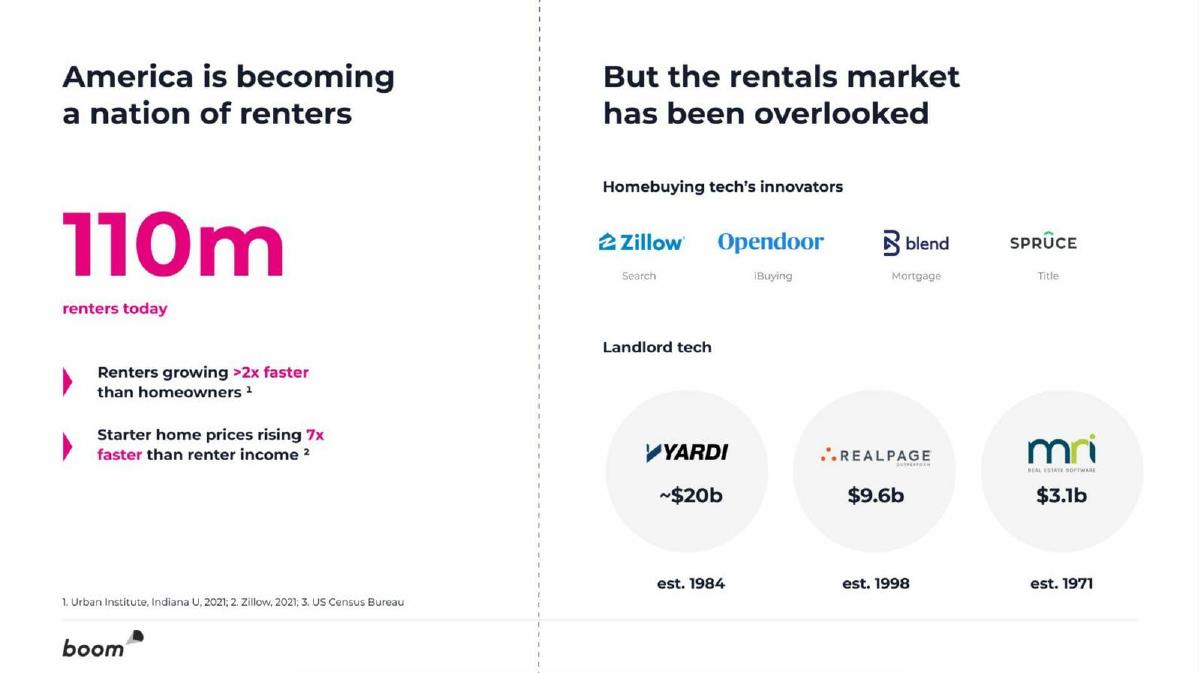
Market Size (TAM): There is no slide dedicated to the Total Addressable Market. While it is implied that the rental market is huge, quantifying the number of renters in the US who could benefit from credit reporting would help frame the 3.0x LTV:CAC within a larger growth context.
What Founders Should Copy
The Flywheel Visualization: Founders should emulate Slide 4’s layout. It connects distribution (affiliates), unit economics (LTV:CAC), and product expansion (BoomSplit) into a single, cohesive narrative. It shows that the company understands how its business grows, not just how its product works.
Real-World Testimonials: Move away from polished, marketing-approved quotes. Use screenshots of app store reviews, Slack messages, or text threads. The raw nature of the testimonials on Slide 6 feels more authentic and carries more weight with cynical investors.
Dual-Sided Problem Statements: If your product sits in a marketplace or affects multiple stakeholders, show the pain for all of them. Boom’s Slide 3 is excellent because it shows how the status quo hurts the renter (fees) and the landlord (delinquency). This doubles the perceived value of the solution.
Final Analysis
Boom’s deck is a high-signal, low-noise presentation. It avoids the common trap of over-explaining the technology and instead focuses on the business's efficiency. By the time an investor reaches the final slide, they have seen a clear problem, a proven acquisition channel with 3.0x returns, and a cap table filled with industry titans. Despite the omission of a founder-specific slide and a formal 'ask' in this version, the strength of the metrics and the quality of the backers make it clear why this company successfully closed a $4.5M seed round in a tightening market.
Frequently asked questions
- What is Boom's primary customer acquisition strategy?
- Boom relies on a scalable affiliate network rather than traditional direct-to-consumer paid ads. According to slide 4, they have onboarded over 170 affiliates. This strategy allows them to acquire converted referrals for just $15.00 each, generating $45.60 in revenue per referral and resulting in an immediate 3.0x LTV:CAC ratio.
- How does Boom plan to expand beyond rent reporting?
- Slide 4 outlines a 'flywheel' where the core rent-reporting product (BoomReport) serves as the entry point. Once users are in the ecosystem, Boom sees a 15% conversion rate into other products like BoomSplit. The ultimate goal is to collect deeper renter data—such as income levels and bank links—to fuel viral growth and additional financial services.
- What specific pain points does Boom address for landlords?
- While the app is renter-facing, slide 3 highlights that only 79% of rent payments are made on time by the 6th of the month. Delinquency costs landlords approximately 5% of annual rent. By incentivizing on-time payments through credit reporting, Boom indirectly solves a major cash-flow problem for property owners.
- Who are the notable investors backing Boom?
- Boom's cap table is a 'who's who' of fintech. Slide 7 lists William Hockey and Zach Perret (Co-founders of Plaid), Brandon Jacoby (Design at Cash App), Harry Stebbings (20VC), and Rob Galanakis (former CTO of Cozy). This level of strategic backing suggests strong industry confidence in their technical and market approach.
- What are the financial costs for renters mentioned in the deck?
- Slide 3 notes that the current 'outdated' experience costs renters up to $150 per month in late fees due to mistimed payroll and $30 per occurrence for overdrafts. Boom positions its 'flexible' rent options as a way to avoid these predatory costs while building credit equity.