Borzo’s 10-slide deck is a highly efficient Series C presentation that prioritizes traction and scalability over conceptual problem-solving. Raising $35M in 2021, the company positioned itself as a 'fully asset-light marketplace' leveraging a crowdsourced courier pool. The deck excels at demonstrating geographic diversification, showing a presence in 10 countries and 100 cities with a heavy tilt toward the APAC region. It provides granular detail on unit economics, including a 20% take rate and a 5-year capped LTV/CAC of at least 3x. While it lacks a specific 'Ask' slide or a detailed use-of-…
Key takeaways
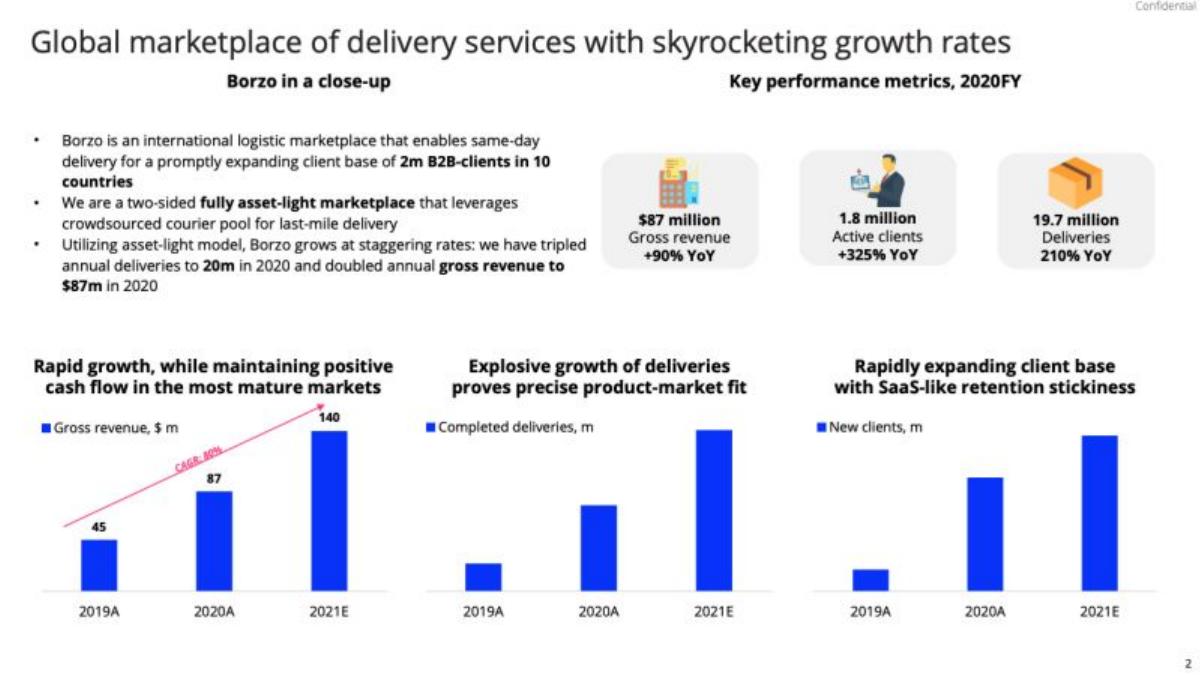
- The company achieved $87 million in gross revenue in 2020, representing 90% year-over-year growth (Slide 2).
- Borzo operates as a fully asset-light marketplace using a crowdsourced courier pool for last-mile delivery (Slide 2).
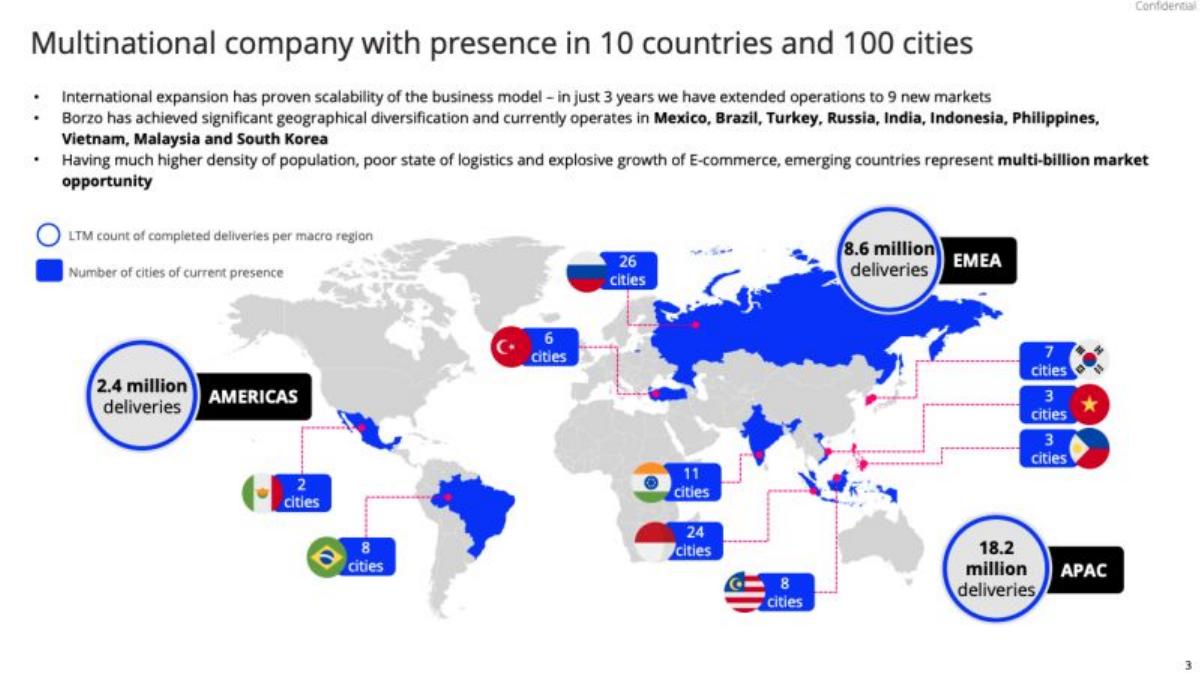
- The business model is highly diversified, with operations in 10 countries including Mexico, Brazil, Turkey, Russia, India, Indonesia, Philippines, Vietnam, Malaysia, and South Korea (Slide 3).
- APAC is the dominant region for the company, accounting for 18.2 million deliveries compared to 8.6 million in EMEA and 2.4 million in the Americas (Slide 3).
- The marketplace maintains a 20% take rate, which the company notes is higher in more mature markets (Slide 5).
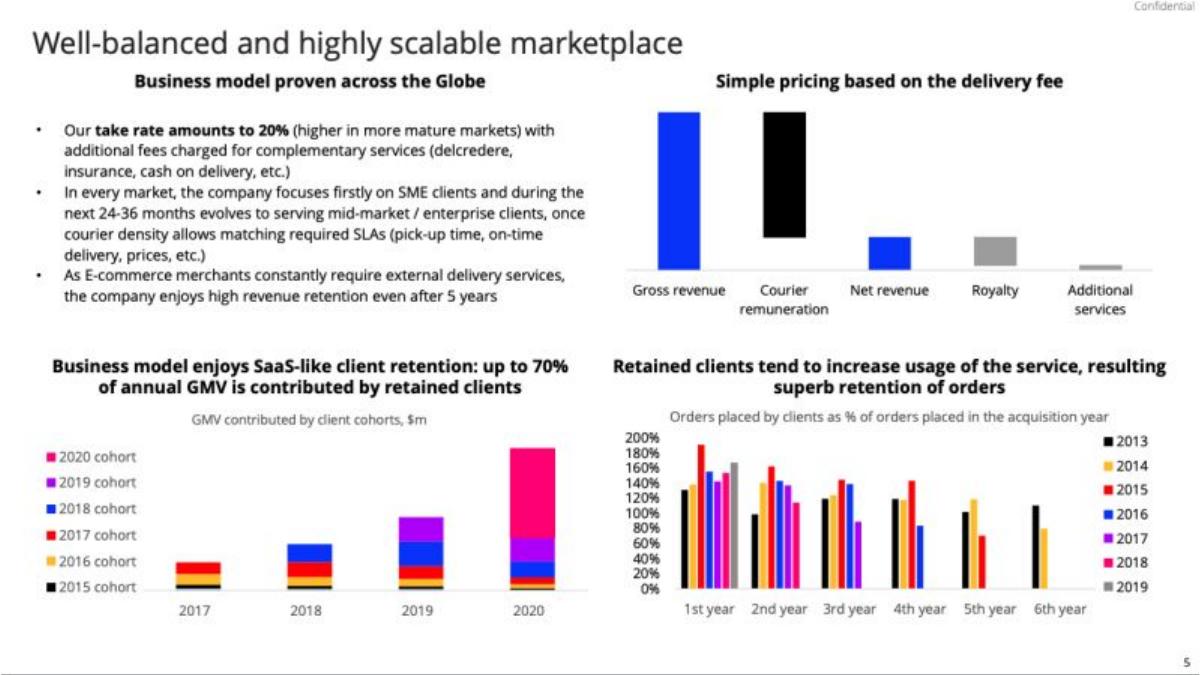
- Client retention is a core strength, with up to 70% of annual GMV contributed by retained clients (Slide 5).
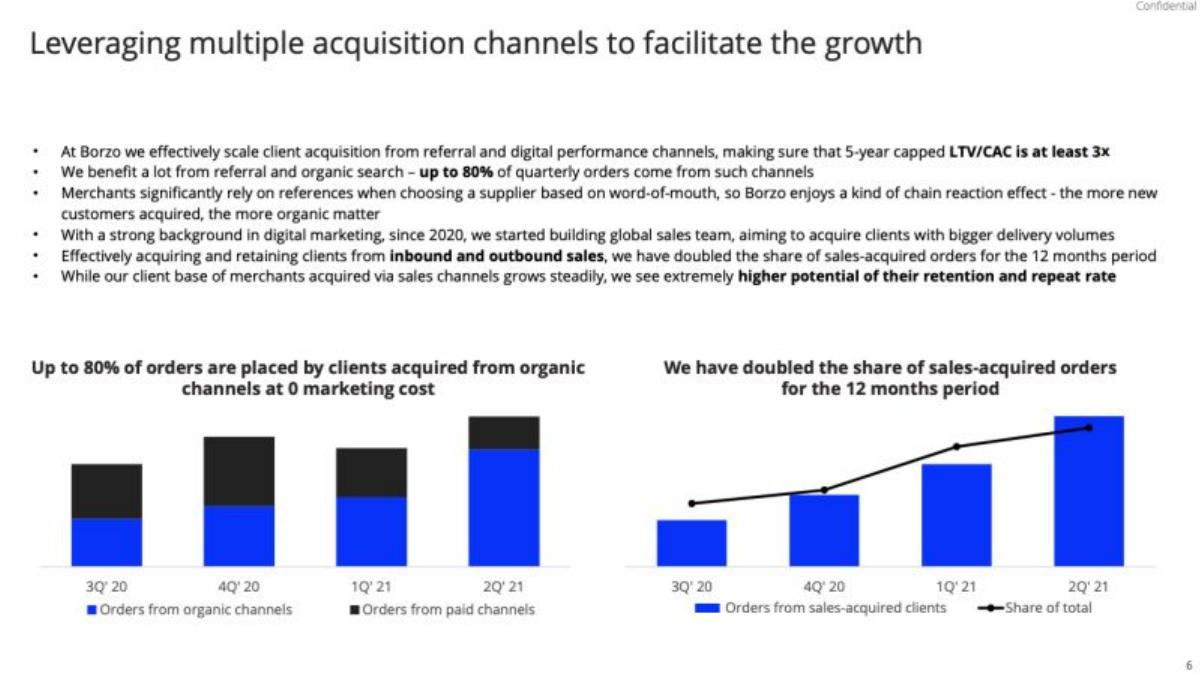
- Organic and referral channels are highly efficient, accounting for up to 80% of quarterly orders (Slide 6).
- The product mix is segmented by delivery distance and time, ranging from 1-5km premium products to 20km+ enterprise intervals (Slide 7).
The Series C Shift: From Vision to Velocity
By the time a company reaches Series C, the 'problem' and 'solution' slides are often relegated to the background. Investors at this stage are looking for a machine that converts capital into growth with predictable efficiency. Borzo’s 10-slide deck is a textbook example of this transition. It is dense, data-driven, and focused almost entirely on the mechanics of their marketplace and the proof of their international scalability.
Slide 1: The Identity Statement
The cover slide is minimalist, featuring the Borzo logo and the tagline: "Global same-day logistics marketplace." It sets an immediate expectation of scale. There is no fluff about 'disrupting' or 'reimagining'—just a clear definition of the category and the geographic scope.
Slide 2: The Performance Snapshot
Slide 2 is arguably the most important slide in the deck. It functions as an executive summary of the company’s health as of the 2020 fiscal year. Borzo highlights three massive figures: $87 million Gross revenue (+90% YoY), 1.8 million Active clients (+325% YoY), and 19.7 million Deliveries (210% YoY). By leading with these numbers, Borzo establishes that they are not just growing, but accelerating. The slide also defines their model as "fully asset-light," a key phrase for investors who want to see high margins without the overhead of vehicle maintenance or driver employment.
Slide 3: Geographic Diversification
Logistics is often a local game, but Borzo uses Slide 3 to prove they have cracked the code for international expansion. They list 10 countries, including Mexico, Brazil, Turkey, Russia, India, Indonesia, Philippines, Vietnam, Malaysia, and South Korea. The map visualization is critical here; it shows that they aren't just a regional player. The data points are split by macro-region, revealing that APAC is the powerhouse with 18.2 million deliveries, followed by EMEA at 8.6 million and the Americas at 2.4 million. This tells investors exactly where the growth engine is located.
Slide 4: Regional Growth Trends
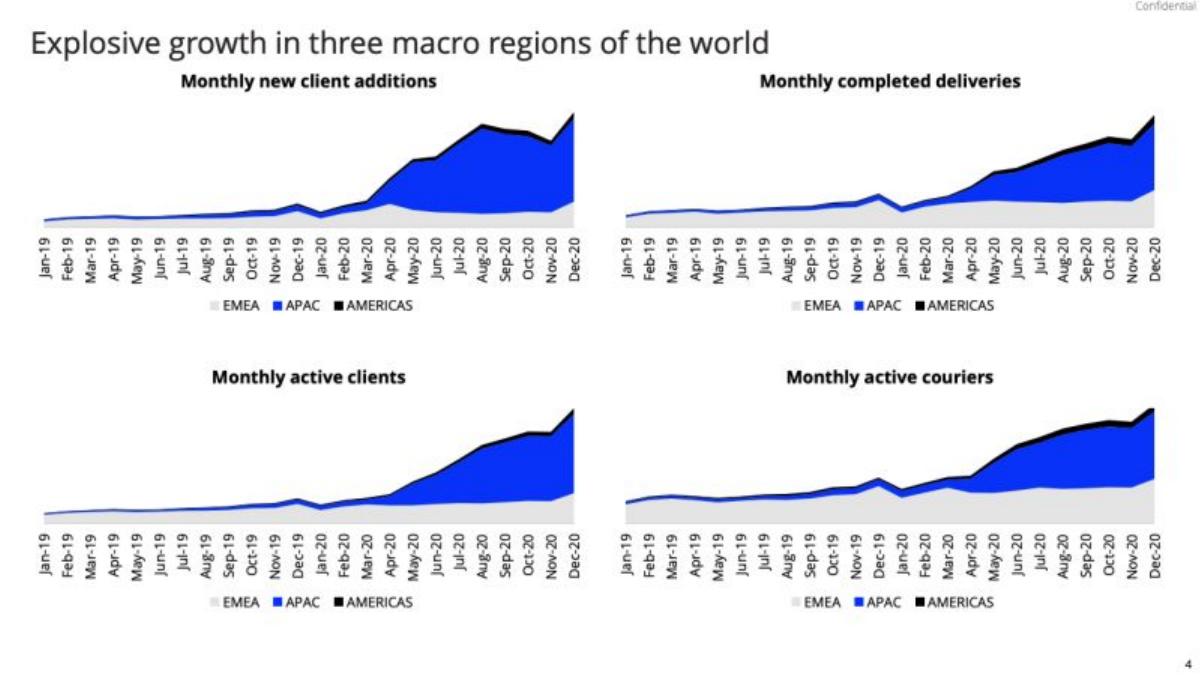
Slide 4 provides four charts showing monthly trends from January 2019 to December 2020 for new client additions, completed deliveries, active clients, and active couriers. The visual takeaway is the 'hockey stick' curve that begins in early 2020. While the pandemic certainly provided a tailwind for delivery services, these charts show that the growth was sustained across all three macro-regions, not just a single lucky market.
Slide 5: Unit Economics and Retention
This slide dives into the 'SaaS-like' nature of their business. Borzo claims a 20% take rate and shows a waterfall chart of how gross revenue is split between courier remuneration, net revenue, and royalties. The most impressive part of this slide is the cohort analysis. It shows that 70% of annual GMV is contributed by retained clients . The bar chart on the bottom right, "Orders placed by clients as % of orders placed in the acquisition year," shows that many cohorts actually increase their usage over time, with some reaching 180% of their initial volume by the second year. This is the 'negative churn' equivalent in the marketplace world.
Slide 6: Acquisition Channels and LTV/CAC
Efficiency is the theme of Slide 6. Borzo states that up to 80% of orders are placed by clients acquired from organic channels at 0 marketing cost . This is a dream metric for Series C investors. It suggests that the brand has significant pull and that the 5-year capped LTV/CAC of at least 3x is likely a conservative estimate. The slide also notes a shift toward a global sales team to capture enterprise clients, showing a strategic evolution from pure self-service to a high-touch model for larger volumes.
Slide 7: Product Mix and Segmentation
Slide 7 explains how Borzo addresses different market segments. They categorize their services by distance (1km to 20km+) and time (30 minutes to 2 hours+). This matrix shows they aren't just a 'courier app' but a comprehensive logistics partner for Local retail chains, SME merchants, and Enterprise clients . By offering 'routed same-day delivery' for enterprise clients, they demonstrate an ability to handle complex logistics, not just simple A-to-B drops.
Slide 8: Market Opportunity and Macro Drivers
Every deck needs a 'Why Now?' slide. Borzo points to the E-commerce boom, noting that online sales in their markets reached $290bn in 2020 and are expected to hit $500bn by 2024 . They specifically highlight that online sales penetration in APAC is expected to almost double by 2024. This slide justifies the 'Global' part of their title, showing that they are positioned in the highest-growth markets in the world.
Slide 9: The Leadership Team
The team slide features six key executives. It emphasizes experience and 'serial entrepreneurship.' Mike Alexandrovski (CEO) is noted for 20 years of experience and a mix of successful and failed startups—a sign of a seasoned founder. Alex Shamis (Deputy CEO) brings marketplace credibility, having merged a previous venture with DeliveryHero. The inclusion of a CRO from Maersk (Sabrina Shaikh) is a strategic signal that they are serious about the enterprise logistics space.
Slide 10: Conclusion
The final slide is a standard placeholder from the source library and does not contain company-specific information. Notably, the 10-slide sequence ends without a formal 'Ask' or 'Financial Projections' slide, which are common in Series C decks but may have been omitted from this public version for confidentiality.
What Borzo Does Exceptionally Well
The Borzo deck is a masterclass in Marketplace Liquidity Proof . They don't just say they are a marketplace; they show the balance between active clients and active couriers (Slide 4). They don't just say they are global; they show the delivery volume by city and country (Slide 3). This level of transparency builds immense trust with institutional investors.
Furthermore, the focus on asset-light economics is perfectly timed. In a sector where many competitors struggle with the high costs of owning fleets or employing drivers, Borzo’s 20% take rate on a crowdsourced model presents a much clearer path to profitability. The cohort data on Slide 5 is the 'smoking gun' that proves their product is sticky and that their growth is sustainable, not just a result of burning cash on acquisition.
What is Missing from the Deck
The most glaring omission is the Financial Ask and Use of Funds . While we know from catalogue facts that they raised $35M, the deck itself doesn't specify how much they were seeking or how they planned to spend it (e.g., tech R&D vs. market expansion). Additionally, there is no Competitive Landscape slide. In the crowded last-mile delivery space, failing to mention how they differ from giants like Grab, Gojek, or Lalamove is a missed opportunity to define their unique edge.
The deck also lacks detailed unit economics per delivery . While they mention a 20% take rate, they don't disclose the average order value (AOV) or the contribution margin per delivery. For a logistics company, these are the 'atomic' metrics that determine long-term viability.
What Other Founders Should Copy
Founders should emulate Borzo’s Cohort Analysis (Slide 5) . If you can show that your customers from three years ago are spending more today than they did when they signed up, you have already won half the battle. This 'expansion revenue' is the ultimate proof of product-market fit.
Another takeaway is the Geographic Volume Map (Slide 3) . Instead of just listing countries, Borzo shows the actual delivery volume per region. This allows investors to see the 'weight' of the business. If you are a multi-market startup, don't just show a map of pins; show a map of dollars or transactions. It turns a geographic claim into a commercial reality.
Frequently asked questions
- What is Borzo's primary business model?
- Borzo operates as a two-sided, asset-light logistics marketplace. According to slide 2, they do not own a fleet but instead leverage a crowdsourced pool of couriers to provide same-day last-mile delivery. They monetize this through a 20% take rate on delivery fees, supplemented by fees for additional services like insurance and cash-on-delivery (Slide 5).
- How does Borzo acquire its customers?
- The company relies heavily on organic growth and word-of-mouth. Slide 6 states that up to 80% of orders come from referral and organic search channels at zero marketing cost. However, they have also scaled a global sales team since 2020 to target enterprise-level clients with higher delivery volumes and better retention potential.
- Which geographic region is most important to Borzo?
- While Borzo is a multinational company, the APAC region is its largest market by volume. Slide 3 shows that APAC accounts for 18.2 million deliveries, which is more than double the volume of the EMEA region (8.6 million) and significantly larger than the Americas (2.4 million).
- What are the key unit economics mentioned in the deck?
- Borzo highlights a 5-year capped LTV/CAC ratio of at least 3x (Slide 6). They also emphasize 'SaaS-like' retention, where 70% of annual Gross Merchandise Value (GMV) comes from existing client cohorts rather than new acquisitions (Slide 5).
- Is there a specific funding request in this deck?
- The 10 slides provided do not include a specific 'Ask' slide or a breakdown of how the $35M Series C funds will be allocated. The deck functions primarily as a performance report and a proof of scalability to justify a late-stage valuation.