BountyHunter, operating under Bounty Tavern Inc., positions itself as a crowdsourcing hub for creative competitions. The deck is heavily focused on social proof and case studies rather than traditional financial forecasting. By showcasing successful campaigns for global brands such as Google, Blizzard, and Playboy, the founders demonstrate their ability to generate high engagement—evidenced by 4,775 participants for a Google campaign and 8,137 votes for a Playboy design contest. While the deck lacks a formal 'Ask' slide or detailed unit economics in the provided 9-slide sample, it effectively…
Key takeaways
- The platform defines itself as a 'Crowdsourcing Platform for Ideas and Product Designs' on slide 1.
- BountyHunter highlights its participation in 500 Startups Batch 007 and AppWorks on the title slide.
- A campaign for Google exceeded a goal of 1,300 participants to reach 4,775, as shown on slide 4.
- The company contrasts its output against traditional design firms, claiming 100+ designs versus a firm's 3-6 on slide 6.
- A Playboy bag design competition generated 125 designs and 8,137 votes/shares, according to slide 7.
- The team consists of four key members including founders Hana Chang (Product) and Roxman Yang (Sales) on slide 8.
- The deck lists an impressive roster of clients including Microsoft, Lexus, Ogilvy, and Kabam on slide 5.
- The presentation lacks a clear financial slide, revenue model, or specific funding request in the provided sequence.
Introduction and Branding
BountyHunter, incorporated as Bounty Tavern Inc., presents a pitch deck that leans heavily into a specific subculture aesthetic—a mix of gaming, fantasy taverns, and creative community vibes. The title slide (Slide 1) immediately establishes the company's pedigree by displaying the logos for 500 Startups (Batch 007) and AppWorks. This is a strategic move to build immediate credibility with investors by signaling that the company has already passed the vetting process of two reputable accelerators. The subtitle, 'Crowdsourcing Platform for Ideas and Product Designs,' provides a clear, functional definition of the business, though the background imagery of a tavern suggests a community-centric approach rather than a sterile corporate tool.
The Problem and Market Context
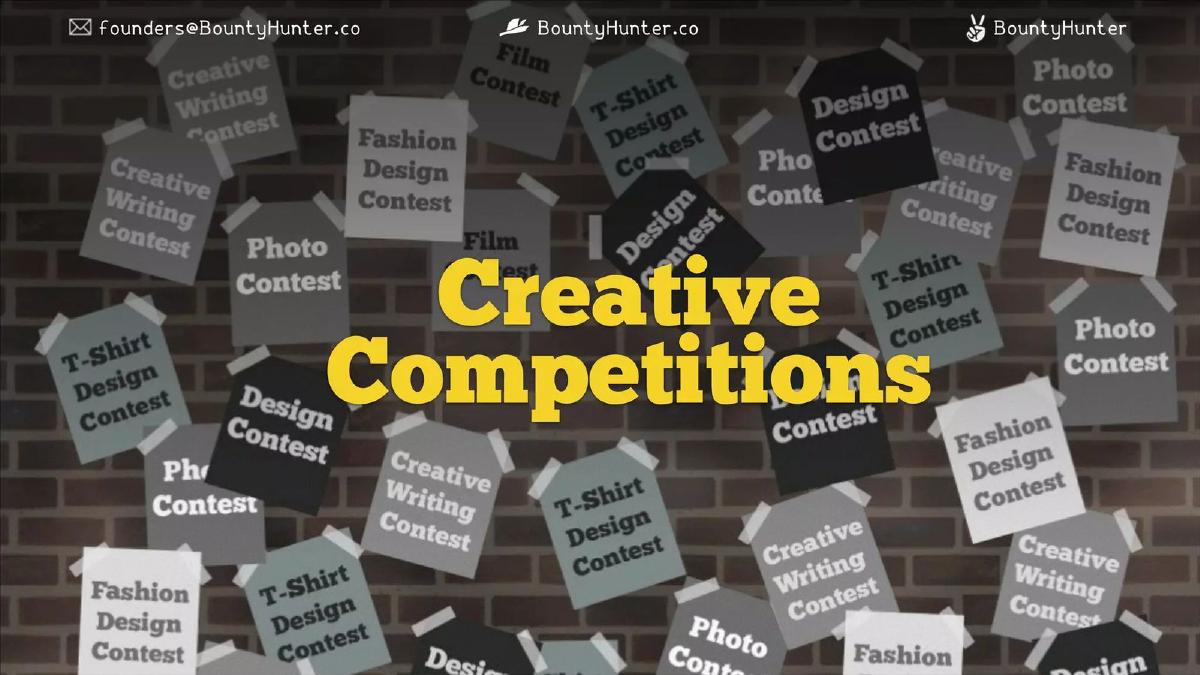
Slide 2 is a visual representation of the 'Creative Competitions' landscape. It features a brick wall covered in flyers for various contests: T-shirt design, film, photo, fashion, and creative writing. While this slide lacks text-based problem statements, it visually communicates the fragmented nature of the creative contest market. It implies that these competitions are happening everywhere but perhaps lack a centralized, professionalized hub to manage them. This sets the stage for BountyHunter to act as the aggregator and platform of record for these disparate activities.
Validation Through Big-Brand Partnerships
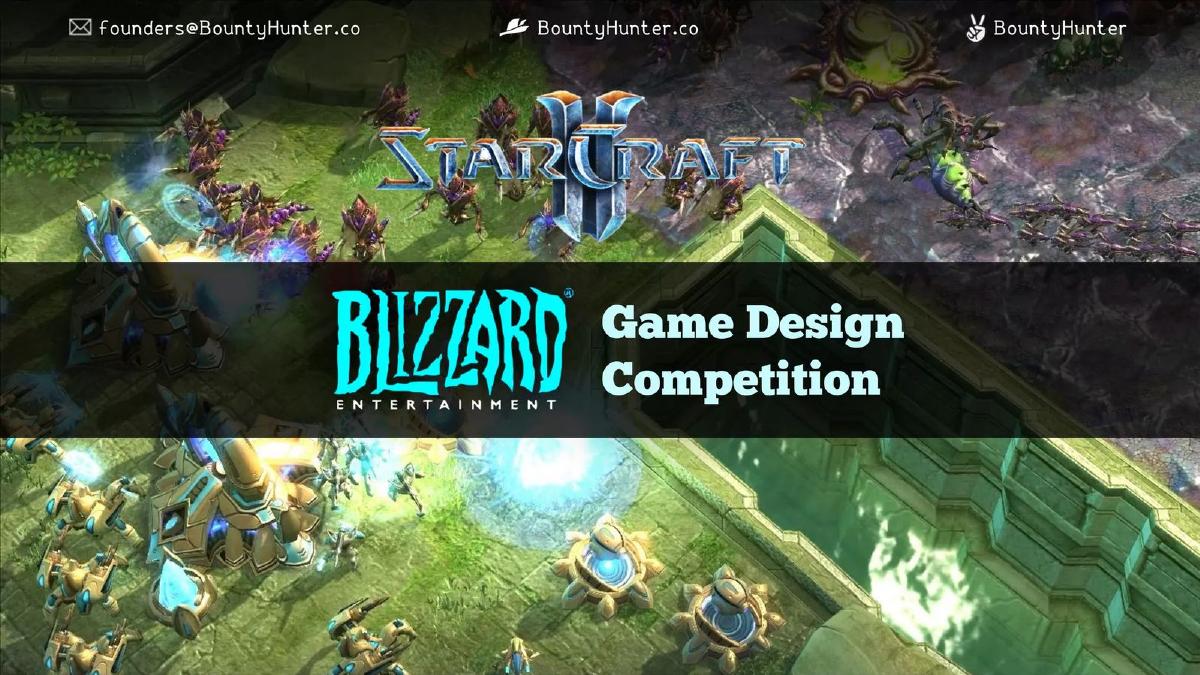
The core of this deck's strength lies in its social proof. Slide 3 introduces a specific case study: a Game Design Competition for Blizzard Entertainment’s StarCraft II. By leading with one of the most recognizable names in gaming, BountyHunter aligns its brand with high-quality, high-stakes creative work. This isn't just a theoretical platform; it is one trusted by Blizzard.
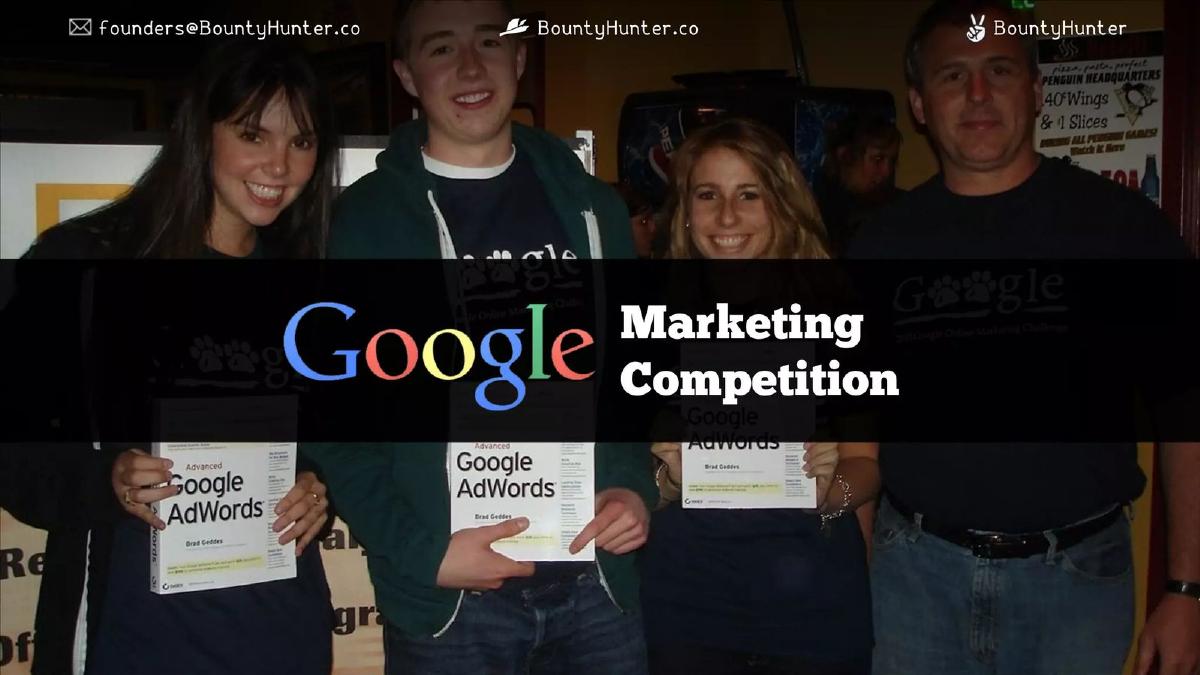
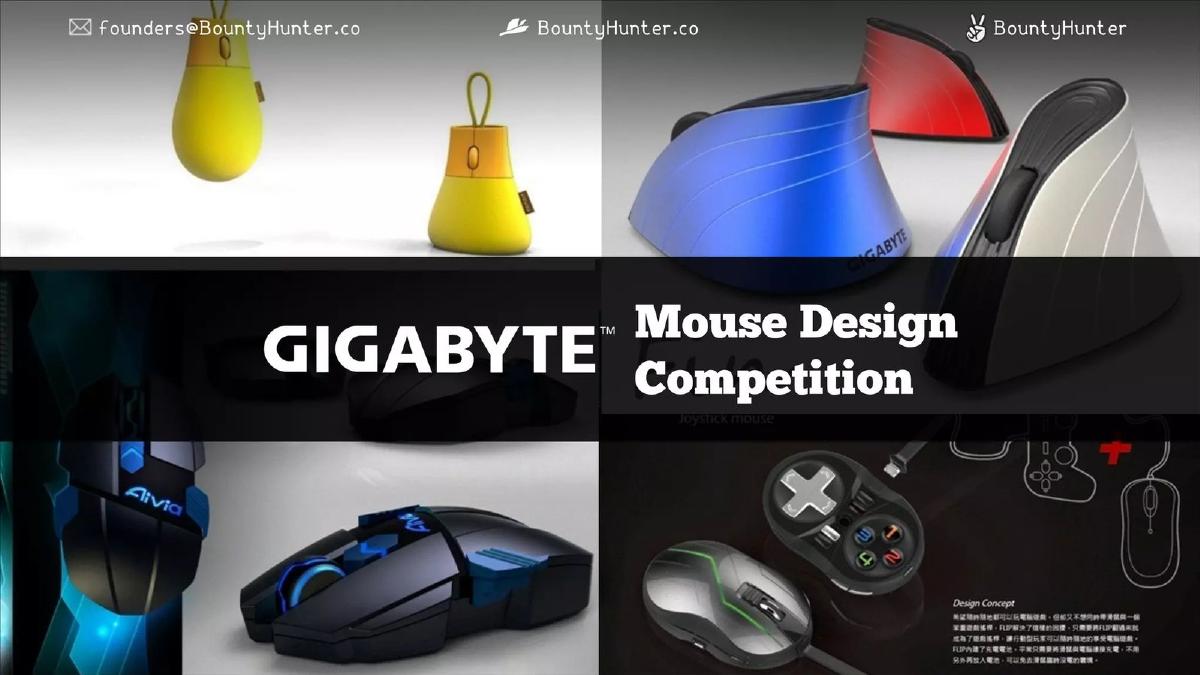
Slide 4 doubles down on this validation by providing hard numbers for three major clients: Google, Gigabyte, and Blizzard. The metrics are presented as 'Goal' versus 'Result,' which is an excellent way to demonstrate over-performance. For Google, the goal was 1,300 participants, but the result was 4,775. Gigabyte sought 40 mouse designs and received 140. Blizzard aimed for 25 game designs and received 35. These figures prove that the platform can consistently deliver more creative volume than the clients initially expect, which is a powerful selling point for any B2B service.
Market Reach and Client Roster
Slide 5 is a classic 'Logo Slide,' featuring Microsoft, Kabam, Lexus, Ogilvy, and Playboy alongside the previously mentioned brands. The inclusion of Ogilvy is particularly noteworthy, as it suggests that even top-tier traditional advertising agencies see value in using BountyHunter’s crowdsourcing model. The diversity of these logos—ranging from automotive (Lexus) to media (Playboy) to tech (Microsoft)—demonstrates that the platform’s utility is not limited to a single niche like gaming, but is applicable across any industry requiring creative input.
The Competitive Advantage: Volume and Engagement
Slide 6 presents the most direct 'Why Us' argument in the deck. It compares a 'Design firm' to 'BountyHunter.' The claim is stark: a traditional firm provides 3 to 6 designs, whereas a BountyHunter competition provides over 100. This slide addresses the value of choice and the 'long tail' of creativity. For a brand like Playboy (used as the example here), the platform offers a much wider net for finding a 'winning' design than a small team of internal or agency designers could ever produce.
Slide 7 provides a deeper look at the user interface and the community aspect of the platform. Using the Playboy Bag Design Competition as the example, it shows the voting mechanism. The results—125 designs and 8,137 votes/shares—highlight a secondary benefit of the platform: marketing. A design competition on BountyHunter isn't just a way to get a product designed; it’s a way to generate thousands of social interactions and brand impressions. This transforms the service from a simple design tool into a dual-purpose design and marketing platform.
Team and Contact Information
Slide 8 introduces the team. Hana Chang (Founder, Product) and Roxman Yang (Founder, Sales) are the leads. The team is small, with only four members listed, including BD and Marketing. The photos are casual, consistent with the 'Tavern' branding of the company. However, the slide is light on details regarding their specific backgrounds, years of experience, or previous exits. In a seed or Series A pitch, investors would typically want to see more 'why this team' evidence beyond just their current titles.
Slide 9 serves as the closing slide, providing contact information and a link to their AngelList profile. The background image of a live band continues the community/creative theme but doesn't add new information to the business case.
What Works in This Deck
1. Exceptional Social Proof: The deck does a masterful job of leveraging big-brand logos. For an early-stage company, having Google, Microsoft, and Blizzard as active clients is a massive de-risking factor for investors. It proves that the product is enterprise-ready and that there is a real demand for crowdsourced design among the world's largest companies.
2. Clear Metric Over-Performance: By showing that they consistently beat their goals (Slide 4), the founders demonstrate that their platform has a 'viral' or 'high-engagement' component that exceeds client expectations. This suggests a healthy, active user base of creators.
3. Simple Value Comparison: The comparison between a design firm (3-6 designs) and BountyHunter (100+ designs) is a 'lightbulb moment' slide. It clearly articulates the efficiency and variety advantage of the crowdsourcing model in a way that is easy to grasp instantly.
What Is Missing
1. Business Model: There is no mention of how BountyHunter makes money. Do they charge a flat fee per competition? Do they take a percentage of the prize pool? Is there a SaaS subscription for brands? Without this, it is impossible to evaluate the scalability or profitability of the business.
2. Market Size: The deck lacks a TAM (Total Addressable Market) slide. While they show they can work with big brands, they don't quantify how large the creative competition or crowdsourced design market is globally. Investors need to know if this is a billion-dollar opportunity or a niche lifestyle business.
3. The Ask: The most significant omission is the lack of a funding request. There is no information on how much they are raising, at what valuation, or what the milestones are for the next 18 months. This makes the deck feel more like a company credentials presentation than a fundraising tool.
Founder Takeaways
Focus on Outcomes: If you have big-name clients, do not just show their logos. Show the results you achieved for them, as BountyHunter did on Slide 4. Quantifiable success beats a logo wall every time.
Visual Consistency: BountyHunter maintained a very specific 'vibe' throughout the deck. While the tavern theme might be polarizing, it is memorable and gives the company a distinct identity in a sea of generic corporate decks.
Address the 'Why Now': While this deck is strong on 'What' and 'Who,' it lacks the 'Why Now.' Founders should ensure they explain why the current market conditions (e.g., the rise of the gig economy, the need for rapid content creation) make their solution essential at this specific moment.
Final Analysis
BountyHunter’s deck is a high-signal, low-data presentation. It relies almost entirely on the prestige of its client list and the volume of its creative output to tell the story. For a company coming out of 500 Startups, this 'traction-first' approach is common. However, to secure a lead investor for a significant round, the founders would need to supplement these slides with a rigorous financial model, a clear path to $100M in ARR, and a more detailed breakdown of their competitive moat beyond just 'having more designs.'
Frequently asked questions
- What is the core value proposition of BountyHunter?
- BountyHunter positions itself as a high-volume alternative to traditional design agencies. Slide 6 explicitly compares the two, noting that while a design firm might provide 3 to 6 concepts, a BountyHunter competition can generate over 100 designs. This allows brands to tap into a global pool of creators to find a wider variety of ideas and product designs at scale.
- Which major brands have used the BountyHunter platform?
- The deck features a significant number of Tier-1 global brands. Slide 5 displays logos for Google, Blizzard Entertainment, Microsoft, Kabam, Gigabyte, Lexus, Ogilvy, and Playboy. Slide 4 provides specific metrics for Google, Gigabyte, and Blizzard, indicating these were not just superficial partnerships but active campaigns with measurable participant outcomes.
- How does BountyHunter measure engagement for its clients?
- Engagement is measured through three primary metrics: number of participants, number of design submissions, and community interaction (votes/shares). For example, slide 7 shows a Playboy competition that resulted in 125 unique designs and 8,137 total votes or shares, suggesting the platform provides both creative output and marketing reach for the sponsoring brand.
- Who are the founders and what are their roles?
- The team slide (slide 8) identifies two founders: Hana Chang, who leads Product, and Roxman Yang, who leads Sales. They are supported by Young Chien in Business Development (BD) and Cody Juric in Marketing. The deck does not provide detailed professional backgrounds or past successes for these individuals, focusing instead on their current functional roles.
- What is missing from this pitch deck?
- The 9-slide sample is notably missing several standard venture components. There is no slide detailing the business model or how BountyHunter makes money (e.g., platform fees vs. commission). There is no market size (TAM/SAM/SOM) analysis, no competitor matrix, and no 'Ask' slide detailing how much capital is being raised or how it will be deployed.