Bragg Gaming Group’s May 2021 investor presentation serves as a post-RTO progress report, emphasizing the company's transition from a concentrated client base to a diversified global iGaming provider. The deck leans heavily on financial momentum, citing a 62% year-over-year revenue increase to C$20.9m in Q1 2021. By showcasing the acquisition of Oryx Gaming and the leadership’s deep roots in industry giants like DraftKings and SBTech, Bragg positions itself as a low-marginal-cost operator ready to capture the estimated $60b+ U.S. TAM. While the deck excels at demonstrating historical growth a…
Key takeaways
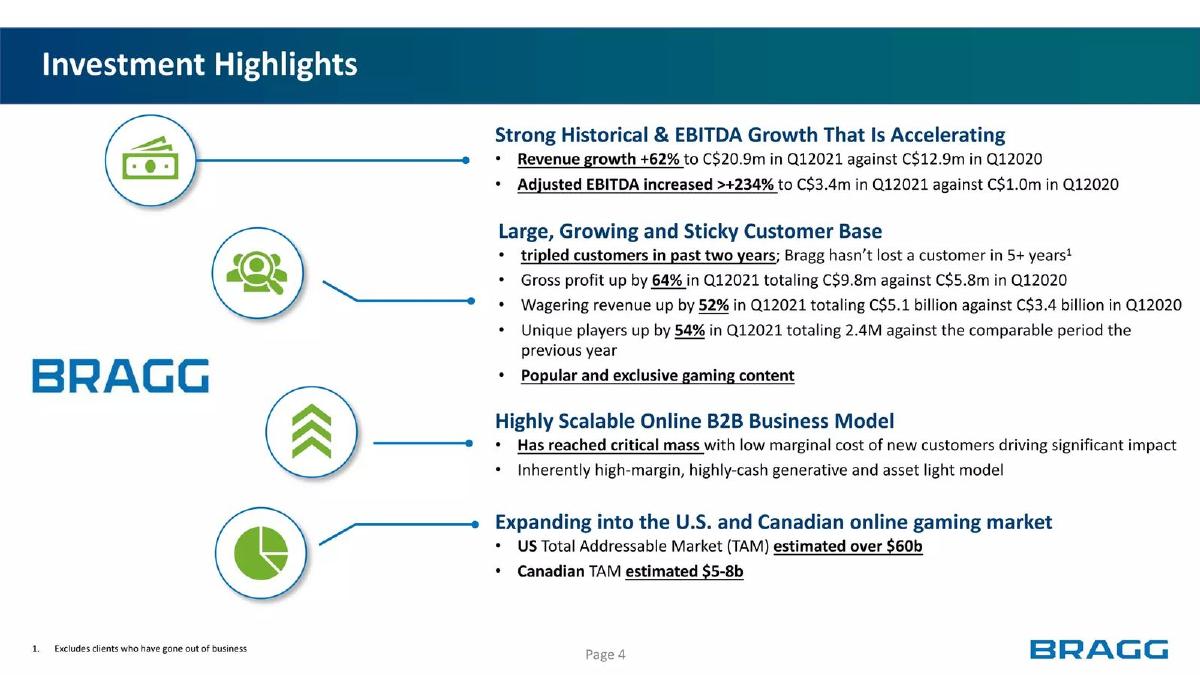
- Revenue grew 62% year-over-year to C$20.9m in Q1 2021, up from C$12.9m in Q1 2020 (Slide 4).
- Adjusted EBITDA saw a significant increase of over 234%, reaching C$3.4m in Q1 2021 (Slide 4).
- The company successfully diversified its revenue, reducing top 10 client concentration from 72% in FY2019 to 58% in FY2020 (Slide 8).
- Bragg targets a massive North American opportunity, estimating the U.S. Total Addressable Market at over $60b and Canada at $5-8b (Slide 4).
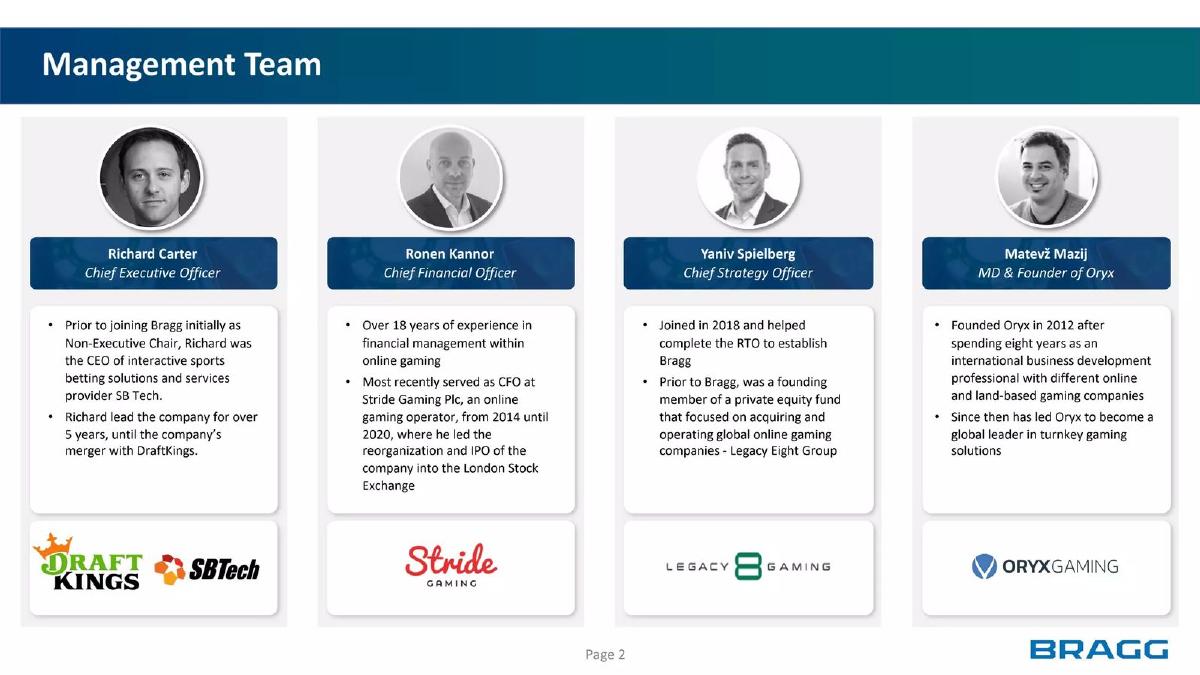
- The management team features high-level experience from DraftKings, SBTech, and Stride Gaming (Slide 2).
- The product suite is built on the Oryx Gaming acquisition, offering over 13,000 games from 100+ providers (Slide 6).
- The business model is described as 'asset light' and 'highly-cash generative' with low marginal costs for new customers (Slide 4).
- Growth strategy is centered on three pillars: enhancing technology, diversifying revenue, and entering new markets like Latin America (Slide 10).
Executive Summary: A Public Market Growth Story
The Bragg Gaming Group investor deck from May 2021 is a masterclass in presenting a high-growth, post-revenue company to the public markets. Unlike early-stage startup decks that focus on the 'problem' and 'solution' through a narrative lens, Bragg focuses on execution, scalability, and market capture . The deck serves as a progress report for a company that has already achieved significant scale, boasting C$69 million in FY2020 revenue and a clear path toward the lucrative North American iGaming market.
Slide 1: Title and Branding
The cover slide is minimalist, featuring the Bragg Gaming Group logo against a dark background with blue-tinted dice. The tagline "Up Your Gaming" and the date "May 2021" establish the context. It is a standard corporate title slide that relies on industry-specific imagery to set the tone for an audience already familiar with the gambling and gaming sector.
Slide 2: Management Team
This slide is a significant strength for Bragg. It doesn't just list names; it highlights pedigree and successful exits . Richard Carter (CEO) is linked directly to the DraftKings/SBTech merger, one of the most significant events in the industry at that time. Ronen Kannor (CFO) is credited with leading Stride Gaming to an IPO on the London Stock Exchange. Yaniv Spielberg (CSO) is noted for his role in the RTO (Reverse Takeover) that established Bragg, and Matevž Mazij is presented as the technical founder of Oryx, the core engine of the company. By including the logos of DraftKings, SBTech, Stride, and Oryx at the bottom, the slide uses visual shorthand to communicate that this team has 'been there and done that' at the highest levels of the industry.
Slide 4: Investment Highlights
Slide 4 serves as the 'Executive Summary' of the company's current state. It is dense with metrics, which is exactly what public market investors look for. Key figures include:
Revenue growth: +62% to C$20.9m in Q1 2021. · Adjusted EBITDA: Increased >234% to C$3.4m. · Customer Retention: The claim that Bragg "hasn't lost a customer in 5+ years" is a powerful indicator of product-market fit and stickiness. · Market Opportunity: A combined U.S. and Canadian TAM of over $65 billion.
The slide also characterizes the business model as "asset light" and "highly-cash generative," which are keywords for investors seeking high-margin software plays rather than capital-intensive operations.
Slide 6: Oryx Products and Services
This slide explains the 'What' of the business. Bragg operates through Oryx Gaming, providing turnkey solutions across three verticals: Casino, Sportsbook, and Lottery . The slide highlights the scale of their content aggregation: 13,000+ games from 100+ providers. It also mentions the "Oryx HUB" and "iGaming Platform," positioning the company not just as a content provider, but as the underlying infrastructure (omni-channel, real-time data processing, fraud management) that allows operators to run their businesses. This reinforces the B2B 'toll booth' model where Bragg earns a piece of the action across a massive volume of play.
Slide 8: Exceptional Track Record of Revenue Growth
This is arguably the most important slide in the deck for a growth-stage investor. It provides a quarterly bar chart from Q4 2018 to Q1 2021. The visual shows a clear, albeit slightly non-linear, upward trajectory. Revenue increased from C$41.5 million in FY2019 to C$69 million in FY2020 . The slide also addresses a common investor concern: concentration risk. By stating that the top 10 clients now represent 58% of revenue (down from 72%), Bragg demonstrates that they are successfully diversifying their base and becoming a more stable, less vulnerable entity.
Slide 10: Our Vision and Growth Strategy
Bragg outlines a three-pillar strategy to become a "Leading Online Gaming Solution Provider":
Enhancing Technology: Continued investment in proprietary content and platform tools. · Diversify Revenues: Moving into new products like instant-win games and enhancing platform services. · New Markets: A specific focus on the U.S., Canada, and Latin America.
The green arrow pointing toward "Value for Shareholders" is a bit cliché, but the underlying goals are concrete and measurable. It connects the technical roadmap directly to the financial outcome.
Slide 12: Diversify Product Offering
This slide provides a visual breakdown of the second pillar of their growth strategy. It shows logos of content partners like Gamomat, Golden Hero, Kalamba, and Givme Games . It also previews their entry into "new products" like mobile-optimized slots and card games. The mention of "Realtime tournaments" and "customizable jackpots" under platform services suggests a move toward gamification tools that help their B2B clients increase player lifetime value (LTV). This slide is designed to show that Bragg is not a static company but one that is constantly expanding its feature set to stay competitive.
What Bragg Gaming Group Does Well
The deck is exceptionally strong at quantifying success . In a sector often clouded by regulatory complexity, Bragg stays focused on the numbers: revenue, EBITDA, unique players, and TAM. The use of a pro forma basis (noted on Slide 8) for their historical charts allows for a clean comparison that accounts for the Oryx acquisition, giving investors a realistic view of the combined entity's momentum.
Furthermore, the management slide is one of the best examples of 'founder-market fit' in a corporate context. By emphasizing their roles in the DraftKings/SBTech merger, they immediately establish credibility in the U.S. market—a key area of their growth strategy.
What Is Missing from the Deck
While the deck is comprehensive for a public company update, it omits several key elements that a private venture investor would typically demand:
Unit Economics: There is no mention of Customer Acquisition Cost (CAC) or the specific take-rate (commission percentage) they earn from their B2B partners. · Competitive Landscape: The deck operates in a vacuum. It does not name competitors or explain how Bragg’s technology is superior to other aggregators or platform providers. · The 'Ask': As this is an investor presentation for a likely already-public or late-stage entity, there is no specific request for capital or a breakdown of how a new round of funding would be allocated. · Regulatory Risks: The gaming industry is highly regulated. While "Compliance with Regulation" is mentioned as a footer on Slide 10, the deck does not detail the specific licenses they hold or the hurdles they face in new jurisdictions like the U.S.
Founder Takeaways: Copy These Moves
1. Use 'Anchor' Logos: If your team has experience at industry leaders, don't just write the names in text. Use the logos. Bragg’s use of the DraftKings logo (Slide 2) immediately elevates the perceived value of their leadership team.
2. Address the 'Elephant in the Room': If your company has a high client concentration, show a chart of how you are fixing it. Slide 8’s highlight of reducing top 10 client dependency from 72% to 58% turns a potential weakness into a proof point of successful execution.
3. Define the TAM with Specificity: Bragg doesn't just say the market is 'big.' They break it down by region (U.S. vs. Canada) and provide specific dollar estimates (Slide 4). This helps investors understand exactly which 'pockets' of the market the company is targeting.
4. The Power of 'Zero Churn': If you have a sticky product, shout it from the rooftops. The claim on Slide 4 that they haven't lost a customer in 5 years is a massive de-risking statement for any investor.
Frequently asked questions
- What is Bragg Gaming Group's primary business model?
- Bragg operates as a B2B online gaming solution provider. According to slide 4, they utilize a highly scalable, asset-light model with low marginal costs for adding new customers. Their core offering, detailed on slide 6, includes turnkey solutions for casino, sportsbook, and lottery operations, powered by their Oryx Gaming subsidiary.
- How has the company's financial performance trended recently?
- The company has shown strong upward momentum. Slide 8 illustrates a quarterly revenue climb from C$9.4m in Q4 2018 to C$20.9m in Q1 2021. Notably, FY2020 revenue reached C$69 million, a significant jump from C$41.5 million in FY2019, representing a 66% annual increase.
- Who are the key leaders driving Bragg's strategy?
- The management team is led by CEO Richard Carter, formerly CEO of SBTech (which merged with DraftKings). Other key figures include CFO Ronen Kannor, who led Stride Gaming to an IPO, and Matevž Mazij, the founder of Oryx Gaming. This combination of M&A, public market, and technical founder experience is highlighted on slide 2.
- What is the company's plan for market expansion?
- Bragg is aggressively targeting the North American market. Slide 4 estimates the combined U.S. and Canadian TAM at over $65 billion. Slide 10 outlines a strategy to extend into these regions, as well as Latin America, through a combination of technology investment and strategic partnerships.
- Is the company's revenue heavily dependent on a few clients?
- While historically concentrated, Bragg is actively diversifying. Slide 8 notes that revenue from the top 10 clients dropped from 72% in FY2019 to 58% in FY2020. This diversification is a core part of their growth strategy to reduce platform risk and increase stability.