Juego Studios' 2022 NFT game deck is a five-page portfolio and collaboration deck, not a fundraising deck: a cover, three shipped-game slides and a “Let's Collaborate” contact page. It leads with real work and closes on a named human, which is right. But it contains no numbers, no team, no business model and two portfolio slides that are mislabelled or unlabelled — so it stops working the moment it is forwarded without the founder on the call.
Key takeaways
- The Juego Studios deck is a five-page portfolio and collaboration deck built in Canva on 17 February 2022, not a venture fundraising deck.
- Three of its five pages are shipped games, which is the correct opening move for a studio selling execution rather than a thesis.
- The deck contains no numbers at all — no downloads, revenue, retention, headcount or years in business — so a reader cannot compare it to any other studio.
- Slide 3 labels premium fantasy RPG artwork as a “social slot game”, and slide 4 carries no label whatsoever, so roughly half the portfolio fails to transmit what it proves.
- A personal @iCartic watermark on every page makes a decade-old studio's material read as one individual's outbound collateral.
- The closing slide names a person with a phone number and an email, which beats a company inbox, but it sets no threshold for what a good inbound project looks like.
- Adding a five-field caption — title, genre, role, platform, result — to each portfolio slide would roughly double the deck's information density without adding a page.
- The deck's real failure is interpretive: it shows evidence and withholds the meaning, so a busy reader supplies the cheapest interpretation available.
What this deck actually is
Before analysing a single slide, classify the document honestly, because almost every mistake founders make when they copy a deck comes from copying the wrong kind of deck.
The Juego Studios "NFT game deck" is not a venture fundraising deck. It is a five-page capability and collaboration deck, built in Canva and exported on 17 February 2022, at the top of the NFT and play-to-earn cycle. The PDF metadata names the author as Cartic P, and every page is watermarked with the personal handle @iCartic . The final slide is headed "Let's Collaborate" and carries a name, a website, a phone number and an email address. There is no raise amount, no cap table, no financial model, no market sizing and no team page.
That makes it a partnership or business-development deck: a document a game studio sends to a token project, a publisher or a Web3 founder who needs games built. Juego Studios is a Bangalore-headquartered game and app development studio that has been building work-for-hire games since 2011. In 2022 a very large number of NFT projects had a treasury and a Discord community but no game, and studios like Juego were selling the missing half. This deck is the door-opener for that conversation.
Teardowns of decks like this are useful for exactly one reason: they show you, in five pages, the ceiling of what a portfolio-led document can achieve and the precise point where it stops working. If you are a services business, an agency, a studio, or a founder pitching a partnership rather than an equity round, this deck is closer to your reality than Airbnb's seed deck will ever be. And if you are raising, this deck is a clean case study in what an investor deck must add on top of proof of work.
Slide-by-slide walkthrough
Slide 1 — Cover: logo only
A cream background, two orange arcs bleeding off opposite corners, the Juego Studios logo centred, and the words "game deck" in small type. The @iCartic handle sits bottom right.
What works: the visual identity is confident and consistent, and the file loads as something made by people who can make things look good — which, for a game art and development studio, is itself part of the pitch. A studio whose deck looks amateur is telling you what its output looks like.
What does not work: the cover carries no positioning line. "Game deck" is a filename, not a claim. The reader does not learn, on page one, that Juego builds full-stack NFT and play-to-earn games for other people's IP. In a deck with only five pages, spending the first one on a logo costs 20% of the total surface area and delivers no information. A single line — "We build NFT and play-to-earn games end to end. Here are three we shipped." — would have converted the cover from decoration into an argument.
Slide 2 — Tap Coins aka Game-X-Change
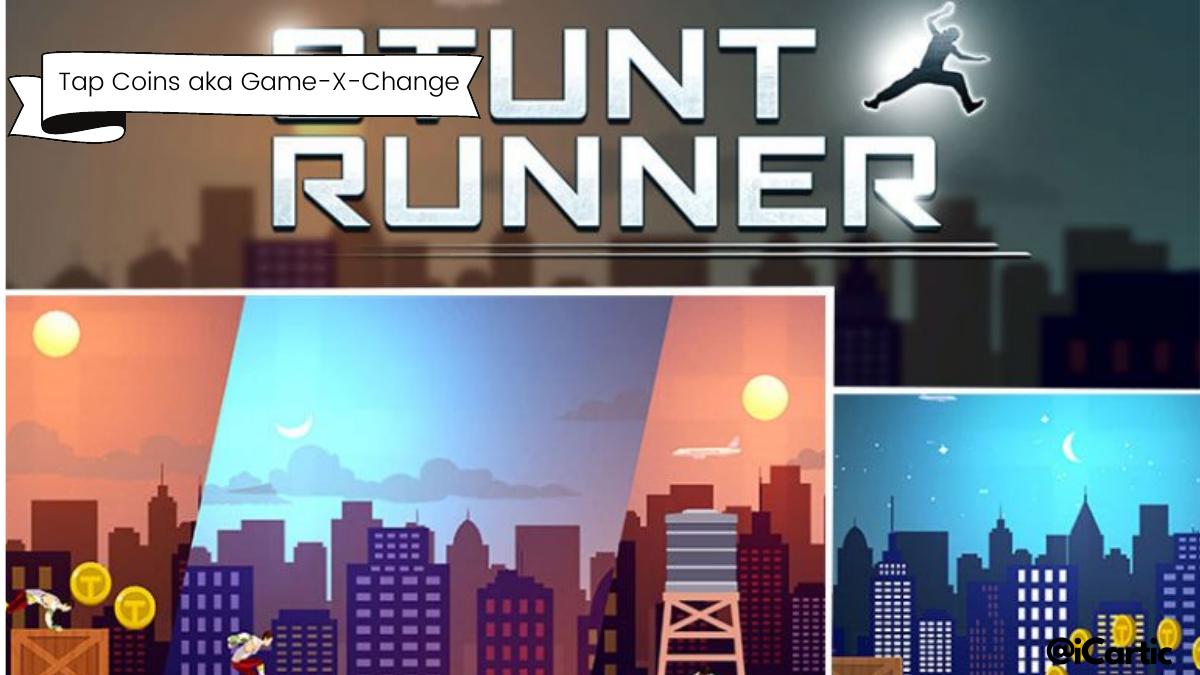
The first portfolio page. A hand-lettered banner label reads "Tap Coins aka Game-X-Change", laid over key art from an endless runner titled Stunt Runner , plus three in-game screenshots showing the same city skyline at dawn, day and night, with a running character collecting coins.
The concept underneath the label is the most commercially interesting idea in the whole deck: an in-game tap-to-earn coin economy with an exchange layer, so coins earned in casual play convert into something tradable. In February 2022 that was the core mechanic of the entire play-to-earn thesis. This slide is where a partner's interest actually starts.
And it is where the deck under-delivers hardest. There is no player count, no session length, no retention curve, no revenue figure, no platform, no launch date, no client name. The screenshots prove the art was made. They do not prove the game worked. For a work-for-hire studio, that distinction is the entire sale: any studio can show renders; the studio that shows a D7 retention number and a live app store link wins the contract.
Slide 3 — Social slot game
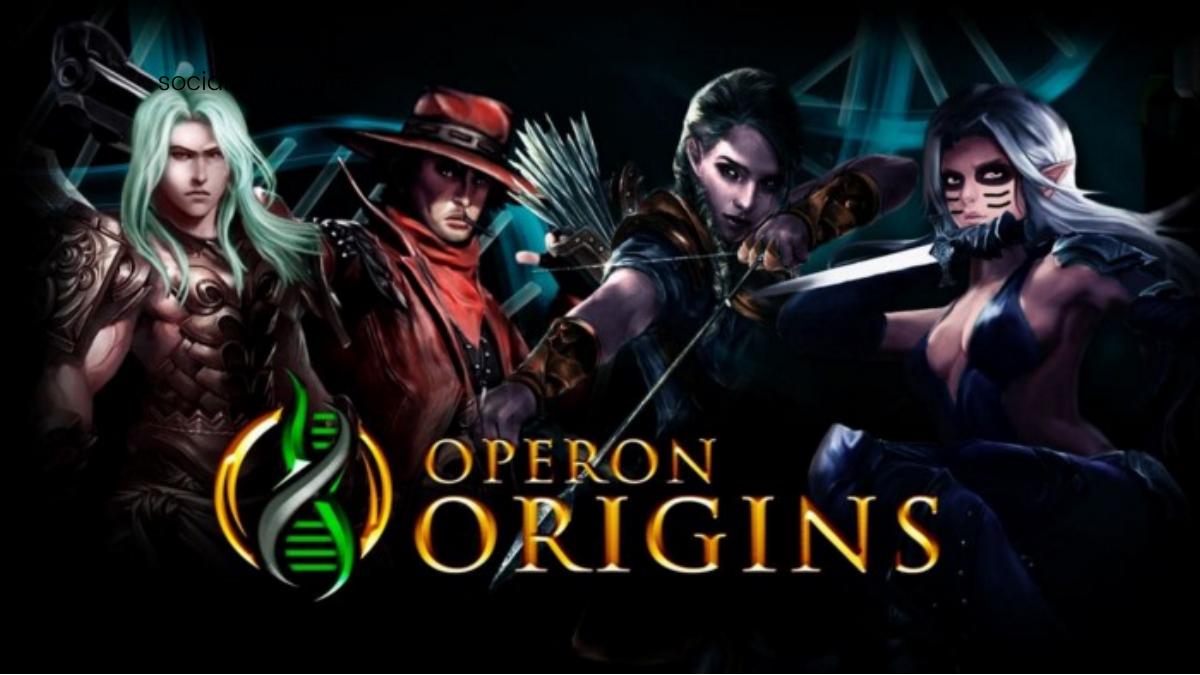
A near-full-bleed piece of key art for Operon Origins , showing four fantasy characters — a warrior, a gunslinger, an archer and an assassin — against a dark arena background. The label "social slot game" is set in small pale text top-left, where it partly disappears into the artwork.
Two problems compound here. First, the label contradicts the visual: the art reads as a premium card-battle or fantasy RPG title, not a social casino product. A reader who spends three seconds on the page leaves with the wrong idea of what was built. Second, the label is genuinely hard to read. Any text placed directly on complex artwork needs a scrim, a plate, or a caption bar beneath the image. This deck uses a clean banner device on slide 2 and then abandons it here — the inconsistency makes the deck feel assembled rather than designed.
The underlying credential is strong. Operon Origins is a real released title, and blockchain-adjacent collectible-character games were precisely what NFT projects wanted in 2022. It is described in four words.
Slide 4 — Age of Gods (unlabelled)
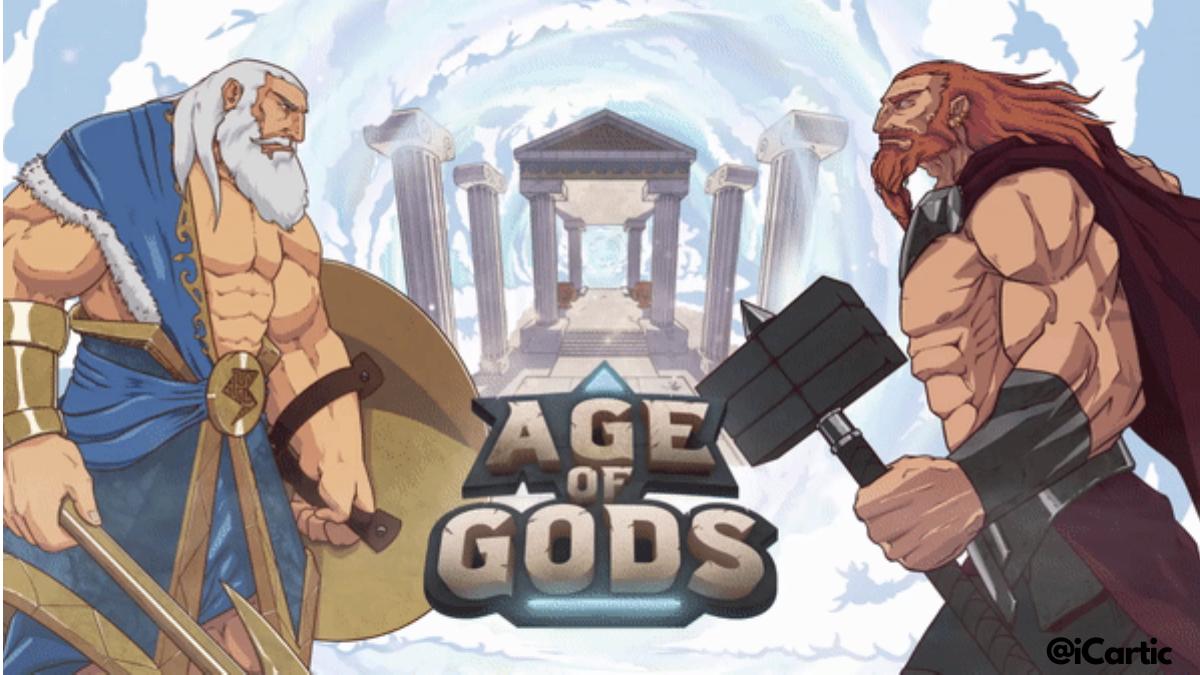
Full-bleed key art for Age of Gods : two mythological figures facing off in front of a temple. It is the best-looking page in the deck. It also carries no label at all — no title, no genre, no role, no result. The only text on the page is the @iCartic watermark.
An unlabelled portfolio slide asks the reader to do the studio's work. Did Juego build this, art-direct it, port it, or co-develop it? Was it shipped? On which platform? A partner evaluating three studios in one afternoon will not chase that down; they will assume the least impressive answer that fits the evidence. Where a slide is silent, the reader fills the silence pessimistically. That is true in a partner meeting and it is doubly true in an investor meeting.
Slide 5 — Let's Collaborate
The closing page returns to the cream-and-orange cover treatment. "LET'S COLLABORATE" is set large and angled, followed by the contact block: Cartic P, @iCartic, www.JuegoStudio.com, a phone number and an email address.
This is the deck's most decisive page, and it is the one most founders get wrong in the opposite direction. It names one human being, gives three ways to reach him, and states the desired relationship — collaboration, not investment. There is no ambiguity about what happens next.
What is missing is the shape of the engagement. There is no indication of what Juego wants to be sent, what a typical project looks like, what team it can allocate, how long a build takes, or what it costs. "Let's collaborate" is an invitation without a threshold, so it attracts tyre-kickers as efficiently as it attracts buyers.
What a five-slide deck can and cannot do
There is a persistent piece of advice that decks should be short, and this deck is a good place to test it. Five pages is the right length for a document whose only job is to get a reply. It is the wrong length for a document that has to survive being forwarded.
Those are two different jobs, and the second one is where most decks die. The person who opens your deck first is rarely the person who decides. A partnership deck gets forwarded to a producer or a CTO. An investor deck gets forwarded to an associate, then to a partner, then into a Monday meeting where nobody in the room has met you. At each hop, the deck loses the voice-over that made it make sense. Everything the sender said out loud disappears, and only what is printed survives.
Judged that way, this deck loses most of its value on the first forward. Without Cartic on the call to say "we built that one end to end, it shipped on iOS and Android, here is what it did", slides 2 through 4 are three pretty pictures. The fix is not more pages. It is more sentences on the pages that already exist — the five-field caption described below costs no additional slide and makes the deck forwardable.
The practical rule: write every slide as though you will not be in the room when it is read, then keep the page count short by deleting slides rather than by deleting words from the slides you keep. Short and self-contained beats short and dependent every time, and it beats long and thorough almost as often.
Why this deck existed in February 2022
Context matters for judging it fairly. In early 2022, capital had flooded into Web3 gaming, and a very specific shortage had opened up: hundreds of projects had raised on a token and a roadmap, and could not build the game the roadmap promised. Studios with a decade of work-for-hire experience were suddenly the scarce input, and the fastest way to reach those buyers was to reframe an existing portfolio in their language.
That is what this document is — a rapid, opportunistic repositioning, assembled in Canva by one person, aimed at a window that stayed open for roughly nine months. Seen that way, several of its shortcuts are defensible. Speed genuinely mattered more than polish, and a five-page attachment to a direct message is a rational format for that moment.
What is not defensible is the missing labelling, because that cost nothing to fix. Captioning three portfolio slides properly is twenty minutes of work, and it is the difference between a deck that survives a forward and one that does not.
What this deck does better than most startup pitch decks
It is five pages. Most founders send 24 slides to a first conversation. This deck respects that the first document's only job is to earn the meeting, and it stops the moment it has made its case. · It leads with work, not with words. Three of five pages are shipped product. No mission statement, no "we are disrupting", no macro-trend slide about the size of the gaming market. For a studio selling execution, showing the execution is the correct opening move. · It has one visual identity and commits to it. Cover and closer share the same cream-and-orange system so the portfolio pages sit inside a frame. Even in a deck built in Canva, that consistency reads as care. · It names a person, not a company inbox. The closing slide is a named individual with a direct phone number and email. Decks that close on "info@" lose replies that decks closing on a human keep. · It states the ask it actually wants. "Let's Collaborate" is honest about the transaction on offer. Far more decks blur the line between a partnership pitch and a funding pitch and end up achieving neither. · It was timed to the market. Building an NFT-specific version of a general portfolio in early 2022 is exactly the right instinct: the pitch is reframed around the buyer's current obsession rather than around the seller's full capability list.
Where this deck would fail in an investor meeting
No numbers of any kind. There is not a single figure in the deck — no downloads, no revenue, no retention, no headcount, no years in business. An investor cannot underwrite adjectives, and a partner cannot compare studios without at least one comparable metric. · No team page. For a services business, the team is the product. The deck never says how many engineers, artists or Solidity developers Juego can put on a project. · No business model. Fixed-bid, time-and-materials, revenue share, token allocation? In 2022, whether a studio would take part of its fee in tokens was the single most important commercial question in Web3 game development, and the deck does not touch it. · No client names or testimonials. Three games are shown; not one publisher, client or partner is credited. NDA constraints are real, but "shipped for a top-10 mobile publisher" is sayable and this deck does not say it. · Two of three portfolio slides are mislabelled or unlabelled. Slide 3's label fights its artwork; slide 4 has no label at all. Roughly half the portfolio therefore fails to transmit what it is supposed to prove. · A personal watermark on a company deck. The @iCartic handle on every page signals that this is one person's outbound collateral rather than the studio's institutional material. It is fine for a founder-led DM; it undercuts the credibility of a company that has existed for over a decade. · No process or timeline. Buyers of game development are buying predictability. Nothing in the deck describes discovery, milestones, QA or delivery. · No differentiation. Dozens of studios could have sent this same five-page structure in February 2022. Nothing here answers "why you and not the other three studios in my inbox?"
Portfolio deck vs investor deck: what actually changes
Dimension This deck (portfolio / collaboration) What an investor deck must add
Length 5 pages is correct 12–18 slides, because the burden of proof is higher
Core evidence Shipped work you can see Growth, retention and revenue you can verify
Team Optional; the work implies it Mandatory, with why-this-team-wins framing
Market Implied by the buyer's own need Explicit, bottom-up, with a named beachhead
Business model Discussed on the call On a slide, with pricing and unit economics
Competition Rarely shown Named honestly, with a defensibility claim
The ask "Let's collaborate" Amount, runway purchased, milestones unlocked
Closing slide Contact details Contact details plus the specific next step
How you would rebuild this deck today
Put the claim on the cover. Replace "game deck" with the sentence a buyer needs: what you build, for whom, and how many times you have done it. One line, page one. · Give every portfolio slide the same five-field caption. Title, genre, your role, platform, and one result. Same position, same treatment, every page. This single change would roughly double the information density of the deck without adding a page. · Put a number on each game. Downloads, rating, months to ship, team size, live status. Any verifiable figure beats none, and one number per slide is enough to move the deck from "renders" to "record". · Fix the label–art mismatch. If the art reads as fantasy RPG, do not caption it "social slot game". Either recaption honestly or swap the artwork for something that matches the claim. · Add one page of proof-of-process. Team composition, typical timeline, engagement models. For a services pitch this converts better than a fourth portfolio slide, because it answers the buyer's real fear, which is delivery risk. · Replace the personal watermark with the company mark. Keep the named human on the closing slide; take the personal handle off every other page. · Sharpen the close. "Let's collaborate" becomes "Send us your game design doc and we'll return a scoped build plan and timeline in five working days." Same warmth, an actual threshold, a far better filter. · Date the deck. A deck built around a 2022 market moment needs a visible date, or it silently ages into looking stale the moment the cycle turns.
The transferable lesson
Juego Studios' deck fails in the most instructive way possible: not because the work is weak, but because the deck never tells you how strong the work is. Three shipped games are on the page. Their titles, results, roles and clients are not. The reader is shown evidence and denied the interpretation, so the reader supplies their own — and the interpretation a busy reader supplies is always the cheapest one.
That is the failure mode in the overwhelming majority of decks, whether the reader is a partner or a partner at a fund. Founders assume the strength of the underlying business is visible in the artefact. It rarely is. What is visible is the labelling: the caption on the screenshot, the number under the logo, the sentence on the cover, the specific next step on the closing page. A deck is not a record of what you have done. It is an argument about what it means.
Which means the useful question about your own deck is not "does it look good?" — this one does. It is "if a stranger reads it for ninety seconds and never speaks to me, what do they conclude?" Most founders have never had that answered honestly, because the people who read their deck either say something polite or say nothing at all.
Frequently asked questions
- What is the Juego Studios pitch deck?
- It is a five-page NFT game deck exported on 17 February 2022 by Juego Studios, a Bangalore-based game and app development studio. It is a portfolio and collaboration deck used for business development with Web3 projects and publishers, not a deck used to raise venture capital. It contains a cover, three shipped-game slides and a contact page.
- Is the Juego Studios deck a pitch deck for investors?
- No. There is no raise amount, no market sizing, no financial model, no team slide and no use of funds. The final slide is headed “Let's Collaborate” and lists a name, website, phone number and email. It is a partnership pitch aimed at NFT projects that needed a studio to build their game.
- What games are shown in the Juego Studios deck?
- Three: Stunt Runner, presented under the label “Tap Coins aka Game-X-Change” and showing an endless runner with a coin economy; Operon Origins, labelled “social slot game” despite fantasy character artwork; and Age of Gods, shown as full-bleed key art with no label, title or description at all.
- Which slides should founders copy from this deck?
- Two. The portfolio-first structure, because leading with shipped work beats leading with a mission statement when you are selling execution. And the closing slide, because it names a single human with a direct phone number and email rather than a generic company inbox, which measurably improves reply rates.
- What is the biggest mistake in the Juego Studios pitch deck?
- Unlabelled and mislabelled portfolio slides. One game is captioned as a genre its artwork clearly contradicts and another carries no caption at all, so the reader cannot tell what Juego built, what role it played, or whether the title shipped. Fixing it would have taken twenty minutes and cost no extra pages.
- How many slides should a portfolio or partnership deck have?
- Five to eight is usually right, but page count matters less than self-containment. Assume your deck will be forwarded to someone you never speak to. Every slide has to make its point without your voice-over, so shorten by deleting slides rather than by deleting the captions and numbers on the slides you keep.