Jubilee’s 2023 pitch deck, which secured $1.1M in Seed funding as reported by Business Insider, is a masterclass in leveraging existing distribution to justify a new product launch. The deck establishes Jubilee as a media powerhouse with over 500 million quarterly views and 12.3 million subscribers across platforms like YouTube, TikTok, and Snapchat. The core thesis is that Gen Z viewers want to move from passive viewership to active participation, specifically in the realm of romantic connection. By identifying a market gap in the 'broken' dating app culture—citing a -25 NPS for existing app…
Key takeaways
- The company reports reaching over 500M+ quarterly views as of Q2 2022 on slide 3.
- Jubilee claims a total subscriber base of 12.3M+, with YouTube accounting for 56.1% of that total on slide 3.
- The deck identifies a specific market pain point: dating apps have an average NPS score of -25 according to slide 7.
- The strategic pivot is defined as moving from 'Viewership' to 'Participation' on slide 5.
- Nectar is introduced on slide 9 as a new brand focused on 'a new way to love.'
- The investor roster on slide 11 includes tech luminaries like Steve Chen (YouTube), Kevin Lin (Twitch), and Sam Yam (Patreon).
- The deck omits a traditional 'Team' slide for the founders, focusing instead on the 'team of investors' on slide 11.
- There is no mention of specific revenue figures, burn rate, or the exact dollar amount of the 'ask' within the 12 slides.
The Vision: From Content to Connection
Jubilee’s pitch deck is a concise 12-slide narrative that focuses on the evolution of a media brand into a technology platform. As reported by Business Insider, this deck helped secure $1.1M in Seed funding in 2023. The presentation does not follow the traditional problem-solution-product-market format. Instead, it builds a case based on massive existing distribution and a cultural shift in how Gen Z interacts with media.
Slide 1: Title and Mission
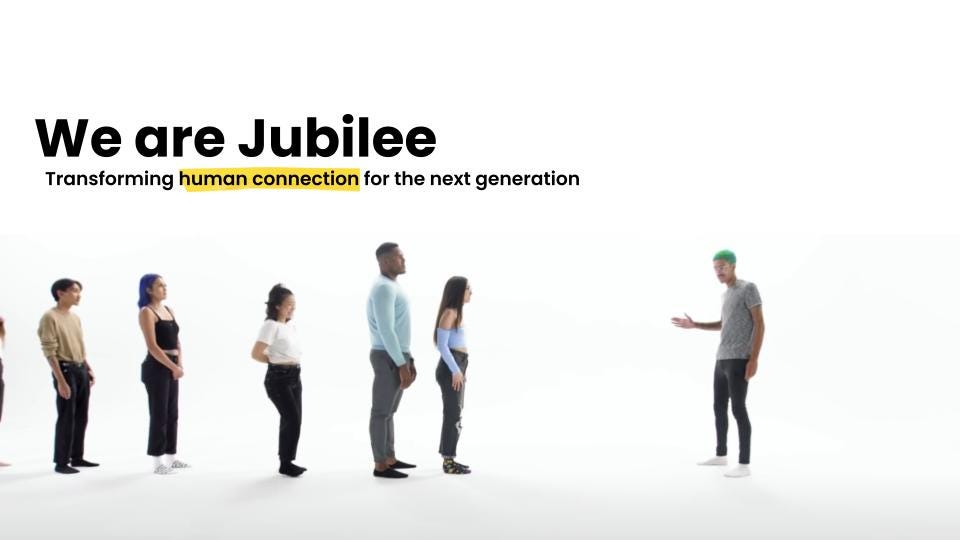
The deck opens with a minimalist title slide: "We are Jubilee" . The subtitle, "Transforming human connection for the next generation," sets a broad, ambitious tone. The background image features a line of diverse young people in a studio setting, which is the signature aesthetic of their viral YouTube content. This immediately signals to the investor that the company is already operational and has a defined brand identity.
Slide 2: The Core Identity
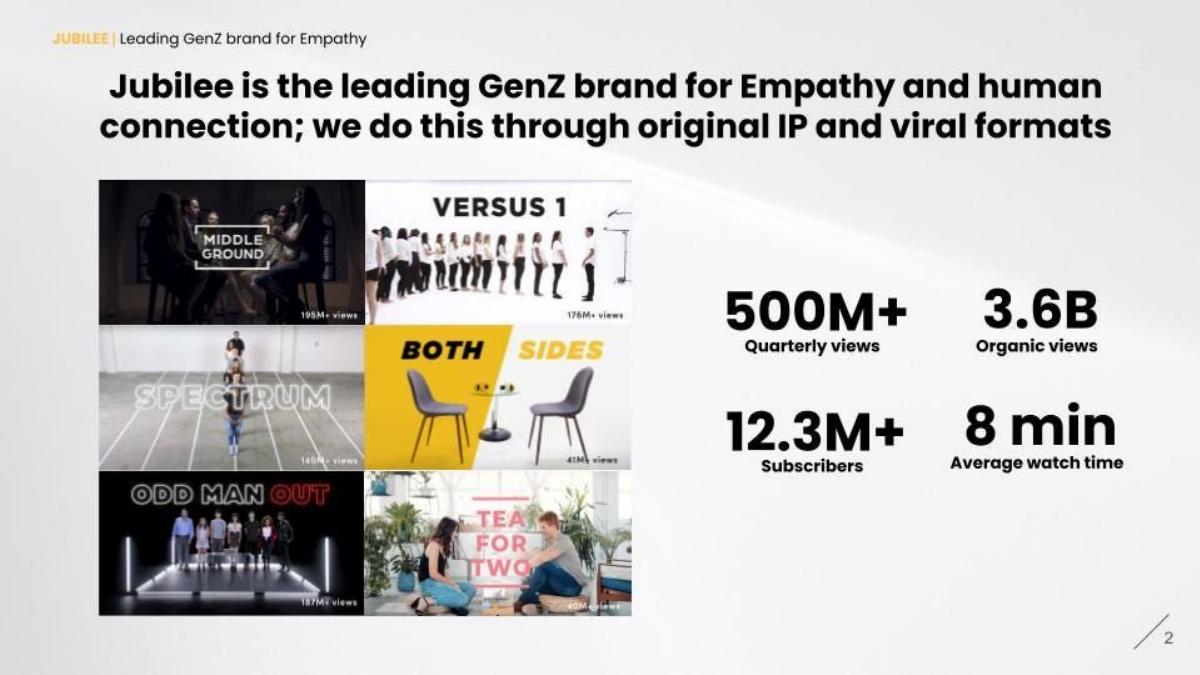
Slide 2 reinforces the brand's mission. While the text is not provided in detail, the publisher summary indicates this section likely establishes Jubilee as a media company and content studio focused on empathy. This serves as the foundation for the 'why' behind their upcoming product launches.
Slide 3: Massive Organic Traction
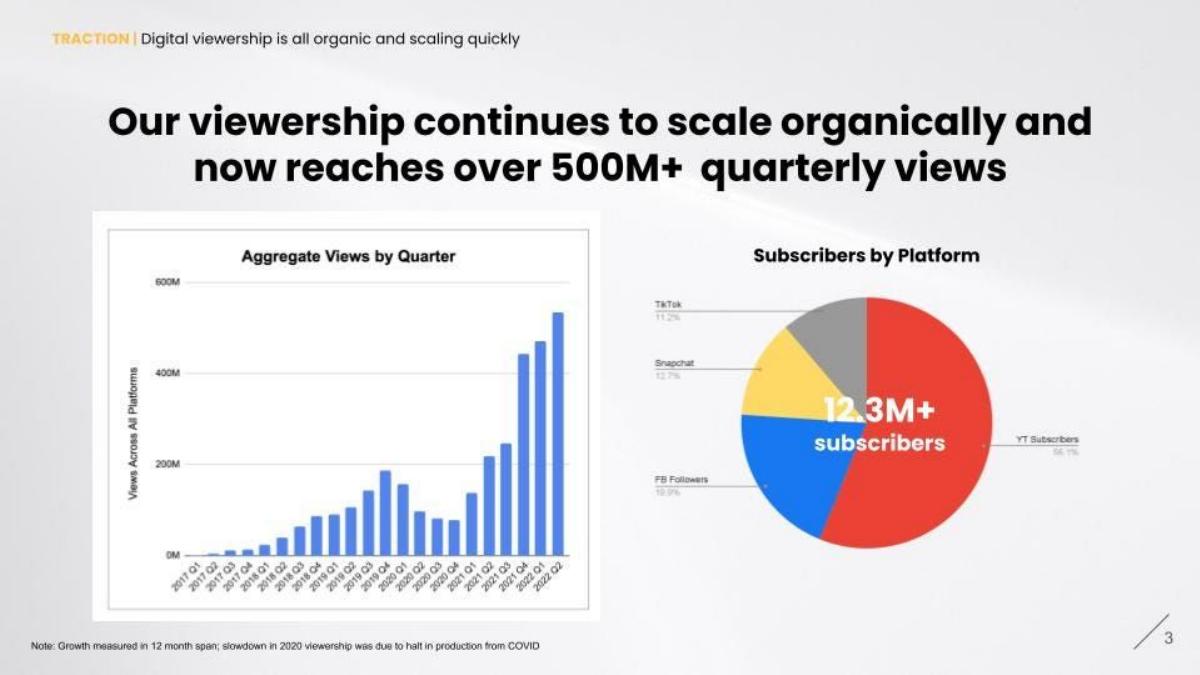
This is the 'heavy lifter' slide of the deck. Jubilee presents two primary charts to prove they have captured the attention of their target demographic. The first chart, "Aggregate Views by Quarter," shows a steady climb from 2017 Q1 through 2022 Q2, peaking at "500M+ quarterly views." A note at the bottom clarifies that a dip in 2020 was due to a production halt during COVID-19, which provides honest context for the data.
The second chart, "Subscribers by Platform," shows a total of "12.3M+ subscribers." The breakdown is critical for understanding their reach: 56.1% YouTube Subscribers , 12.7% Snapchat , 11.2% TikTok , and 10.9% FB Followers . This diversification suggests they are not overly dependent on a single algorithm, though YouTube remains their primary engine.
Slide 4: The Audience Profile
Slide 4 likely delves into the demographics of these 12.3 million subscribers. Given the context of the later slides, this section presumably highlights the Gen Z and Millennial concentration of their audience, setting the stage for the dating app pivot.
Slide 5: Jubilee 2.0 and the Participation Gap
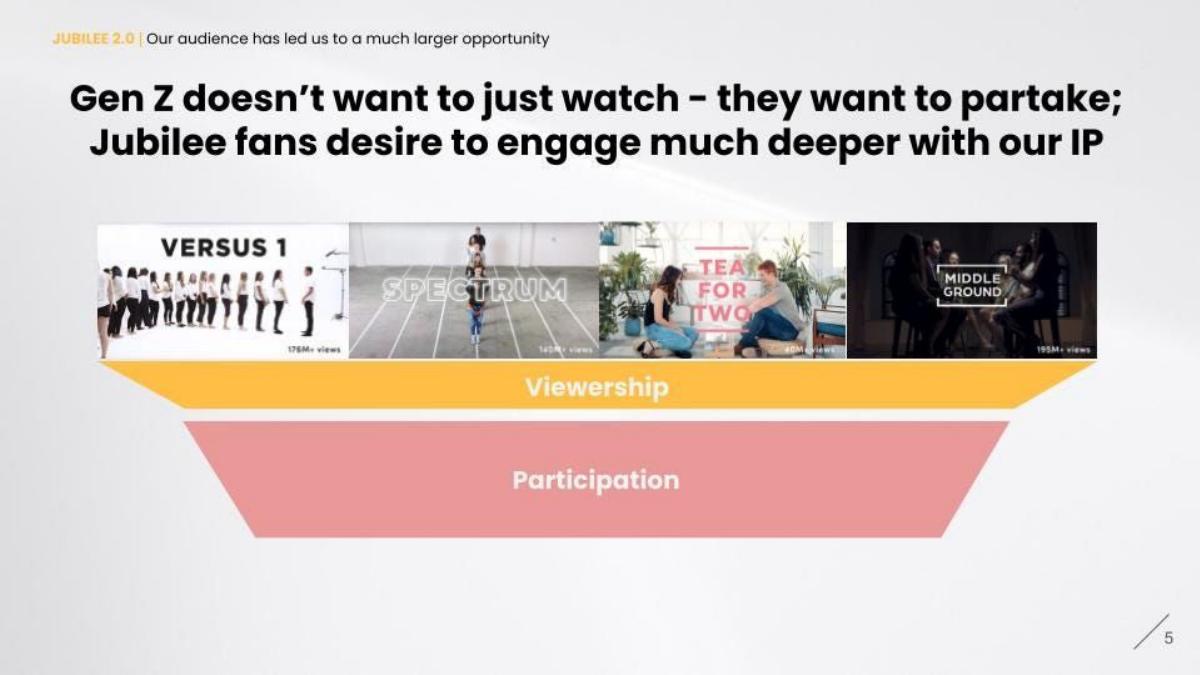
Slide 5 introduces the strategic pivot. The headline states: "Gen Z doesn’t want to just watch – they want to partake; Jubilee fans desire to engage much deeper with our IP." This is visualized through a funnel moving from "Viewership" to "Participation."
The slide features thumbnails of their most successful intellectual property (IP), including "Versus" (176M+ views) , "Spectrum" (140M+ views) , "Tea for Two" (40M+ views) , and "Middle Ground" (195M+ views) . By showing these numbers, Jubilee argues that they have already built the 'top of the funnel' and now need to build the tools for the 'bottom of the funnel.'
Slide 6: The Transition to Product
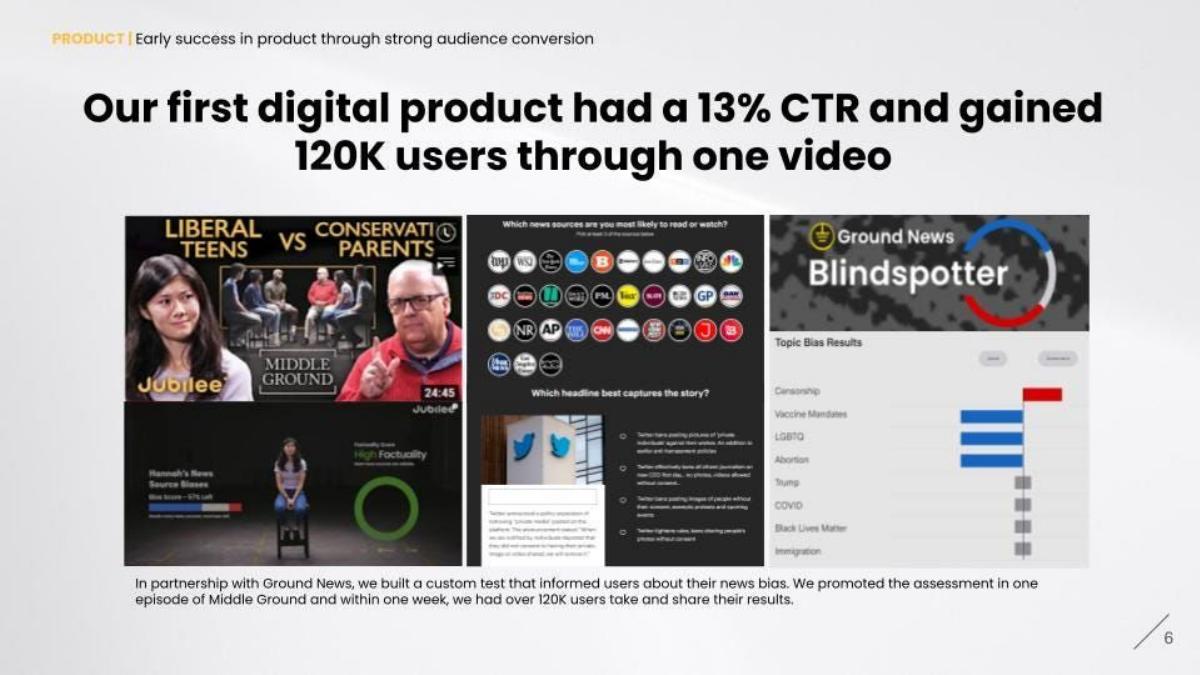
Slide 6 acts as a bridge between the media success and the new technology venture. It likely outlines the limitations of existing social media platforms for deep engagement, justifying the need for a proprietary Jubilee platform.
Slide 7: The Problem - Broken Dating Culture
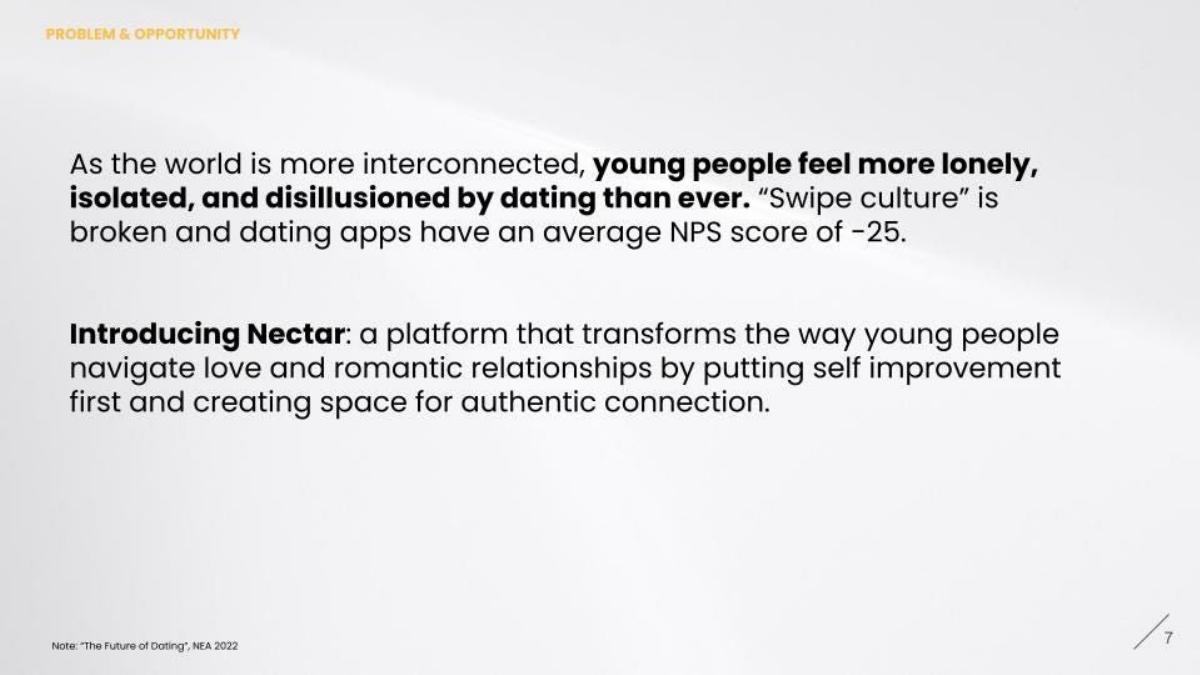
Jubilee identifies a specific vertical for their participation strategy: Love and Dating. The slide claims that "young people feel more lonely, isolated, and disillusioned by dating than ever." The most compelling data point here is that "dating apps have an average NPS score of -25," citing a 2022 NEA report titled "The Future of Dating."
The solution is introduced as "Nectar: a platform that transforms the way young people navigate love and romantic relationships by putting self improvement first and creating space for authentic connection." This positioning attempts to distance Nectar from the 'swipe culture' of Tinder or Bumble.
Slide 8: Nectar Product Deep Dive
Slide 8 likely contains mockups or descriptions of the Nectar interface. While the specific text isn't provided, the narrative flow suggests this slide explains how the 'authentic connection' mentioned on the previous slide actually works in practice.
Slide 9: Branding Nectar
Slide 9 is a simple brand reveal. It shows the "Nectar" logo with the tagline "a new way to love." The use of a bright orange/red color palette differentiates it from the primary Jubilee brand while maintaining a similar modern aesthetic. This slide confirms that Nectar is being positioned as a standalone brand, likely to avoid alienating viewers who enjoy Jubilee's non-dating content.
Slide 10: The Roadmap
Slide 10 presumably covers the go-to-market strategy or the product roadmap. For a media-first company, this usually involves leveraging their existing YouTube shows to drive traffic to the new app, effectively lowering their Customer Acquisition Cost (CAC) to near zero.
Slide 11: The Investor Roster
Instead of a traditional team slide, Jubilee uses slide 11 to showcase their "unparalleled team of investors." This is a high-signal slide designed to build immediate credibility. The list includes:
Steve Chen: Co-founder, YouTube · Kevin Lin: Co-founder, Twitch · Sam Yam: Co-founder, Patreon · Morgan Beller: Gen Partner, NFX · Simu Liu: Actor · Stanley Tang: Co-founder, DoorDash · Michael Redd: Twenty Two Ventures · Mike Su: Snap, Yellow Accelerator · Jeremy Lin: NBA Player · Laura Huang: Harvard Business School
The inclusion of founders from YouTube, Twitch, and Patreon is highly strategic, as these individuals have successfully scaled platforms that sit at the intersection of content and community—exactly what Jubilee is attempting to do.
Slide 12: Closing and Contact
The final slide provides contact information and a call to action. It serves as the bookend to a deck that is less about spreadsheets and more about the power of a massive, engaged audience.
What Jubilee Does Well
The strongest element of this deck is the Distribution Advantage . Most startups have to explain how they will find customers; Jubilee spends slide 3 and slide 5 proving they already have millions of them. By citing 500M+ quarterly views , they move the conversation from 'will people like this?' to 'how do we monetize the people who already like this?'
The Social Proof on slide 11 is also exceptional. For a Seed round, having the co-founders of the three most relevant platforms (YouTube, Twitch, Patreon) as investors is a massive validator. It signals to other investors that the people who built the creator economy believe in Jubilee’s specific vision for 'Jubilee 2.0.'
Finally, the Problem Identification on slide 7 is very sharp. Using a negative NPS (-25) for the dating industry is a clever way to quantify 'disillusionment.' It provides a data-backed reason for why a new entrant is needed in a crowded market.
What is Missing from the Deck
The most glaring omission is a Founding Team Slide . While the investors are impressive, VCs typically invest in the founders at the Seed stage. The deck relies entirely on the brand's existing success rather than the specific pedigree of the individuals running the company day-to-day.
There is also a complete lack of Business Model/Unit Economics . The deck explains the 'what' (Nectar) and the 'why' (loneliness), but never the 'how' regarding revenue. Will Nectar be a subscription service? Will it have in-app purchases? How does the media side of the business currently make money? These are critical questions for a $1.1M raise.
Lastly, there is no Competitive Landscape analysis. While they mention the negative NPS of dating apps generally, they don't name specific competitors or explain how Nectar’s features will technically prevent the 'swipe culture' they criticize. The deck leans heavily on 'vibes' and brand affinity rather than technical or structural moats.
What Founders Should Copy
Founders should emulate Jubilee’s use of Visual Funnels . Slide 5’s transition from 'Viewership' to 'Participation' is a perfect way to explain a complex business pivot in a single image. It takes a vague concept (community engagement) and turns it into a logical progression of a user journey.
Another takeaway is the Contextualization of Data . On slide 3, the note about the 2020 COVID-19 production halt is a great example of how to handle 'bad' data. Instead of trying to hide a dip in growth, they explained it. This builds trust with investors and shows that the management team is paying attention to the 'why' behind their metrics.
Finally, the deck’s Minimalism is a strength. With only 12 slides and very little text per slide, the deck is designed to be talked over, not read like a book. This forces the presenter to lead the narrative and keeps the investor focused on the big-picture vision rather than getting bogged down in minor details during the initial pitch.
Frequently asked questions
- What is the primary problem Jubilee aims to solve?
- According to slide 7, Jubilee addresses the issue that young people feel more lonely and isolated despite being interconnected. They specifically target 'broken' swipe culture, noting that current dating apps suffer from a negative Net Promoter Score (NPS) of -25, creating an opportunity for a platform that prioritizes authentic connection and self-improvement.
- How does Jubilee plan to monetize its audience?
- The deck suggests a transition from passive viewership to active participation. Slide 5 illustrates this as 'Jubilee 2.0,' where the existing audience for shows like 'Middle Ground' and 'Spectrum' is funneled into new interactive products. The primary vehicle for this is 'Nectar,' a platform for romantic relationships introduced on slides 7 and 9.
- What are Jubilee's strongest traction metrics?
- Slide 3 highlights significant scale: 500M+ quarterly views and 12.3M+ total subscribers. The growth is described as 'all organic.' The platform breakdown shows YouTube as the dominant channel (56.1%), followed by Snapchat (12.7%), TikTok (11.2%), and Facebook (10.9%).
- Who are the notable investors in Jubilee?
- Slide 11 lists an 'unparalleled team of investors,' including Steve Chen (Co-founder, YouTube), Kevin Lin (Co-founder, Twitch), Sam Yam (Co-founder, Patreon), Stanley Tang (Co-founder, DoorDash), and actor Simu Liu. Institutional investors shown include NFX, Horizons Ventures, and Strong Ventures.
- What is missing from the Jubilee pitch deck?
- The deck lacks several standard venture components: a slide dedicated to the founding team's backgrounds, a clear business model or revenue breakdown, a competitive landscape analysis, and a specific financial 'ask' or use of funds. It functions more as a vision and traction document than a detailed operational plan.