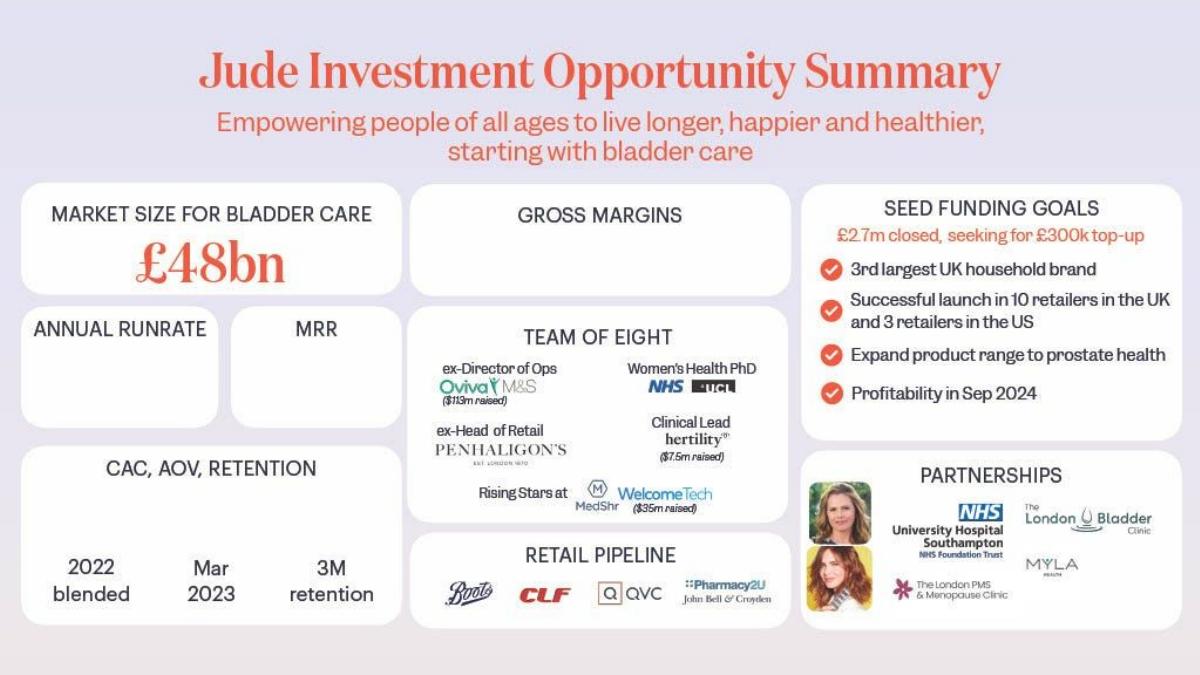
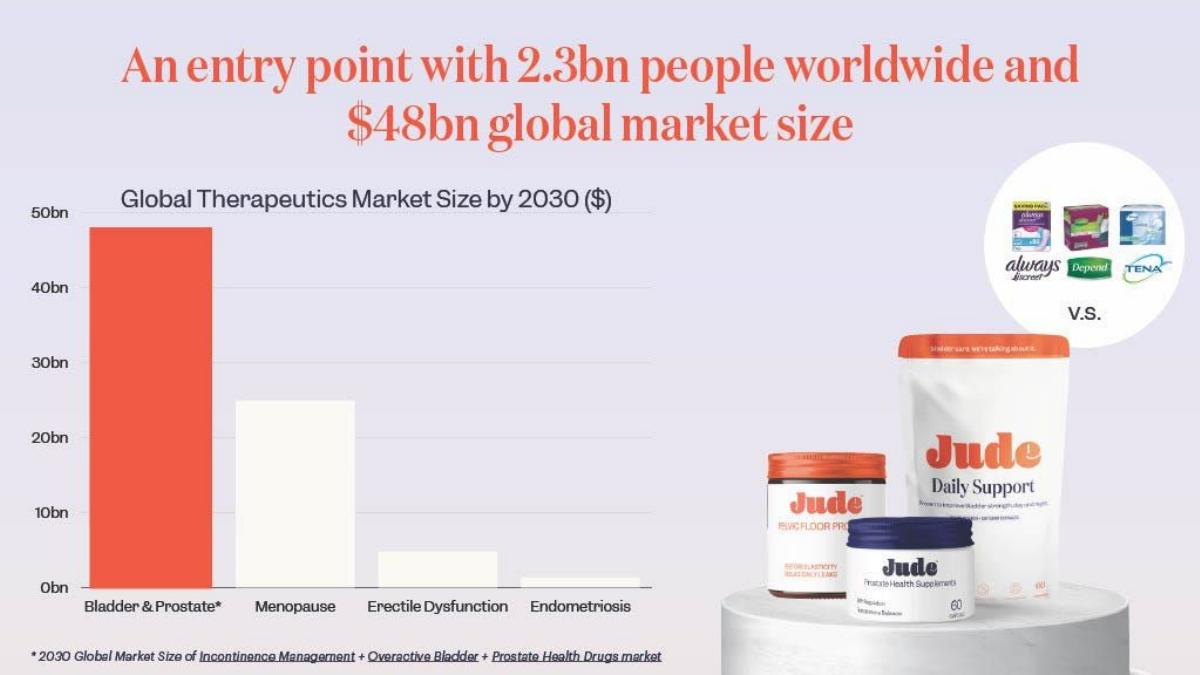
Jude’s pitch deck focuses on the massive, underserved 'Boomer' healthcare market, valued at $600bn across the UK and US. By positioning bladder care as an entry point into healthy aging, Jude differentiates itself from 'antiquated' legacy players like Tena and Always, who focus primarily on containment rather than prevention. The deck highlights a hybrid model of natural therapeutics and digital health tracking, supported by a retail expansion strategy into major chains like Boots and Waitrose. While the deck lacks a formal team slide and specific unit economics in this version, the clear mar…
Key takeaways
- The Boomer self-care market is valued at $600bn and is twice the size of the millennial market (Slide 2).
- Jude positions itself in the 'Prevention' and '360 Support' quadrant, contrasting with legacy brands that focus on 'Transactional' and 'Containment' (Slide 4).
- The company aims to be the first UK traditional medication for bladder health, using natural therapeutics to build defensibility (Slide 5).
- The product ecosystem includes a digital prescription service and symptom tracking to improve patient outcomes (Slide 6).
- Revenue growth is shown as a steep upward curve since January 2022, though specific MRR and margin figures are redacted in this version (Slide 7).
- Retail expansion is a core pillar, with existing placements in Boots and Ocado and plans for US giants like Target and Walmart (Slide 8).
- The funding ask was for £300k to complete a £3m seed round, with 48% of funds allocated to Marketing and Digital (Slide 9).
- The deck sets a specific milestone for profitability by Q3 2024 (Slide 9).
Market Opportunity: The $600bn Boomer Gap
Slide 1: Title Slide
The deck opens with a high-resolution image of a woman in the target demographic (senior/boomer) with the tagline "Healthcare brand for a new age." The branding is bright orange, signaling a departure from the clinical blues and whites typically associated with senior care products.
Slide 2: The Boomer Economy
Jude makes a strong quantitative case for their target audience. They identify 14 million UK Boomers and 70 million US Boomers. The slide quotes a £98bn UK health & personal care market and a £500bn US market. Crucially, it notes that the Boomer self-care market is 2x bigger than the millennial market and that a single boomer spends £7k on health and personal care annually. This slide establishes the "why now" and the scale of the opportunity.
Slide 3: Redefining Healthy Ageing
This slide positions Jude against the current wave of D2C health brands. It lists millennial-focused companies like Thinx, Hims & Hers, Queen V, and Nurx, stating that Jude is "redefining healthy ageing with bladder care as an entry point." This suggests that while they are starting with bladder health, the long-term vision is a broader platform for senior health.
Competitive Landscape and Product Strategy
Slide 4: The Competitive Matrix
Jude uses a standard 2x2 matrix to map the market. The Y-axis ranges from "Transactional" to "360 Support," and the X-axis ranges from "Containment" to "Prevention." Legacy brands like Tena, Always, and Depend are clustered in the bottom-left (Transactional/Containment), with a note that 86% of the incontinence market is dominated by these players. Jude places itself in the top-right quadrant, emphasizing prevention and holistic support. They also call out Elvie and Innovo as high-price point products with low retention.
Slide 5: Natural Therapeutics and Defensibility
The company describes itself as developing the "UK First Traditional Medication for Bladder Health." The slide highlights their focus on natural therapeutics for overactive bladder and incontinence. They aim to create the "go-to" for urinary tract issues, similar to how probiotics are viewed for gut health. The stated benefits of this approach are unlocking a medical go-to-market strategy and creating defensibility through a medical license.
Slide 6: Digital Ecosystem
Jude isn't just a supplement company; they are building a digital health layer. Slide 6 outlines a four-step process: 1. Start visit (3-minute questionnaire), 2. Recommendation, 3. Provider review (clinician review within 24 hours), and 4. Treatment delivery. The slide also shows a mobile app interface for tracking and improving symptoms, which supports their "360 support" claim from Slide 4.
Traction and Future Growth
Slide 7: Explosive Growth
This slide features a bar chart showing revenue growth from January 2022 to May (presumably 2023). While the specific numbers for Jul MRR and Gross Margin are left as blank white boxes in this version of the deck, the visual trend is a consistent month-over-month increase. It also mentions a "Team of nine superstars."
Slide 8: Retail Expansion Roadmap
Jude shows a clear path to physical retail dominance. They use logos to show current and future partners. Existing or in-progress partners (marked with orange checkmarks) include Boots, Ocado, Waitrose, and Pharmacy2U . The "beyond" section of the arrow points toward Sainsbury's, John Lewis, Target, Walmart, Walgreens, and Holland & Barrett . This demonstrates a clear understanding of where their target demographic shops.
Slide 9: The Ask and Milestones
The final slide in this set states that with £2.7m already raised , Jude is seeking £300k to complete a £3m seed round . A pie chart breaks down the use of funds: 48% Marketing and Digital , 24% Ops and CX, 21% US Expansion, and 7% R&D and Medical. They list six key milestones, including reaching profitability by Q3 2024 and becoming the "third largest household brand in the UK."
What Works in This Deck
Specific Market Sizing: Instead of just saying the market is big, Jude breaks it down by spend per individual (£7k/year) and compares it to a well-known segment (millennials). This makes the "Boomer" opportunity feel tangible and urgent.
Clear Differentiation: The competitive matrix on Slide 4 is effective because it doesn't just say they are better; it explains that they are solving a different part of the problem (prevention vs. containment). This justifies why they can coexist with or disrupt 86% of the market.
Omnichannel Credibility: Listing specific retail partners like Boots and Waitrose provides immediate validation. It shows that the product has passed the quality and supply chain requirements of major national retailers.
What Is Missing
Team Background: While Slide 7 mentions a "team of nine superstars," there is no dedicated team slide in this selection. For a seed round, the founders' backgrounds in healthcare, D2C, or retail are usually critical for investors to assess execution risk.
Unit Economics: The deck mentions gross margin and MRR on Slide 7 but leaves the boxes empty. While this might be for confidentiality in a public version, a fundraising analyst would need to see CAC (Customer Acquisition Cost), LTV (Lifetime Value), and churn rates, especially for a subscription-based digital health product.
Clinical Evidence: Slide 9 mentions a goal for "1 clinical trial to increase product defensibility." However, the deck does not provide current data or pilot results that prove their natural therapeutics actually work better than existing solutions.
Founder Takeaway: The 'Entry Point' Strategy
Founders should study how Jude uses a specific, stigmatized problem (bladder care) as an "entry point" (Slide 3) to a much larger market (healthy aging). By starting with a high-intent, high-pain-point problem, they can acquire customers who are likely to stay for a broader range of health services. This is a classic "wedge" strategy. Additionally, the focus on "prevention" allows for a higher-margin, supplement-and-service model compared to the low-margin, commodity-heavy "containment" market. If you are building in a legacy category, look for the "prevention" angle to move up the value chain.
Frequently asked questions
- What is Jude's primary product offering?
- Jude offers a combination of natural therapeutics (supplements) for bladder health and a digital health platform. According to Slide 5, they aim to be the 'go-to' for lower urinary tract issues, similar to how cranberry extract is used for UTIs. Their digital component (Slide 6) includes symptom tracking and a digital prescription service via certified pharmacists.
- How does Jude differentiate itself from competitors like Tena or Always?
- Jude uses a 2x2 matrix on Slide 4 to show that legacy players like Tena, Always, and Depend are 'transactional' and focused on 'containment' (pads/diapers). Jude positions itself as a '360 support' brand focused on 'prevention,' aiming to treat the root causes of bladder issues rather than just managing the symptoms.
- What are the market size opportunities mentioned in the deck?
- Slide 2 identifies a £98bn market for UK Boomer health and personal care and a £500bn market in the US. The deck emphasizes that the Boomer self-care market is twice as large as the millennial market, which is often the primary focus of modern D2C healthcare brands.
- What is the company's retail strategy?
- Jude is pursuing an aggressive omnichannel approach. Slide 8 shows they are already 'working to place' or already in Boots, Ocado, and Waitrose. Their roadmap includes expansion into UK pharmacies like Lloyds and eventually US retail giants including Target, Walmart, and Walgreens.
- How does Jude plan to use the raised capital?
- According to Slide 9, the largest portion of the seed round (48%) is dedicated to Marketing and Digital. The remainder is split between Operations and CX (24%), US Expansion (21%), and R&D and Medical (7%). Key goals include reaching profitability by Q3 2024 and launching a clinical trial.