Judolaunch’s pitch deck is a masterclass in visual storytelling, utilizing a progressive disclosure of information to highlight a specific pain point: the saturation of the US Amazon marketplace. Instead of leading with complex technical features, the deck uses simple icons and maps to demonstrate how brands can double their revenue by expanding into the EU and Japan. By the time the deck reaches its traction slide, the investor already understands the market dynamics of the 100 brands served. While the deck is light on competitive analysis and team biographies in this 13-slide selection, it…
Key takeaways
- The deck identifies the US market as 'SATURATED' for Amazon sellers on Slide 4.
- Judolaunch positions itself as the 'gear' or engine that connects products to six international markets: UK, DE, FR, ES, IT, and JP (Slide 6).
- The core value proposition is a 'X2' revenue increase through global expansion (Slide 7).
- The deck uses a '100 Brands' milestone to demonstrate product-market fit (Slide 10).
- Visual representation of diverse product categories—from footwear to electronics—suggests a broad horizontal application (Slide 12).
- Traction is clearly stated as $23K Monthly Revenue on Slide 13.
- The company reports a 25% MoM Revenue Growth on Slide 13.
- The deck omits a traditional team slide, competitor matrix, and specific 'Ask' in this 13-slide sequence.
The Narrative: From Saturation to Global Expansion
The Judolaunch pitch deck, dating from 2016, is a notable example of minimalist design used to communicate a complex logistical value proposition. At its core, Judolaunch is a tool for Amazon merchants to scale globally. Rather than starting with a list of software features, the deck builds a narrative about the lifecycle of an e-commerce brand. It moves from the 'good old days' of easy US growth to the current reality of a crowded marketplace, finally offering global expansion as the only logical next step for ambitious sellers.
Slides 1-5: Establishing the Problem of Saturation
Slide 1 serves as the title card, featuring the tagline 'Giving Ecommerce Brands the Power to Expand Globally.' The imagery of a mountain range suggests the scale of the ambition, while the logo includes the phrase 'Strap a jetpack to your brand and watch your sales skyrocket.' This sets an aggressive, growth-oriented tone immediately.
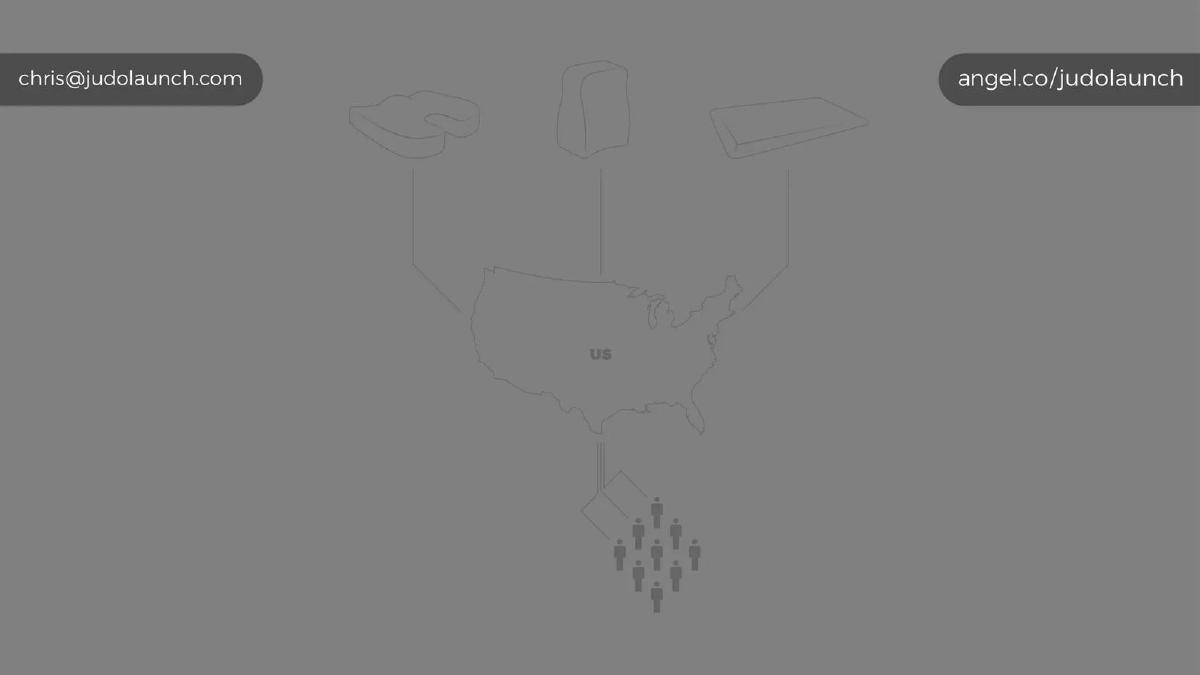
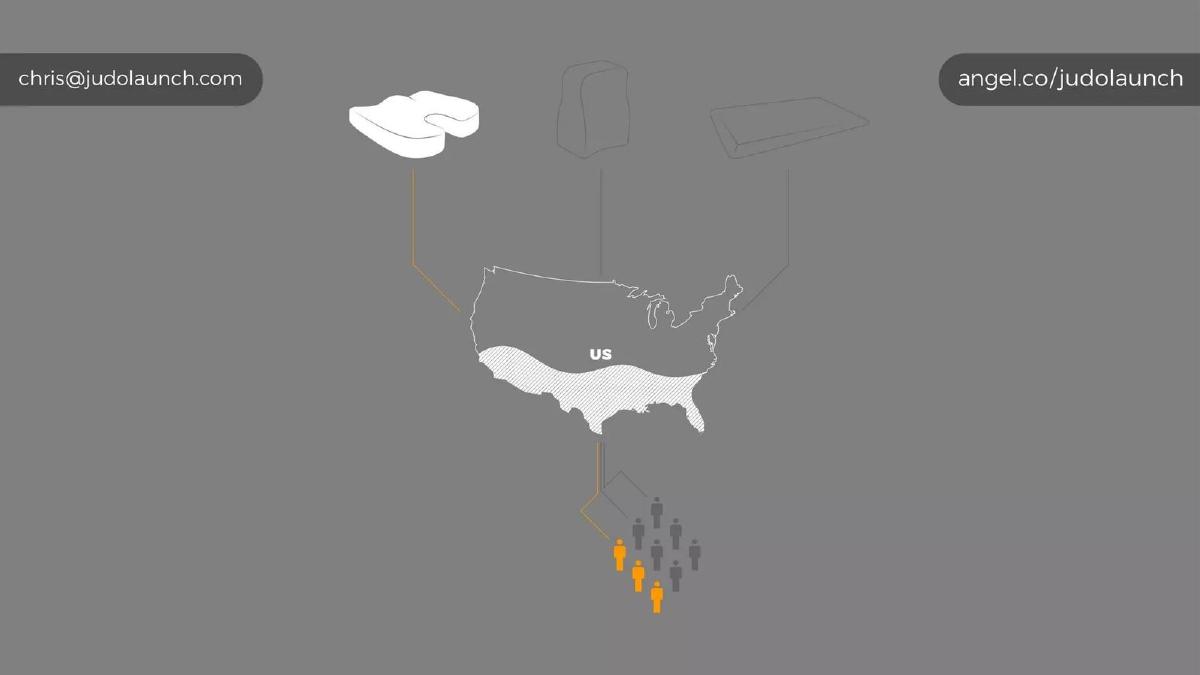
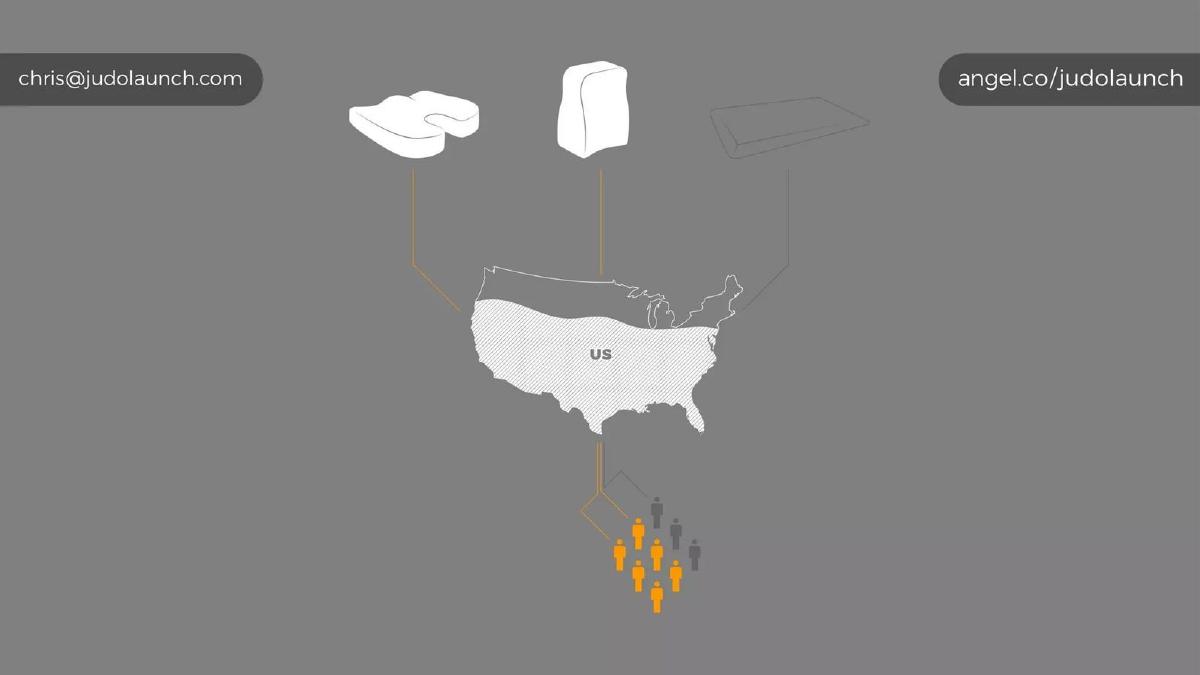
Slide 2 begins the 'story' with the text '2 YEARS AGO,' showing three simple product icons: a seat cushion, a block, and a wedge. This represents the starting point for many private-label Amazon sellers. Slide 3 shows these products entering the US market and successfully reaching a small group of customers. However, the narrative shifts quickly.
Slide 4 is the 'Problem' slide. It shows the US map with the word 'SATURATED' in bright orange. The customer icons at the bottom have increased in number, but the implication is that the market can no longer absorb new growth easily. Slide 5 introduces the alternative: the EU market, marked with a question mark. This creates a 'gap' in the investor's mind that the following slides must fill.
Slides 6-10: The Solution and the Multiplier Effect
Slide 6 introduces the Judolaunch mechanism. It depicts the three original products passing through a 'gear' icon—representing the Judolaunch platform—and being distributed across six markets: UK, DE, FR, ES, IT, and JP. This is a highly effective way to explain a 'black box' technology product; it shows the input (products) and the output (global distribution) without getting bogged down in API documentation.
Slide 7 delivers the 'Why.' It features a large 'X2' next to stacks of cash. The message is simple: by using Judolaunch to enter these six markets, a brand can double its revenue. This is the 'hook' for the investment. Slide 8 and Slide 9 reinforce this by showing different product categories (a shopping bag and a perfume bottle) following the same global distribution pattern. This suggests that the Judolaunch 'gear' works for any type of physical good.
Slide 10 introduces the first major proof point: '100 Brands.' By showing the global distribution map fully populated with orange customer icons under the '100 Brands' header, the deck signals that this is not a theoretical concept but a proven system already in use by a significant number of clients.
Slides 11-13: Product Diversity and Traction
Slide 11 and Slide 12 move away from icons to high-quality photography of actual products. We see shoes, toothpaste, backpacks, sunglasses, and electronics. This transition from abstract icons to real-world objects grounds the pitch. It demonstrates that Judolaunch is handling tangible goods for recognizable (though unnamed in the slides) brands. It answers the unspoken question: 'What kind of products does this actually work for?' The answer provided is 'everything.'
Slide 13 is the 'Money Slide.' It returns to the mountain background of the cover slide and presents three key metrics in circles: '$23K Monthly Revenue,' '25% MoM Revenue Growth,' and '100 Brands Served.' These figures provide the quantitative evidence needed to support the visual narrative established in the first ten slides. A 25% month-over-month growth rate is a classic 'venture-scale' metric that indicates strong early traction and product-market fit.
What Works in the Judolaunch Deck
The most successful element of this deck is its visual economy . The founders understood that investors see hundreds of decks; by using icons and maps, they allow the reader to 'speed-read' the problem and solution in under 30 seconds. The use of the 'gear' icon to represent their platform is a clever way to bypass technical jargon while still communicating that they provide the 'engine' for growth.
Furthermore, the geographic focus is very clear. By naming the specific Amazon marketplaces (UK, DE, FR, ES, IT, JP), they demonstrate a deep understanding of the Amazon ecosystem. They aren't just promising 'international expansion'; they are promising access to the specific high-value territories where Amazon has a dominant presence.
What is Missing from the Judolaunch Deck
While the narrative is strong, this 13-slide selection leaves several critical questions unanswered. First, the 'How' is entirely absent. While the gear icon is a great metaphor, a sophisticated investor would want to know if Judolaunch is a software-as-a-service (SaaS) platform, a tech-enabled agency, or a logistics provider. The deck doesn't explain the user experience or the specific hurdles (translation, VAT compliance, shipping) that the software solves.
Second, there is no team slide. In a seed-round deck, the founders' pedigree is often more important than the current revenue. Without knowing who is building the 'gear,' it is difficult to assess the execution risk. Third, the competitive landscape is ignored. By 2016, the Amazon 'seller tools' market was already becoming crowded. Failing to mention how Judolaunch differs from competitors like Helium 10 or Jungle Scout (or specialized expansion services) is a notable omission.
What a Founder Should Copy
Founders should emulate the progressive disclosure used in Slides 2 through 6. By starting with a historical context ('2 Years Ago') and moving to a current crisis ('Saturated'), Judolaunch makes their solution feel like an inevitability rather than just another tool. This 'market-shift' narrative is much more compelling than a standard 'Problem/Solution' slide.
Additionally, the revenue multiplier on Slide 7 ('X2') is a powerful way to frame value. Instead of talking about 'increased efficiency' or 'lower overhead,' they talk about doubling the top line. If your product has a direct, calculable impact on a customer's revenue, that should be the loudest part of your deck.
Frequently asked questions
- What is the primary problem Judolaunch solves?
- Judolaunch addresses the problem of market saturation for e-commerce brands. According to Slide 4, the US market is depicted as 'SATURATED,' making it difficult for sellers to grow. The deck suggests that the solution is expanding into less crowded international Amazon marketplaces like Europe and Japan, which Judolaunch facilitates through its platform.
- What markets does Judolaunch help sellers enter?
- Based on Slide 6 and Slide 10, the platform focuses on six key international territories: the United Kingdom (UK), Germany (DE), France (FR), Spain (ES), Italy (IT), and Japan (JP). The deck uses these country codes and maps to show a streamlined path from a single product to multiple global audiences.
- What are the key traction metrics for Judolaunch?
- As of the time of this deck in 2016, Judolaunch reported $23,000 in monthly revenue. More importantly for a seed-stage startup, they showcased a 25% month-over-month (MoM) revenue growth rate and a customer base of 100 brands served, as detailed on Slide 13.
- How does the deck explain the business model?
- The deck explains the model visually rather than through text. Slide 6 shows a 'gear' icon sitting between the merchant's products and the international markets. This implies that Judolaunch acts as the automated infrastructure or service layer that handles the complexities of cross-border selling, resulting in the 'X2' revenue multiplier shown on Slide 7.
- What critical information is missing from this pitch deck?
- This 13-slide selection is missing several standard venture capital requirements. There is no team slide detailing the founders' backgrounds, no competitive landscape analysis, no detailed financial projections, and no specific 'Ask' slide indicating how much capital is being raised or how it will be used.