This teardown analyzes LinkedIn's 2004 Series B pitch deck, revealing how Reid Hoffman used the 'Web 2.0' transition to frame the platform as the 'Google for Professionals.' By prioritizing network effects over immediate revenue and using powerful analogies to established giants like eBay and PayPal, LinkedIn built a compelling case for market dominance that eventually led to its $26.2 billion acquisition.
Key takeaways
- Frame your idea using familiar analogies like 'X for Y' to create instant mental shortcuts for investors.
- If your moat is the network, prioritize and prove network growth and virality over early revenue.
- Create investor FOMO by using data to demonstrate clear market leadership and increasing market share.
- Prioritize substance over style; a logical, data-backed argument is more valuable than sophisticated graphic design.
- Sell a new category rather than just a product to position your company as a market-defining force.
A Glimpse into the Past: The World in August 2004
To truly understand the genius of LinkedIn's 2004 Series B pitch deck, we must first transport ourselves back in time. August 2004 was a fascinating inflection point in the tech world. The scars of the dot-com bust were still fresh, but a new wave of innovation was cresting. The term 'Web 2.0' was just beginning to enter the tech lexicon, championed by figures like Tim O'Reilly. It described a new internet paradigm, one built not on static pages but on user-generated content, rich applications, and, most importantly, network effects.
Friendster had already shown the viral potential of social networks, and MySpace was rapidly gaining traction among a younger audience. A tiny, college-only network called Thefacebook had launched just six months prior. But the professional world remained firmly rooted in Web 1.0. Your online professional 'identity' was a static resume uploaded as a Word document to sites like Monster.com. Finding business contacts meant sifting through alumni directories or paying for expensive services like Lexis-Nexis. Collaboration and trust were conducted offline.
Into this environment stepped LinkedIn. And in the very month this deck was presented, a monumental event occurred: Google held its Initial Public Offering. The world was captivated by Google's success, which was built on a revolutionary network-based algorithm called PageRank. It had proven, on a global scale, that ranking results 'by looking at the network of links between pages' was infinitely superior to the old way. This context is not just background noise; it is the stage upon which Reid Hoffman and the LinkedIn team delivered a masterclass in strategic positioning.
Deconstructing the Deck: A Slide-by-Slide Walkthrough
The LinkedIn Series B deck is not a visual masterpiece. It's a text-heavy, repetitive, and aesthetically utilitarian PowerPoint. But its argumentative structure is a work of art. It builds a case so logical and compelling that by the end, the investment feels less like a risk and more like an inevitability.
Slides 1-4: Defining the Category and the Thesis
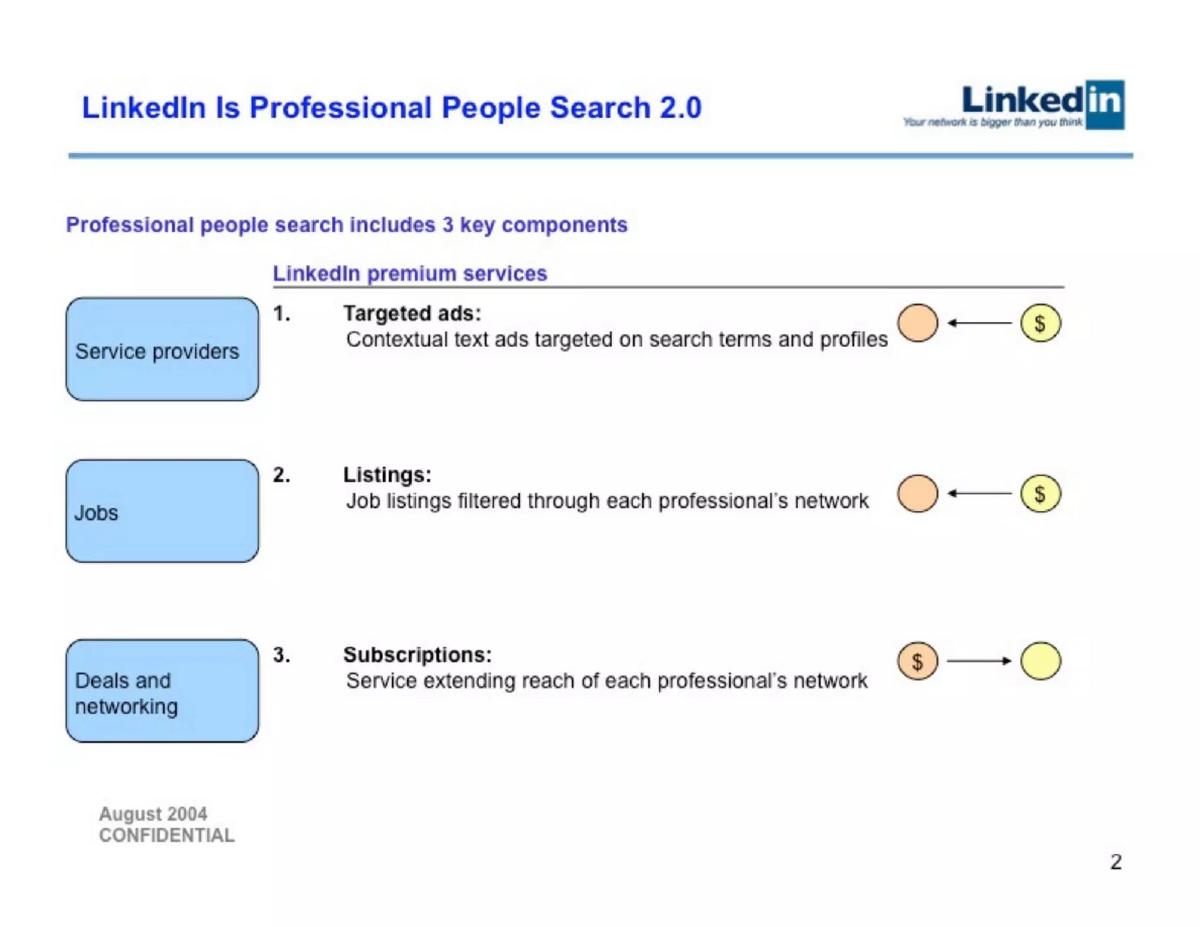
The deck opens with a simple, powerful tagline: 'Your network is bigger than you think.' This immediately frames the product around user value and discovery. Slide 2 gets straight to the point, defining LinkedIn as 'Professional People Search 2.0' and laying out the three eventual revenue pillars: Targeted ads, Listings (jobs), and Subscriptions. This upfront clarity is crucial. They aren't hiding the business model; they are simply stating it will come later.
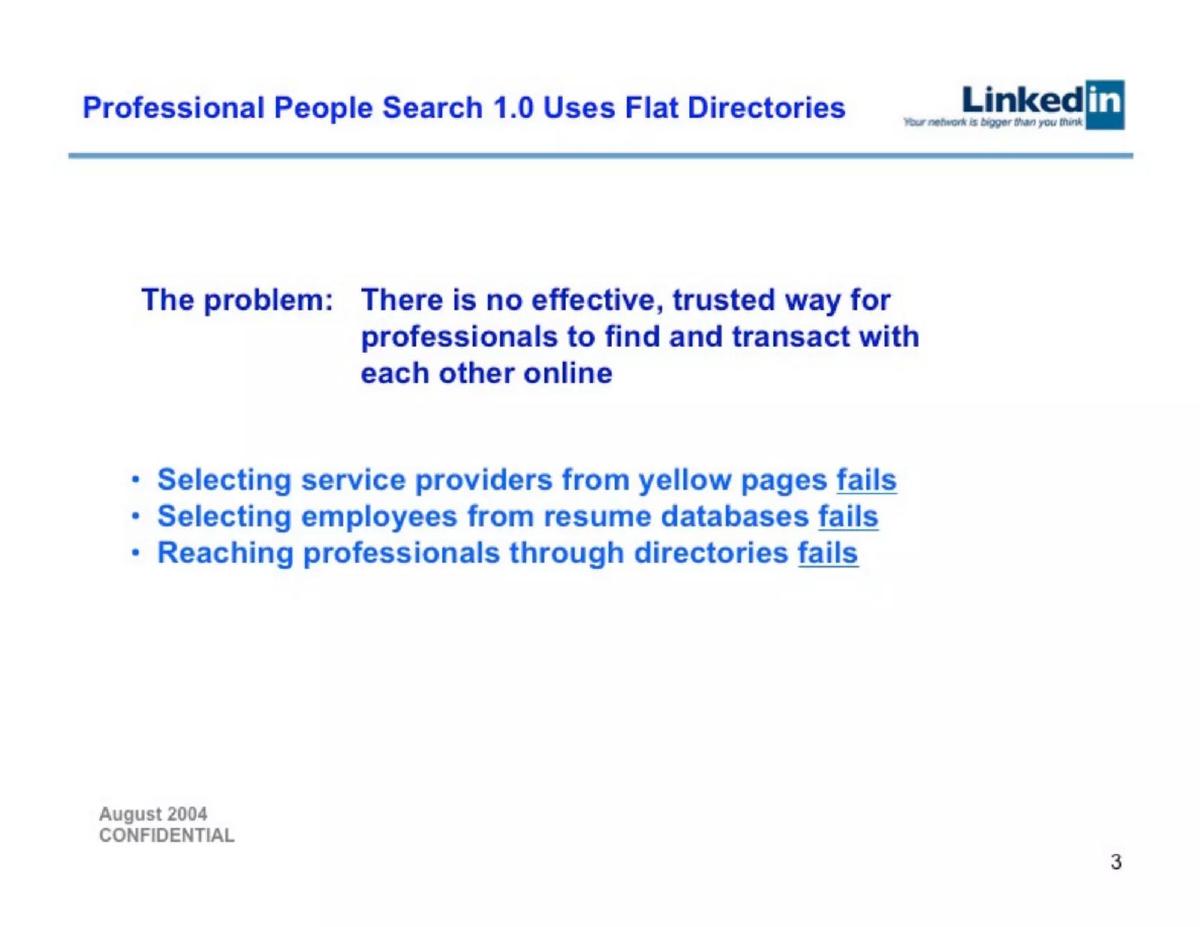
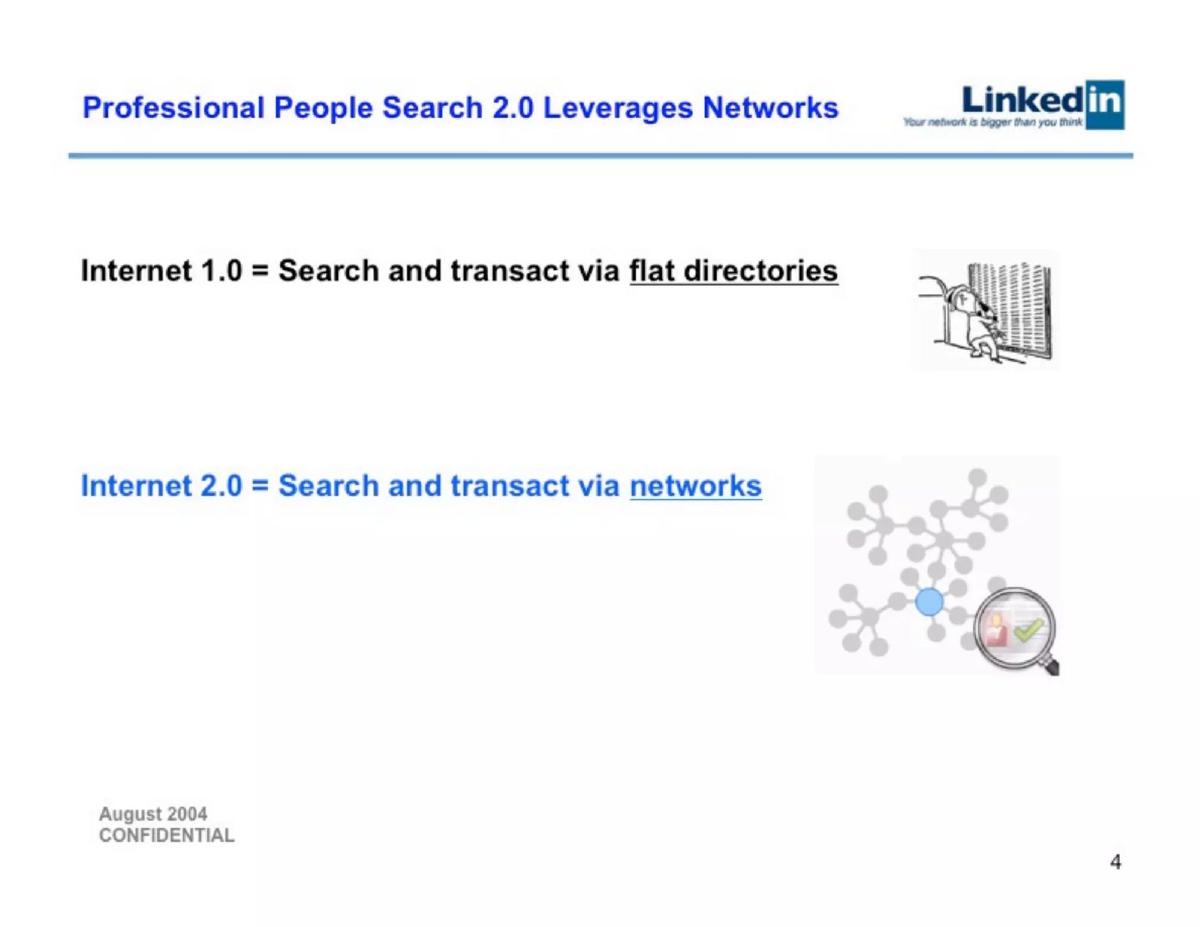
Slides 3 and 4 present the classic problem/solution framework. The problem is simple: 'There is no effective, trusted way for professionals to find and transact with each other online.' They call out the failures of 'flat directories' like yellow pages and resume databases. The solution, then, is the deck's central thesis: 'Internet 1.0 = Search and transact via flat directories. Internet 2.0 = Search and transact via networks.' This clean binary sets the stage for the entire argument.
Slides 5-9: The '2.0' Analogies Masterstroke
This section is the heart of the deck and its most brilliant move. The team uses pattern recognition to make their abstract concept concrete and exciting. They present a series of mini-case studies:
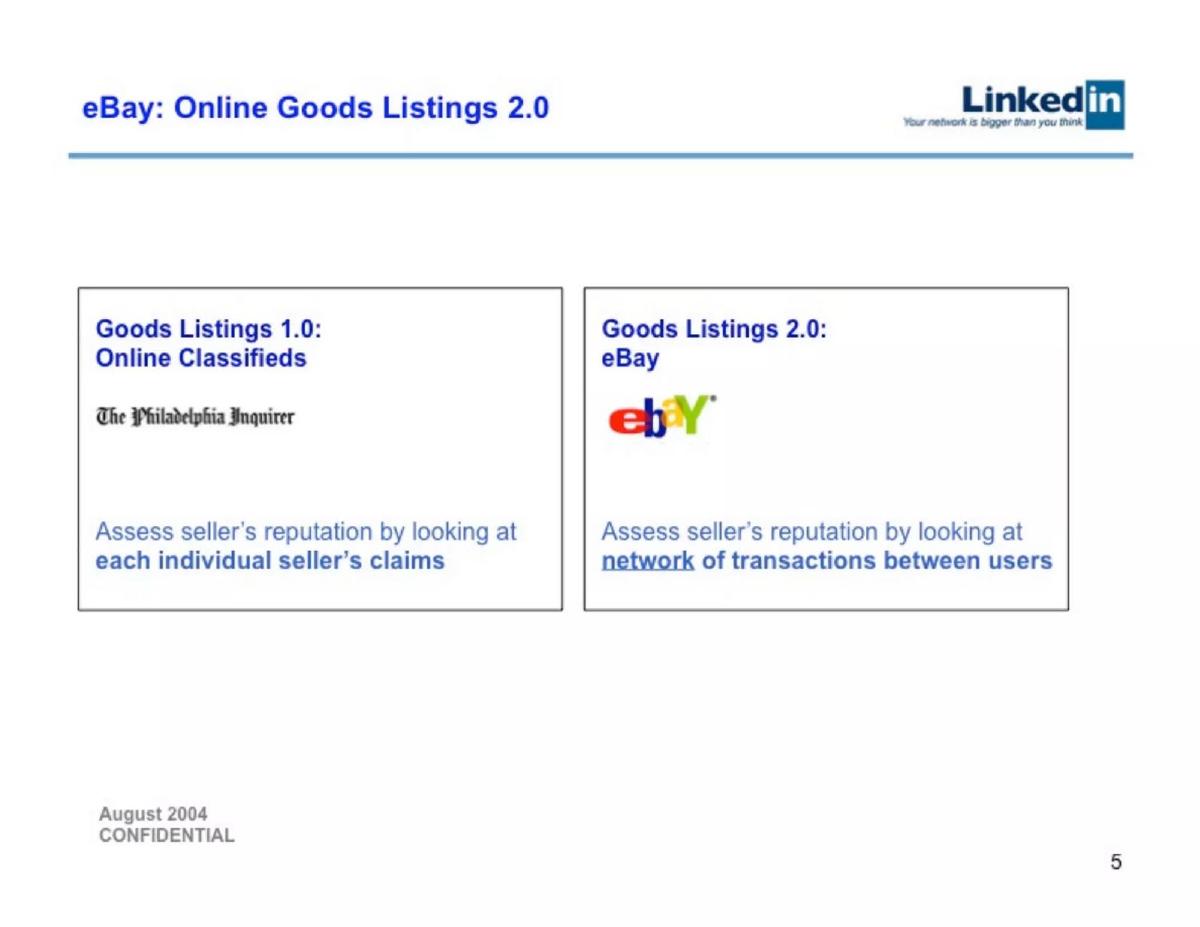
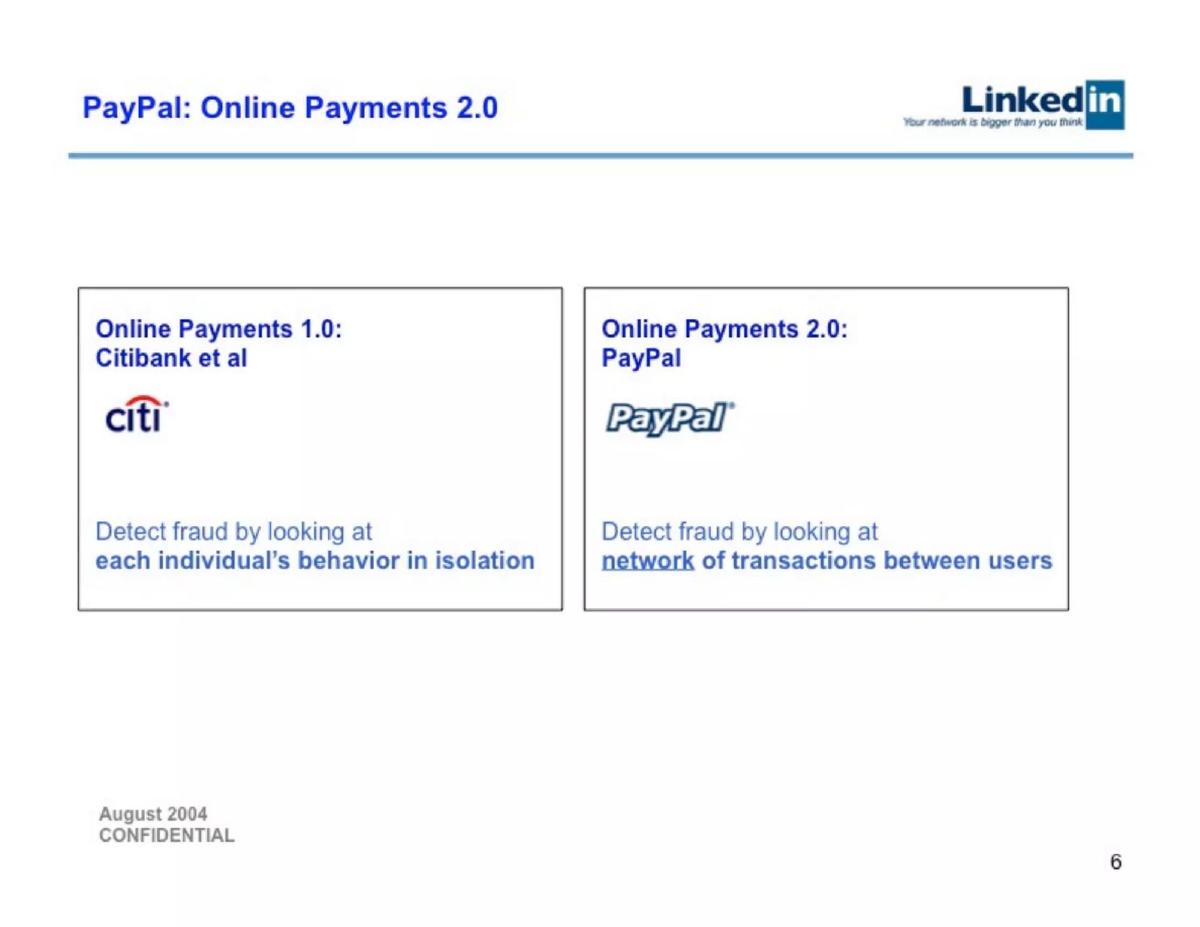
Goods Listings 1.0 (Online Classifieds) vs. Goods Listings 2.0 (eBay): Assessing reputation via seller claims vs. a network of transactions. · Online Payments 1.0 (Citibank) vs. Online Payments 2.0 (PayPal): Detecting fraud in isolation vs. via a network of transactions. · Search for Things 1.0 (Altavista) vs. Search for Things 2.0 (Google): Ranking pages in isolation vs. via a network of links.
After establishing this undeniable pattern of '1.0' being disrupted by '2.0', they deliver the punchline on slide 9:
Professional People Search 1.0 (Monster, Lexis Nexis) vs. Professional People Search 2.0 (LinkedIn): Assessing professionals by claims vs. via a network of relationships.
By framing themselves as the next link in this chain, they implicitly promise a disruption on the scale of eBay, PayPal, and Google. It’s an incredibly potent psychological tool for an investor audience already high on the success of these companies.
Slides 10-13: Network First, Revenue Second (With Proof)
Having established the 'why', the deck pivots to the 'how' and 'when'. Slide 10, 'Establishing the Network: Our First Priority,' preempts the inevitable question about revenue. They state their strategy boldly: 'Where the network is the key, the first mover is critical to revenue.' They provide the perfect alibi by citing a familiar name from their own analogy section: 'PayPal waited until 4 million registered users before turning on revenue'. This transforms a potential weakness (low revenue) into a sign of strategic discipline.
The following slides provide the proof that this strategy is working. Slide 11 shows their original Series A growth projections, and Slide 12 overlays their 'Actual data', which blows the projections out of the water. This is a classic 'up and to the right' chart that every VC wants to see. Then, on Slide 13, they hammer home their dominance with pie charts showing their market share of 'online professional network tools' growing from 54% to 73% in just six months. The use of phrases like 'tipping point effects' is designed to create intense FOMO (Fear Of Missing Out).
Slides 14-18: Moats and Momentum
This section is all about demonstrating defensibility and validation. Slide 14 presents a competitive landscape that effectively dismisses everyone else. Competitors are either too 'social' (Ryze), too 'enterprise' (Spoke), or insignificant 'Friendster clones.' LinkedIn is positioned as the sole, focused leader. Slide 15 reinforces this with 'brand endorsement' from major MBA programs and conferences, lending credibility and showing they are capturing high-value user segments.
Slide 16 is a beast of a traction slide, packed with metrics to impress any investor: 930k+ users, 29k+ weekly growth, high-quality user demographics ('22% of users are CxOs/senior execs'), and strong engagement, all achieved with less than $4 million spent. Slide 17 adds more validation with major business development deals in the works with the DirectEmployers Association and American Express. Finally, Slide 18 summarizes their moat: viral design, network effects, a reputation system, and two key patents. This is the checklist for a defensible Series B company.
Slides 19-25: Connecting the Network to Revenue
The final act of the deck brings the argument full circle, tying the network they've built back to the revenue opportunities outlined in the beginning. Slide 19 revisits the analogies (eBay, PayPal, Google) but this time focuses on how their networks enable their business models. For example, Google's page rank system isn't directly monetized, but it produces the best results, which attracts users, who then see the AdWords. LinkedIn promises the same dynamic: the network builds trust and utility, which enables their three revenue streams.
The subsequent slides attempt to quantify the opportunity. Slide 22 presents the 'Comparable market sizes,' showing the billions of dollars up for grabs in search ads, job sites, and directories. This frames the Total Addressable Market (TAM) as massive. The final slides (23-25) provide mockups and brief explanations for 'InLeads' (contextual ads) and 'Opportunities' (job listings), giving a glimpse of how the network would be leveraged in practice. For example, a job posting isn't just a listing; it's filtered through the user's network to reveal inside connections.
What Worked and Why It Was Brilliant
The 'Web 2.0' Framing
The decision to frame LinkedIn as the '2.0' version of professional search was the deck's single most effective tactic. In 2004, investors were actively searching for the 'next Google.' This deck told them, 'Stop looking, we're it, but for the professional world.' It provided a powerful, familiar mental model, transforming a novel and unproven concept (a professional social network) into the logical next step in an established trend of digital disruption.
Focus on Network First, Revenue Second
Many founders struggle to explain pre-revenue traction. LinkedIn's leadership embraced it. They didn't apologize for a lack of revenue; they presented it as a core part of a deliberate, proven strategy. By citing PayPal's playbook, they borrowed credibility and showed they understood the specific dynamics of winner-take-all markets based on network effects. The message was: the value is the network, and we are laser-focused on building that value. The monetization will be an outcome of that dominance.
Overwhelming Proof of Traction and Leadership
The deck is a relentless assault of data supporting one claim: 'We are winning.' The user growth charts surpassing projections, the market share charts showing them pulling away from the pack, the engagement metrics, the low cost of acquisition, the big-name partnerships—it all combines to create an undeniable narrative of momentum. For a VC, this data de-risks the investment significantly. It's no longer a bet on an idea; it's a bet on a horse that is already leading the race.
Simple, Repetitive, and Clear
Great communication isn't about using big words; it's about making a big idea easy to understand. The deck's core message, 'Networks > Directories,' is hammered home repeatedly. The '1.0 vs 2.0' structure, while used multiple times, serves to reinforce the central thesis until it feels like an established fact. In the high-stakes, low-attention-span world of fundraising, this clarity and repetition ensured the key takeaway was impossible to miss.
What Was Weak (or Could Be Improved)
Visual Design and Aesthetics
By today's standards, the deck is visually unappealing. The stark white backgrounds, generic fonts, and clipart-style icons feel dated. A modern founder would use a much more sophisticated design language. However, in the context of 2004, this was less of a liability. The focus was on substance, and the deck's powerful argument more than compensated for its lack of visual flair.
Ambiguous Revenue Projections
While the deck was brilliant in justifying its pre-revenue focus, it's very light on financial specifics. It identifies massive market sizes but offers no financial model, no timeline for revenue activation, and no projections for what its revenue streams might actually generate. This was a deliberate choice to keep the focus on the network growth story, but later-stage investors would certainly demand a much more detailed financial plan.
5 Key Lessons for Today's Founders
Frame Your Idea Using Familiar Analogies. The 'X for Y' formulation is powerful. LinkedIn was 'Google for Professionals.' This creates an instant mental shortcut for investors, helping them grasp a complex idea quickly by comparing it to something they already understand and value. · If Your Moat is the Network, Prove Network Growth Above All Else. Don't apologize for not having revenue. Instead, show how you are building an unassailable competitive advantage through user growth, engagement, and virality. Tell the story of how you will own the market first, then monetize it. · Create FOMO with Market Leadership Data. It's not enough to show you're growing. You must show you're growing faster than everyone else and capturing the market. LinkedIn's pie charts, which visualized their increasing market share, were a powerful tool for creating investor urgency. · Substance Beats Style. A clear, logical, data-backed argument in a basic presentation is infinitely more valuable than a beautiful deck that is confusing or lacks substance. The strength of LinkedIn's thesis and evidence was what won the day, not its graphic design. · Sell a Category, Not Just a Product. LinkedIn didn't sell a website. They sold the dawn of a new era: 'Professional People Search 2.0.' By defining and labeling a new category that they just happened to be dominating, they elevated their company from a simple product to a market-defining force.
Where Are They Now? The Legacy of the Network
The 2004 pitch deck was not just a successful fundraising tool; it was a remarkably accurate blueprint for the future. After securing its $10M Series B, LinkedIn continued its relentless focus on network growth. The company went public in May 2011 in one of the most anticipated tech IPOs of its time.
In 2016, Microsoft acquired LinkedIn for an astounding $26.2 billion, one of the largest tech acquisitions in history. The rationale? The power of its network. Microsoft CEO Satya Nadella saw the value in combining 'the world's leading professional cloud with the world's leading professional network.'
Most tellingly, LinkedIn's business today is built on the very same three pillars proposed in that 2004 deck. 'InLeads' has become Marketing Solutions. 'Opportunities' has become Talent Solutions, a multi-billion dollar recruiting behemoth. And 'Network Plus' has become Premium Subscriptions. The original vision was not only correct, but it was also enduring.
Today, with over one billion members, LinkedIn is the undisputed, essential fabric of the professional world. It is the de facto resume, recruiting database, sales intelligence tool, and business publication for global professionals. The 2004 pitch deck is a historical document that shows how a clear vision, a deep understanding of market dynamics, and a disciplined focus on building a network-based moat laid the foundation for one of the most important and valuable companies of the digital age.
Frequently asked questions
- How much was LinkedIn raising with this Series B deck?
- The pitch deck itself does not state a specific amount. However, historical records show that this deck was used to raise LinkedIn's $10 million Series B round, which was led by Greylock Partners and closed in October 2004.
- Who was LinkedIn's main competitor in 2004?
- The deck identifies Ryze as its largest direct competitor by user numbers at the time. However, it strategically positions its primary competition as the '1.0' incumbents like Monster.com, Lexis-Nexis, and traditional offline directories.
- Did LinkedIn's revenue model prediction come true?
- Yes, almost perfectly. The three proposed revenue streams—contextual ads (InLeads), job listings (Opportunities), and premium subscriptions (Network Plus)—evolved into LinkedIn's core business lines: Marketing Solutions, Talent Solutions, and Premium Subscriptions, which together generate billions in annual revenue today.
- What was the key message of the LinkedIn pitch deck?
- The central message was that network-based platforms ('Internet 2.0') were fundamentally superior to and destined to replace static directories ('Internet 1.0'). The deck argued that LinkedIn was building the definitive, winning network for professionals and was therefore poised for massive success.
- Why was the comparison to Google, eBay, and PayPal so effective?
- It was effective because it created powerful pattern recognition for investors. In 2004, these three companies were celebrated examples of 'Web 2.0' success. By showing how network-based models had already disrupted search, e-commerce, and payments, LinkedIn made its own disruption of the professional world feel credible, inevitable, and potentially just as large in scale.
- How many users did LinkedIn have in August 2004?
- According to the deck (slide 16), LinkedIn had over 930,000 registered users in August 2004 and was growing by more than 29,000 new users per week.