Lion One Metals’ 2019 PDAC presentation is a classic resource-sector pitch that leans heavily on the 'jockey' rather than just the 'horse.' By highlighting Chairman and CEO Walter Berukoff’s history of selling mining companies for a combined $3.1 billion, the deck builds immediate credibility for the Tuvatu Gold Project in Fiji. The presentation focuses on the project's high-grade potential (11.3 g/t gold) and its location within the same alkaline gold corridor as the massive Vatukoula mine. While the deck provides strong technical data on Net Present Value (US$107M) and Internal Rate of Retu…
Key takeaways
- The deck leans heavily on CEO Walter Berukoff's track record of $3.1 billion in exits across three major companies (Slide 5).
- The Tuvatu Gold Project is presented as fully permitted with a 62% IRR based on a $1,300 gold price (Slide 2).
- Geological validation is sought by proximity to the Vatukoula mine, which has 7 million ounces of historic production (Slide 13).
- The project boasts high-grade resources, including 299,500 oz. indicated at 8.46 g/t Au (Slide 15).
- Operational progress is demonstrated through photos of a new assay laboratory and mobilized drill rigs (Slide 7).
- The company identifies a '6 Year Mine Plan' targeting 352,000 oz. of gold (Slide 15).
- The deck lacks a specific financial 'ask' or use-of-funds breakdown for the 2019 exploration program.
- Visual evidence of 'Work in Progress' is used to mitigate the perceived risk of a 'startup' mining operation (Slide 7).
Introduction
The Lion One Metals pitch deck, presented at the PDAC (Prospectors & Developers Association of Canada) convention in March 2019, serves as a strategic update for a publicly traded mining company (TSX-V: LIO). Unlike a traditional tech startup deck seeking a seed round, this presentation is designed to attract institutional and retail investors by emphasizing geological certainty, regulatory de-risking, and, most importantly, the pedigree of its leadership. The Tuvatu Gold Project in Fiji is the centerpiece, framed as a high-grade, low-cost opportunity in a proven gold corridor.
Slide 1: Title Slide
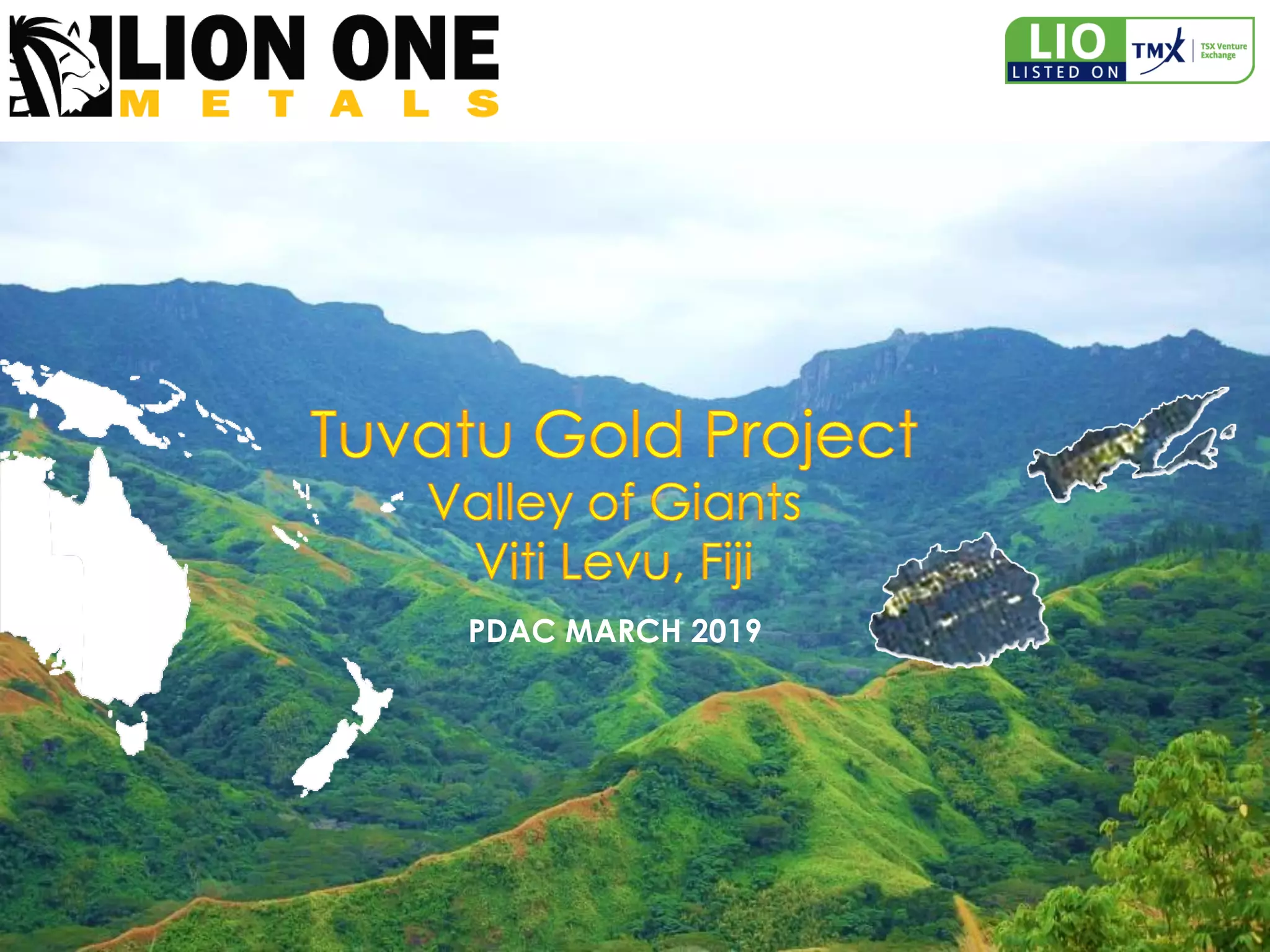
The cover slide establishes the geographic context immediately. It features an aerial view of the lush, mountainous terrain of Viti Levu, Fiji, labeled as the 'Valley of Giants.' The Lion One Metals logo is prominent, along with the 'LIO' ticker symbol for the TSX Venture Exchange. The date 'PDAC MARCH 2019' identifies this as a conference presentation, intended for a sophisticated audience of mining investors and analysts.
Slide 2: Tuvatu Gold Project Overview
This slide functions as the executive summary. It defines the project as a 'Fully Permitted High Grade, Low Cost Underground Gold Mining Startup.' The use of the word 'startup' is interesting in a mining context, perhaps aiming to capture the growth-oriented mindset of modern investors. The slide lists critical de-risking milestones: 100% interest, mining and surface leases, exploration licenses, and environmental approvals (EIA & EMP). Crucially, it provides hard economic figures: a 62% IRR on the initial mine plan at a $1,300 gold price, a US$107M NPV (5% discount rate), and $138M in after-tax cash flow.
Slide 3: Chairman & CEO - Walter H. Berukoff
Slide 5 (as numbered in the deck) introduces the 'jockey.' Walter H. Berukoff is presented not just as a manager, but as a prolific exit-generator. The slide lists three massive successes: La Mancha Resources (sold for $500M in 2012), Northern Orion Resources (sold for $1.1B in 2007), and Miramar Mining (sold for $1.5B in 2008). By totaling $3.1 billion in sales to majors like Newmont and Yamana, the deck argues that Berukoff is a specialist in taking junior miners to lucrative acquisitions. The photo shows him in mining gear, emphasizing hands-on experience.
Slide 4: Work in Progress
Slide 7 provides visual proof of activity, moving the project beyond theoretical geology. Three photos show 'Plant Site Civil Earthworks' (completion in Q3), a 'New Assay Laboratory' (commissioning in Q2), and 'Drill Rigs Mobilized.' This slide is intended to show that capital is being deployed effectively and that the project is physically moving toward production. It concludes with a 'Coming Soon' teaser for the 2019 exploration program.
Slide 5: Company Builder Track Record
Slide 9 reinforces the CEO's pedigree with a logo-heavy layout of previous mining startups. It maps the timeline of Berukoff's exits to major players like Yamana Gold, Newmont, and Endeavour Mining. This slide serves as a 'social proof' equivalent for the mining world, showing that the world's largest gold producers have repeatedly validated Berukoff's projects by acquiring them.
Slide 6: Fiji's Alkaline Gold Corridor
Slide 11 shifts to 'nearology'—the practice of valuing a mine based on its proximity to other successful mines. It maps the 'Viti Levu Lineament,' a geological trend across the island of Fiji. The Tuvatu project is shown sitting directly on this line, along with 'Fiji Water' and the 'Vatukoula' mine. This spatial positioning suggests that Tuvatu is part of a larger, proven mineralized system rather than an isolated anomaly.
Slide 7: Giant Neighbour
Slide 13 doubles down on the proximity argument. It quotes WH Ireland Research describing the neighboring Vatukoula as 'one of the 10 largest epithermal gold systems ever discovered.' The slide notes Vatukoula's 7 million ounces of historic production. A gravity contour map shows a high-intensity red zone for Lion One that mirrors the signature of its 'Giant Neighbour,' visually implying that Tuvatu could host a similar scale of mineralization.
Slide 8: Tuvatu Resource and Mine Plan
Slide 15 is the most data-dense slide in the deck. It provides a cross-section of the Tuvatu site, labeling various anomalies like 'Golden Ridge' and 'Banana Creek' with high-grade rock chip results (e.g., 'Up to 502 g/t'). It reiterates the 6-year mine plan: 352,000 oz. at 11.3 g/t gold. The most compelling statement here is 'Less than 10% of the System Drilled,' which suggests that the current $107M NPV is just the floor of the project's potential value.
Slide 9: District Scale Geology
Slide 17 provides a technical geological map of the Navilawa Caldera. It shows the various Special Prospecting Licenses (SPL 1283, 1296, 1412) and the Special Mining Lease (SML 62). This slide is for the technical analysts in the room, proving that Lion One controls the entire district-scale system, preventing competitors from 'staking' nearby land if Tuvatu proves to be a massive success.
Slide 10: Contact Information
The final slide (Slide 20) is a standard 'Thank You' with contact details for the North Vancouver headquarters and Investor Relations. It features a map of the South Pacific, again grounding the project's location in Fiji relative to Australia and New Zealand.
What Lion One Metals Does Well
The deck is exceptionally strong at establishing credibility through leadership . In the high-risk world of junior mining, investors often 'bet the jockey.' By dedicating two of the ten slides to Walter Berukoff's $3.1 billion track record, the company mitigates the fear of mismanagement. Furthermore, the deck uses visual evidence of progress (Slide 7) to separate itself from 'lifestyle companies' that spend years in exploration without ever turning a shovel of dirt. The economic modeling is also clear; providing a specific NPV and IRR at a stated gold price ($1,300) gives investors a concrete benchmark for valuation.
What is Missing from the Deck
The most notable omission is a specific capital ask . While this is common for public company presentations at conferences like PDAC, a private investor would want to know exactly how much money is being raised and what the specific 'use of proceeds' looks like for the 2019 exploration program. Additionally, there is no detailed team slide beyond the CEO. Mining requires a deep bench of geologists, engineers, and community relations experts; the deck leaves the viewer wondering who else is executing the plan. Finally, there is a lack of sensitivity analysis ; while a 62% IRR at $1,300 gold is impressive, showing how the project performs at $1,100 or $1,500 gold would provide a more complete picture of the project's robustness.
What Other Founders Can Copy
Founders in capital-intensive industries should emulate Lion One's use of 'Nearology' and Benchmarking . If you are building in a space with a dominant incumbent, show why your 'neighborhood' (geographic, technological, or market-wise) is the right place to be. Lion One's Slide 13 is a perfect example of using a neighbor's success to validate one's own potential. Additionally, the 'Work in Progress' slide is a powerful tool for any startup. Showing real photos of construction, equipment, or laboratory commissioning provides a level of 'ground truth' that renderings and bullet points cannot match. It signals to the investor that the company is in the execution phase, not just the dreaming phase.
Frequently asked questions
- What is the primary value proposition of the Tuvatu Gold Project?
- The value proposition is built on three pillars: high grade, low cost, and full permitting. Slide 2 highlights a 62% IRR and a US$107M NPV based on a $1,300 gold price. The project is described as a 'startup' underground mine that is already fully permitted, which significantly reduces the regulatory risk typically associated with new mining ventures in foreign jurisdictions.
- How does the company justify the potential of the Fiji location?
- Lion One uses 'nearology' to justify the site's potential. Slide 11 and Slide 13 map the 'Viti Levu Lineament,' placing Tuvatu in the same 'Alkaline Gold Corridor' as the Vatukoula mine. By citing Vatukoula's 7 million ounces of historic production and its status as one of the world's largest epithermal gold systems, Lion One suggests that Tuvatu shares similar world-class mineralization characteristics.
- Who is the key individual behind Lion One Metals?
- The deck focuses almost exclusively on Walter H. Berukoff, the Chairman and CEO. Slides 5 and 9 detail his history as a 'Company Builder,' specifically his roles in founding and selling Northern Orion Resources ($1.1B), Miramar Mining ($1.5B), and La Mancha Resources ($500M). This track record is used to signal to investors that the leadership knows how to exit a resource play for significant premiums.
- What stage of development was the project in during this presentation?
- The project was in the transition from exploration to development. Slide 7 shows 'Work in Progress,' including civil earthworks for a plant site, a new assay laboratory being commissioned in Q2 2019, and drill rigs mobilized for a new exploration program. Slide 15 notes that less than 10% of the system had been drilled, indicating significant remaining exploration upside despite having a 6-year mine plan in place.
- What financial metrics are provided for the mine plan?
- Slide 15 provides specific projections: a 6-year mine plan targeting 352,000 oz. at 11.3 g/t gold. It calculates a Tuvatu NPV of $107 million and a 62% IRR at a gold price of $1,300. The current resource is listed as 299,500 oz. indicated (8.46 g/t) and 468,000 oz. inferred (9.70 g/t), providing a baseline for the economic projections.