Linte’s 12-slide deck from 2015 targets the massive inefficiency of the Brazilian legal system. The company positions itself as a SaaS solution for litigation management, specifically tackling the volume of lawsuits faced by large enterprises. The deck is notable for its heavy reliance on a single, high-impact case study with Moip, demonstrating a reduction in manual data entry from five times to once, and a time-per-lawsuit drop from 12 minutes to 3. With a reported 23% month-over-month growth and a market size of 100 million lawsuits in Brazil, Linte makes a compelling case for the necessit…
Key takeaways
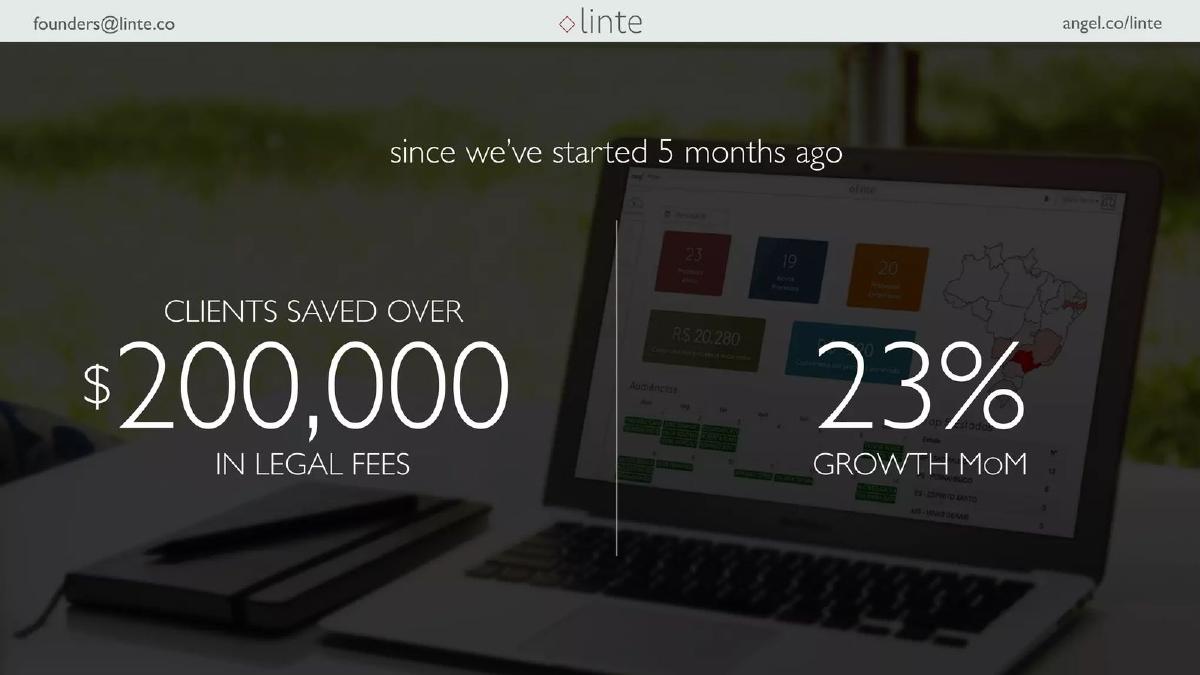
- The company reported 23% month-over-month growth within five months of launching (Slide 6).
- Linte claims to have saved clients over $200,000 in legal fees in its first five months (Slide 6).
- The Brazilian market is defined by 100 million lawsuits and a $27B small claims court sector (Slide 10).
- A case study with Moip showed a 60% reduction in expenses and a 75% reduction in time spent per lawsuit (Slides 8-9).
- The product automates data entry, reducing the need to type data into multiple systems from 5x to 1x (Slides 8-9).
- The business model is based on enterprise software with subscription plans (Slide 10).
- The team includes experience from major Brazilian and international firms like Vale, Telefonica, and Fiat (Slide 11).
- The deck omits a specific funding goal, valuation, or use-of-funds breakdown.
The Hook: Quantifying the Legal Burden
Slides 1-3: The Problem Statement
Linte opens with a minimalist title slide (Slide 1) that sets a bold tone: "killing inefficiency in the legal industry." This is immediately followed by a visual representation of the problem. Slide 2 uses a background image of overflowing paperwork with the question, "HOW MANY LAWSUITS DO YOU GET?"
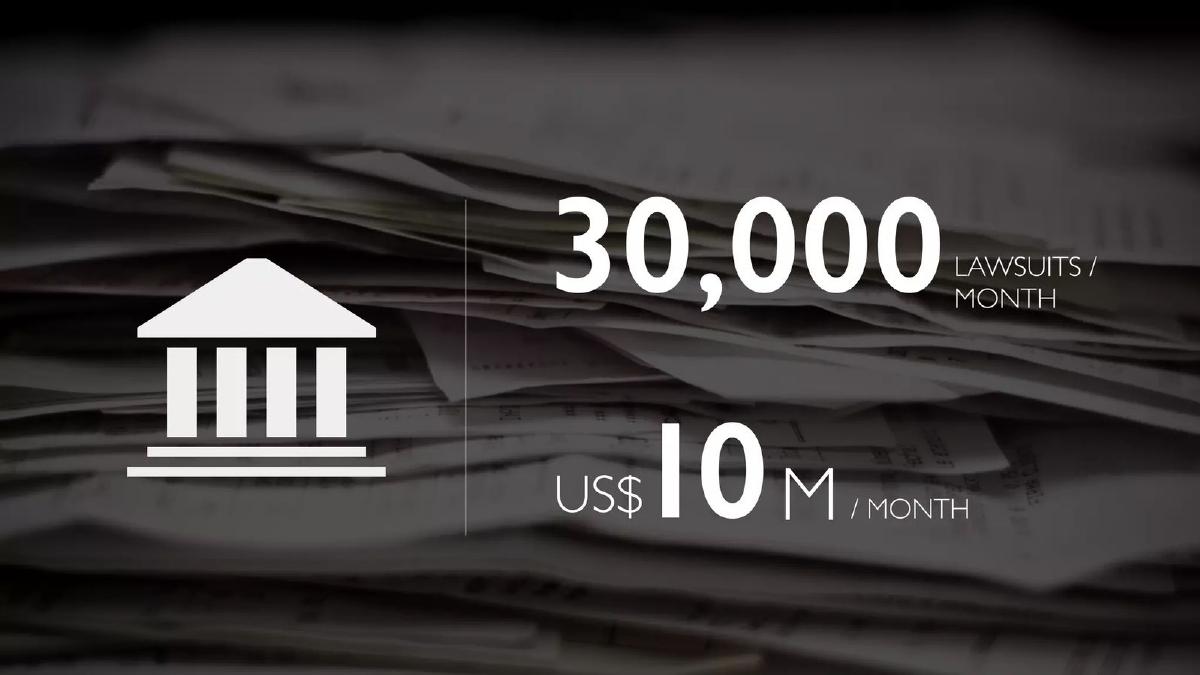
Slide 3 provides the quantitative answer for their target enterprise segment. It cites a staggering 30,000 lawsuits per month for a single large entity, representing a cost of US$ 10M per month . By starting with these high-velocity figures, Linte establishes that their solution isn't for small firms, but for major corporations where legal costs are a significant line item on the P&L.
The Solution and Early Traction
Slides 4-6: Visualizing the Product and Results
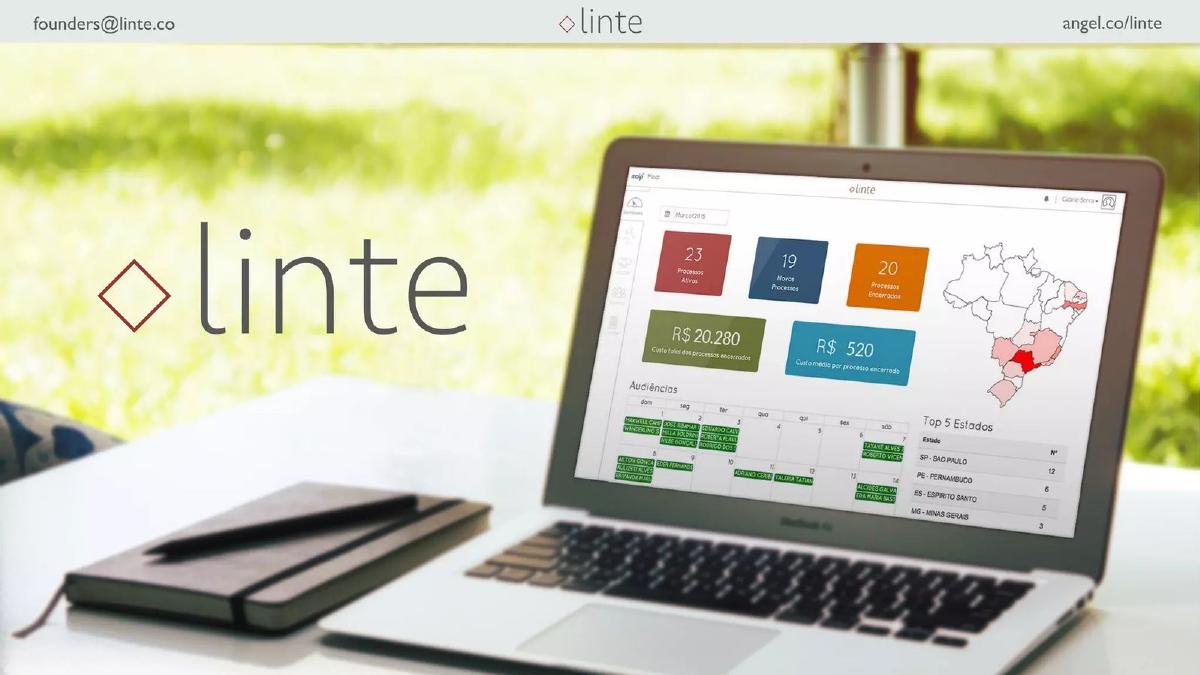
Slide 4 is a curious inclusion—a photo of the character Saul Goodman from 'Better Call Saul.' While it serves as a cultural touchstone for the legal industry, it adds little substantive value to the pitch. However, Slide 5 quickly pivots back to the product. It shows the Linte dashboard on a laptop, featuring metrics like "Custo total dos processos encerrados" (Total cost of closed processes) and a map of Brazil showing lawsuit distribution by state.
Slide 6 is the "money slide" for traction. It states that in the 5 months since launch, Linte has achieved 23% MoM growth and saved clients over $200,000 in legal fees . This is a strong validation of the product-market fit, showing that the software provides immediate financial relief to its users.
The Power of the Case Study
Slides 7-9: The Moip Transformation
Linte uses a three-slide sequence to walk through a case study with Moip (a Brazilian payments company). Slide 7 sets the baseline: "lot of money spent in litigation management," an average of 12 minutes spent on a single lawsuit, and data being typed into 5 different systems .
Slide 8 shows the 'After' state. With Linte, the client saw a 60% reduction in expenses . The time spent per lawsuit dropped from 12 minutes to 3 minutes , and the data entry was consolidated from five times to a single time . This is an exceptionally clear way to demonstrate ROI. It moves the conversation from "we have a cool tool" to "we save you 9 minutes and 4 data entries per case." When multiplied by the 30,000 cases mentioned in Slide 3, the efficiency gains are massive.
Market Opportunity and Business Model
Slides 10-12: The Macro View and The Team
Slide 10 defines the business model and market size. Linte identifies as Enterprise Software with Subscription Plans . The market size in Brazil is listed as 100M lawsuits and a $27B small claim courts market. This slide justifies the scalability of the business; even a small percentage of this market represents a multi-billion dollar opportunity.
Slide 11 introduces the team. While it lacks detailed bios, it uses the logos of major companies like Vale, Telefonica, Buscapé, Fiat, and Natura to provide social proof of the team's professional background. This suggests the founders understand the corporate environments they are selling into. The deck concludes on Slide 12 with contact information for CEO Gabriel Senra.
What Linte Does Well
Quantifiable ROI: The Moip case study is the strongest part of the deck. By breaking down the specific minutes and data-entry points saved, Linte makes the value proposition undeniable. Investors can easily calculate the potential savings for a company with 30,000 lawsuits based on these metrics.
Market Specificity: Rather than claiming to solve legal tech globally, Linte focuses on the specific, high-volume pain point of the Brazilian legal system. The mention of 100 million lawsuits provides a clear ceiling for the opportunity within their home market.
Traction Velocity: Reporting 23% MoM growth within the first five months is an excellent indicator of momentum. It suggests that the sales cycle for their enterprise software might be shorter than industry averages, or that their initial outreach was highly effective.
What is Missing from the Deck
The Ask: This is the most glaring omission. A pitch deck is a tool to raise money, yet there is no mention of the amount being sought, the valuation, or the milestones the company intends to reach with the new capital.
Competitive Landscape: The deck assumes that the only competition is the status quo (manual paperwork). It does not address other legal tech startups or existing enterprise resource planning (ERP) systems that might have legal modules.
Product Roadmap: We see the current dashboard, but we don't see what's next. Does Linte plan to move into AI-driven contract analysis? Marketplace services for lawyers? The future vision is left to the imagination.
Founder's Playbook: What to Copy
The 'Before and After' Slide: Founders should emulate the Moip case study. If your product saves time or money, don't just say "it's efficient." Say "it used to take 12 minutes and 5 entries; now it takes 3 minutes and 1 entry." Specificity wins every time.
High-Impact Problem Sizing: Slide 3 is a great example of anchoring. By putting the numbers "30,000 lawsuits" and "$10M/month" in front of an investor early, you set the stakes for the rest of the presentation. It makes the subsequent solution feel necessary rather than optional.
Clean Visuals: The deck uses a consistent, clean design with plenty of white space. Even the product screenshots are framed within hardware (laptops/tablets), which makes the software feel more tangible and ready for market.
Frequently asked questions
- What is the primary problem Linte is solving?
- Linte targets the extreme inefficiency in the legal industry, specifically in Brazil. According to Slide 3, large entities can face up to 30,000 lawsuits per month, costing roughly $10M monthly. The deck highlights the manual burden of litigation management, where data is often typed into five different systems for a single case, taking an average of 12 minutes per lawsuit.
- How does Linte's product actually work?
- While the deck is light on technical architecture, Slide 10 shows the product as a cross-platform (mobile, tablet, desktop) SaaS tool. It features a dashboard for tracking active and closed processes, costs per process, and geographic distribution of lawsuits. The core value proposition is document assembly and marketplace tools that automate the 'typing' phase of litigation.
- What traction did Linte have at the time of this deck?
- Linte demonstrated significant early momentum. Slide 6 states that in the five months since starting, they achieved 23% month-over-month growth and saved their clients a cumulative $200,000 in legal fees. This suggests a rapid implementation cycle and immediate ROI for their B2B customers.
- Who are the founders and what is their background?
- The team consists of Gabriel Senra (CEO), Carlos Pereira (CTO), Paulo Hecht (Head of Product), and Cristiano Bunte (Marketing & Design). Slide 11 displays logos from Vale, Telefonica, Buscapé, Fiat, and Natura, implying the team has professional experience or pedigree from these established corporate and tech giants.
- What is missing from this pitch deck?
- The most significant omission is the 'Ask.' There is no slide detailing how much capital Linte is raising, the terms of the round, or how the money will be spent. Additionally, there is no competitive landscape analysis or a detailed financial projection beyond the initial five months of growth.