Linguana’s 13-slide deck focuses heavily on the tangible financial upside for creators, positioning itself as a zero-risk partner rather than just a software tool. By utilizing a revenue-share model where the company takes on the operational fees and risk, Linguana aligns its success directly with creator growth. The deck highlights significant traction, claiming a jump from 19.5M views in Q1 2024 to an estimated 190.5M by Q1 2025. While the deck excels at demonstrating the 'incremental revenue' argument through specific use cases, it lacks a formal 'Ask' slide, detailed unit economics, or a…
Key takeaways
- Linguana operates on a revenue-share model, explicitly stating they 'take on the fees and risk' on slide 2.
- The platform claims to manage approximately 3.5M daily views as of the deck's publication on slide 3.
- Projected growth is aggressive, targeting a nearly 10x increase in quarterly views from 19.5M in Q1 2024 to 190.5M in Q1 2025 (slide 3).
- The deck uses a 'Geopolitics channel' as a primary case study to show how English content translates into French, Italian, and Spanish revenue (slide 4).
- Localization performance varies significantly by language; for one video, French generated $1,600 from 900K views, while Italian generated $400 from 225K views (slide 4).
- The company claims an average audience increase of 37% to 50% per localization across its use cases (slide 5).
- The team is led by Co-founders Yuval Tal (CEO) and Oded Shafran (CTO), supported by operations and sales leads (slide 6).
- The deck omits a specific funding ask, a breakdown of the $8.5M round usage, and a detailed technical explanation of the AI stack.
Linguana: Scaling the Creator Economy via AI Localization
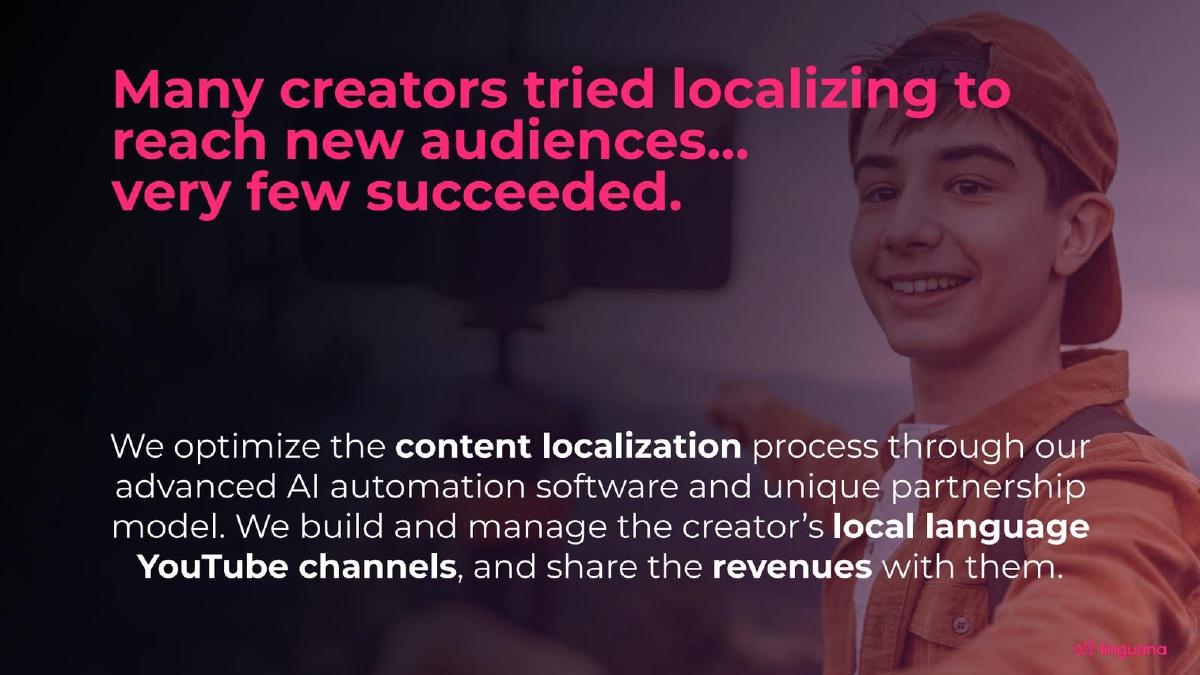
Linguana’s pitch deck is a masterclass in focusing on the 'Bottom Line.' In an era where AI tools are often sold as SaaS subscriptions, Linguana differentiates itself by pitching a partnership. The core message is simple: creators provide the content, Linguana provides the global audience, and everyone shares the profit. This teardown examines the 13-slide deck that helped secure $8.5M in Seed funding, as reported by Business Insider.
Slide 1: The Hook
The title slide is minimalist, featuring the Linguana logo and the tagline: "Monetizing the world for video creators." The imagery of a hand holding a smartphone with video thumbnails floating around it immediately identifies the target market: mobile-first video consumers and the creators who serve them. It sets a professional, media-centric tone without cluttering the opening with technical jargon.
Slide 2: The Value Proposition and Business Model
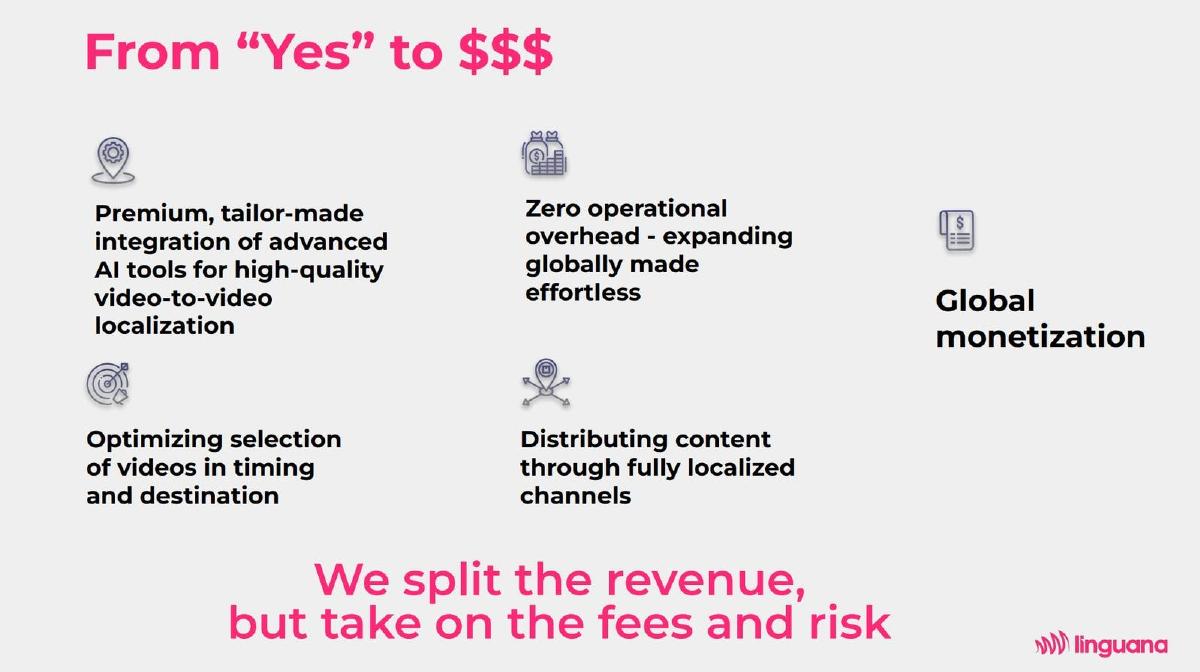
Slide 2, titled "From 'Yes' to $$$$," is perhaps the most important slide for an investor. It outlines the five pillars of their service: premium AI tools for video-to-video localization, optimized video selection, zero operational overhead, distribution through localized channels, and global monetization. The most critical text is at the bottom: "We split the revenue, but take on the fees and risk." This clarifies that Linguana is not a tool creators pay for; it is a service that pays creators. By removing the barrier of entry (cost and effort), Linguana positions itself as an irresistible 'no-brainer' for large creators.
Slide 3: Traction and Growth Metrics
This slide uses a stacked bar chart to show the "Views of Linguana-localized videos growing rapidly." The numbers are impressive: 19.5M views in Q1 2024 growing to a projected 190.5M in Q1 2025. The slide also notes "current daily views ± 3.5M." The use of a stacked bar chart suggests a growing portfolio of channels or languages, indicating that their scaling mechanism is working across multiple assets simultaneously. The steepening curve between Q3 and Q4 2024 (39.9M to 108.1M) suggests a significant breakthrough in either technology efficiency or creator acquisition during that period.
Slide 4: The Geopolitics Case Study
To prove the model, Linguana provides a "Highlight Performance Snapshot" of a Geopolitics channel originally in English. This slide is highly effective because it provides raw data. For example, a video about 'World War 3' with 600K original views generated 900K views and $1,600 in revenue in French, and 225K views and $400 in revenue in Italian. This demonstrates that localized content can sometimes outperform the original in specific markets, providing a massive incentive for creators to sign on.
Slide 5: Use Case Breakdown
Slide 5 reinforces the data from the previous slide by showing the aggregate impact. It claims an average "37% to 50% increase in video audience" per localization. It also lists specific 'additional revenue' figures like $5,900 and $2,300. The closing statement, "The results speak for themselves, and the profits keep on coming," emphasizes the passive income nature of their offering for the creator.
Slide 6: The Team
The "Founders" slide introduces Yuval Tal (CEO) and Oded Shafran (CTO). It also lists Galit Assaf (Operations) and Shuki Merlis (Sales). While the slide includes LinkedIn icons, it lacks the 'pedigree' logos (former companies like Google, Meta, etc.) often seen in Silicon Valley decks. However, in a Seed round, the focus is often on the ability to execute, and the previous traction slides do the heavy lifting here.
Slide 7: Conclusion
The final slide is a simple "Thank You" with the company logo. Notably, the deck ends without a formal 'Ask' slide or a 'Contact Us' slide in this version. This suggests the deck may have been used as a supporting visual for a live pitch rather than a standalone document sent via email, or that the specific terms of the $8.5M round were handled in a separate document.
What Linguana Does Well
Clarity of Model: Many AI startups struggle to explain how they make money. Linguana is crystal clear: they share revenue. This aligns their interests with both the creator and the investor.
Data-Driven Proof: By showing specific dollar amounts and view counts for localized videos, they move the conversation from 'theoretical AI potential' to 'actual cash flow.'
Focus on Friction: The phrase "Zero operational overhead" addresses the primary pain point for creators who are already overworked. Linguana isn't selling a tool that requires more work; they are selling a result.
What is Missing from the Deck
The Competitive Landscape: The deck does not mention competitors like YouTube's native multi-audio features or other AI dubbing startups (e.g., Dubverse, Papercup). Investors would want to know how Linguana's 'managed service' model holds up against platform-native tools.
Technical Moat: There is very little information on the 'Advanced AI tools' mentioned on slide 2. Is the technology proprietary, or are they wrapping existing APIs? For a $8.5M Seed round, the technical defensibility is a key question.
The Ask: As noted, there is no slide detailing the amount being raised, the valuation, or the milestones they intend to hit with the capital. While this is common in 'leaked' decks, it is a vital component of a functional fundraising tool.
Advice for Founders Copying This Style
Use Real Numbers: If you have traction, follow Linguana's lead on slide 4. Don't just say 'we increase revenue'; show a specific video, its original views, and its localized earnings. Specificity builds trust.
Highlight the 'No-Risk' Factor: If your business model involves taking on the risk for your customers, make that a headline. It is one of the most powerful ways to overcome sales objections.
Keep it Visual: Linguana avoids walls of text. They use icons, charts, and clear headings to guide the reader through the narrative. This is especially important for media and AI companies where the product is visual by nature.
Frequently asked questions
- What is Linguana's business model?
- Linguana uses a revenue-share model. According to slide 2, they provide 'zero operational overhead' for creators by handling the localization and distribution of content through fully localized channels. They explicitly state they split the resulting revenue while Linguana absorbs the operational fees and risks associated with the expansion.
- How fast is Linguana growing in terms of viewership?
- The growth is rapid and exponential. Slide 3 shows quarterly views of localized videos starting at 19.5M in Q1 2024, rising to 31.2M in Q2, 39.9M in Q3, and 108.1M in Q4. They estimate reaching 190.5M views by Q1 2025, with current daily views hovering around 3.5M.
- What kind of revenue can a creator expect from localization?
- Slide 4 provides specific examples from a Geopolitics channel. One video with 600K original views earned an additional $1,600 in French (900K views) and $400 in Italian (225K views). Another video with 5M original views earned $1,300 in French. Slide 5 notes that additional revenue per channel ranges from $740 to $5,900 depending on the audience size.
- Who are the founders of Linguana?
- The company was founded by Yuval Tal (CEO) and Oded Shafran (CTO). The leadership team also includes Galit Assaf in Operations and Shuki Merlis in Sales, as shown on slide 6. The deck provides LinkedIn links for the founders but does not detail their professional backgrounds.
- What is missing from the Linguana pitch deck?
- The deck is missing several standard venture components: a slide detailing the specific 'Ask' (how much they are raising), a 'Use of Funds' breakdown, a competitive analysis showing how they differ from other AI dubbing tools, and a deep dive into the underlying technology or unit economics beyond simple revenue splits.