Link-Up’s pitch deck, presented at Draper University, is a brief, product-centric presentation that identifies a specific industrial pain point: wasted time in manufacturing. By citing the World Economics Forum's 2018 Future of Jobs Report, the company establishes a baseline for human-machine task distribution (71% human vs. 29% machine). The deck relies heavily on screenshots of its 'Live Streaming' and 'AI Analytics' interfaces to prove technical capability, specifically highlighting how it identifies 'Idle' versus 'Productive' time. While it successfully demonstrates a 44% misuse of task t…
Key takeaways
- The deck identifies 'Motion' and 'Waiting' as the primary sources of manufacturing waste on slide 2.
- Link-Up uses the World Economics Forum's 2018 Future of Jobs Report to frame the automation landscape on slide 2.
- Technical validation is provided through a 'Live Streaming' slide showing OpenPose-style skeletal tracking at 6.6 fps on slide 3.
- The software categorizes worker activity into binary states: 'Idle' (highlighted in red) and 'Productive' (highlighted in green) on slide 4.
- A specific data organization example on slide 5 claims that 3.35 seconds, or 44% of a task, was misused.
- The value proposition is split into two phases: 'Catch' (recording and locating delays) and 'Improve' (analysis and cost reduction) on slide 6.
- The company is headquartered in Seoul, Republic of Korea, as stated on the final contact slide.
- The deck omits critical investor information, including the business model, competition, and financial projections.
Link-Up Pitch Deck Teardown
The Link-Up pitch deck, originating from a Draper University program, is a minimalist 7-slide presentation. It focuses almost exclusively on the technical application of AI video analytics within a factory setting. While it lacks the traditional narrative arc of a seed-stage deck—omitting sections on market size, competition, and team—it provides a clear visual demonstration of the product's utility in identifying industrial waste.
Slide 1: Title Slide
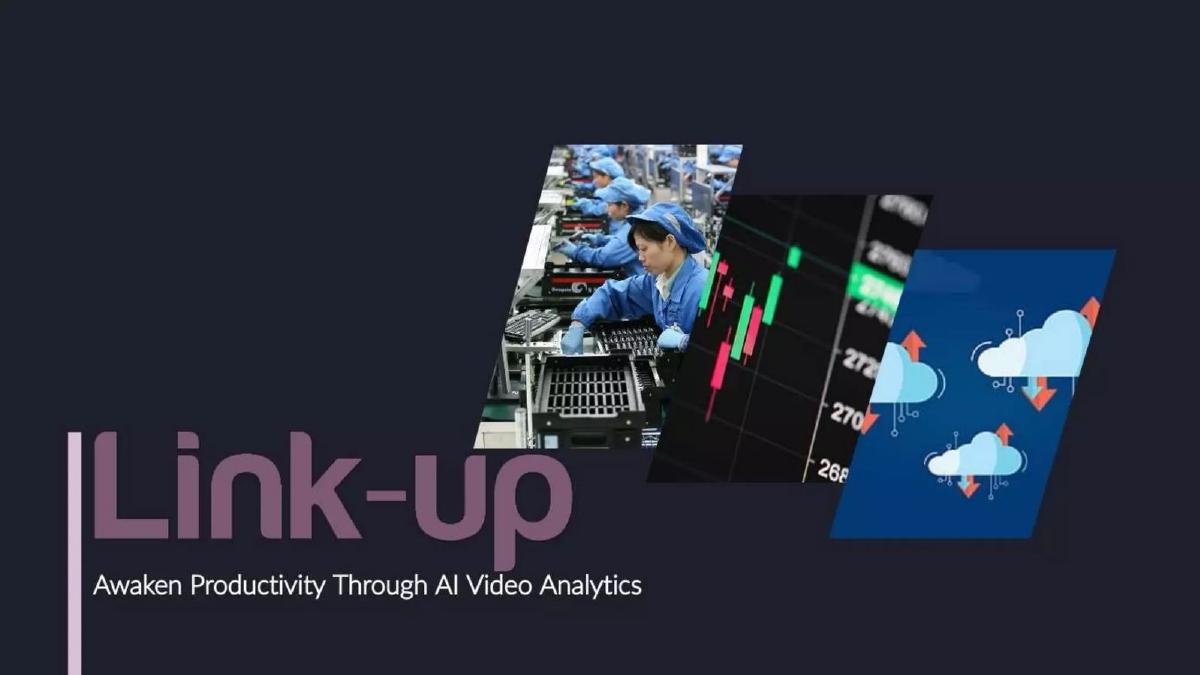
The cover slide introduces the company name, Link-Up, and its core mission: "Awaken Productivity Through AI Video Analytics." The imagery is industrial, featuring a factory assembly line, a stock market candlestick chart, and cloud computing icons. This immediately signals that the company operates at the intersection of manufacturing (IoT/Edge) and data analytics.
Slide 2: The Problem and Market Context
Link-Up uses a quote from Carl Sandburg ("Time is the coin of your life") to frame the problem of inefficiency. More importantly, it cites the World Economics Forum's "Future of Jobs Report 2018," which notes that in 2018, the rate of automation was 71% human to 29% machine. This suggests a massive opportunity for human-centric optimization. The slide identifies two specific types of waste: Motion (wasted effort related to unnecessary movements) and Waiting (waste from time spent waiting for the next process step or idle equipment). These are classic Lean Manufacturing principles (Muda), which Link-Up intends to solve via software.
Slide 3: Live Streaming and Technical Proof
This slide serves as a technical proof of concept. It shows a screenshot of the software in action, utilizing skeletal tracking (OpenPose) on two factory workers. The interface displays a frame count (135) and a processing speed of 6.6 fps (frames per second). By showing the colorful skeletal overlays on the workers, the deck proves that the company has a functional computer vision model capable of identifying human posture and movement in a cluttered industrial environment.
Slide 4: AI Analytics Interface
Slide 4 demonstrates the output of the AI. It shows a split-screen interface where the software categorizes activities. On the left, a worker's state is labeled "Idle" in red; on the right, the state is labeled "Productive" in green. This binary classification is the foundation of their analytics engine, allowing managers to see exactly when and where time is being lost on the floor without manually reviewing hours of footage.
Slide 5: Data Organization and Case Study
This is the most data-dense slide in the deck. It shows a dashboard titled "Manufacturing / List / Hinge assembly / Measure / Graph." It breaks down a specific task (unloading a bracket from a press machine) and identifies that 3.35 seconds, or 44% of the task, was "misused." The bar chart compares "Current T/T" (Total Time) against a "Target T/T," highlighting the "Non-Value Added time" in red. This slide is critical because it moves the conversation from "we can track skeletons" to "we can provide actionable ROI by identifying specific seconds of waste."
Slide 6: The Value Proposition
Link-Up summarizes its workflow into two categories: Catch and Improve . Under "Catch," they list recording steps, creating a database, locating delays, and removing human error. Under "Improve," they promise comprehensive analysis, revamped productivity, reduced costs, and improved product quality. The visual uses arrows pointing up for efficiency and quality, and an arrow pointing down for cost, providing a standard business value summary.
Slide 7: Contact Information
The final slide provides a URL (link-up.co.kr), a phone number, a Gmail address, and a physical address in Seoul, Republic of Korea. The presence of a Korean address and a .co.kr domain suggests the company is targeting the robust manufacturing sector in East Asia.
What Link-Up Does Well
The deck excels at visual evidence . Instead of describing what AI video analytics could do, slides 3, 4, and 5 show the software actually doing it. The use of skeletal tracking screenshots and specific time-waste graphs (down to the hundredth of a second) builds immediate technical credibility. By focusing on "Non-Value Added time," they are speaking the language of factory managers and Lean Six Sigma practitioners, which makes the product's utility very clear.
What is Missing from the Deck
This deck is significantly incomplete by standard venture capital standards. The following elements are entirely missing:
Team Slide: There is no information on who is building this. In AI startups, the pedigree of the engineering team is often the most important factor for early-stage investors. · Market Size (TAM/SAM/SOM): The deck doesn't quantify how many factories could use this or what the total market opportunity is. · Business Model: It is unclear if this is a per-camera subscription, a per-factory license, or a consultancy-based model. · Competition: The deck does not mention other players in the computer vision or industrial IoT space. · The Ask: There is no mention of how much money the company is raising or what the milestones for the next 18 months are.
Founder Takeaways
Show, Don't Just Tell: Link-Up’s decision to include actual software screenshots with skeletal tracking and data dashboards is a strong move. For technical founders, showing a functional UI/UX is often more persuasive than a dozen slides of bullet points about "proprietary algorithms."
Identify a Specific Metric: By focusing on "3.35 seconds of misused time," the founders make the abstract concept of "productivity" concrete. When pitching, finding a single, relatable metric that your product impacts can help anchor the investor's understanding of your value.
Contextualize with Reputable Data: Using the World Economics Forum report on slide 2 helps validate that the problem Link-Up is solving is a recognized global trend, not just a niche observation. This adds a layer of professional gravity to the presentation.
Frequently asked questions
- What is the core technology behind Link-Up?
- Based on slide 3, Link-Up utilizes AI video analytics, specifically skeletal tracking (labeled as OpenPose in the screenshot) to monitor personnel in manufacturing environments. The software processes live video at approximately 6.6 frames per second to analyze human motion and identify inefficiencies in real-time.
- What specific problem does Link-Up solve for manufacturers?
- Link-Up targets 'Non-Value Added time.' According to slide 2, this includes needless time caused by excessive motions in personnel and time spent waiting on materials or idle equipment. Slide 5 demonstrates their ability to quantify this, showing a task where 44% of the time was classified as 'misused' relative to a target cycle time.
- Is there any information on the founding team?
- No. The 7-slide deck completely omits a team slide. There is no mention of the founders' names, technical backgrounds, or previous experience in AI or manufacturing. The only identifying information is a general contact email and a physical address in Seoul, South Korea, provided on slide 7.
- Does the deck include a market size or financial ask?
- The deck contains no information regarding the Total Addressable Market (TAM), the business model (SaaS vs. Licensing), or the amount of capital being raised. It is a product-focused presentation likely intended for a demo day environment rather than a full venture capital due diligence process.
- How does Link-Up define productivity?
- Link-Up defines productivity through motion analysis. On slide 4, the AI analytics interface distinguishes between 'Idle' and 'Productive' states. Slide 6 further explains that the system 'catches' human error and delays by recording steps and creating a database, which is then used to 'improve' product quality and reduce costs.