The Lish pitch deck is a masterclass in visual storytelling, utilizing high-quality food photography and minimalist text to establish a premium brand position in the crowded food-tech space. By focusing on the 'chef-driven' aspect of their platform, Lish differentiates itself from budget-oriented delivery services like GrubHub or Seamless. However, the deck is notably light on traditional venture capital requirements. It lacks a clear 'Ask' slide, detailed financial projections, and a breakdown of unit economics. While the team slide effectively leverages big-tech pedigree from Amazon and Mic…
Key takeaways
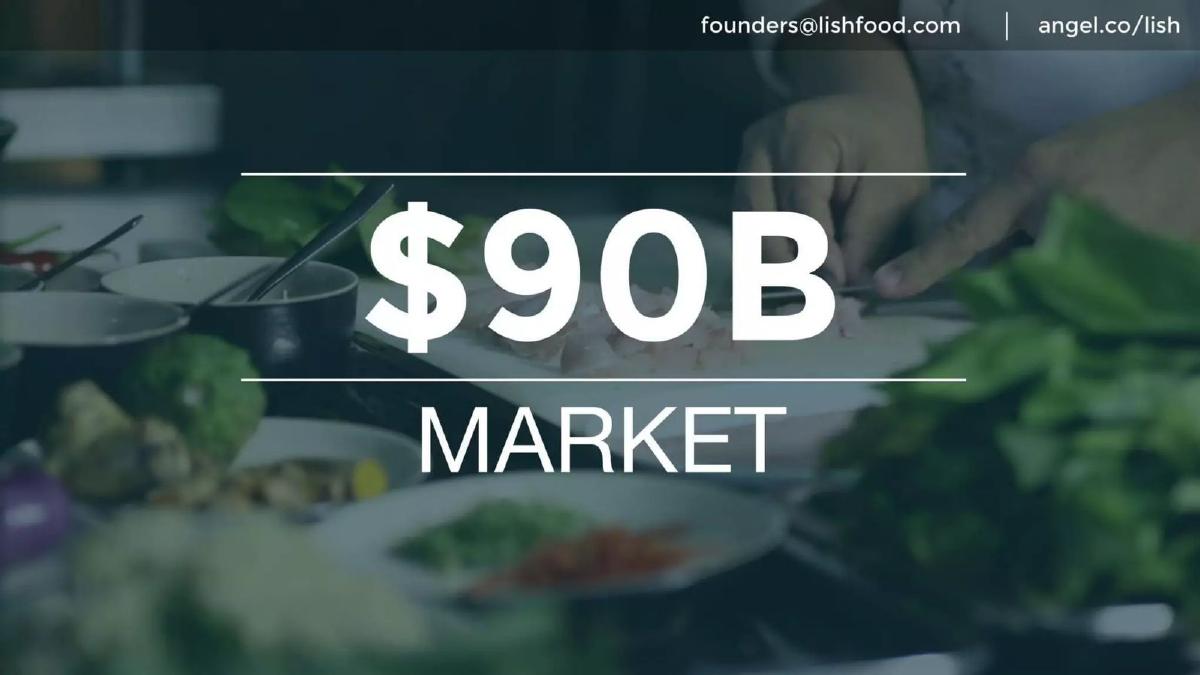
- The deck identifies a $90B market opportunity on slide 4, though it does not specify the source or the specific segment (TAM/SAM/SOM).
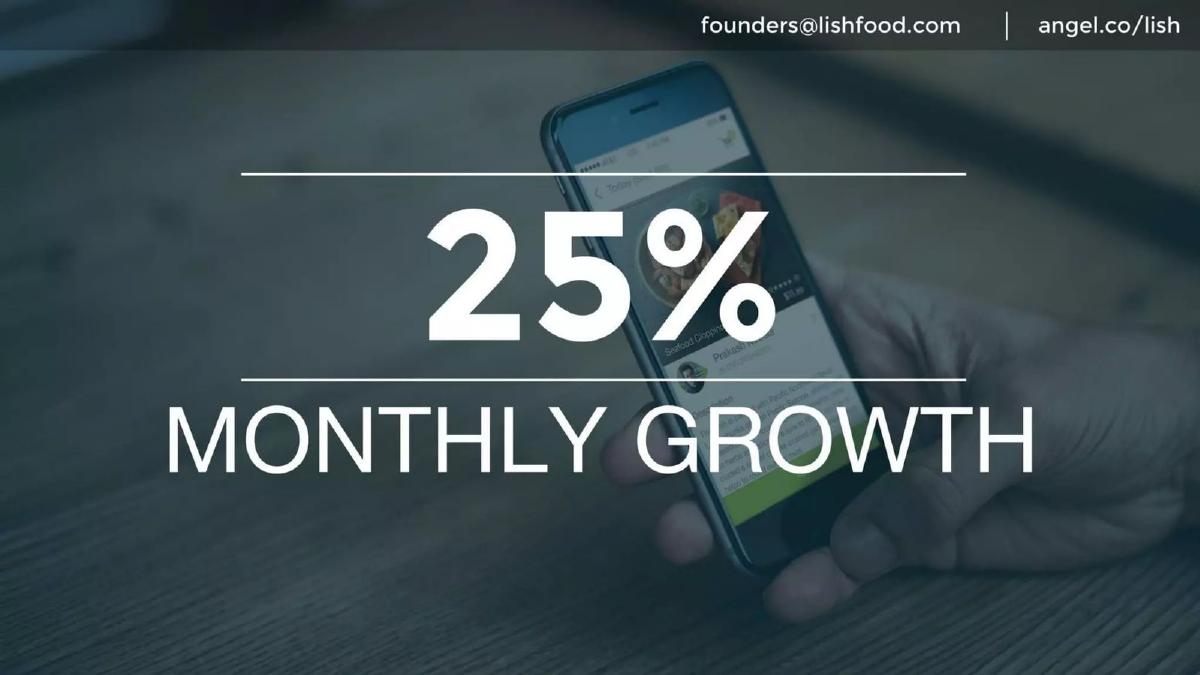
- Lish claims a 25% monthly growth rate on slide 5, which is repeated as a core traction metric on slide 21.
- The platform emphasizes high-end culinary talent by comparing the James Beard Award to an Oscar on slide 14.
- Competitive positioning on slide 16 places Lish at the top of a pyramid above 'Mid-tier' and 'Budget' restaurants served by Caviar, Postmates, and GrubHub.
- The team slide (slide 20) highlights 20 years of e-commerce experience and a founder who managed $100M in revenue for an Amazon business unit.
- The deck uses a 'show, don't tell' strategy for its product, dedicating slides 10, 11, and 12 entirely to high-resolution food photography.
- There is no slide dedicated to unit economics, customer acquisition cost (CAC), or lifetime value (LTV).
- The deck completely omits a funding ask, leaving the desired amount and use of funds unknown to the viewer.
The Visual Allure of Lish: A Premium B2B Food Play
Lish’s 2014 pitch deck is a fascinating example of brand-first fundraising. In an era where food-tech was becoming increasingly commoditized by logistics giants, Lish attempted to pivot the conversation toward quality and curation. The deck is remarkably sparse on text, favoring full-bleed imagery and bold, singular metrics. While this creates a compelling aesthetic, it leaves significant gaps in the business case that a sophisticated investor would need to bridge.
Slides 1-4: Setting the Scene and Market Size
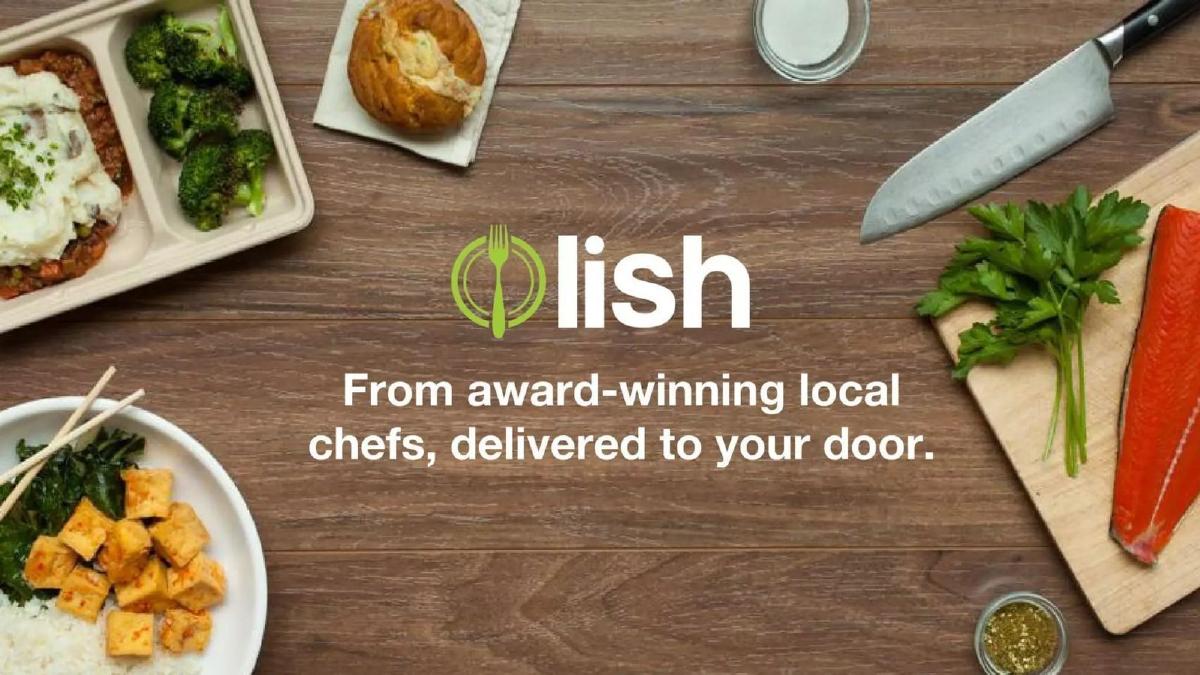
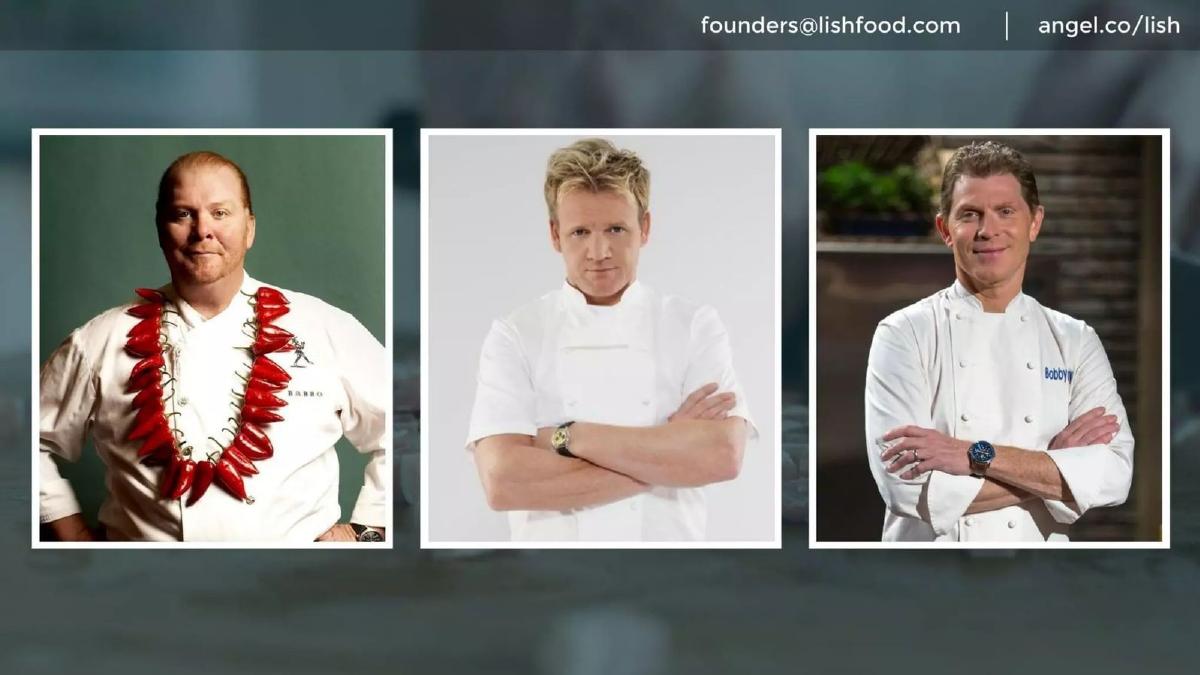
The deck opens with a title slide (Slide 1) that immediately establishes the brand's focus: 'From award-winning local chefs, delivered to your door.' The imagery is rustic and high-quality, signaling a premium service. Slide 2 uses celebrity chef imagery (Gordon Ramsay, Bobby Flay) to anchor the concept of 'chef-driven' food, even if these specific chefs are not on the platform. It serves as a psychological anchor for the quality level they aim to provide.
Slide 3 shows a lifestyle shot of a couple dining, which is slightly confusing given the company's self-description as a B2B platform for offices. This suggests the deck may have been originally designed for a B2C audience or that they were pitching a hybrid model at the time. Slide 4 introduces the market size with a bold $90B MARKET claim. While the number is large, the slide lacks any breakdown of how much of that market is corporate catering versus general delivery, a common critique of 'big number' market slides.
Slides 5-9: Traction and Product Interface
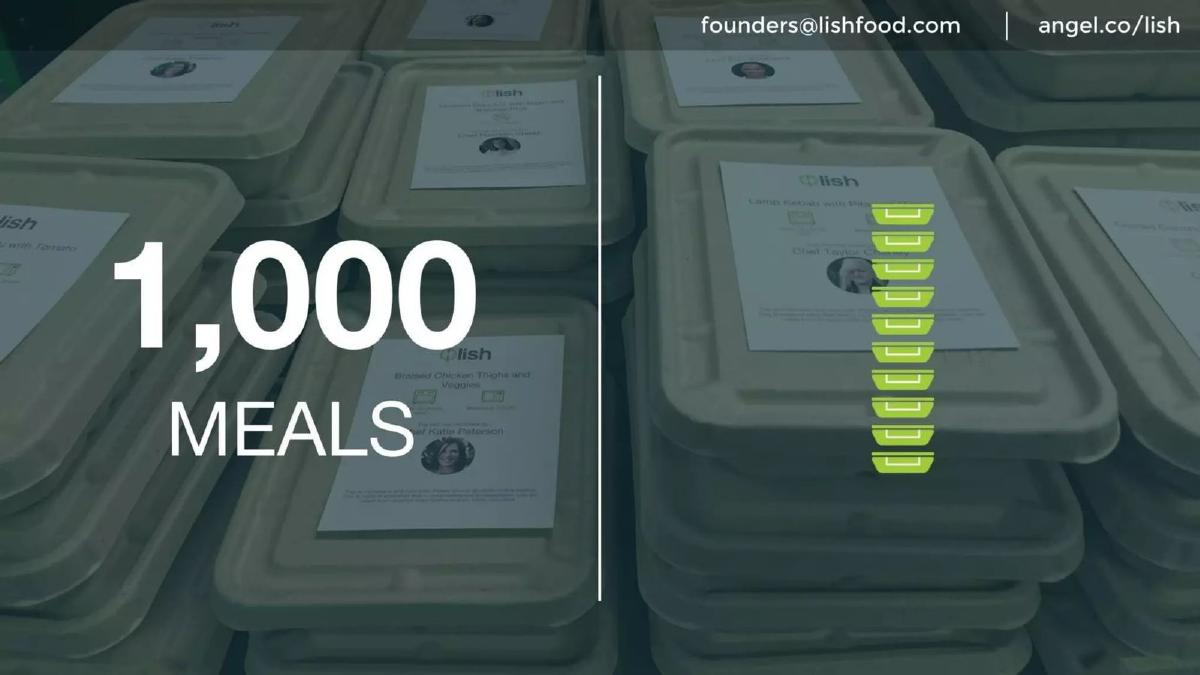
Slide 5 highlights 25% MONTHLY GROWTH . This is a strong metric, though without a baseline (growth from $1k to $1.25k is different from $100k to $125k), its impact is limited. Slides 6 and 7 use a visual tally of containers to show a jump from 1,000 MEALS to 10,000 MEALS . This is an effective way to visualize scale without over-complicating the slide with charts.
Slide 8 shows the product interface across mobile and tablet devices. The UI looks clean and modern for 2014, emphasizing food photography. Slide 9 is a 'humor' slide, contrasting a poorly presented meal with a character from the movie 'Office Space.' This is a risky move in a professional deck, as it uses valuable real estate for a joke rather than data, but it does clearly illustrate the 'pain point' of mediocre office food.
Slides 10-15: The 'Chef' Value Proposition
This section is the heart of the Lish brand. Slides 10, 11, and 12 are purely high-resolution photos of tacos, grain bowls, and packaged meals. There is no text on these slides. The goal is clearly to make the investor hungry and to prove that 'delivery food' can look like 'restaurant food.'
Slide 13 shows the packaging and collateral, including a 'thank you' note from the chef. This highlights the personal connection Lish tries to facilitate between the maker and the consumer. Slide 14 is a critical positioning slide, equating the James Beard Foundation Award to an Oscar . This educates investors who might not be familiar with culinary accolades. Slide 15 then lists local Seattle restaurants and chefs (Bar Cotto, Red Cow, Staple & Fancy) to prove they have already secured high-end supply.
Slides 16-19: Competition and Operations
Slide 16 is the most 'business-heavy' slide in the deck. It uses a pyramid to categorize the market. Lish sits at the top ('Top Chef Restaurants'), while competitors like Caviar , Postmates , GrubHub , and Seamless are relegated to the 'Mid-Tier' and 'Budget' categories. This is a classic strategy to avoid direct price competition with larger, better-funded rivals.
Slides 17 and 18 show the 'old way' of doing things—industrial kitchens and assembly lines. The imagery is sterile and unappealing. Slide 19 contrasts this with a photo of two chefs working in a high-end kitchen. The narrative is clear: Lish is about craftsmanship, not industrial food production. However, this raises questions about scalability—can 'craft' food scale to the 10,000+ meal level shown earlier without losing its soul (or its margins)?
Slides 20-21: The Team and Final Traction
Slide 20 introduces the team. This is a strong slide. It highlights 20 YRS e-commerce experience and a specific win: $100M revenue in 3 yrs for Amazon biz unit . The logos of Amazon, Zillow, and Microsoft provide significant social proof. The inclusion of a 'Pro chef heading operations' (Aaron) is a smart way to show they have domain expertise, not just tech expertise.
The deck ends on Slide 21, which repeats the 25% MONTHLY GROWTH and TOP CHEFS IN THE CITY claims. It functions as a summary slide but lacks a call to action or a specific funding request.
What Works in the Lish Deck
1. Strong Brand Identity: The deck is visually consistent. The use of high-quality photography makes the product feel premium and desirable. In a crowded market, looking 'expensive' can be a differentiator.
2. Clear Positioning: By using the pyramid graphic on Slide 16, Lish successfully carves out a niche. They aren't trying to be the cheapest; they are trying to be the best. This appeals to corporate clients with high budgets for employee perks.
3. Team Pedigree: The team slide is excellent. It doesn't just list titles; it lists specific achievements (like the $100M Amazon revenue) that are relevant to scaling an e-commerce platform.
What is Missing from the Lish Deck
1. The Ask: The most glaring omission is the lack of a funding ask. Investors need to know how much you want, what the valuation is (or the cap), and exactly what that money will buy (e.g., '18 months of runway to expand to Portland and San Francisco').
2. Business Model and Unit Economics: How does Lish make money? Is it a commission on the food, a delivery fee, a subscription for offices, or all three? More importantly, what are the margins? Premium food often comes with premium costs; showing that the business is profitable on a per-unit basis is vital for food-tech.
3. Customer Acquisition Strategy: The deck mentions B2B in the listing, but the slides don't explain how they land these corporate accounts. Is there a direct sales force? A self-service portal? The 'how' of the growth is missing.
What a Founder Should Copy
1. Minimalist Slide Design: Lish avoids the 'wall of text' trap. Each slide has one main point. This forces the founder to speak to the details rather than reading from the screen.
2. Visual Proof: If you are in a physical product space (food, hardware, apparel), your deck should look like your product. Lish’s use of full-bleed food photography is much more effective than a bulleted list of 'delicious ingredients.'
3. Comparative Anchoring: The James Beard = Oscar comparison (Slide 14) is a brilliant way to explain a niche industry concept to a generalist investor. Founders should look for similar analogies in their own industries to simplify complex value propositions.
Final Analysis
The Lish pitch deck is a 'teaser' deck. It is designed to get a meeting by selling a vision of a premium, high-growth brand led by a competent tech team. However, as a standalone fundraising document, it fails to provide the financial rigor required for a closing. For a 2014-era startup, this level of 'vision over math' was more common, but in today's market, a founder would need to supplement these beautiful visuals with at least three to four slides of hard data regarding margins, CAC/LTV, and a detailed roadmap for the use of funds.
Frequently asked questions
- What is the primary value proposition of Lish?
- Lish positions itself as a premium B2B food platform that connects offices with 'award-winning local chefs.' Unlike standard delivery apps that aggregate various restaurant tiers, Lish focuses exclusively on the top culinary segment, using the prestige of James Beard Award-winning chefs to differentiate its service from competitors like GrubHub and Seamless.
- How does the deck demonstrate traction?
- Traction is presented through two primary metrics: a 25% month-over-month growth rate and volume milestones. Slide 6 shows a milestone of 1,000 meals, while slide 7 shows a leap to 10,000 meals. These figures suggest a scaling operation, though the deck does not provide a specific timeline for these growth phases.
- What information is missing from the Lish pitch deck?
- The deck is missing several critical components for a professional fundraise. Most notably, there is no 'Ask' slide detailing how much capital is being raised. Furthermore, it lacks a business model slide explaining how Lish makes money, a unit economics slide, and any forward-looking financial projections or use-of-funds breakdown.
- Who are the key team members mentioned?
- The team is led by Aakhil (CEO) and Mark (CTO). The deck emphasizes their pedigree, citing experience at Amazon, Zillow, and Microsoft. Specifically, it notes 20 years of e-commerce experience and a history of managing a $100M revenue business unit at Amazon, which lends credibility to their ability to scale a logistics-heavy platform.
- How does Lish compare itself to the competition?
- On slide 16, Lish uses a pyramid graphic to segment the market. It places itself at the peak under 'Top Chef Restaurants.' It categorizes Caviar and Postmates as 'Mid-Tier' and GrubHub and Seamless as 'Budget.' This positioning justifies a higher price point and targets a corporate clientele looking for premium employee perks.