Little Otter’s 13-slide Series A deck is a clinical-first narrative that successfully bridged the gap between high-growth tech and rigorous medical standards. Raising $22M in 2022, the company focused on a massive, underserved market: mental health for children aged 0-14. The deck’s strength lies in its immediate disclosure of impressive traction—60% month-over-month growth—and its heavy emphasis on the 'Founders' slide, which showcases a rare combination of Palantir-level product leadership and Ivy League clinical authority. By presenting data that 85% of their patients move from clinical to…
Key takeaways
- The company reported 60% month-over-month member and revenue growth at the time of the Series A (Slide 2).
- Clinical efficacy is a core pillar, with 85% of patients moving from clinical to subclinical status in under six weeks (Slide 2 and 9).
- The founders possess significant domain expertise, including a CEO from Palantir/CZI and a CMO who oversaw a $50M budget at NYU (Slide 3).
- The deck identifies a $98 billion estimated market size by 2026, growing at 9% annually (Slide 4).
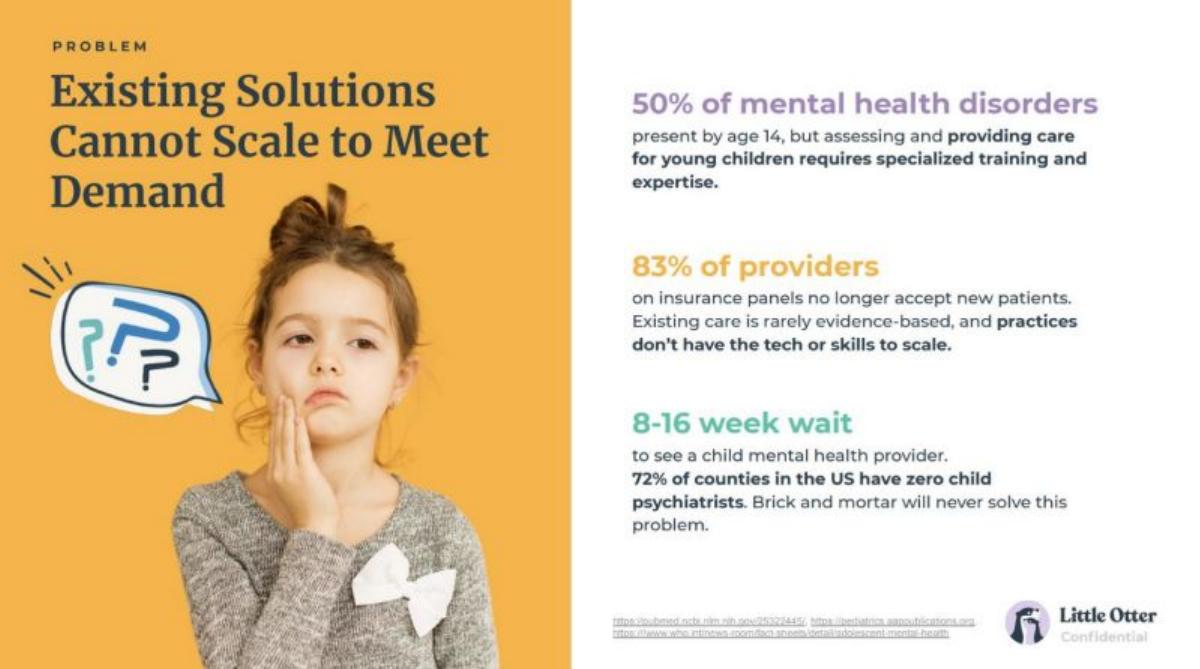
- The problem slide highlights a critical shortage of care, noting that 72% of US counties have zero child psychiatrists (Slide 6).
- The product is positioned as a 'one-stop shop' covering assessment, treatment, growth tracking, and education (Slide 8).
- The business model emphasizes cost-effectiveness for insurers, citing a $14,000 savings per prevented pediatric hospitalization (Slide 10).
- The deck omits a specific funding ask, use of funds breakdown, and long-term financial forecasts (Omitted).
The Executive Summary: Traction and Timing
Slide 1: Title Slide
The deck opens with a clean, minimalist title slide featuring the Little Otter logo—a mother and child otter. It clearly states 'Series A Fundraise' and the date 'Fall 2021'. The branding is soft and approachable, which aligns with the sensitive nature of pediatric mental health.
Slide 2: The Hook
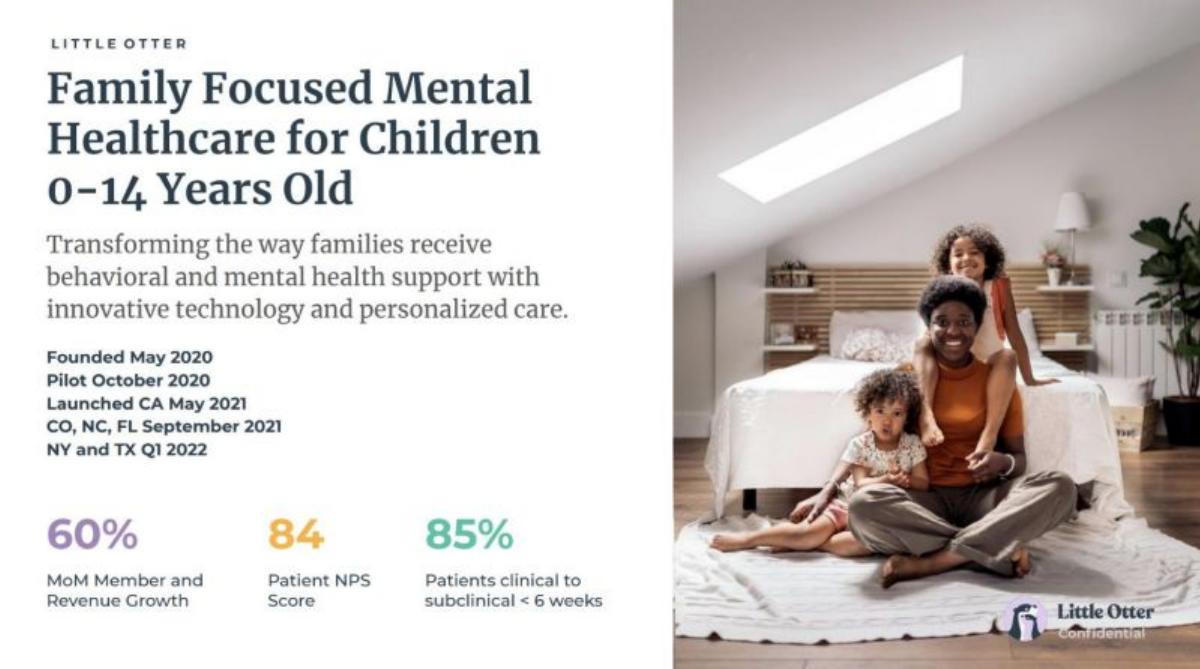
Little Otter does not wait to show its hand. Slide 2 acts as a summary of the entire business. It defines the target demographic as 'Children 0-14 Years Old' and lists a timeline of rapid expansion: founded in May 2020, launched in California in May 2021, and expanded to four more states by September 2021. The most critical elements here are the three 'big' numbers at the bottom: 60% MoM Member and Revenue Growth , a Patient NPS of 84 , and the clinical claim that 85% of patients move from clinical to subclinical in less than 6 weeks . This slide effectively answers the 'Why now?' and 'Does it work?' questions immediately.
The Pedigree: Founder-Market Fit
Slide 3: The Founders
In healthcare, credibility is everything. Slide 3 introduces Rebecca Egger (CEO) and Dr. Helen Egger (CMO). The slide highlights Rebecca’s background in product development at Palantir and the Chan Zuckerberg Initiative. Dr. Helen Egger’s credentials are even more robust: an internationally renowned child psychiatrist who oversaw 200+ therapists and a $50M budget at NYU. This slide is designed to de-risk the investment by showing the company is led by both a scaling expert and a clinical authority. The inclusion of logos like Yale, Duke, and NYU Langone adds significant institutional weight.
The Market Opportunity
Slide 4: Market Size
This slide quantifies the opportunity. It identifies 60 million kids in the US under 14 (18% of the population). It projects a $98 Billion market size by 2026 based on 9% annual growth. Interestingly, it also provides a 'Serviceable' market figure of $24 billion for the states they intended to enter by 2022, showing a realistic path to capturing value.
Slide 5: Market Demand
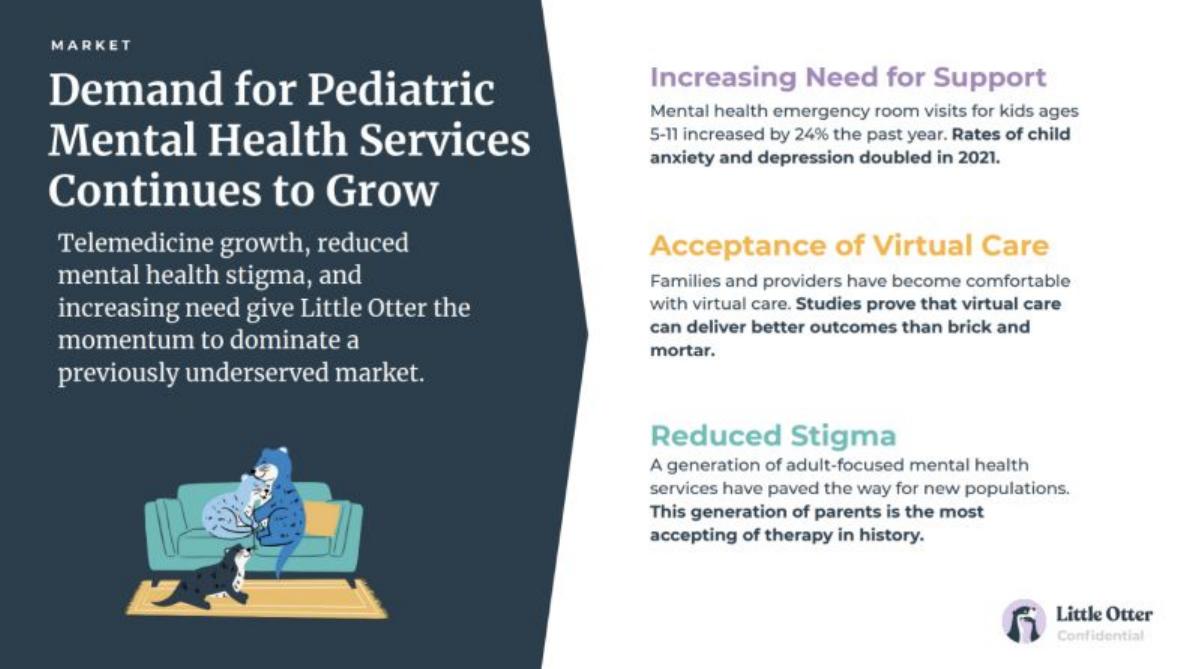
Slide 5 explains the tailwinds driving the business. It cites a 24% increase in mental health ER visits for kids aged 5-11 and notes that rates of child anxiety and depression doubled in 2021. The slide also mentions the 'Acceptance of Virtual Care' and 'Reduced Stigma' as key factors that have paved the way for Little Otter’s digital-first model.
The Problem and Solution
Slide 6: The Problem
The deck paints a grim picture of the current state of pediatric mental health. It notes that 50% of disorders present by age 14, yet 72% of US counties have zero child psychiatrists . The '8-16 week wait' to see a provider is highlighted as a critical failure of the 'brick and mortar' system. By stating 'Brick and mortar will never solve this problem,' Little Otter positions itself as the only viable solution for scale.
Slide 7: The Solution
The solution is presented as a three-part framework: 1. Proprietary Triage, 2. Accessible & Personalized care, and 3. Whole Family Care. A mobile app mockup is shown, giving a glimpse into the user interface where parents can choose between connecting with a provider, taking an assessment, or exploring resources.
Slide 8: User Experience
This slide breaks down the product into four pillars: Assessment, Treatment, Growth, and Education. It emphasizes that Little Otter is a 'one-stop shop,' even for families not yet ready for clinical treatment, who can still use the app for 'personalized content' and 'outcome tracking'.
Clinical Validation and Economics
Slide 9: Results
This is perhaps the most important slide for a Series A healthcare company. It provides data-backed proof of efficacy. It repeats the 85% clinical improvement stat but adds a baseline comparison: traditional longer treatments only see a 13% improvement in the same timeframe. It also notes that 71% of parents reported reduced impact of emotions/behavior . This validates that the 'Little Otter way' is objectively better than the status quo.
Slide 10: Investment Case for Partners
Slide 10 shifts the focus to B2B and insurance partners. It argues that Little Otter is a 'cost-effective investment.' It cites that preventing a single pediatric mental health hospitalization saves approximately $14,000 . This is a clear signal to investors that the company has a path toward insurance reimbursement and enterprise partnerships by proving it can lower the 'total health cost' of a child.
The Team and Conclusion
Slide 11: The Extended Team
Beyond the founders, this slide lists the 'HQ Team' and 'Clinical & Scientific' leads. The team is stacked with former employees from McKinsey, Palantir, BCG, and Diageo, alongside PhDs from Duke, UCLA, and Emory. The 'Notable Advisors' section includes the CMO of Humana Healthy Horizons, further cementing their ties to the insurance industry.
Slide 12: Closing
A simple 'Thank You' slide featuring an illustration of otters on a swing set. It maintains the brand’s friendly, family-oriented aesthetic.
What Little Otter Does Well
1. Clinical Rigor: Most 'wellness' startups shy away from hard clinical data. Little Otter leans into it, using specific percentages (85% improvement) and comparing them to medical baselines. This is essential for a Series A in the healthcare space.
2. Founder-Market Fit: The mother-daughter founder story is not just a 'nice to have'—it represents the perfect marriage of technical product scaling and deep medical expertise. The deck highlights this brilliantly on Slide 3.
3. Urgent Problem: By citing the 72% of counties without psychiatrists, the deck makes the 'Problem' feel like a national crisis that only a digital solution can solve.
What is Missing from the Deck
1. The Ask: There is no slide detailing how much money is being raised or what the specific milestones for the next 18-24 months are. While we know from external sources they raised $22M, the deck itself is silent on the terms.
2. Unit Economics: For a Series A, investors usually want to see CAC (Customer Acquisition Cost) and LTV (Lifetime Value). This deck focuses on 'Member Growth' but doesn't explain the cost of acquiring those members or the churn rates.
3. Competition: The deck ignores other players in the pediatric or general tele-therapy space (like Brightline or Lyra). A competitive matrix would have helped define their 'moat' more clearly.
What Founders Should Copy
The 'Traction First' Approach: Don't wait until Slide 10 to show your numbers. Little Otter put their 60% MoM growth on Slide 2. If you have great numbers, lead with them.
The 'Cost Savings' Argument: If you are in healthcare or B2B, don't just say you are 'better.' Show how much money you save the person paying the bill (in this case, the $14k savings for insurers on Slide 10).
Visual Consistency: The deck uses a consistent color palette and high-quality photography of diverse families. It feels like a professional, trustworthy medical brand from start to finish.
Frequently asked questions
- What is Little Otter's primary value proposition?
- Little Otter provides a specialized, tech-enabled mental health platform specifically for children aged 0-14 and their families. Unlike general mental health apps, it focuses on early intervention and 'whole family' care, using a proprietary triage system to move children from clinical to subclinical status faster than traditional brick-and-mortar models.
- How does the deck prove the business is scalable?
- The deck addresses scalability by contrasting its digital-first model against the 'broken' brick-and-mortar system. It points out that 83% of providers on insurance panels are full and wait times are 8-16 weeks. Little Otter uses 'proprietary triage' and 'standardized care pathways' to deliver evidence-based treatment at a scale traditional practices cannot match.
- Who are the founders and why do they matter?
- The founders are a mother-daughter duo: Rebecca Egger (CEO) and Dr. Helen Egger (CMO). Rebecca brings technical scale experience from Palantir and the Chan Zuckerberg Initiative. Dr. Egger is a renowned child psychiatrist who led departments at Duke and NYU. This combination of 'big tech' product scaling and 'gold-standard' clinical expertise is the deck's strongest selling point.
- What market data does Little Otter use to justify its valuation?
- The deck cites a $98 billion market size by 2026. It further narrows this down to a $24 billion immediate opportunity in the specific states they planned to serve by 2022. They also highlight a 24% increase in mental health ER visits for kids, signaling a massive, urgent demand for their services.
- What is missing from this pitch deck?
- The deck is notably missing a 'The Ask' slide, which typically details how much capital is being raised and how it will be spent. It also lacks a detailed competitive landscape and a slide on unit economics (LTV/CAC). This suggests the deck was likely used in a competitive round where the team's reputation and growth metrics spoke for themselves.