Twin Health’s Series C deck is a highly polished example of how to balance deep tech with human-centric outcomes. By framing metabolic disease as a 'damaged metabolism' problem rather than a symptom-management problem, the company justifies its complex 'Whole Body Digital Twin' technology. The deck excels at establishing credibility through clinical data, citing a 90%+ type 2 diabetes reversal rate and multiple peer-reviewed publications. While it lacks traditional financial slides like revenue growth or a specific 'Ask,' it compensates with a powerhouse board and advisory team featuring lead…
Key takeaways
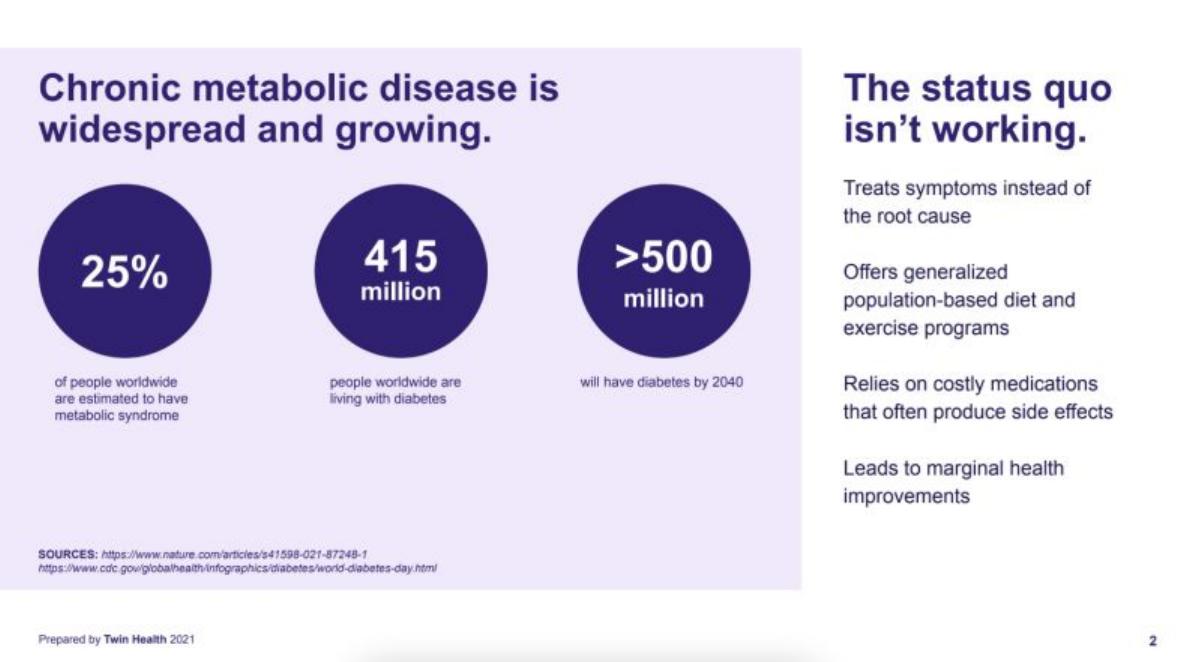
- The deck identifies a massive market opportunity, noting that over 500 million people will have diabetes by 2040 (Slide 2).
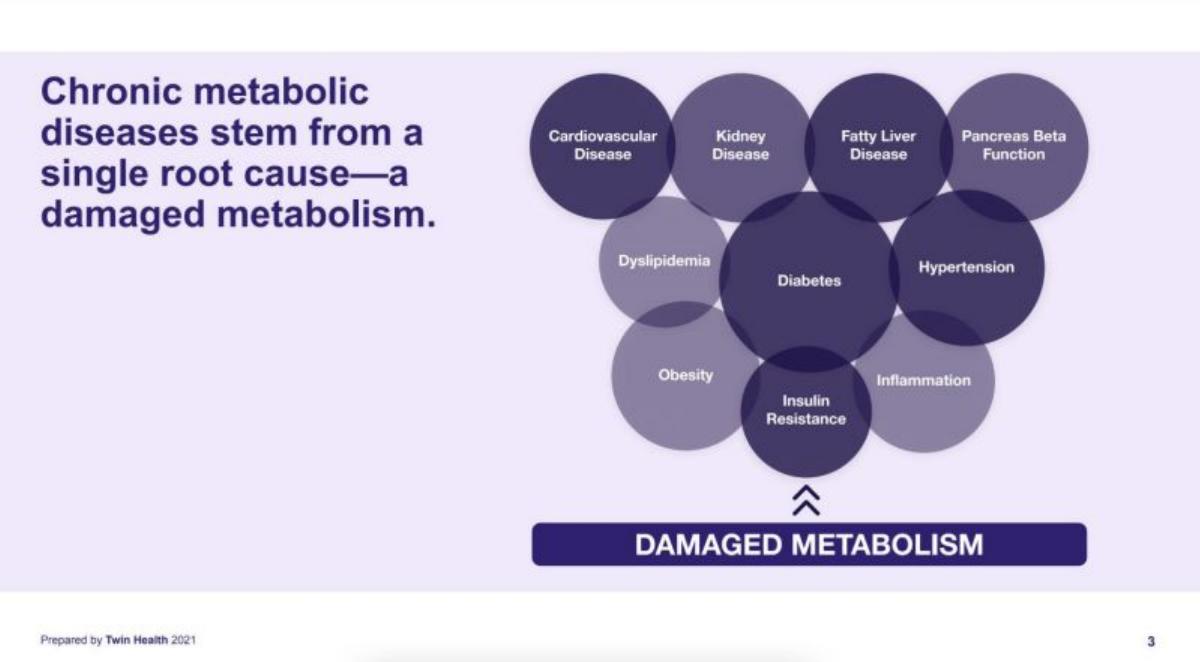
- It positions 'damaged metabolism' as the single root cause for a cluster of chronic diseases including obesity, hypertension, and fatty liver disease (Slide 3).
- The 'Whole Body Digital Twin' is defined as a dynamic representation built from thousands of data points collected daily via non-invasive sensors (Slide 7).
- Clinical results are the centerpiece, highlighting a 90%+ type 2 diabetes reversal rate and a 92% elimination of all diabetes medications (Slide 9).
- The company emphasizes speed of impact, stating members feel mood and energy improvements within the first month (Slide 10).
- Validation is reinforced through a list of six major clinical publications and conference presentations from 2021 (Slide 12).
- The executive team features deep expertise, including a CEO with 80+ patents and a CMO with experience at Evolent Health (Slide 13).
- The board of directors includes high-profile investors from Benchmark Capital, Sequoia Capital India, and ICONIQ Capital (Slide 14).
The Narrative Arc: From Global Crisis to Personalized Cure
Twin Health’s Series C deck is a masterclass in professional, clinical-grade storytelling. At this stage of funding, the 'why' and 'how' are often more important than the 'what.' The deck does not lead with a product demo; it leads with a paradigm shift. By the time the investor reaches the team slide, the company has established a massive problem, a proprietary technological solution, and rigorous clinical proof.
Slides 1-4: Establishing the Problem and the Root Cause
Slide 1 serves as a clean title page, immediately defining the mission: using advanced technology and medical science to 'reverse and prevent chronic metabolic disease.' The use of a smiling, healthy individual in the imagery suggests the end goal is human wellness, not just data points.
Slide 2 quantifies the crisis. It cites that 25% of people worldwide have metabolic syndrome and over 415 million live with diabetes. The most striking figure is the projection that over 500 million will have diabetes by 2040. Crucially, this slide attacks the 'status quo,' labeling current treatments as symptom-focused, generalized, and reliant on costly medications with side effects.
Slide 3 is a pivotal conceptual slide. It visualizes 'Damaged Metabolism' as the foundation for a tree of diseases, including Cardiovascular Disease, Kidney Disease, Fatty Liver Disease, and Hypertension. This framing is essential because it expands the company's Total Addressable Market (TAM) beyond just diabetes into the entire spectrum of metabolic health.
Slide 4 introduces the necessity of personalization. It argues that because every metabolism is unique, healthcare providers find it 'almost impossible' to customize care. This sets the stage for a technology-led intervention.
Slides 5-8: The Solution — The Whole Body Digital Twin
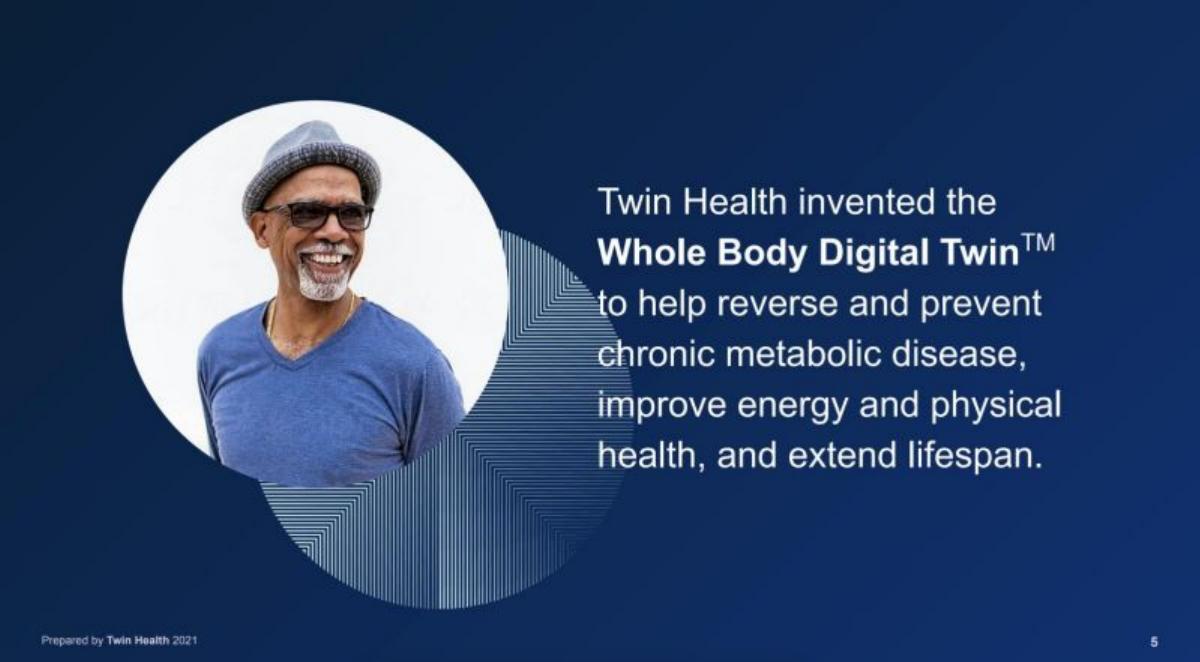
Slide 5 introduces the proprietary term: 'Whole Body Digital Twin™.' It claims this invention helps reverse disease, improve energy, and extend lifespan. The use of a trademark symbol reinforces the idea of intellectual property defensibility.
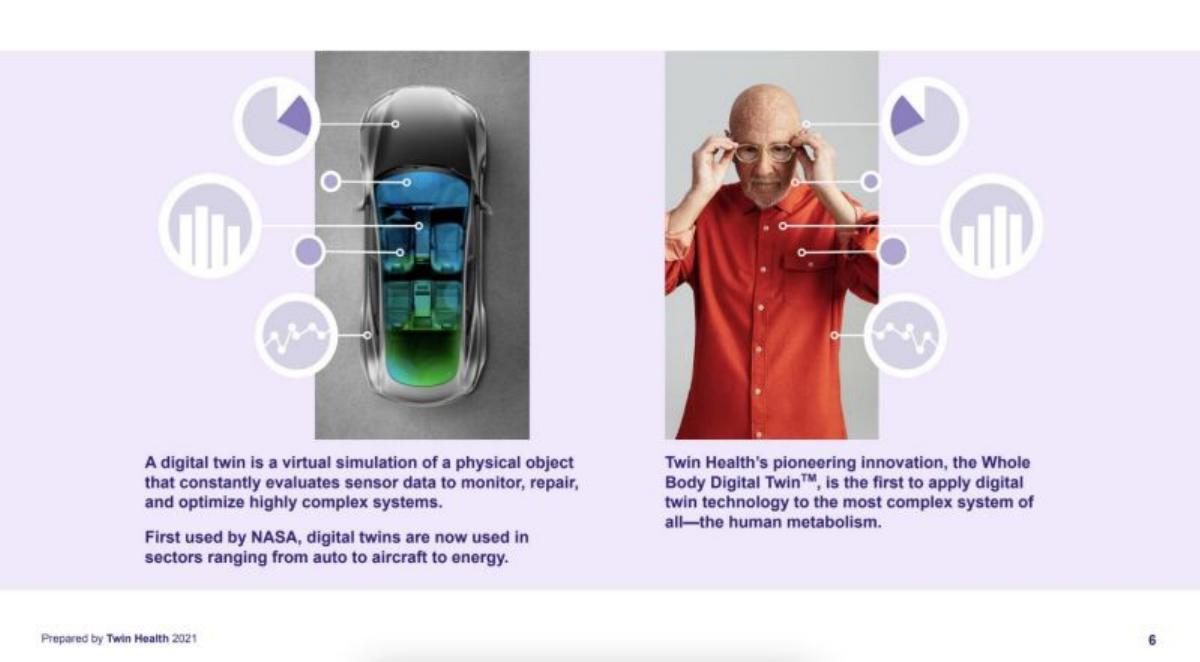
Slide 6 uses an analogy to explain a complex concept. It compares the digital twin of a human to the digital twins used by NASA and the auto industry to monitor complex systems. This de-risks the technology by showing it is already a proven concept in other high-stakes sectors.
Slide 7 provides the technical definition. The digital twin is a 'dynamic, digital representation' built from 'thousands of data points' collected via 'non-invasive wearable sensors.' This is a critical detail for investors concerned about user friction; 'non-invasive' implies a lower barrier to adoption.
Slide 8 shows the user interface. The app provides an 'Action Score' and guidance across nutrition, sleep, activity, and breathing. It emphasizes that this happens 'under the guidance of their healthcare provider,' which suggests a B2B2C or provider-integrated business model rather than a pure consumer play.
Slides 9-12: Clinical Validation and Social Proof
Slide 9 is arguably the most important slide in the deck. It presents data from the 'world’s first randomized controlled trial for reversing chronic metabolic disease using digital twin technology.' The metrics are staggering: 90%+ achieved type 2 diabetes reversal, 92% eliminated medications (including insulin), and an average HbA1c reduction of 3.1. These are not 'soft' metrics; they are clinical outcomes that speak the language of payers and providers.
Slide 10 pivots to the patient experience, noting that members feel improvements in mood and energy within the first month. This addresses the 'retention' aspect of the business—if patients feel better quickly, they are more likely to stick with the program.
Slide 11 provides qualitative 'What members say' testimonials. These include specific data points, such as a member moving from an HbA1c of 11.4 to 6.6. The inclusion of emojis and raw text makes the testimonials feel authentic and emotionally resonant.
Slide 12 lists 'Published clinical results.' It cites six different medical associations and journals from 2021, including the American Diabetes Association and the Journal of the Endocrine Society. For a Series C healthcare company, this slide is the ultimate 'trust signal.'
Slides 13-14: The Pedigree of the Team and Board
Slide 13 introduces the executive team. CEO Jahangir Mohammed is highlighted as a 'prolific inventor with over 80 patents.' The team is a mix of deep tech (IoT, machine learning) and clinical leadership (MDs from University of Chicago and Evolent Health). This cross-disciplinary expertise is necessary for a 'HealthTech' company.
Slide 14 showcases the Board of Directors and Advisory Board. The presence of Bruce Dunlevie (Benchmark) and Toby Cosgrove (Cleveland Clinic) provides immense institutional credibility. The Advisory Board is equally heavy-hitting, featuring former presidents of the ADA and former CMOs of Medtronic and CMS. This slide tells the investor: 'The smartest people in the industry are already behind us.'
What Works in This Deck
The 'Root Cause' Framing: By focusing on 'damaged metabolism' rather than just diabetes, Twin Health positions itself as a platform rather than a single-point solution. · Heavy Clinical Weight: Slide 9 and Slide 12 provide the hard data required to back up the 'AI' and 'Digital Twin' buzzwords. Without these, the deck would feel like science fiction. · Analogy Usage: Comparing the human body to a NASA-monitored spacecraft or a high-end vehicle (Slide 6) makes the 'Digital Twin' concept immediately understandable to non-medical investors. · Speed to Value: Highlighting that users feel better within 30 days (Slide 10) is a strong counter-argument to the idea that chronic disease reversal is a slow, grueling process.
What Is Missing from This Deck
The Business Model: There is no mention of how Twin Health makes money. Do they sell to employers, insurers, or directly to consumers? What is the price point? · Financial Performance: For a Series C round, investors usually expect to see revenue growth, gross margins, and unit economics. This deck is entirely focused on the clinical and technological narrative. · The Competition: There is no competitive landscape slide. Companies like Virta Health or Livongo operate in similar spaces, and a Series C deck should ideally explain Twin Health's unique edge over them. · The Ask: The deck does not state how much capital is being raised or how it will be allocated (e.g., R&D, sales expansion, international growth).
What Other Founders Should Copy
The 'Status Quo' Slide: Slide 2 is a perfect example of how to frame a problem by attacking the current solution's inefficiency rather than just the disease itself. · Data Visualization: The use of large, bold circles for key metrics on Slide 9 makes the clinical success impossible to miss. · The Analogous Proof: If you are building something highly complex or 'futuristic,' use Slide 6’s approach—show where that technology already works in another industry to build confidence. · Credentialing: If you have a strong board or advisors, give them their own slide (Slide 14). In healthcare, who you know and who vouches for you is often as important as the tech itself.
Frequently asked questions
- What is the core technology behind Twin Health?
- Twin Health utilizes what they call the 'Whole Body Digital Twin.' According to slides 6 and 7, this is a virtual simulation of a person's unique metabolism. It is built using thousands of daily data points from non-invasive wearable sensors and personal preferences to provide precise, AI-driven guidance on nutrition, sleep, activity, and breathing.
- How does Twin Health prove its clinical efficacy?
- The deck relies on data from a randomized controlled trial published in the American Diabetes Association's Diabetes journal. Slide 9 cites specific outcomes: a 90%+ reversal rate for type 2 diabetes, a 92% medication elimination rate, and an average HbA1c reduction of 3.1 from a baseline of 8.7.
- Who are the key investors and board members?
- The deck lists a high-tier board of directors on slide 14, including Bruce Dunlevie (Benchmark), Toby Cosgrove (former CEO of Cleveland Clinic), Mohit Bhatnagar (Sequoia Capital India), and Caroline Xie (ICONIQ Capital). This level of institutional backing is a primary signal of the company's Series C maturity.
- What business metrics are missing from this deck?
- This is a clinical and narrative-heavy deck. It lacks a slide on the business model (how they make money), current revenue or ARR, customer acquisition costs (CAC), or a specific 'Ask' detailing how much they are raising and how the funds will be used.
- What is the primary problem Twin Health is solving?
- As stated on slide 2, the company is addressing the failure of the 'status quo' in healthcare, which treats symptoms rather than root causes. They argue that generalized population-based diets and costly medications lead to only marginal health improvements, whereas their personalized approach targets the 'damaged metabolism' directly.