Twisto’s 2019 pitch deck presents a compelling case for a regional FinTech champion in Central and Eastern Europe. By positioning itself as a localized alternative to Klarna and Revolut, Twisto emphasizes its deep understanding of the CEE market and its proprietary credit-scoring engine, NIKITA. The deck effectively uses data to show a +258% growth in December ARR between 2017 and 2018, alongside a +168% increase in average annual revenue per good client. While the deck is light on specific unit economics and the exact Series B ask amount—using placeholders like '€[ ]M'—it clearly outlines a…
Key takeaways
- Twisto positions itself as the regional leader for CEE, specifically targeting the Czech Republic and Poland (Slide 7).
- The proprietary 'NIKITA' engine processes over 400 factors per transaction in milliseconds to provide instant credit scoring (Slide 10).
- Revenue growth is significant, with December ARR increasing by 258% from 2017 to 2018 (Slide 19).
- Average annual revenue per 'good client' saw a 168% increase in the 2018 estimate compared to 2017 (Slide 19).
- The company utilizes a dual financing structure, using Series B equity for 18+ months of operations and debt for portfolio financing (Slide 25).
- A strategic partnership with ING provides access to 4 million retail customers and 20,000 SMEs in Poland (Slide 22).
- The product roadmap includes a transition from 'Buy now, pay later' to a full 'Money app' with NFC cards and bracelets by Q2 2019 (Slide 22).
- Twisto identifies 'Swipe to pay later' as its key monetization feature within the app interface (Slide 13).
Introduction: The Regional FinTech Challenger
The Twisto 2019 pitch deck is a masterclass in regional positioning. At a time when global giants like Klarna and Revolut were expanding rapidly, Twisto focused its narrative on becoming the 'regional champion' for Central and Eastern Europe (CEE). The deck emphasizes that local presence and specialized data are the keys to winning in markets like the Czech Republic and Poland. By focusing on a specific geographic niche, Twisto presents a defensible moat against larger, more generalized competitors.
Slide 1: Title and Vision
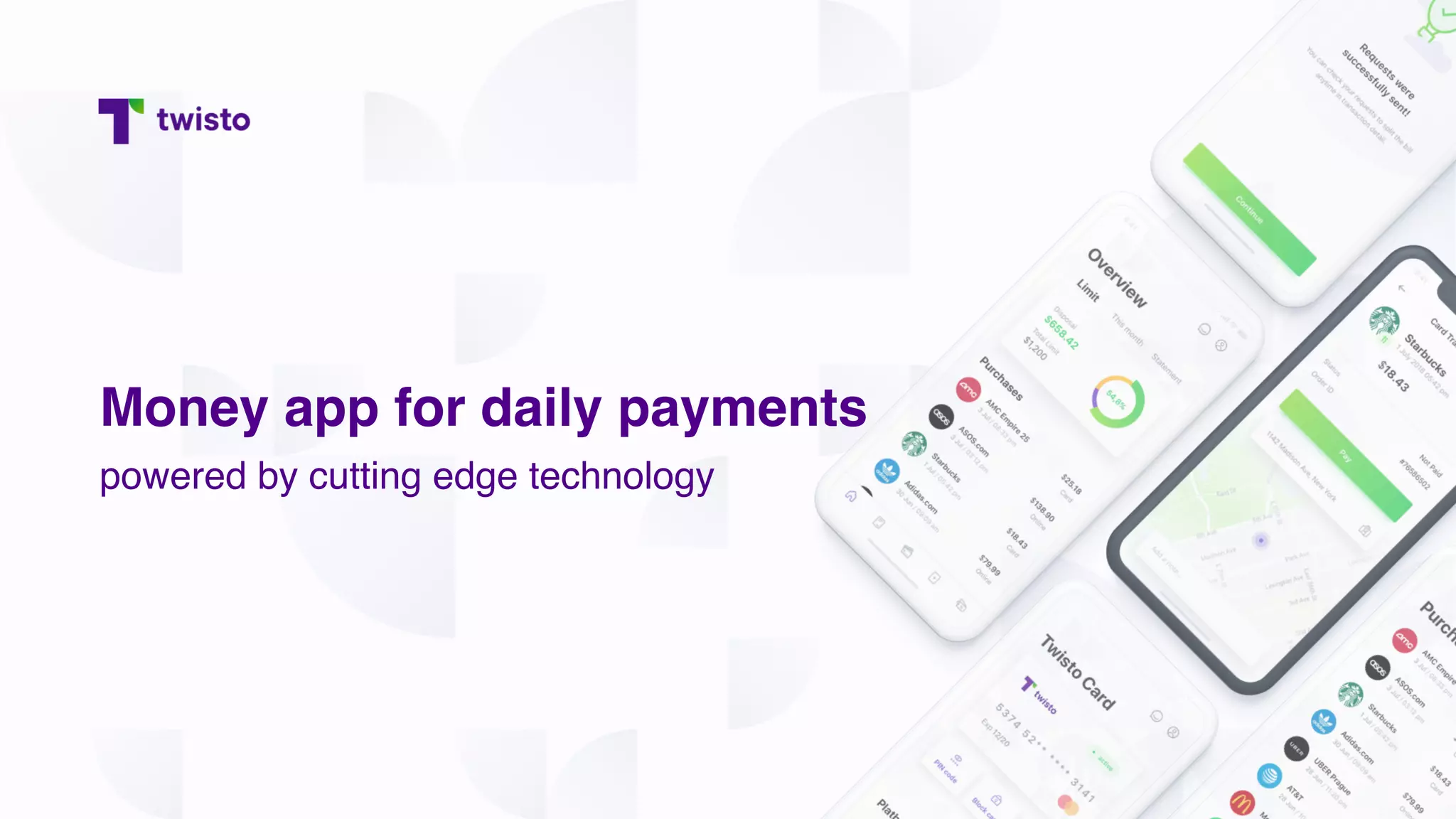
The opening slide establishes Twisto as a 'Money app for daily payments powered by cutting edge technology.' The visual design is clean, featuring a collage of mobile app screens that showcase a user-friendly interface, transaction histories, and a physical Twisto Card. This immediately communicates that the product is live, functional, and covers both digital and physical payment spheres.
Slide 4: Investor Backing
Slide 4 highlights the company's credibility through its backers. It lists equity investors including ING Ventures, UNIQA Ventures, Finch Capital, Velocity Capital, Miton, Enern, and Partners. Notably, it also lists debt providers Conseq and Wirecard. The inclusion of both equity and debt partners is crucial for a FinTech company that requires significant capital to fund its lending/deferred payment book. The presence of institutional names like ING suggests strong corporate validation.
Slide 7: Competitive Landscape
This slide uses a standard 2x2 matrix to position Twisto against the market. The axes are 'Strategic focus on CEE and local presence' (Low to High) and 'Integrated multichannel payment solution' (Online to Online, offline & more). Twisto places itself in the top-right quadrant, claiming high focus and high integration. It positions Klarna as having low CEE focus and Revolut as having high CEE focus but lower multichannel integration at the time. This slide explicitly mentions Twisto's 'lower cost structure' and '5-years of payment/customer data' as unfair advantages.
Slide 10: The NIKITA Engine
Twisto introduces its proprietary technology, 'NIKITA,' on Slide 10. The slide breaks down the tech into three pillars: Big data scoring (400+ factors), Identification (15-factor clustering), and Machine learning (processing in milliseconds). A waterfall chart shows the speed of processing, with tasks like 'Customer ID' taking 28.29ms and 'Rating' taking 5.04ms. This slide serves to prove that Twisto is a technology company first, not just a traditional lender, and mentions a B2B revenue stream by offering NIKITA as an API to third parties.
Slide 13: Product Features and Monetization
This slide details the 'stickiness' of the app through features like 'Snap bills' (paying bills via photo), 'Paperless returns,' and 'Saving money' (cashback). Most importantly, it identifies 'Swipe to pay later' as the 'Key monetization' feature. The UI shows a 'Defer bill' screen where a user can choose to pay a portion of a 5,175 CZK bill now and defer the rest at an APR of 17.7%. This provides clear insight into how the company generates interest income.
Slide 16: Historical Performance Transition
A simple transition slide marking the third section of the deck: 'Historical performance - strong adoption of a highly sticky product.' This sets the stage for the hard metrics that follow.
Slide 19: Growth Metrics and Economics
Slide 19 provides the most significant data points in the deck. It shows a 'Revenue structure 2018YE' where one segment accounts for 62% of revenue. The 'Average annual revenue per good client' chart shows a massive +168% jump in the 2018 estimate compared to 2017. Furthermore, the 'Revenues (€M)' chart shows that December ARR grew by +258% year-over-year from 2017 to 2018. While the absolute Euro figures are redacted with placeholders, the growth percentages tell a story of rapid scaling.
Slide 22: Market Expansion: Poland
Twisto highlights its entry into Poland, described as the 'biggest CEE market with 40M people.' The slide details a 'Product roll-out plan' that transitions from BNPL in July 2018 to a full money app by Q2 2019. A key highlight here is the 'cooperation with ING,' which grants Twisto access to 4 million retail customers and a dedicated sales force of 12 people. This partnership is presented as a primary engine for market penetration.
Slide 25: Financing Structure
This slide explains how Twisto manages its capital. It separates 'Equity financing' (Series B) from 'Debt financing.' Equity is used for 'Customers growth' and 'Operations' (covering 18+ months of OpEx/CapEx). Debt is used for 'Portfolio financing' to fund customer receivables. The slide notes a 'Security' feature: an SPV structure that separates operational equity risk from the receivables used as collateral, a sophisticated setup typical of mature FinTech lenders.
Slide 28: Team and Contact
The final slide introduces the leadership team: Michal Smida (Founder/CEO), Michal Krocil (CRO), and Ondrej Vejdovec (CFO). It includes their direct contact information and a standard legal disclaimer. The team is lean, focusing on the core functions of leadership, risk, and finance.
What Twisto Does Well
Twisto excels at defining its 'Why now?' and 'Why us?' through the lens of geography. By focusing on the CEE region, they turn their smaller size into an advantage of agility and local expertise. The technical deep-dive into the NIKITA engine (Slide 10) is excellent; it provides enough technical detail to satisfy a due diligence team without being overly academic. Furthermore, the clear distinction between equity and debt usage (Slide 25) demonstrates financial maturity and a clear understanding of how to scale a lending-based FinTech without excessive equity dilution.
What is Missing from the Deck
The most glaring omission in this version of the deck is the specific Series B 'Ask.' While Slide 25 mentions 'Series B proceeds,' the actual amount is redacted or missing. Additionally, while the deck mentions 'good clients' and revenue growth, it lacks a detailed breakdown of Unit Economics (CAC vs. LTV). There is no mention of churn rates or the specific default rates managed by the NIKITA engine, which are critical metrics for any credit-based business. Finally, the team slide is very brief, lacking the 'logos' of previous companies or schools that usually help establish founder-market fit for early-stage investors.
Founder Takeaways: What to Copy
Regional Specialization: If you are competing against global incumbents, follow Twisto’s lead by emphasizing your 'Local Presence' and 'Local Data' as a moat (Slide 7). · Tech as a Product: Don't just say you have an algorithm; name it and show its performance metrics. Naming the engine 'NIKITA' and showing millisecond processing times makes the tech feel tangible (Slide 10). · Strategic Partnerships: Highlight how you leverage larger players to scale. The ING partnership on Slide 22 is a powerful signal of credibility and a low-cost distribution channel. · Capital Sophistication: Clearly explaining how you will use equity vs. debt (Slide 25) shows investors that you understand the mechanics of your industry and won't waste expensive equity capital on low-risk assets.
Frequently asked questions
- What is Twisto's primary competitive advantage according to the deck?
- Twisto claims a unique lead in the CEE region (Czech Republic, Poland) by combining a localized presence with a lower cost structure and five years of proprietary payment data. Slide 7 specifically contrasts Twisto against global players like Klarna and Revolut, noting that Twisto has a 'high focus' on CEE and local presence that international competitors lack.
- How does Twisto handle credit risk and scoring?
- The company uses a proprietary technology named 'NIKITA.' According to Slide 10, this system analyzes over 400 factors and variables per transaction, including behavioral, technical, and financial data. It performs identification using a 15-factor cluster and completes the entire processing cycle—including GMaps address validation and internal rating—in milliseconds.
- What are the main revenue drivers for the Twisto app?
- Slide 13 identifies 'Swipe to pay later' as the key monetization feature. The revenue structure on Slide 19 shows that 62% of revenue comes from a primary source (likely interest or fees on deferred payments), while other streams include merchant cashback (Saving money) and potentially B2B API access to their NIKITA scoring engine.
- What is Twisto's strategy for the Polish market?
- Twisto entered Poland to tap into a market of 40 million people and an €8B e-commerce sector. As shown on Slide 22, they leverage a partnership with ING Bank to access 4 million retail customers and 20k SMEs. Their roll-out plan moved from BNPL in July 2018 to a full money app with NFC capabilities by mid-2019.
- How is the company's capital structured?
- Twisto employs a bifurcated financing model. Slide 25 explains that Equity financing (Series B) is used for customer growth and 18+ months of operations (OpEx and CapEx). Debt financing is used strictly for 'Portfolio financing' to fund customer receivables, utilizing an SPV structure to separate operational equity risk from debt collateral.