TympaHealth’s Series A deck is a masterclass in positioning a medical device as a scalable platform. By focusing on the 'de-specialization' of ear care, the company demonstrates how their portable system allows non-specialists to perform complex procedures like microsuction and digital otoscopy in under 30 minutes. The deck leans heavily on clinical validation, citing the world’s largest bank of ear health data (>500k records) and an AI algorithm with over 90% sensitivity. While the deck lacks explicit financial projections or a detailed breakdown of the $23M ask in the provided slides, it su…
Key takeaways
- The WHO estimates that by 2050, more than 700 million people globally will experience profound hearing loss (Slide 4).
- TympaHealth positions hearing loss as the leading modifiable risk factor for dementia prevention (Slide 4).
- The platform enables a full ear care appointment—including digital otoscopy, microsuction, and hearing assessment—in under 30 minutes (Slide 7).
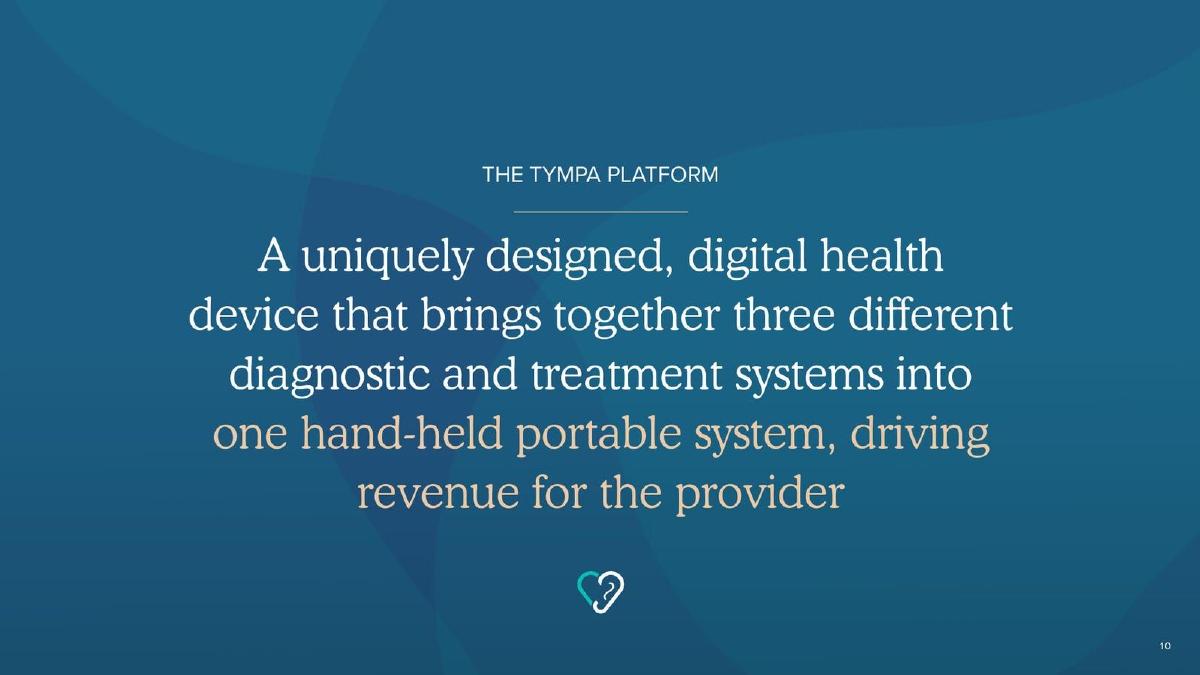
- The hardware is described as a 'uniquely designed, digital health device' that integrates three diagnostic systems into one portable unit (Slide 10).
- The company claims to hold the world’s largest bank of ear and hearing health data with over 500,000 records (Slide 22).
- Their AI algorithm identifies eardrum abnormalities with >90% sensitivity and specificity (Slide 22).
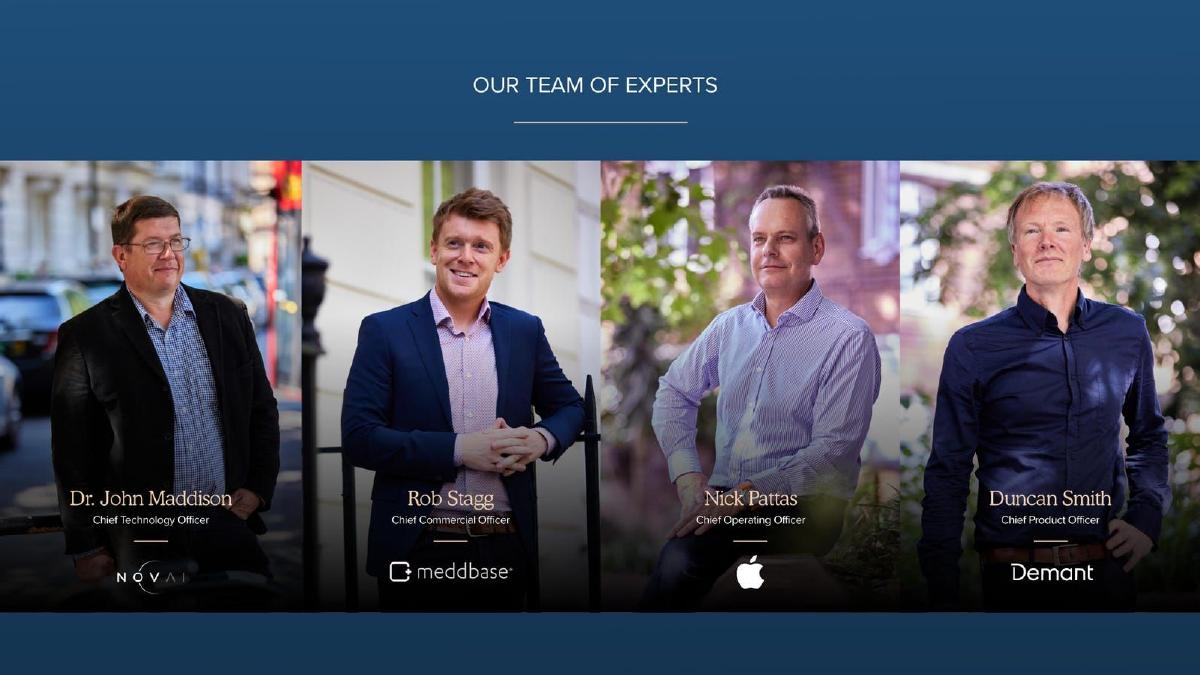
- The leadership team features executives with backgrounds from Apple, Demant, and Meddbase (Slide 16).
- The deck highlights a 'first-mover advantage' in newly created ear and hearing health markets through multiple sector deployment (Slide 19).
The Narrative: Moving Specialist Care to the High Street
TympaHealth’s Series A deck is built on a foundation of clinical necessity and market expansion. The London-based startup, as reported by Business Insider, raised $23M in 2024 to solve a specific logistical bottleneck in healthcare: the fact that ear and hearing care is traditionally locked behind expensive, hospital-based specialist appointments. The deck argues that by decentralizing this care, TympaHealth can address a massive global health crisis while creating a new revenue stream for retail healthcare providers.
Slide 1: The Hook and Validation
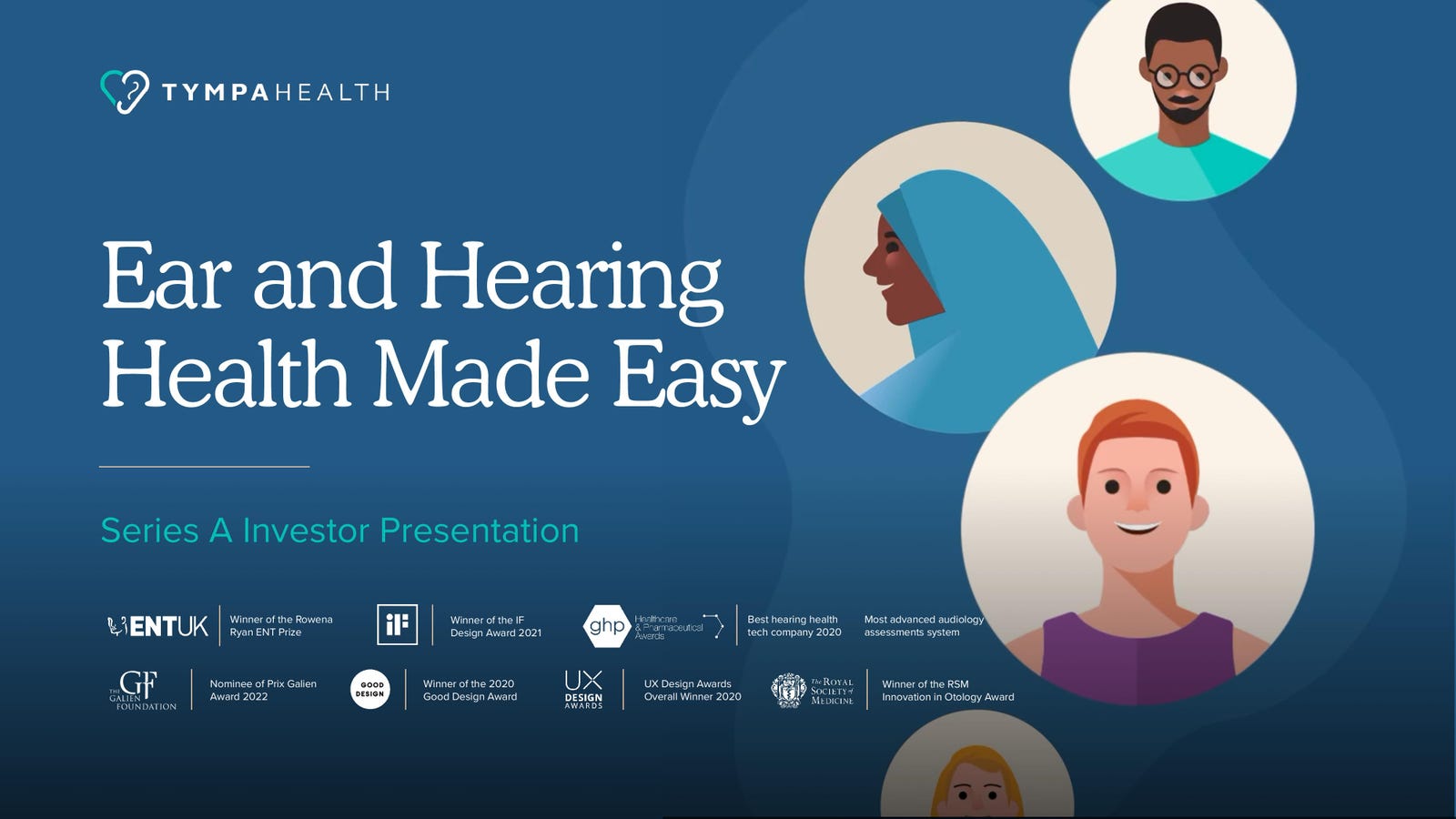
The title slide, Ear and Hearing Health Made Easy , immediately establishes the value proposition. Rather than focusing on the technical specifications of the device, it focuses on the outcome. The bottom of the slide is crowded with high-tier validation logos, including the ENTUK Winner of the Rowena Ryan ENT Prize , the IF Design Award 2021 , and the RSM Innovation in Otology Award . For a Series A company, this level of third-party clinical and design validation is a powerful signal of de-risked technology.
Slide 4: The Macro Problem
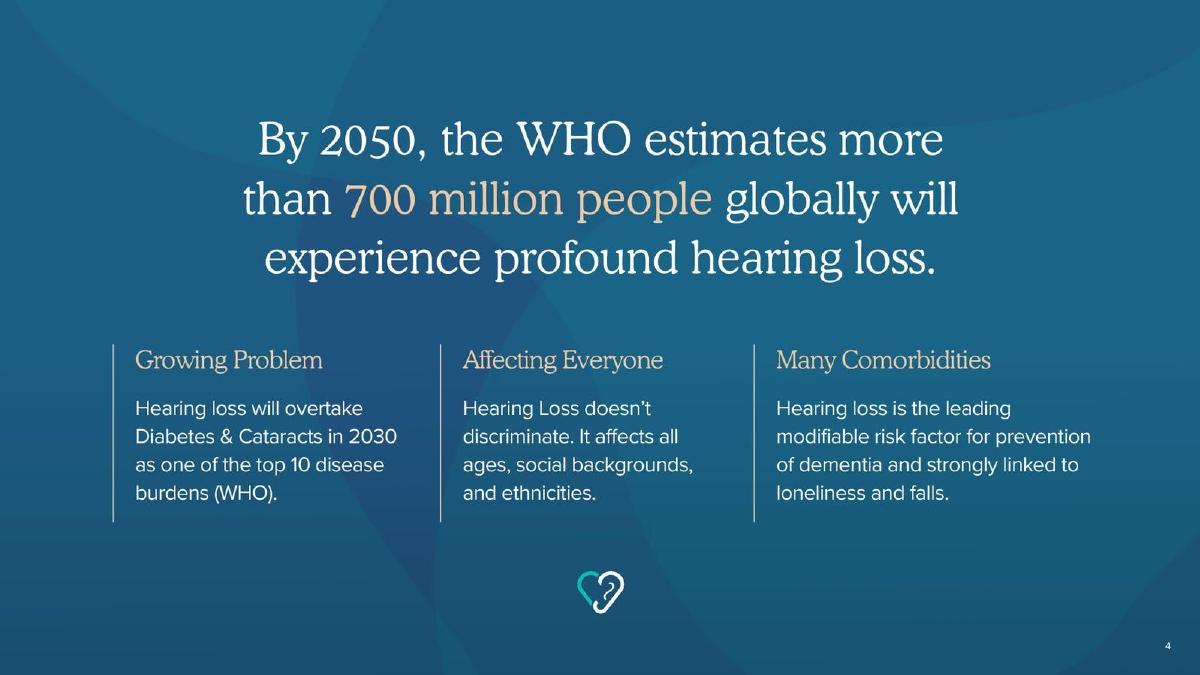
Slide 4 utilizes World Health Organization (WHO) data to frame the urgency of the mission. It notes that by 2050, 700 million people will experience profound hearing loss. Crucially, it links hearing loss to broader, high-cost health issues: it is the 'leading modifiable risk factor for prevention of dementia' and is strongly linked to falls and loneliness. By framing ear care as dementia prevention, TympaHealth elevates its product from a 'nice-to-have' wellness tool to a critical piece of preventative healthcare infrastructure.
Slide 7: The Opportunity and Workflow
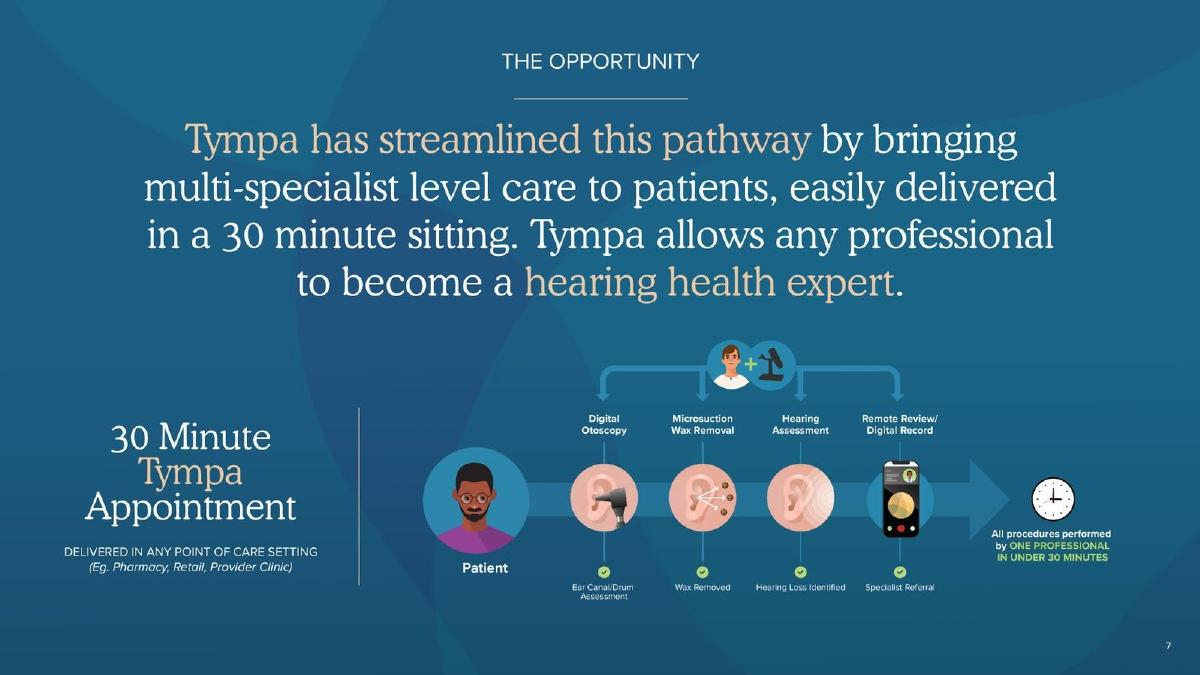
This slide explains the 'how.' It introduces the 30 Minute Tympa Appointment . The graphic shows a linear pathway: Digital Otoscopy, Microsuction Wax Removal, Hearing Assessment, and Remote Review. The key takeaway here is that 'any professional' can become an expert. This is the core of their business model—labor arbitrage. By moving these tasks from a high-cost ENT specialist to a lower-cost pharmacy technician, they unlock massive efficiency in the healthcare system.
Slide 10 & 13: The Hardware and Software Platform
Slide 10 defines the platform as a 'uniquely designed, digital health device' that integrates three systems into one portable unit. Slide 13 provides a visual breakdown of the ecosystem. It isn't just a scope; it includes Integrated Machine Learning , Digital Records & Imaging , and a Remote Review & Diagnostics portal. This slide is critical because it justifies the 'SaaS' component of the business. The hardware is the Trojan horse that enables a continuous stream of data and remote consultation fees.
Slide 16: The Team
The 'Team of Experts' slide highlights four key leaders. Dr. John Maddison (CTO) is associated with Novai, Rob Stagg (CCO) with Meddbase, Nick Pattas (COO) with Apple, and Duncan Smith (CPO) with Demant. The inclusion of Apple and Demant (a global leader in hearing healthcare) is particularly strategic, suggesting the company has the operational expertise to scale consumer-grade hardware with medical-grade precision.
Slide 19 & 22: The Data Moat and Future Opportunities
Slide 19 mentions 'Multiple sector deployment with first-mover advantage.' This is expanded upon in Slide 22, which is perhaps the most important slide for a Series A investor. It claims Tympa holds the 'world’s largest bank of ear and hearing health data (>500k)' . In the age of AI, data is the ultimate moat. The slide notes their AI can identify abnormalities with >90% sensitivity and mentions ongoing research with UCL to use the ear drum as a diagnostic window for diabetes and hypertension. This transforms the company from a hearing aid screening tool into a multi-diagnostic platform.
What Works in the TympaHealth Deck
1. Clear Value Proposition for the Buyer: The deck explicitly mentions 'driving revenue for the provider' on Slide 10. In healthcare, clinical efficacy is rarely enough; you must show how the person buying the device makes their money back. By highlighting the 30-minute appointment window, they make the ROI calculation simple for pharmacy owners.
2. Massive Data Moat: Claiming the world's largest dataset of ear health (>500k records) is a significant competitive advantage. It suggests that even if a competitor builds a similar device, they will be years behind in training diagnostic AI models.
3. Strategic Comorbidity Linking: By connecting hearing loss to dementia and falls (Slide 4), TympaHealth taps into the largest cost centers for healthcare payers and governments. This makes their solution relevant to a much broader set of stakeholders than just audiologists.
What is Missing from the Provided Slides
1. Unit Economics: While the deck mentions revenue generation for providers, it does not disclose the cost of the hardware, the subscription fee for the SaaS platform, or the margins on the remote review service. Investors at the Series A stage typically require a clear view of the LTV/CAC ratio.
2. Competitive Landscape: The deck asserts a 'first-mover advantage' but does not provide a competitive matrix. There are other digital otoscopes and portable audiometry devices on the market; the deck fails to explicitly contrast TympaHealth against these incumbents or other startups.
3. Financial Projections and The Ask: The provided slides end with a brand-focused 'I Heart Tympa' slide (Slide 25). There is no slide detailing the specific use of the $23M raised, nor are there projections for market penetration or revenue growth over the next 3-5 years.
Founder Takeaways: How to Pitch a 'De-Specialization' Play
Focus on the 'Who,' not just the 'What': TympaHealth succeeds by showing that their product allows a less-expensive worker to do a more-expensive worker's job. If your startup involves decentralizing a professional service, your deck must emphasize the ease of use and the training support (as seen on Slide 13) that makes this transition possible.
Build a Data Narrative Early: Even if your AI isn't fully autonomous yet, showing that you are collecting a proprietary dataset (Slide 22) creates a 'winner-take-all' narrative. Investors want to see that your lead will grow over time, not shrink as competitors enter.
Use Third-Party Validation to Short-Cut Trust: In healthcare, founders often spend too much time explaining the science. TympaHealth uses a 'wall of logos' on Slide 1 to let the experts speak for them. If you have won industry awards or clinical prizes, put them on the front page to immediately establish authority.
Frequently asked questions
- What is the primary problem TympaHealth is solving?
- TympaHealth addresses the growing global burden of hearing loss, which the WHO predicts will affect 700 million people by 2050. Specifically, they solve the bottleneck of specialist-only care by providing a portable system that allows non-specialists in pharmacies or retail clinics to perform professional-grade ear assessments and wax removal.
- How does the TympaHealth platform generate revenue for providers?
- Slide 10 explicitly states the device 'drives revenue for the provider.' By enabling pharmacies and retail clinics to offer services like microsuction wax removal and hearing assessments—which previously required a hospital visit—providers can monetize a 30-minute clinical window that was previously unavailable to them.
- What role does Artificial Intelligence play in their product?
- AI is used for diagnostic support and predictive health. According to Slide 22, their algorithm identifies eardrum abnormalities with over 90% sensitivity. They are also working with UCL to correlate tympanic membrane changes with systemic conditions like diabetes and hypertension, similar to how the retina is used in diagnostics.
- Does the deck include financial metrics or a specific funding ask?
- The provided slides do not contain a specific 'Ask' slide detailing the $23M use of funds, nor do they show historical revenue or P&L projections. The narrative focuses on market opportunity, product capability, and data moats rather than unit economics.
- Who is the target user for the TympaHealth device?
- The target users are non-specialist healthcare professionals in 'any point of care setting,' such as pharmacies, retail environments, and provider clinics. The goal is to allow these professionals to become 'hearing health experts' through the use of their integrated hardware and remote review system.