AgomAb Therapeutics' 21-slide deck is a highly technical, clinical-stage presentation that successfully secured $40.5M in Series B funding. The deck is structured around two core biological platforms: TGF-β targeting for Crohn’s disease and pulmonary fibrosis, and HGF targeting for organ failure. By utilizing clear pipeline charts (Slide 4) and detailed clinical trial designs (Slide 13), the company demonstrates a mature approach to drug development. The presentation avoids typical startup fluff, focusing instead on the biological 'Challenge' versus 'Our solution' (Slide 16) and the specific…
Key takeaways
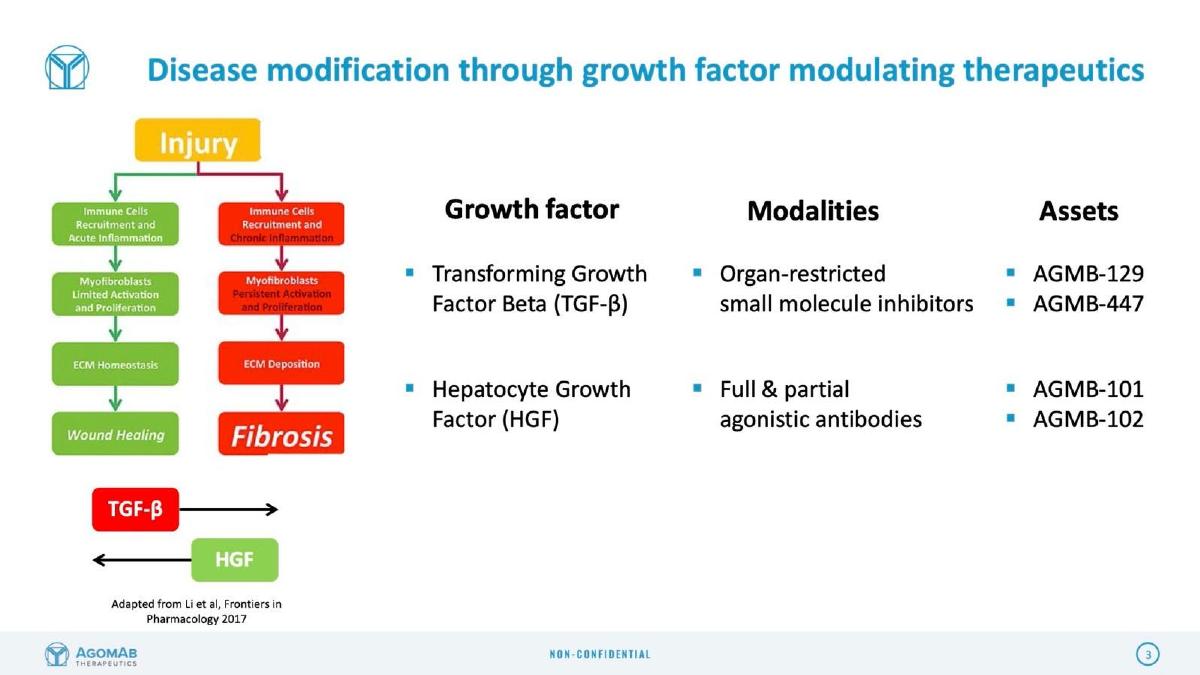
- The deck clearly bifurcates the company's value into two distinct biological platforms: TGF-β and HGF (Slide 4).
- AgomAb identifies a specific high unmet need in Crohn’s disease, noting that 40-70% of patients require surgery within 10 years (Slide 10).
- The pipeline shows a lead candidate, AGMB-129, already progressing through Phase 1 trials (Slide 4).
- Clinical strategy is transparently mapped out, showing a hybrid Phase 1 study designed to drive Phase 2 success for AGMB-447 (Slide 13).
- The HGF platform addresses a specific biological hurdle: the very short 2-5 minute half-life of HGF (Slide 16).
- The company utilizes a 'partial agonist' strategy (AGMB-102) to trigger anti-fibrotic effects while avoiding unwanted proliferative signaling (Slide 19).
- The deck uses a 'Non-confidential' label, indicating it is designed for broad initial investor outreach rather than final due diligence (Slide 1).
- Visual communication of complex signaling pathways (Slide 16) helps bridge the gap between biological theory and therapeutic application.
Executive Summary: The Science of Regeneration
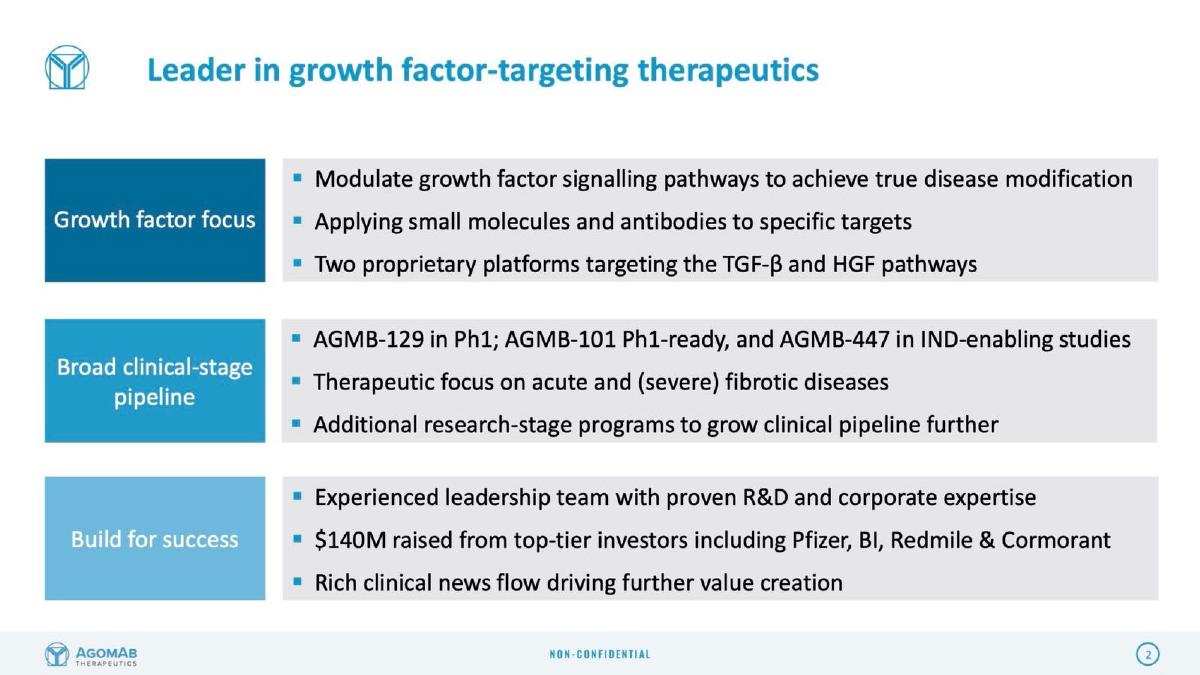
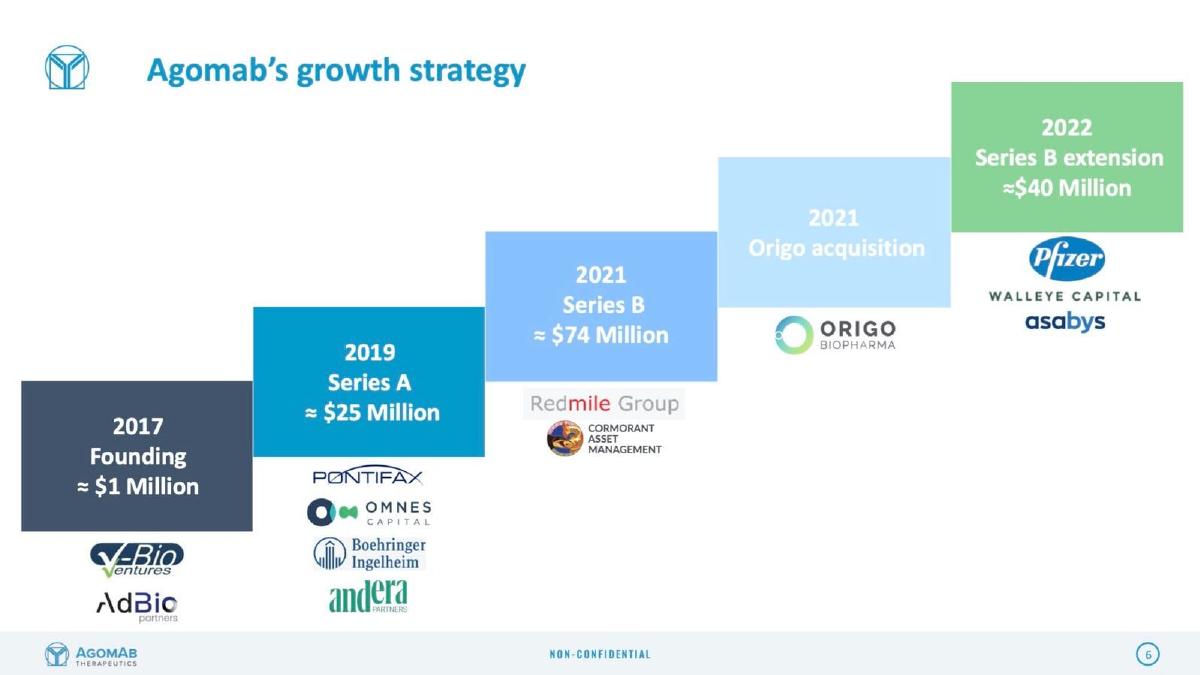
AgomAb Therapeutics presents a 21-slide deck that serves as a technical blueprint for a Series B biotech raise. As reported by Business Insider, this presentation helped secure $40.5M in 2023. The deck is notably professional, eschewing the bright colors and marketing jargon of consumer tech for the sober, data-driven aesthetics of the life sciences industry. By centering the narrative on two distinct biological platforms, AgomAb positions itself not as a single-asset gamble, but as a diversified therapeutic powerhouse.
Slide 1: Title and Positioning
The cover slide establishes the company's core identity: "Leader in Growth Factor-Targeting Therapeutics." Dated July 2022, it carries a "Non-confidential deck" disclaimer. The imagery of a human silhouette overlaid with molecular structures immediately signals the company's focus on systemic biological intervention. The branding is clean, utilizing a professional blue and green palette that persists throughout the presentation.
Slide 4: The Pipeline Overview
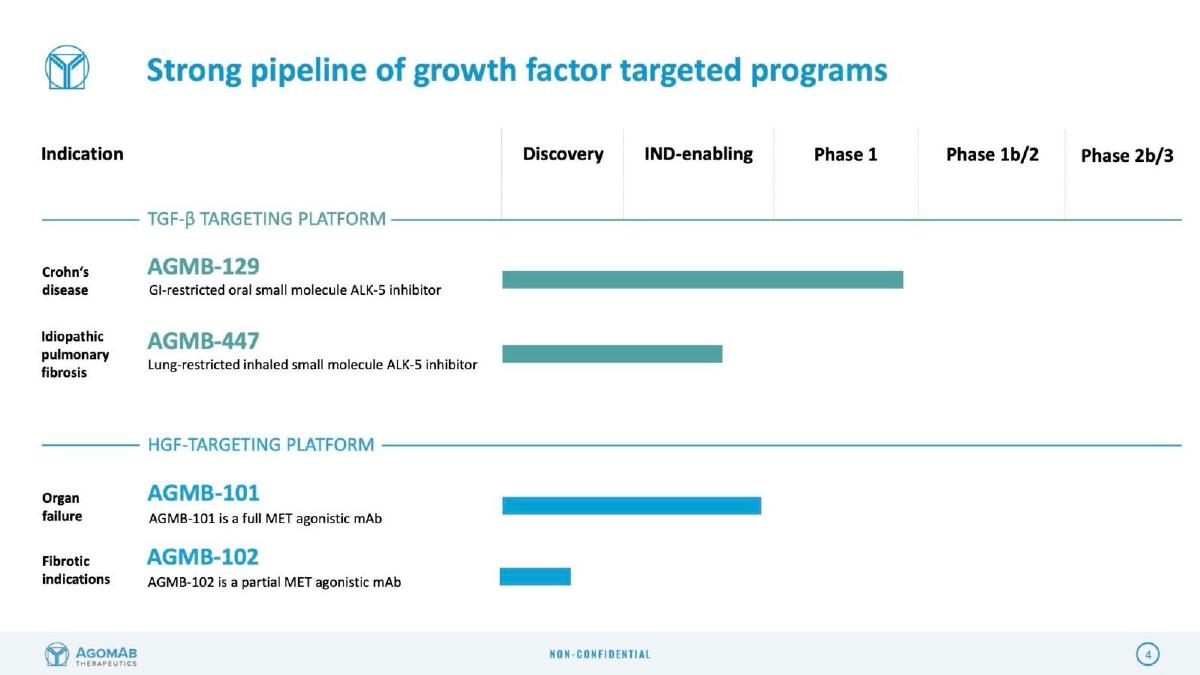
This is arguably the most important slide in any biotech deck. AgomAb divides its programs into two platforms: TGF-β Targeting and HGF-Targeting . The slide shows four distinct programs. AGMB-129 is the most advanced, shown as being well into Phase 1 for Crohn’s disease. AGMB-447 (IPF) and AGMB-101 (Organ failure) are in the IND-enabling phase. AGMB-102 is in discovery. This visual effectively communicates that the company has both near-term clinical milestones and a long-term engine for new drug candidates.
Slide 9 & 10: The Case for Crohn’s Disease
Slide 9 serves as a transition to the TGF-β platform, while Slide 10 dives into the "High unmet need in fibrostenotic Crohn’s Disease." The company uses stark statistics to justify its focus: 50% of patients develop strictures, and 40-70% require surgery within 10 years. Crucially, the slide notes that "Current therapies have no impact on stricture incidence." This identifies a clear market gap that their lead candidate, AGMB-129, aims to fill.
Slide 13: Clinical Strategy for AGMB-447
Slide 13 outlines a "Hybrid Phase 1 study to drive Phase 2 success." This slide is highly technical, detailing the transition from healthy subjects to IPF patients. It lists specific biomarkers (pSMAD2/3 in BALF) and clinical efficacy measures (FVC, DLCO). For an investor, this slide demonstrates that the management team has a rigorous, data-centric plan for navigating the regulatory pathway, reducing the perceived risk of clinical failure.
Slide 16: The HGF Targeting Platform
This slide introduces the second pillar of the company. It uses a "Target / Challenge / Our solution" framework. The challenge is clearly defined: HGF has a "very short half-life" of 2-5 minutes and a "complex 3D structure." AgomAb’s solution involves two different types of MET receptor agonists: AGMB-101 (full agonist) for acute/severe indications and AGMB-102 (partial agonist) for chronic fibrotic indications. This shows a sophisticated understanding of how to tune biological responses based on the disease state.
Slide 19: Differentiating AGMB-102
Slide 19 explains the mechanism of the partial MET agonist. It uses a flow chart to show how AGMB-102 triggers "Signaling events B" (Anti-fibrotic) and "Signaling events C" (Cell survival) while avoiding "Signaling events A" (Proliferation). This is a critical distinction in biotech, as avoiding unwanted side effects (like uncontrolled cell growth) is often the difference between a successful drug and a dangerous one. The slide notes this asset is currently in the discovery stage.
What AgomAb Does Exceptionally Well
The deck excels at platform storytelling . Instead of presenting a list of unrelated drugs, AgomAb groups its assets by biological mechanism. This suggests that if the underlying science of the platform is validated, multiple drugs in the pipeline become more valuable simultaneously. The use of the "Challenge vs. Solution" format on Slide 16 is a masterclass in simplifying complex biology for an investment committee.
Furthermore, the market justification on Slide 10 is excellent. By citing the high rate of surgical intervention in Crohn's patients, they aren't just saying the disease is bad; they are quantifying the failure of current standard-of-care treatments. This creates a compelling economic argument for a new therapeutic approach.
What is Missing from the Deck
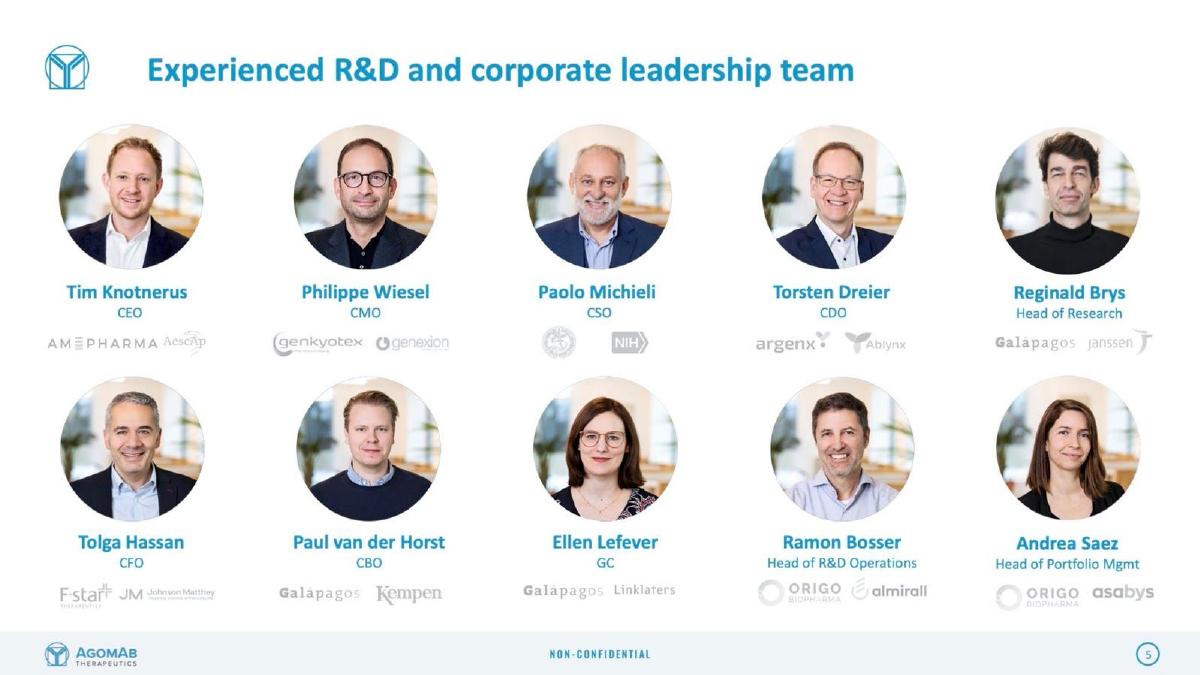
The most glaring omission in the provided slides is a Team Slide . In biotech, the pedigree of the scientific founders and the track record of the management team are often as important as the data itself. Investors want to know who has successfully navigated the FDA or EMA before. Additionally, there is no Competitor Analysis . While Slide 10 mentions "competition is still limited," it does not name specific companies or alternative modalities (like cell therapy or gene editing) that might be targeting the same indications.
Finally, there is no Financial Ask or Use of Proceeds . While this is common in "non-confidential" versions of decks, a Series B investor would eventually need to see how the $40.5M will be allocated across the four programs and what specific value-inflection points that capital will reach.
Lessons for Founders
Lead with the Pipeline: If you have more than one asset, a pipeline chart (like Slide 4) should appear early. it establishes the scale of your ambition and the breadth of your intellectual property. · Quantify the Unmet Need: Don't just say a disease is a problem. Use stats like AgomAb did on Slide 10—surgery rates, recurrence percentages, and the failure of existing drugs to move the needle. · Explain the 'How': Use signaling pathway diagrams (Slide 16 and 19) to show exactly how your drug interacts with the body. Visualizing the mechanism of action builds confidence in the scientific validity of the project. · Define the Clinical Path: Showing a roadmap for Phase 1 and Phase 2 (Slide 13) proves that you are thinking like a drug developer, not just a scientist. It shows you understand the metrics that regulators and future acquirers will care about.
Frequently asked questions
- What is the primary therapeutic focus of AgomAb?
- AgomAb focuses on growth factor-targeted therapeutics. Specifically, they develop drugs to repair damaged organs and treat fibrotic diseases. Their pipeline is split between a TGF-β targeting platform (focused on Crohn’s disease and Idiopathic Pulmonary Fibrosis) and an HGF-targeting platform (focused on organ failure and general fibrotic indications).
- How far along is AgomAb’s clinical pipeline?
- According to Slide 4, the lead program AGMB-129 (for Crohn’s disease) is in Phase 1. AGMB-447 (for IPF) and AGMB-101 (for organ failure) are in the IND-enabling stage, while AGMB-102 is currently in the discovery phase.
- What specific problem does AgomAb solve in Crohn’s disease?
- Slide 10 highlights that 50% of Crohn’s patients develop fibrostenotic strictures, and current therapies have no impact on the incidence or severity of these strictures. AgomAb’s AGMB-129 is a GI-restricted oral small molecule designed to address this specific unmet need.
- What is the technical challenge associated with HGF targeting?
- Slide 16 identifies two main challenges: HGF has a very short half-life of only 2-5 minutes, and it has a complex 3D structure that makes binding difficult. AgomAb’s solution involves MET receptor agonist monoclonal antibodies (mAbs) to utilize full MET biology.
- Does the deck include financial projections or a specific funding ask?
- No. The provided 21-slide deck focuses entirely on the science, clinical strategy, and market need. There is no mention of valuation, burn rate, or a specific dollar amount requested, which is common for 'non-confidential' biotech decks intended for initial screening.