Agility Health’s investor presentation positions the company as a consolidator in the highly fragmented US rehabilitation and therapy services market. With a footprint of over 155 locations and 700+ employees, the company leverages a three-pronged growth strategy: acquisitions of strong local brands, de novo clinician partnerships, and organic growth with existing clients. The deck highlights a 3-year EBITDA CAGR of 9% and a client roster featuring major industrial players like Ford and John Deere. While the presentation successfully establishes the scale and market demand—driven by an aging…
Key takeaways
- The company operates at significant scale with 155+ locations and over 1 million annual patient visits (Slide 4).
- Growth is primarily driven by an M&A 'roll-up' strategy targeting strong local brands to leverage existing infrastructure (Slide 16).
- Macro tailwinds include a 2.4% annual increase in US residents aged 50+ and the expansion of insurance via the Affordable Care Act (Slide 13).
- The business model includes a B2B component, serving as a validated provider for Fortune 500 companies like Alcoa, Medtronic, and American Airlines (Slide 7).
- Financial performance is anchored by a 9% 3-year EBITDA CAGR, though specific dollar amounts are not disclosed in these slides (Slide 4).
- Acquisition criteria focus on cultural fit, local reputation, and the retention of equity by selling management (Slide 19).
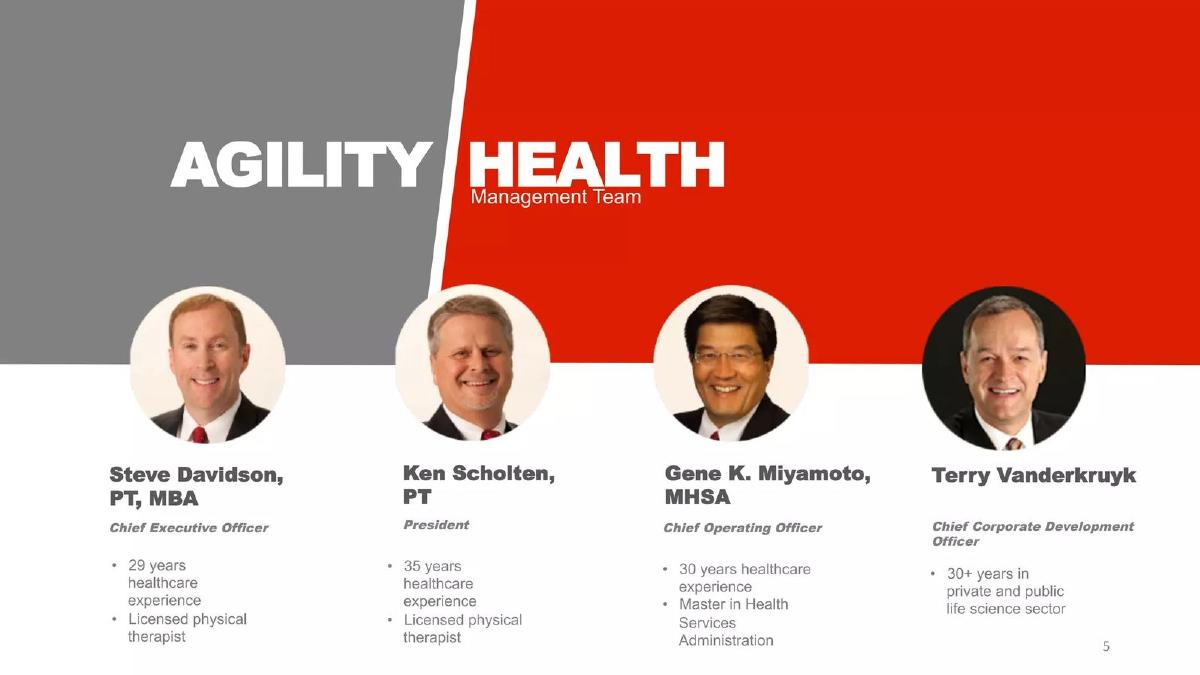
- The deck omits a specific funding ask, use of proceeds, or a detailed breakdown of the executive leadership team (General Omission).
- The investment thesis relies on the 'highly fragmented' nature of the industry and an 'attractive valuation relative to publicly traded peers' (Slide 22).
Executive Summary: The Consolidation Play
Agility Health’s investor presentation is a textbook example of a consolidation or 'roll-up' strategy in the healthcare services sector. The deck focuses on the fragmented nature of the physical therapy market and the company's ability to scale through a mix of acquisitions and organic growth. With 155+ locations and a 9% EBITDA CAGR, the company presents itself as a stable, growing platform capable of absorbing smaller players to increase market share and operational efficiency.
Slide 1: Title Slide
The presentation opens with the Agility Health logo and the tagline 'Serving Together. Better.' It is a standard corporate cover page that establishes a professional, healthcare-oriented brand identity. No specific date or funding round is mentioned on this slide.
Slide 4: Corporate Overview
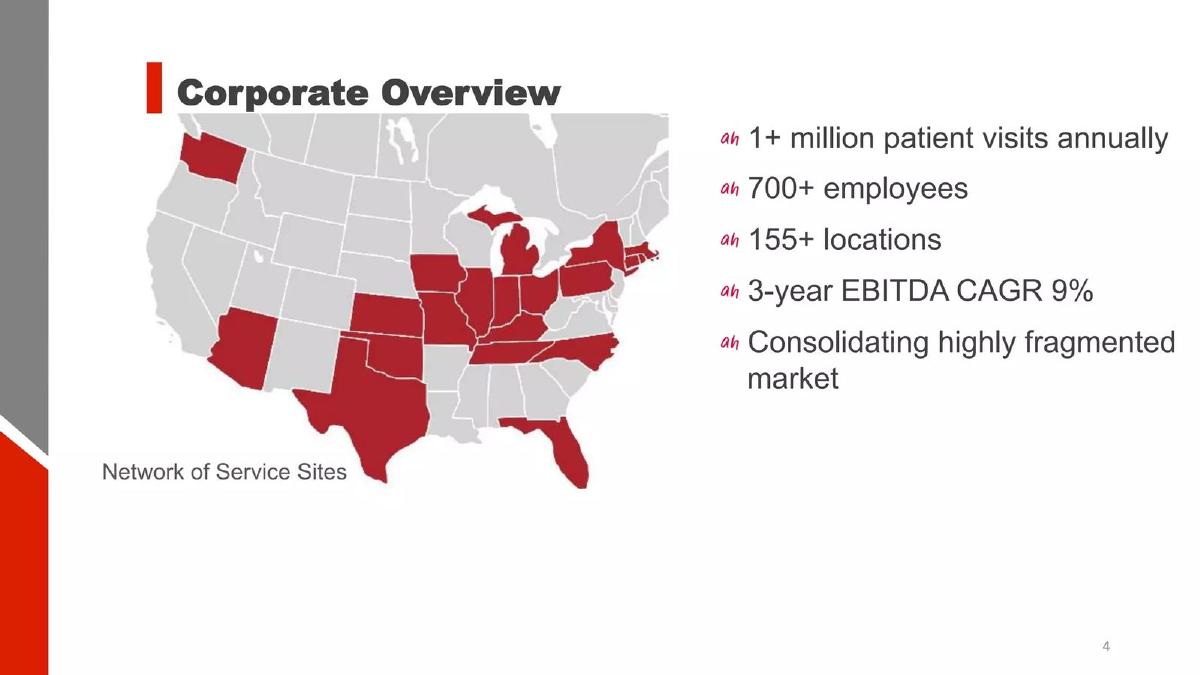
This slide provides the 'meat' of the company's current scale. It lists several key performance indicators: 1+ million patient visits annually , 700+ employees , and 155+ locations . A map of the United States highlights a heavy concentration in the Midwest and South, with additional presence in the Pacific Northwest and Northeast. Crucially, it mentions a 3-year EBITDA CAGR of 9% , signaling consistent profitability and growth. The slide explicitly states their mission: 'Consolidating highly fragmented market.'
Slide 7: A Validated Service Provider
To establish credibility, Agility Health displays a 'logo wall' of corporate clients. This indicates that their business is not just reliant on individual patient referrals but also on B2B contracts. The logos include major global brands such as Alcoa, American Airlines, Amway, Ford, John Deere, Medtronic, and United Technologies . This slide serves as powerful social proof, suggesting that the company’s service quality meets the rigorous standards of Fortune 500 organizations.
Slide 12: Target Market
This is a simple transition slide titled 'TARGET MARKET.' It maintains the visual branding of the deck but contains no data. In a full presentation, this would likely be followed by a deep dive into the total addressable market (TAM).
Slide 13: Demand for Therapy Services
This slide outlines the macro-economic and demographic tailwinds supporting the business. It cites the Patient Protection and Affordable Care Act as a driver for increased insurance coverage. Demographically, it notes a 2.4% annual increase in US residents aged 50+ and an 'increased desire by elderly to retain an active lifestyle.' Other factors mentioned include rising obesity rates and a shift in patient care from hospitals to more cost-effective outpatient centers. This slide effectively justifies why the market is growing independently of the company's specific efforts.
Slide 16: Growth Strategy
Agility Health breaks its growth down into three categories: Acquisitions (Primary Focus), De Novo (Complementary), and Organic (Ongoing, Additive). The acquisition strategy focuses on leveraging infrastructure and clinical portfolios. The 'De Novo' strategy involves clinician partnerships to penetrate new markets, while organic growth focuses on new client wins and expanding work with existing clients. This shows a balanced approach to scaling that doesn't rely solely on expensive M&A.
Slide 19: Typical Acquisition Criteria
For an M&A-heavy business, this slide is vital for investors. It lists five criteria: Cultural fit , Ongoing management participation , Strong local reputation , Retention of equity (actual or synthetic), and Organic growth opportunities . By requiring selling managers to keep 'skin in the game,' Agility Health reduces the risk of post-acquisition performance dips.
Slide 22: Investment Highlights
The deck concludes with a summary of the investment thesis. It reiterates the fragmented industry, the healthy acquisition pipeline, and the growth in revenues and EBITDA. It also claims an 'Attractive valuation relative to publicly traded peers,' which suggests this deck may have been used for a private equity round or a pre-IPO presentation. It emphasizes the 'strong and experienced management' team, though the provided slides do not include their bios.
What Works in This Deck
Scale and Validation: The combination of 155+ locations and a list of Fortune 500 clients (Slide 7) immediately removes the 'startup risk' from the equation. This is a mature business with proven operations.
Clear Growth Engine: The deck does not hide its intentions. It is a roll-up play. By clearly defining the acquisition criteria (Slide 19), the company shows investors exactly how it intends to deploy capital to generate returns.
Macro Alignment: Slide 13 does a good job of connecting the business to unavoidable trends like the aging 'Baby Boomer' generation and healthcare legislative changes, making the growth feel inevitable rather than speculative.
What Is Missing
The 'Ask': There is no slide in this selection that states how much capital Agility Health is seeking or what the specific terms of the investment are. Without this, the deck is an informational brochure rather than a functional fundraising tool.
Financial Transparency: While a 9% EBITDA CAGR is mentioned, the actual dollar amounts for revenue, gross margins, and net income are absent. Investors cannot calculate a valuation without knowing the baseline numbers.
Management Team Details: Slide 22 mentions a 'strong and experienced management' team, but there are no names, faces, or track records provided. In a roll-up strategy, the ability of the leadership to execute M&A is the most important factor.
Competitive Landscape: The deck mentions the market is fragmented but does not name other large consolidators or explain why Agility Health is the preferred partner for a local clinic looking to sell.
Founder's Playbook: What to Copy
Use a Logo Wall for B2B Credibility: If your company serves large enterprises, a slide like Slide 7 is essential. It signals that you have already passed the 'due diligence' of major corporations, which builds trust with investors.
Define Your M&A Criteria: If your strategy involves acquisitions, don't just say 'we will buy companies.' List the specific criteria as Agility Health did on Slide 19. This shows operational discipline and a repeatable process.
Map Your Footprint: For businesses with physical locations, a map (Slide 4) is the most efficient way to communicate market density and geographic strategy. It helps investors visualize where the 'white space' is for future growth.
Final Thoughts
Agility Health’s deck is a professional, albeit conservative, presentation of a late-stage healthcare services provider. It leans heavily on its existing scale and the favorable tailwinds of the US healthcare market. While it lacks the 'visionary' flair of a tech pitch, it compensates with evidence of operational stability and a clear, logical path to further expansion through consolidation. For founders in service industries, this deck provides a solid template for how to pitch a scale-up strategy once the initial 'product-market fit' phase is long settled.
Frequently asked questions
- What is Agility Health's primary business model?
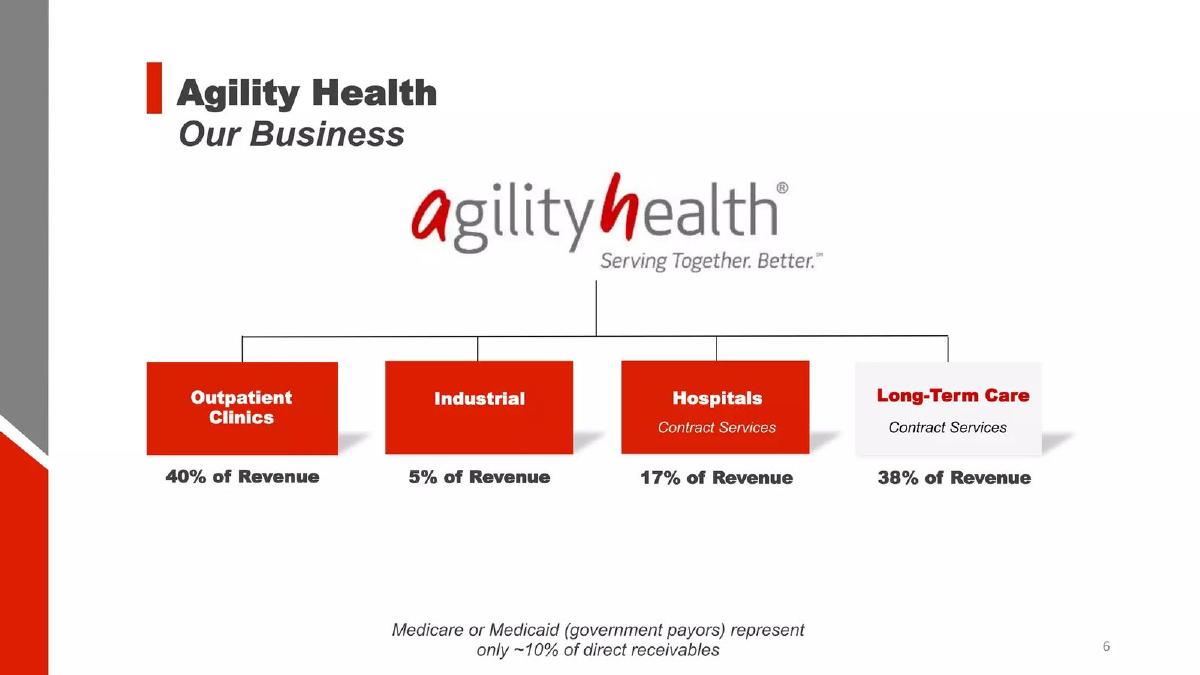
- Agility Health is a provider of physical rehabilitation and therapy services. They operate a network of over 155 service sites across the United States, facilitating more than 1 million patient visits annually. Their model combines direct clinical care with a B2B service provider arm that contracts with large corporate entities for occupational health and therapy needs.
- How does the company plan to grow?
- The company employs a three-tiered growth strategy. The 'Primary Focus' is acquisitions of established local brands. This is supported by 'Complementary' de novo growth through clinician partnerships in new markets, and 'Ongoing' organic growth achieved by winning new clients and expanding services with existing ones.
- What market trends are driving demand for their services?
- Demand is driven by demographic and legislative shifts. Specifically, the deck cites the aging US population (2.4% annual growth in the 50+ demographic), rising obesity rates, and the Affordable Care Act, which increased the number of insured individuals. There is also a noted shift of patients from expensive institutional hospital settings to outpatient centers.
- What are their criteria for acquiring new clinics?
- Agility Health looks for 'cultural fit,' strong local reputations, and opportunities for organic growth post-acquisition. Critically, they prefer deals where the existing management participates in ongoing operations and retains equity, whether actual or synthetic, to ensure alignment and continuity.
- What information is missing from this pitch deck?
- The provided slides lack a specific financial 'Ask' (how much money they are raising) and a 'Use of Proceeds' breakdown. Additionally, there are no detailed biographies for the management team, no specific revenue figures (only CAGR percentages), and no competitive landscape analysis comparing them to other large-scale consolidators.