Ageras’s pitch deck for its $36M private equity round is a high-level strategic document that emphasizes ecosystem depth over simple product features. The company positions itself as the 'ultimate financial cockpit' for small business owners, moving beyond its origins as an accountant marketplace into a full-stack fintech provider. By integrating accounting software, business banking, and embedded financing, Ageras demonstrates a clear path to increasing Average Revenue Per User (ARPU) and customer stickiness. The deck is particularly notable for its transparent M&A roadmap, detailing five sp…
Key takeaways
- The company positions itself as a 'financial cockpit,' aiming to be the first thing a business owner checks on Monday morning (Slide 3).
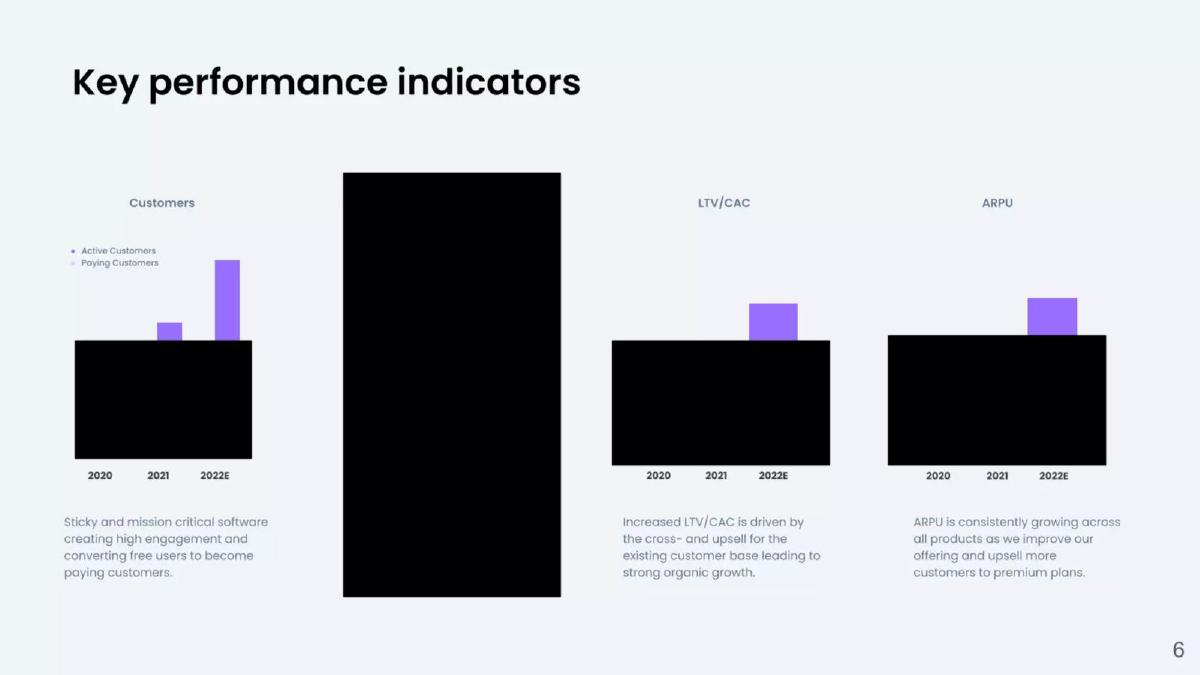
- Ageras claims a massive user base of over 1,000,000 registered customers, though paying customer counts are redacted (Slide 5).
- The business model has shifted toward high-quality recurring revenue, reporting a 98% recurring ratio for 2022E (Slide 7).
- The product suite is divided into four distinct pillars: Marketplace, Accounting & Admin, Banking, and Financing (Slide 9).
- Banking is used as a strategic 'spearhead' for customer acquisition to upsell more lucrative financing products (Slide 13).
- The ideal customer profile targets non-financially savvy SMEs that have not yet hired a full-time CFO (Slide 15).
- Ageras leverages a 100% inbound acquisition strategy, claiming decreasing CAC through a mix of organic and brand signups (Slide 19).
- The deck explicitly lists five key acquisitions—Billy, Tellow, Salary, Zervant, and Kontist—as the engine of their ecosystem expansion (Slide 23).
Executive Summary: The Transition to a Fintech Powerhouse
The Ageras pitch deck for their $36M private equity round represents a significant evolution in the company's narrative. Originally known as a marketplace for finding accountants, the slides demonstrate a deliberate shift toward becoming a comprehensive financial ecosystem. The deck is structured to convince institutional investors that Ageras is no longer just a lead-generation tool, but a 'financial cockpit' that owns the entire administrative workflow of a small business. By integrating M&A strategy directly into the growth narrative, the founders show a sophisticated understanding of how to scale in the fragmented European fintech market.
Slides 1-3: Vision and Positioning
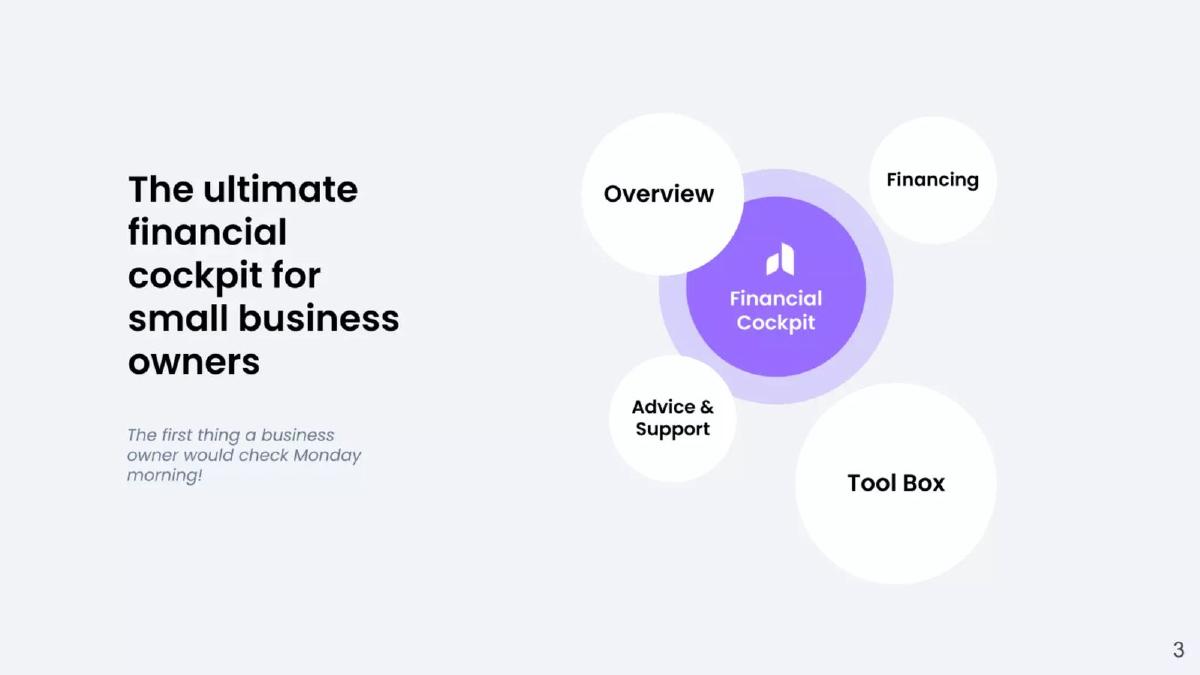
The presentation opens with a clean, professional cover (Slide 1) and moves immediately into the core value proposition on Slide 3. Ageras defines itself as the "ultimate financial cockpit for small business owners." The use of the word 'cockpit' is intentional; it implies control, visibility, and necessity. The sub-text, "The first thing a business owner would check Monday morning!" sets a high bar for engagement and retention. The visual aid on this slide breaks the cockpit into four quadrants: Overview, Financing, Advice & Support, and Tool Box, establishing the framework for the rest of the deck.
Slides 5-7: The Ecosystem and Performance Metrics
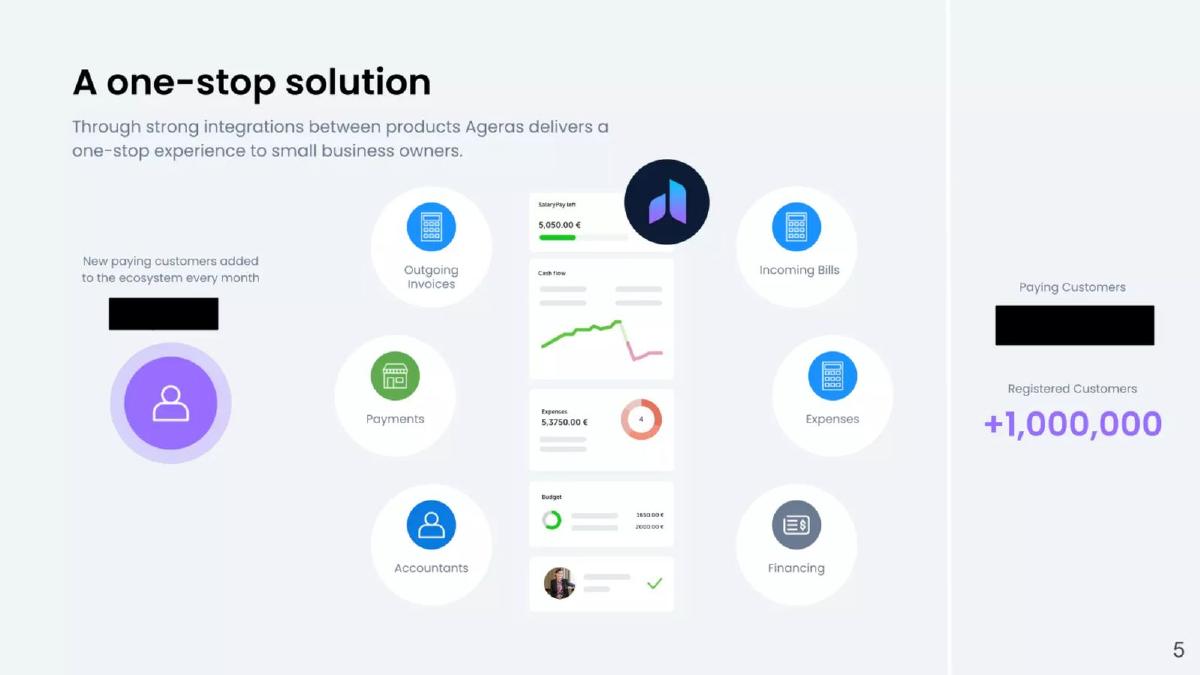
Slide 5 introduces the 'one-stop solution' concept. It shows a central dashboard surrounded by icons for invoices, payments, accountants, financing, and expenses. Ageras claims over 1,000,000 registered customers , a powerful top-of-funnel metric, though the specific number of paying customers is redacted. Slide 7 focuses on 'Performance,' showcasing a strong growth trajectory in Annual Recurring Revenue (ARR). The ARR grew from €6.9m in 2019 to €10.3m in 2020, reaching €16.1m in 2021 . A key highlight here is the 98% recurring ratio for 2022E, which is a critical metric for private equity investors seeking predictable cash flows.
Slides 9-11: Product Deep Dive - Marketplace and Accounting
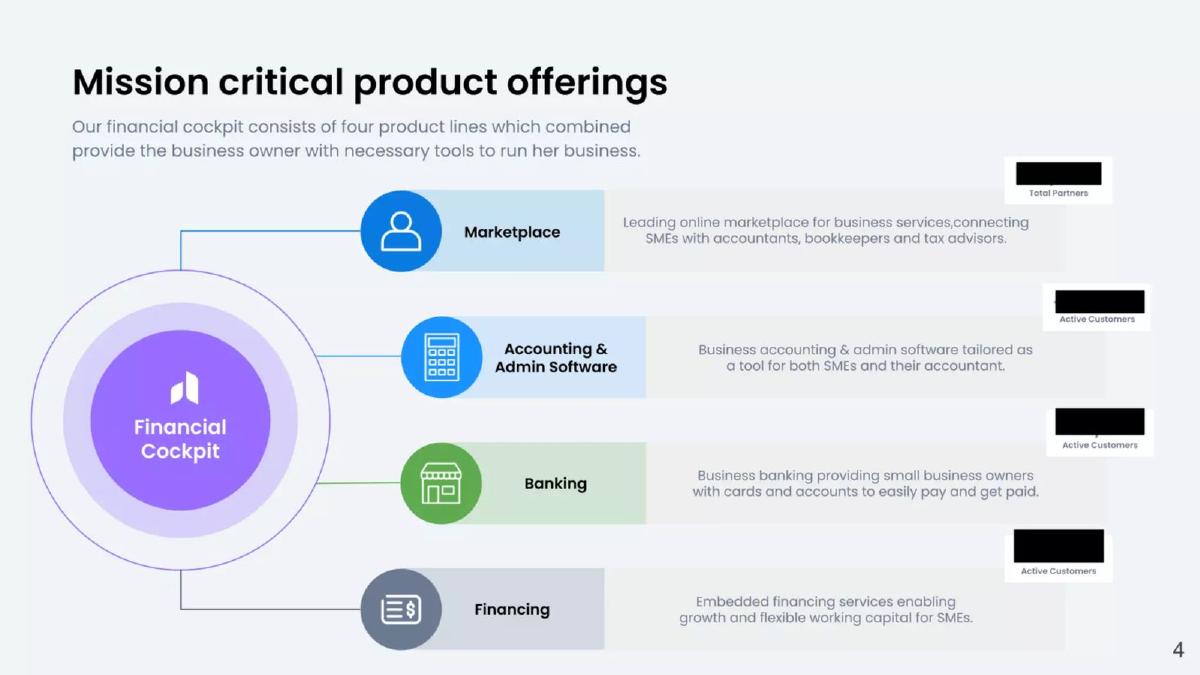
Slide 9 provides a high-level overview of the four product pillars: Marketplace, Accounting & Admin, Banking, and Financing. Each pillar has its own set of features, such as 'Automated matching' for the marketplace and 'Automatic VAT savings' for banking. Slide 11 details the mechanics of the Marketplace, explaining the dual-sided nature of the platform. SMEs (clients) sign up for free to find advisors, while accounting firms (partners) pay an "individual annual subscription fee" to access the right to bid on those clients. This creates a feedback loop where reviews improve the matching algorithm over time.
Slides 13-15: Banking and Customer Profiling
Slide 13 introduces Banking as a strategic asset. Ageras views banking not just as a feature, but as a "spearhead for customer acquisition." By offering banking, they capture transaction data that serves as the 'source of truth' for accounting and the basis for lucrative financing products. The business model for banking includes a freemium subscription, transaction fees, and interchange. Slide 15 defines the Ideal Customer Profile (ICP). They target businesses ranging from freelancers to medium-sized entities, specifically those that are "not financially savvy" and have not yet hired a full-time CFO. Their core markets are listed as Denmark, Germany, The Netherlands, France, and the US.
Slides 17-19: The Financing Gap and Go-To-Market
Slide 17 addresses the problem of SME financing, citing that 68% of SMEs find it difficult to obtain external debt funding . Ageras argues that their access to real-time data allows them to serve an 'untouched market segment.' Slide 19 focuses on their 'Proven go-to-market strategy.' The company claims a 100% inbound acquisition model , utilizing a mix of organic and paid channels. A redacted chart suggests that Customer Acquisition Cost (CAC) is decreasing as the brand gains more organic traction, a vital trend for reaching profitability.
Slides 21-25: Strategy, M&A, and Redacted Economics
Slide 21 is a redacted 'Strategic focus area,' likely containing sensitive competitive advantages. Slide 23 is one of the most important in the deck, titled 'Our acquisitions.' It uses a mountain-climbing metaphor ('Basecamp 3', 'Basecamp 5') to show how they have expanded their ecosystem. They list five acquisitions: Billy (accounting), Tellow (accounting), Salary (payroll), Zervant (light accounting), and Kontist (banking). This slide proves the team's ability to execute M&A to fill product gaps. Slide 25, 'Unit economics,' is entirely redacted in this version, but its presence indicates that the founders were prepared to discuss LTV/CAC ratios and payback periods in detail.
Slides 27-31: Financials, Team, and Structure
Slide 27 contains a redacted Balance Sheet, with a note stating it excludes 'Ageras Finance (SPV) items.' Slide 29 introduces the core team. Co-founders Rico Andersen (CEO) and Martin Hegelund (CMO) both boast 10-year tenures, signaling long-term commitment. The team is rounded out by Claus Jørgensen (CFO) and Philip Dalhstrøm (CTO) , who bring experience from companies like Saxo Bank and Danske Bank. Finally, Slide 31 provides a legal structure overview, showing Ageras A/S as the parent company with 100% ownership of its various international subsidiaries and acquired brands.
What Ageras Does Well
The Ageras deck excels at narrative arc. It doesn't just list features; it tells a story of a company building a 'moat' through ecosystem density. By grouping their products into four clear pillars, they make a complex business model easy to digest. The inclusion of the M&A slide is a masterstroke for a private equity round, as it demonstrates a repeatable growth lever beyond just organic sales. Furthermore, the focus on 'recurring ratio' and 'inbound acquisition' speaks directly to the concerns of late-stage investors who prioritize efficiency and predictability over raw, unbridled growth.
What is Missing from the Deck
While this is a teardown of a partially redacted deck, several key elements are notably absent or obscured. There is no explicit 'Competitor' slide in the 16 slides provided, which is a significant omission given the crowded nature of the SME fintech space (competing with the likes of Qonto, Revolut Business, or Xero). Additionally, while the 'Financing' pillar is mentioned, there is little detail on the risk management framework or the capital intensity of that specific business line. Finally, the deck lacks a clear 'Ask' slide in this sequence, though this is common in private equity presentations where the terms are often discussed in a separate term sheet or supplemental document.
Founder Takeaways: What to Copy
Ecosystem Visualization: If you have multiple products, use a 'Cockpit' or 'Hub' visual (Slide 5) to show how they interact rather than listing them in isolation. · M&A as a Feature: If you have acquired companies, don't hide them. Show how they fit into your 'hike' toward a complete solution (Slide 23). · Tenure as a Signal: Highlighting that founders have been in the trenches for 10 years (Slide 29) builds immense trust with investors, especially in the volatile fintech sector. · Strategic Spearheads: Clearly identify which products are for acquisition (low margin, high volume) and which are for monetization (high margin, high value), as seen in the Banking vs. Financing slides. · Legal Transparency: Providing a clear legal structure chart (Slide 31) is essential for international companies to show investors exactly what they are buying into.
Frequently asked questions
- What is the primary value proposition of Ageras according to the deck?
- Ageras defines itself as the 'ultimate financial cockpit' for small business owners. The goal is to provide a one-stop solution where SMEs can manage outgoing invoices, incoming bills, payroll, banking, and financing in a single integrated ecosystem. By doing so, they aim to become the central administrative hub that business owners rely on daily, moving away from being a transactional marketplace to a mission-critical SaaS platform.
- How does Ageras use M&A to fuel its growth strategy?
- The deck highlights a 'hike' to expand the ecosystem through strategic acquisitions. Slide 23 identifies five specific companies—Billy, Tellow, Salary, Zervant, and Kontist—that provided the technical infrastructure for accounting, payroll, and banking. This suggests that instead of building every feature from scratch, Ageras acquires established regional players to quickly gain market share and functional depth in the SME fintech space.
- What are the key revenue drivers identified in the presentation?
- Revenue is generated through a mix of models across the four pillars. The Marketplace charges accounting firms an annual subscription fee to bid on clients. The Banking and Accounting segments utilize a freemium subscription model, transaction fees, and interchange. Finally, the Financing pillar generates revenue through business loans, credit lines, and invoice financing, often using banking data to assess creditworthiness.
- Which geographic markets does Ageras prioritize?
- According to Slide 15, Ageras focuses on core markets in Europe and North America. Specifically, they name Denmark, Germany, The Netherlands, France, and the United States as their primary targets. The legal structure slide (Slide 31) further confirms this international footprint, showing subsidiaries registered in various jurisdictions including the USA, Sweden, and Germany.
- How does the company address the 'Financing' gap for SMEs?
- Slide 17 notes that 68% of SMEs find it difficult to obtain debt financing due to information asymmetries. Ageras positions its 'Financing' product as the solution, using its access to the customer's real-time accounting and banking data to perform better credit assessments than traditional financiers. They claim the number of their customers wanting debt financing is 2.5x higher than those currently receiving it.