Crunchbase’s Series C deck is a masterclass in leveraging a dominant market position to justify a late-stage expansion round. By framing the private company sector as an 'iceberg' where most value is hidden, they position their proprietary dataset as the only viable map for investors and sales professionals. The deck emphasizes a self-sustaining growth engine—powered by community contributions and automated routines—that creates a high barrier to entry. While the provided slides lack specific revenue figures and a team overview, the narrative focuses heavily on the transition from a directory…
Key takeaways
- The round successfully raised $30 million in Series C funding from investors including OMERS Ventures and Emergence (Slide 1).
- Crunchbase identifies a massive shift in the market, noting that the number of US public companies has halved in 10 years to 46,583 (Slide 3).
- The company positions private companies as a $3T funding opportunity with 124M employees in the US alone (Slide 3).
- The core competitive advantage is a 'Growth Engine' flywheel involving ~1 million community members and 4,000 partners (Slide 7).
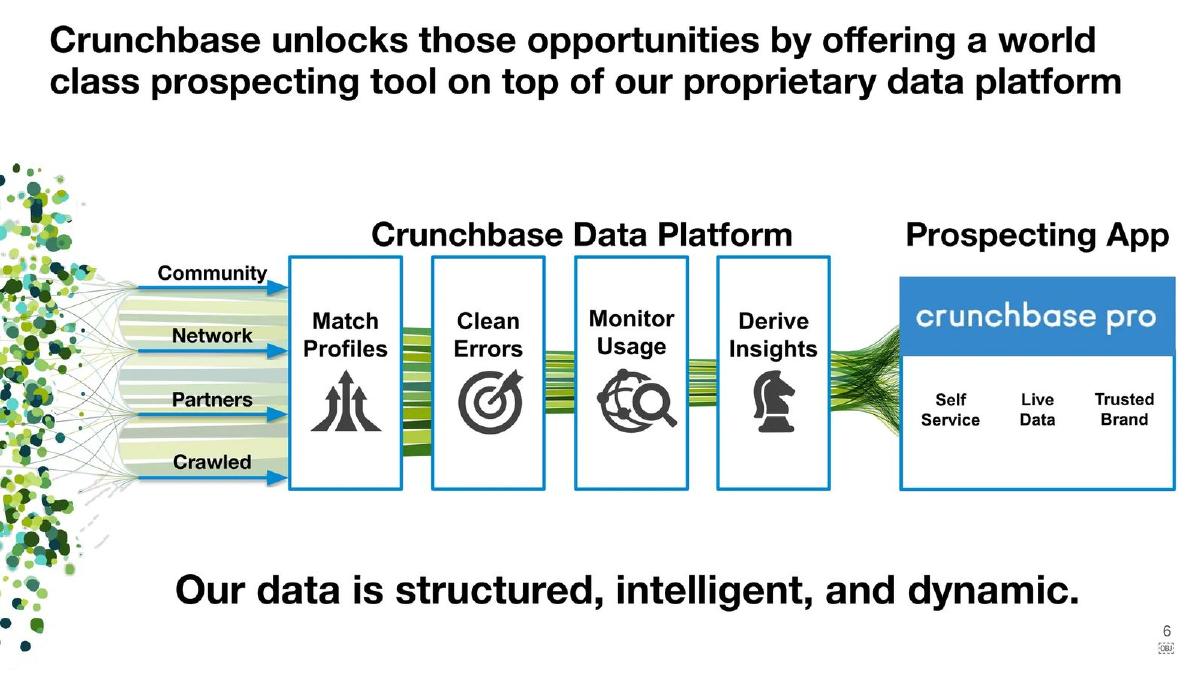
- Product utility is demonstrated through 'Crunchbase Pro,' featuring multi-join dynamic searches and automated buy signals (Slide 9).
- The total addressable market is defined as $35B, encompassing 100M business users connecting to private companies (Slide 11).
- The strategic vision is summarized by the tagline 'Crunchbase: the LinkedIn for Companies' (Slide 13).
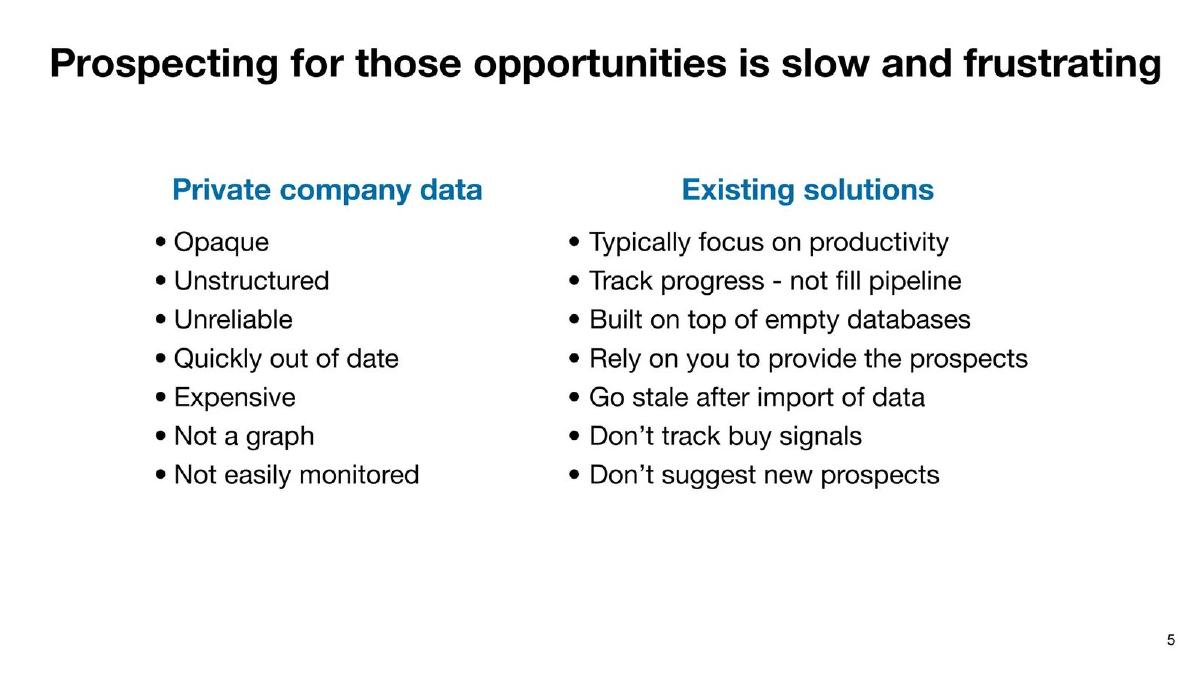
- The deck highlights that existing solutions fail because they are built on 'empty databases' and do not suggest new prospects (Slide 5).
The Series C Narrative: Mapping the Private Economy
Crunchbase occupies a unique position in the startup ecosystem. Originally a side project of TechCrunch, it evolved into a standalone entity that serves as the primary record for venture capital and private company data. By the time they reached their Series C, the goal was no longer to prove that people wanted data, but to prove that this data could be the foundation of a massive, scalable SaaS business. This deck focuses on the 'why now' by highlighting the shrinking public market and the explosion of the private sector.
Slide 1: The Funding Announcement
The deck begins with a retrospective title slide. It explicitly states that the company closed a $30 million Series C funding round . It lists the participating investors: OMERS Ventures, Emergence, Mayfield, Cowboy Ventures, and Verizon Ventures . This slide serves as social proof, immediately establishing the company's credibility by associating it with top-tier venture firms. It sets a tone of transparency, framing the deck as a shared resource for the broader startup community.
Slide 3: The Iceberg Metaphor
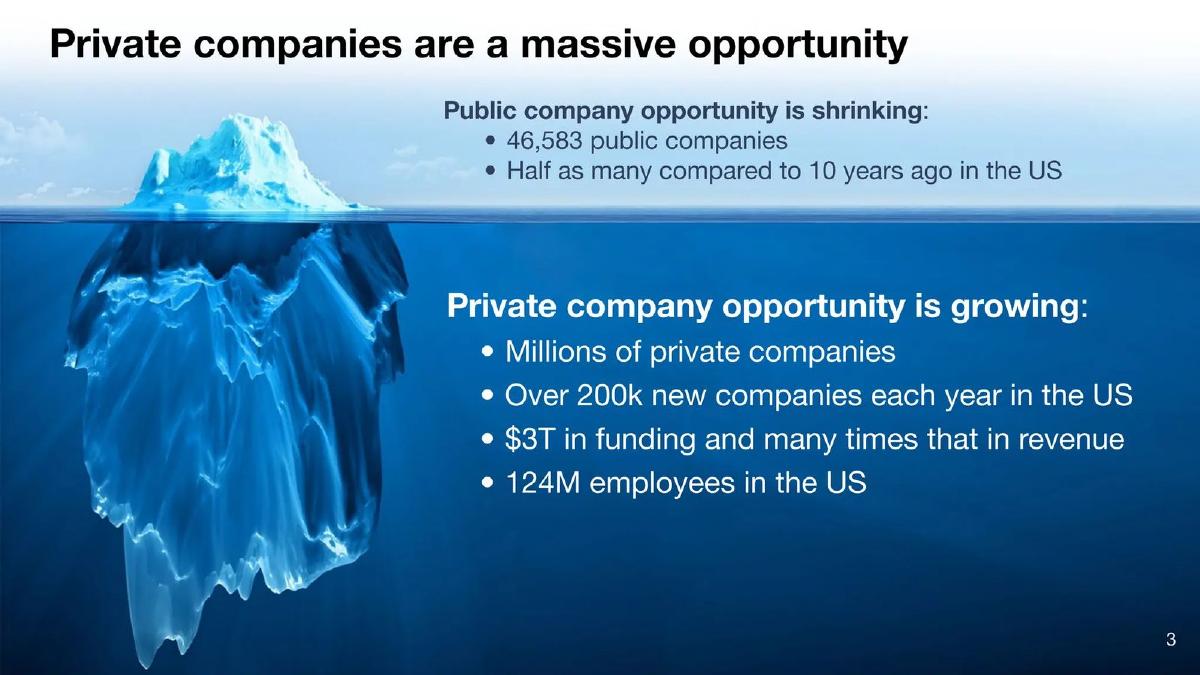
Slide 3 uses a classic 'iceberg' visual to contrast public and private company opportunities. The text notes that the public company opportunity is shrinking , with only 46,583 public companies remaining—a figure that is half of what it was 10 years ago in the US. Conversely, the private company opportunity is growing . The slide cites millions of private companies , over 200k new companies each year in the US , and $3T in funding . By highlighting 124M employees in the US , Crunchbase is signaling that their data isn't just for investors; it is for anyone doing business with the vast majority of the economy.
Slide 5: The Friction in Prospecting
This slide addresses the 'Problem' in the traditional pitch deck flow. It splits the issues into two categories: the nature of the data and the failure of existing tools. It describes private company data as opaque, unstructured, unreliable, and quickly out of date . Crucially, it notes that data is 'not a graph' and 'not easily monitored.' On the solutions side, it critiques competitors for focusing on productivity rather than pipeline generation. The most damning critique of existing solutions is that they 'rely on you to provide the prospects' and 'go stale after import of data.' This sets the stage for Crunchbase to position itself as a proactive, rather than reactive, tool.
Slide 7: The Growth Flywheel
Slide 7 is the most technical in terms of business logic. It introduces the Crunchbase Growth Engine . The flywheel consists of four stages:
Community & Partner Data: Citing ~1 million community members and 4,000 partners (governments, VCs, accelerators) who provide proprietary primary source data. · Intelligently Enhance & Derive Data: Automatic routines that supplement source data with news, Twitter, and usage signals. · SEO & Syndication: Data is crawled by search engines, leading to 'first page SERP keywords' and high relevance. · User and Prospect Engagement: Users discover the platform via search and find value through 'adjacent data and similar companies.'
This slide explains how Crunchbase maintains a data advantage that is difficult for a newcomer to replicate without the same community scale.
Slide 9: Product Utility and Monetization
Slide 9 moves from theory to product. It showcases Crunchbase Pro , the company's paid offering. The headline states that 'Over xxk professionals pay us for prospecting tools' (the specific number is redacted in this version of the deck). The slide highlights three key functional areas: multi-join dynamic searches , customizable columns/alerts , and statistics and analysis . The UI screenshot shows a search for healthcare companies founded in the last 3 years with over $2M in funding, demonstrating how a salesperson or investor would use the tool to generate a lead list.
Slide 11: Market Sizing (TAM)
The market slide uses a nested rectangle visualization to show three levels of opportunity:
$19B Market: 55M yearly users prospecting on Crunchbase. · $25B Market: 1M global businesses selling to private companies. · $35B Market: 100M business users connecting to private companies.
By defining the market this way, Crunchbase argues that their utility extends far beyond the 'venture capital' niche and into the broader category of B2B sales and professional networking.
Slide 13: The Vision Statement
The final slide in this selection provides the 'North Star' for the company: 'Crunchbase: the LinkedIn for Companies.' It shows a profile page for Airbnb, displaying 15 funding rounds and $4.4B in total funding . This comparison to LinkedIn is a powerful shorthand for investors; it suggests a platform where the entities (companies) are the primary nodes, and the data surrounding them creates a network effect that becomes more valuable as more companies and data points are added.
What Works in the Crunchbase Deck
The deck excels at framing the macro-environment . By starting with the decline of public companies, they make the case that a platform for private company data is not just a 'nice to have,' but an essential infrastructure for the modern economy. The use of the flywheel diagram is also highly effective. It moves the conversation away from 'we have a database' to 'we have a system that generates and cleans data automatically,' which is a much more venture-scalable narrative. Finally, the LinkedIn comparison provides a clear exit or growth trajectory that investors can easily visualize.
What is Missing from the Deck
Based on the 7 slides provided out of 14, there are significant omissions that a founder should be aware of. There is no team slide in this selection, which is critical for a Series C where execution capability is paramount. There is also a lack of hard financial metrics ; while 'xxk professionals' is mentioned, there are no charts showing MRR growth, churn rates, or Customer Acquisition Cost (CAC). Additionally, the 'Ask' slide is missing—while we know from the intro that they raised $30M, a standard pitch deck would include a slide detailing how that specific capital would be deployed (e.g., hiring, international expansion, product R&D).
Founder Takeaway: The Power of the Flywheel
Founders should copy the way Crunchbase explains their defensibility . Many startups claim to have a 'data advantage,' but few explain the mechanics of how that data is acquired, cleaned, and leveraged to acquire more users. The Growth Engine slide (Slide 7) is a perfect template for any company that relies on network effects or user-generated content. Furthermore, the use of macro-trends (Slide 3) to justify the market size is much more compelling than simply stating a large TAM number without context. It tells a story of why the world is changing in the company's favor.
Frequently asked questions
- How much did Crunchbase raise with this deck?
- According to the introductory slide, Crunchbase raised $30 million for their Series C round. The lead investor mentioned in the text is OMERS Ventures, with participation from Emergence, Mayfield, Cowboy Ventures, and Verizon Ventures.
- What is the 'Growth Engine' mentioned in the deck?
- Slide 7 describes a four-part flywheel: Community & Partner Data (1M members/4000 partners), Intelligent Enhancement (automated routines), SEO & Syndication (first-page SERP keywords), and User Engagement (discovery through adjacent data). This creates a cycle where more data leads to more users, which in turn generates more data.
- How does Crunchbase define its market opportunity?
- On Slide 11, the company presents a tiered market view. The broadest opportunity is a $35B market with 100M business users. The mid-tier is a $25B market of 1M global businesses selling to private companies, and the base is a $19B market of 55M yearly users prospecting on the platform.
- What problems does Crunchbase claim to solve for professionals?
- Slide 5 outlines that private company data is typically opaque, unstructured, and quickly out of date. Crunchbase claims existing solutions focus on productivity rather than filling the sales pipeline and fail to track 'buy signals' or suggest new prospects.
- What is the primary product featured in the deck?
- The deck highlights 'Crunchbase Pro' on Slide 9. Key features shown include multi-join dynamic searches, customizable columns, email alerts for funding rounds or acquisitions, and statistical analysis of equity funding amounts.