CrowdPlat raised $200,000 in 2013 with a remarkably brief 9-slide deck. The presentation positions the company as a bridge between traditional IT outsourcing giants like Accenture and Infosys and retail freelance platforms like Elance. The deck’s strongest asset is its 'Current Revenue' slide, which shows a clear upward trajectory from April 2014 to July 2015, projecting a $1,000,000 run rate by July 2016. However, the deck is light on technical details, failing to explain how the platform actually manages project quality or handles payments. It relies heavily on the founder's pedigree, showc…
Key takeaways
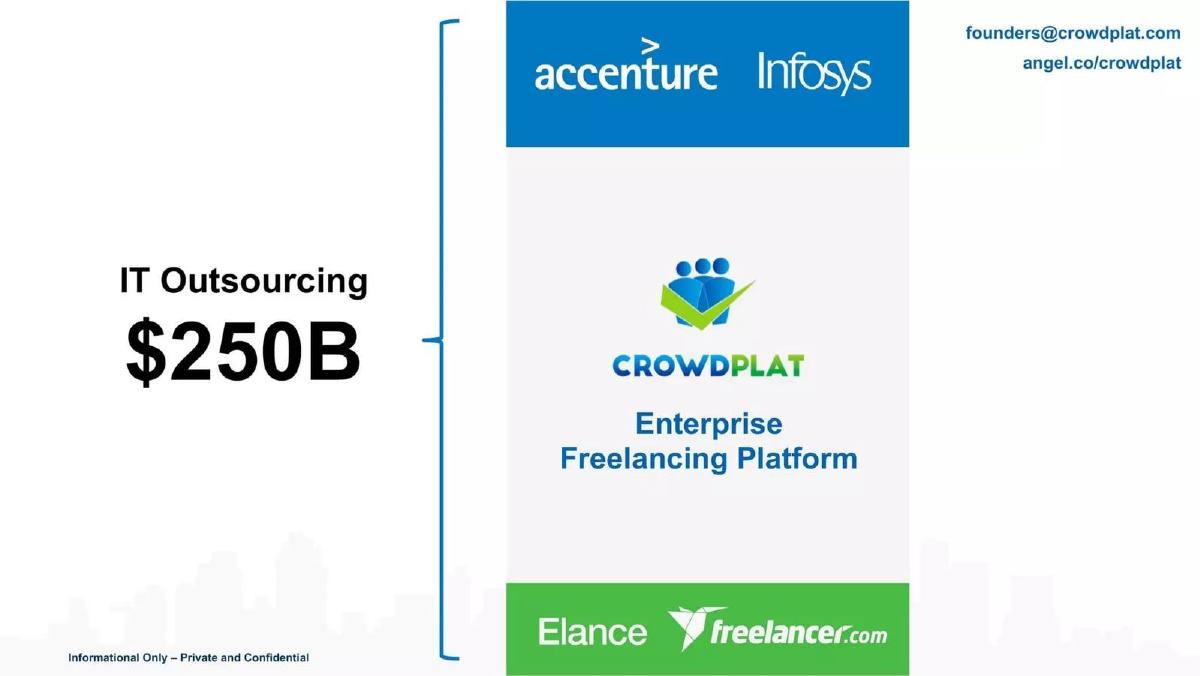
- The company identifies a $250 billion IT outsourcing market opportunity on slide 4.
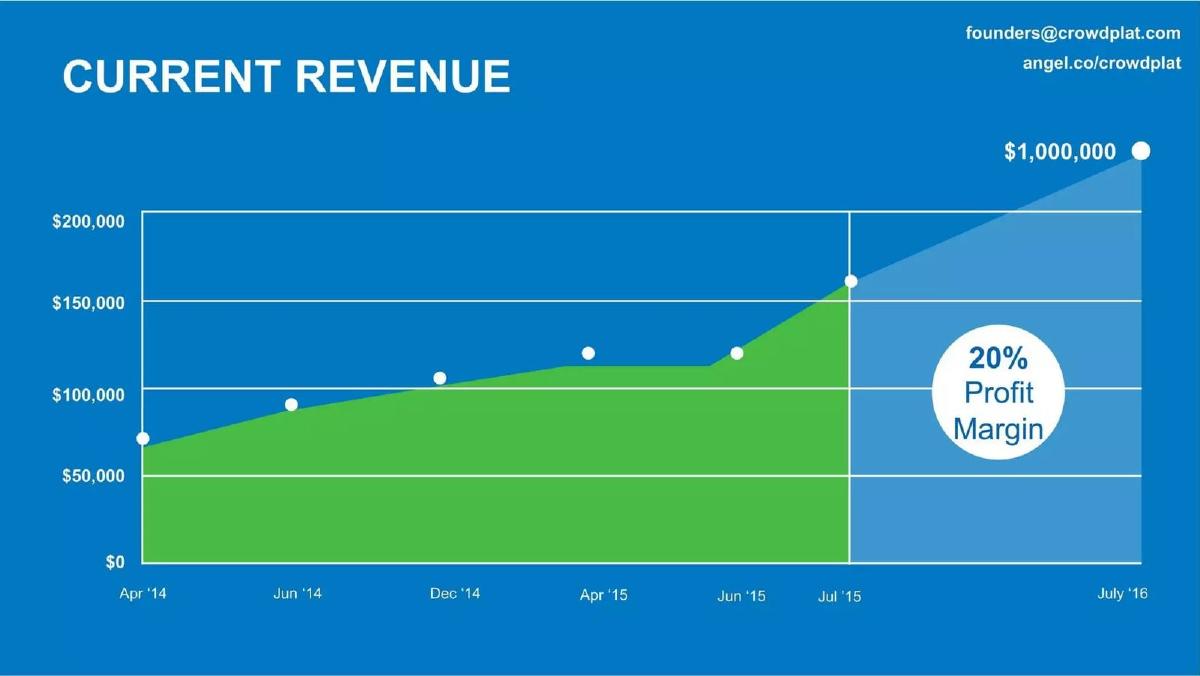
- Revenue traction is the deck's centerpiece, showing growth from approximately $70,000 in April 2014 to over $150,000 by July 2015 (slide 3).
- The business model targets a 20% profit margin as indicated on the revenue projection chart (slide 3).
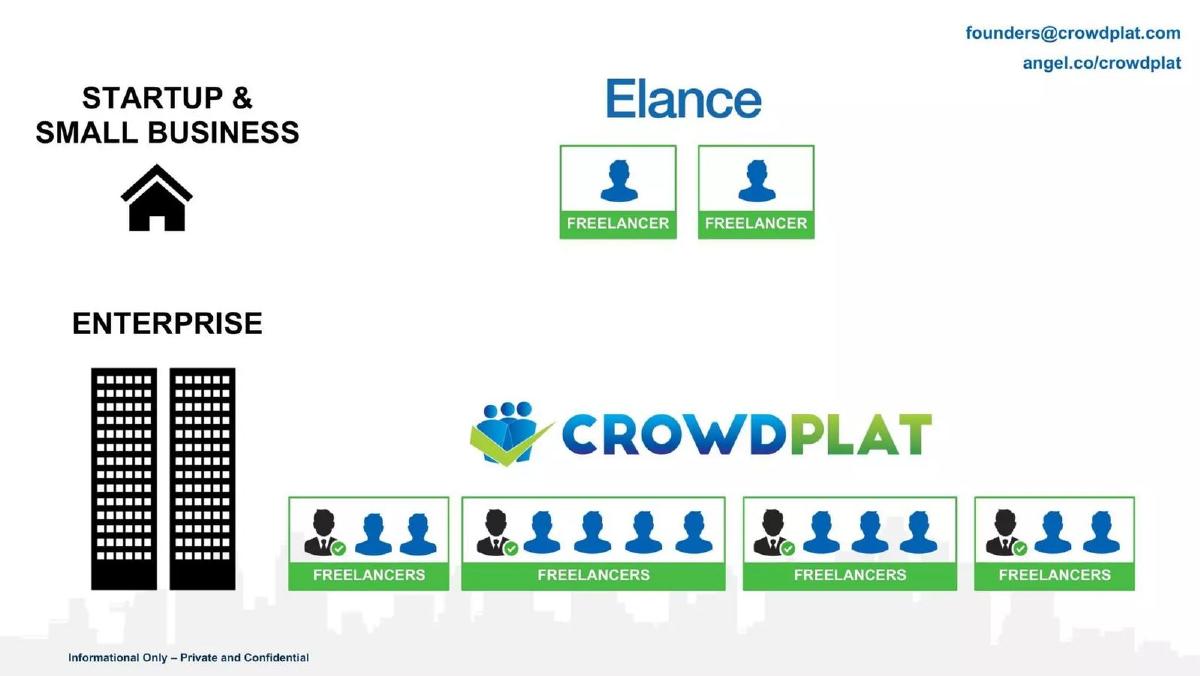
- CrowdPlat differentiates itself from Elance by offering managed teams rather than individual freelancers (slide 2).
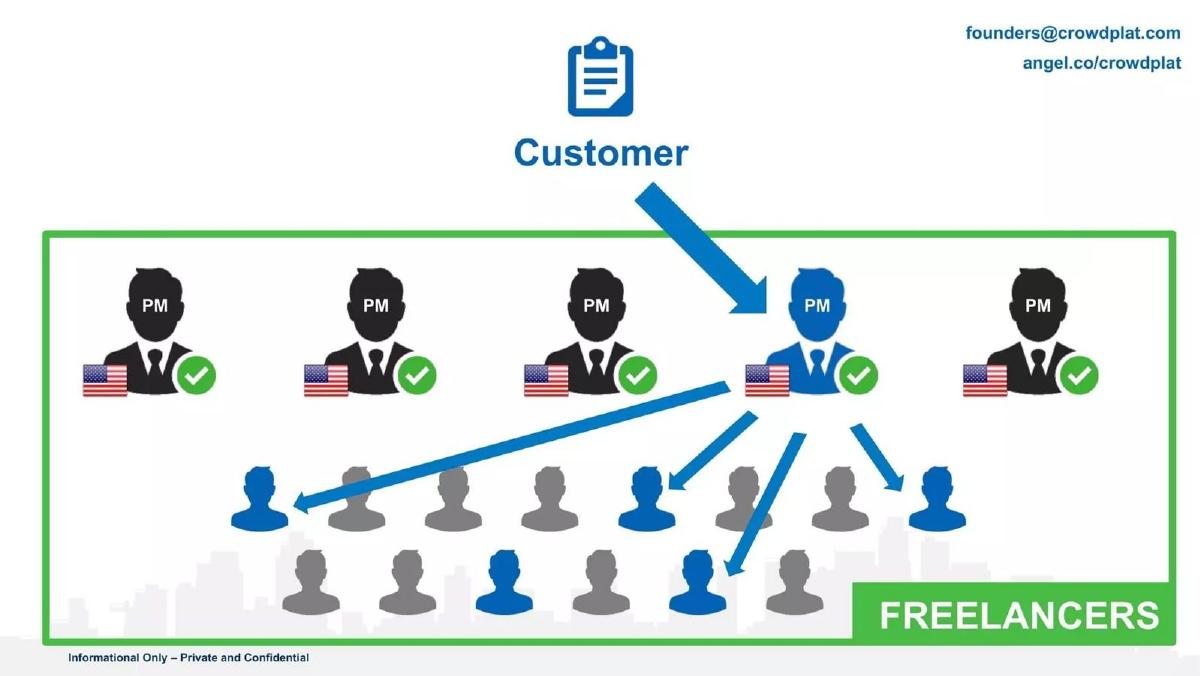
- The workflow relies on U.S.-based, verified Project Managers to lead global teams of freelancers (slide 5).
- The deck positions the company as a middle-ground solution between high-cost consultants (Accenture) and low-cost individual freelancers (slide 4).
- The founder, Sal Sarosh, leverages a background at enterprise heavyweights including Salesforce, HP, and Franklin Templeton (slide 7).
- There is no slide dedicated to the 'Ask' or the specific use of funds for the $200,000 raised.
CrowdPlat: The 9-Slide Seed Deck Analysis
CrowdPlat’s 2013 seed deck is a minimalist presentation that focuses on three core pillars: a massive market, a specific workflow solution, and early revenue traction. At only nine slides, it is shorter than the average seed deck, which typically ranges from 12 to 18 slides. The company successfully raised $200,000 using this format, proving that for some investors, a clear growth chart and a credible founder can outweigh a lack of granular detail.
The Executive Summary and Market Positioning
Slide 1: Title Slide The deck opens with a clean logo and the tagline: "Enterprise Freelancing Platform for IT Projects." The contact information points to an AngelList profile, which was a common practice in the early 2010s to provide investors with a central hub for due diligence materials.
Slide 2: Market Segmentation This slide establishes the company's "Why." It contrasts the existing freelance landscape (represented by Elance) with CrowdPlat’s target. Elance is shown serving "Startup & Small Business" by connecting them to individual freelancers. CrowdPlat, conversely, is positioned for the "Enterprise," connecting large organizations to entire teams of freelancers. This is a crucial distinction; it moves the conversation from "gigs" to "managed services," which carries higher contract values and better retention.
Traction and Market Opportunity
Slide 3: Current Revenue This is arguably the most important slide in the deck. It shows a 15-month revenue history from April 2014 to July 2015. The green area represents actual revenue, which appears to start around $70,000 and climbs to approximately $160,000. The blue area projects a jump to $1,000,000 by July 2016. A callout bubble mentions a "20% Profit Margin." For a seed-stage company, showing six-figure revenue with a healthy margin is a powerful way to de-risk the investment.
Slide 4: The $250B Market CrowdPlat quantifies the IT Outsourcing market at $250 billion. The slide uses a vertical bar to show where the company sits. At the top are high-end firms like Accenture and Infosys. At the bottom are retail platforms like Elance and Freelancer.com. CrowdPlat positions itself in the middle—offering the scale and reliability of the big firms with the flexibility and cost-efficiency of the freelance platforms.
The Solution and Workflow
Slide 5: The Managed Team Model This slide explains the mechanics of the platform. It shows a "Customer" submitting a project, which is then assigned to a "PM" (Project Manager). These PMs are marked with U.S. flags and green verification badges. The PM then manages a sub-group of freelancers. This addresses the primary fear of enterprise buyers: that global freelancers are difficult to manage and lack accountability. By placing a verified, U.S.-based PM at the center, CrowdPlat offers a layer of professional management.
Slide 6: The Vision A transition slide stating "Freelance is the next big revolution... we made freelance work for IT Outsourcing." This is a standard "vision" statement intended to align the company with broader macroeconomic trends (the rise of the gig economy).
Founder Pedigree and Conclusion
Slide 7: Sal Sarosh (Founder & CEO) Instead of a full team slide, the deck focuses entirely on the founder. Sal Sarosh’s experience is presented as a timeline of logos, including Franklin Templeton, Iron Mountain, Salesforce, CGI, Autonomy, and HP. This is a "pedigree play," suggesting that the founder has the enterprise DNA necessary to sell into the large corporations depicted on slide 2.
Slide 8: Summary of Value This slide reiterates the core thesis: taking the $250 billion IT outsourcing market and converting it into an enterprise freelancing model. It uses the same city skyline graphics seen throughout the deck to maintain visual consistency.
Slide 9: Closing Slide A repeat of the title slide. Notably, there is no "Ask" slide. The deck does not state how much capital is being sought, what the valuation is, or what the specific milestones for the next 18 months will be. This information was likely reserved for the AngelList profile or face-to-face meetings.
What Works in the CrowdPlat Deck
Clarity of Revenue: The revenue chart on slide 3 is the star of the show. It doesn't just show growth; it shows a history of performance. Many seed decks rely on "projected" revenue; CrowdPlat leads with "current" revenue, which immediately changes the tone of the pitch from speculative to operational.
Strategic Positioning: Slide 4 does an excellent job of explaining the competitive landscape without using a boring checkmark grid. By placing themselves between Accenture and Elance, they define a "Goldilocks zone"—professional enough for enterprises, but cheaper and faster than traditional consulting firms.
Accountability Model: The use of U.S.-based, verified Project Managers (slide 5) is a smart tactical move. It solves the "trust gap" that often prevents large companies from using freelance marketplaces. It shows the founders understand the specific pain points of their target customers.
What is Missing from the CrowdPlat Deck
The Financial Ask: The most glaring omission is the lack of a funding slide. Investors need to know how much is being raised and how that money will accelerate the growth shown on slide 3. Without this, the deck feels like a company overview rather than a fundraising tool.
Competitive Moat: While the deck shows where CrowdPlat sits in the market, it doesn't explain why a competitor couldn't simply copy their PM-led model. There is no mention of proprietary technology, network effects, or exclusive contracts that would protect their 20% margin.
Unit Economics: While a 20% profit margin is mentioned, the deck lacks data on Customer Acquisition Cost (CAC) or the average contract value. For a marketplace/platform model, understanding the cost to acquire a new enterprise client versus the lifetime value of that client is essential for assessing long-term viability.
The Broader Team: Relying solely on the founder’s bio (slide 7) is risky. Investors generally prefer to see a balanced team (e.g., a CTO or a Head of Sales), especially for a platform that claims to manage complex IT projects globally.
What a Founder Should Copy
Visual Minimalism: This deck is a great example of "less is more." Each slide has one job and one primary visual. There are no dense paragraphs of text or confusing diagrams. This forces the investor to listen to the founder rather than squinting at the screen.
The "Bridge" Strategy: If you are entering a crowded market, use the logic from slide 4. Don't just say you are better than everyone; show how you occupy a unique space between two established but flawed extremes (in this case, the "too expensive" consultants and the "too risky" freelancers).
Leading with Traction: If you have revenue, put it front and center. CrowdPlat’s growth chart is the most persuasive argument in the entire deck. It proves market demand and execution capability simultaneously.
Final Thoughts
CrowdPlat’s deck is a product of its time—a period when AngelList was rising and seed rounds were often closed on the strength of a single compelling metric. While it lacks the depth required for a modern Series A, its focus on revenue and a clear enterprise workflow makes it a highly effective seed-stage document. It successfully identifies a massive legacy industry (IT outsourcing) and proposes a modern, scalable alternative without overcomplicating the message.
Frequently asked questions
- How does CrowdPlat differentiate itself from Upwork or Elance?
- According to slide 2, CrowdPlat focuses on 'Enterprise' needs by providing structured teams rather than individual freelancers. While Elance is shown connecting a small business to a single freelancer, CrowdPlat is depicted connecting large enterprises to managed groups of freelancers led by a verified Project Manager. This 'managed' approach is intended to solve the quality and coordination issues inherent in retail freelance platforms.
- What was the company's financial status at the time of the pitch?
- Slide 3 shows that the company had significant early traction. Starting in April 2014 with under $100,000 in revenue, they grew steadily to over $150,000 by July 2015. The deck projects hitting a $1,000,000 revenue milestone by July 2016 with a 20% profit margin. This suggests the business was already generating cash and proving its model before seeking the seed investment.
- Who is the target customer for CrowdPlat?
- The deck explicitly targets the 'Enterprise' segment. Slide 2 uses a skyscraper icon to represent the customer base, contrasting it with the 'Startup & Small Business' segment served by Elance. Slide 4 further reinforces this by placing CrowdPlat in the same market category as enterprise service providers like Accenture and Infosys, rather than just peer-to-peer marketplaces.
- What is the role of the Project Manager in the CrowdPlat ecosystem?
- Slide 5 illustrates a workflow where a 'Customer' interacts directly with a 'PM' (Project Manager). These PMs are identified with U.S. flags and green checkmarks, signifying they are verified and domestic. The PM then manages a larger pool of global freelancers. This structure is designed to give enterprise clients a single point of accountability and a U.S.-based contact for complex IT projects.
- What critical information is missing from this pitch deck?
- The deck is missing several standard components: a specific 'Ask' slide detailing how much money is being raised and how it will be spent, a 'Competition' slide showing how they beat specific rivals, and a 'Technology' slide explaining the platform's features. It also lacks a full team slide, focusing only on the founder, and provides no information on customer acquisition costs (CAC) or lifetime value (LTV).