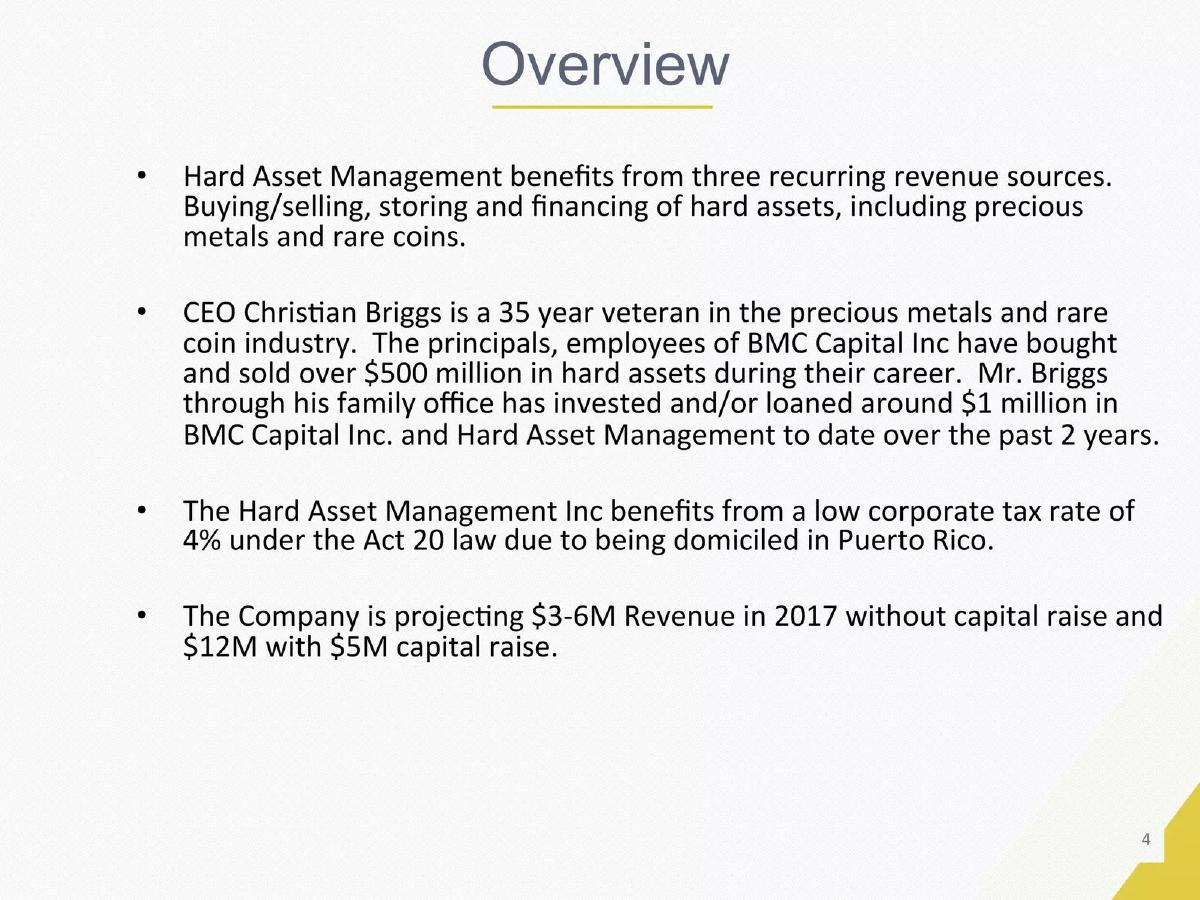
Hard Assets Management BMC is a subsidiary of BMC Capital, Inc., focused on the trade and financing of physical assets like gold, silver, and rare coins. The deck, dated around early 2017 based on SEC filing milestones, outlines a business model that combines brokerage with asset-backed lending. The company claims a significant tax advantage via a 4% corporate tax rate, likely due to its San Juan, Puerto Rico operations. With 178 million shares outstanding and 85% inside ownership, the management seeks $5 million to build out storage infrastructure and inventory. The presentation leans heavil…
Key takeaways
- The company is a wholly owned subsidiary of BMC Capital, Inc., as stated on the title slide.
- Management is seeking an initial capital raise of $5 million to build a storage facility and rare coin inventory (Slide 15).
- The business model includes a 1% commission on purchases and interest rates of 6-9% on asset-backed loans (Slide 11).
- The company claims a 4% corporate tax rate, likely linked to its San Juan, Puerto Rico storage facility location (Slides 9 and 11).
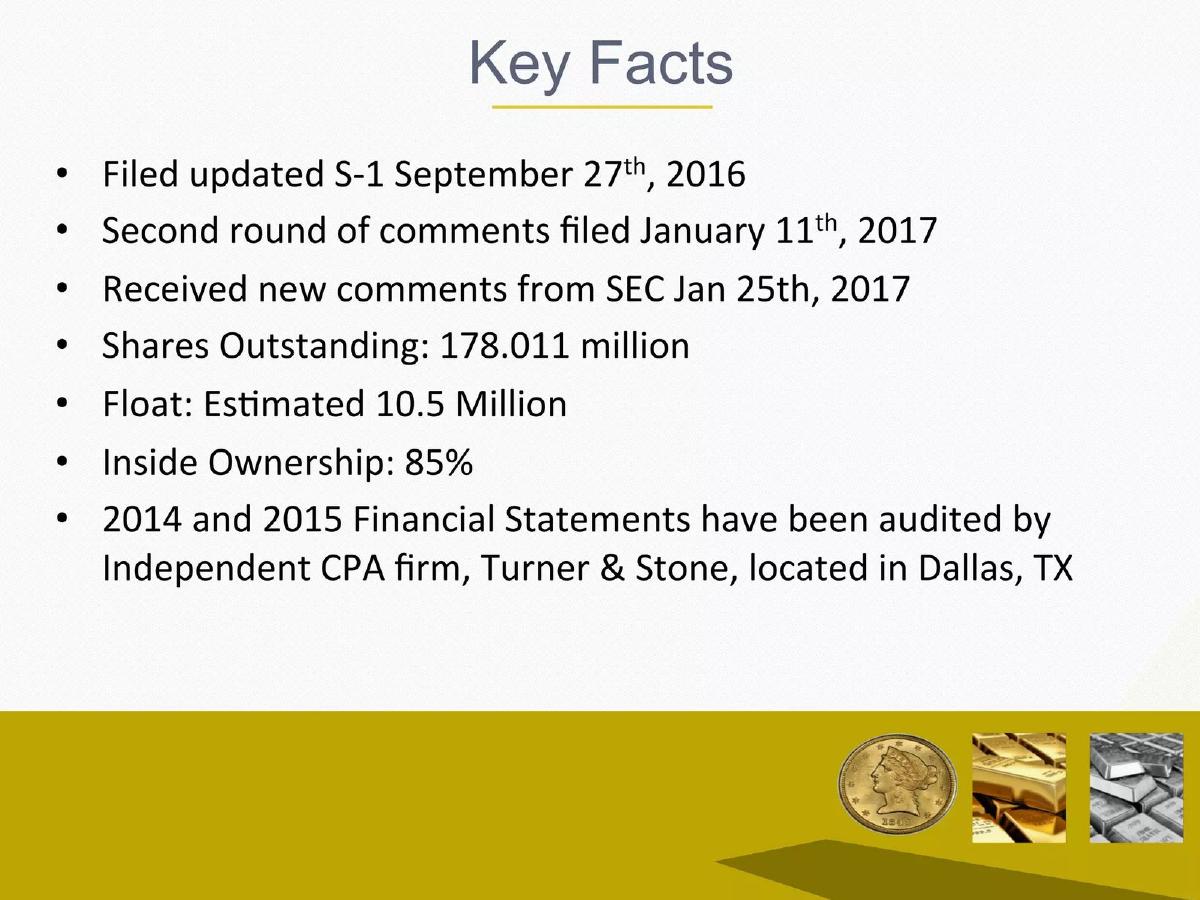
- SEC filing milestones are used as key traction metrics, including an S-1 update on September 27, 2016, and SEC comments received in January 2017 (Slide 5).
- Inside ownership is high at 85%, with 178.011 million shares outstanding (Slide 5).
- The company projects $3-6 million in revenue for the first 12 months even without a capital raise (Slide 9).
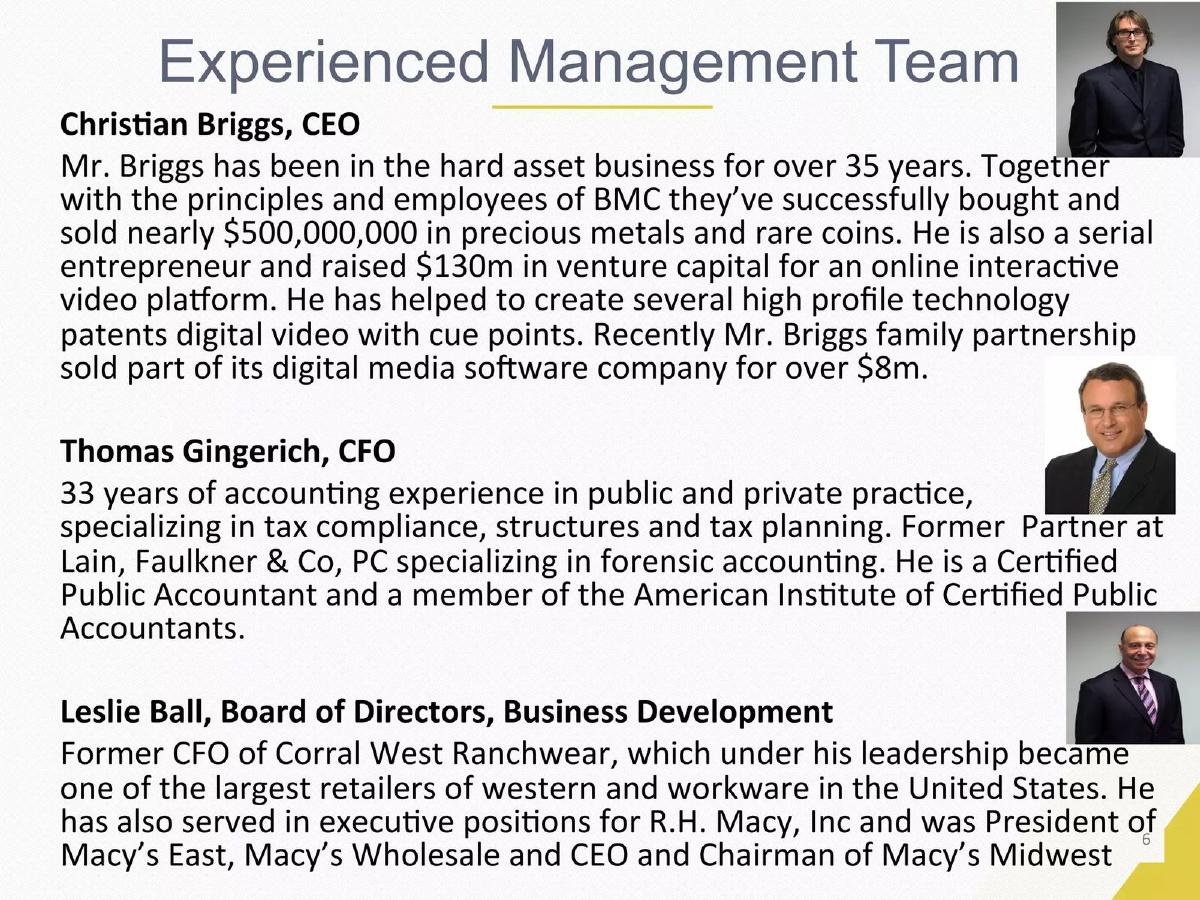
- Herschel Walker is listed as a 'Pending-Board of Director,' leveraging his profile as a Heisman Trophy winner and business owner (Slide 7).
Hard Assets Management BMC: A Deep Dive into Asset-Backed Financing
Hard Assets Management, Inc. (HAM) positions itself as a comprehensive solution for high-net-worth individuals and family offices looking to diversify into physical assets. The deck focuses on the intersection of commodity brokerage and private lending, using physical gold, silver, and rare coins as collateral. By operating out of San Juan, Puerto Rico, the company leverages specific tax incentives to bolster its bottom line while providing liquidity to asset holders who do not wish to sell their positions.
Slide 1: Title and Corporate Structure
The cover slide introduces Hard Asset Management, Inc. as a wholly owned subsidiary of BMC Capital, Inc. The branding emphasizes "Rare Coins & Precious Metals" and provides the URL BMCHardAssets.com. The background imagery features a coastal cityscape, which aligns with the company's operational base in San Juan, Puerto Rico, mentioned later in the deck.
Slide 3: Introduction and Vision
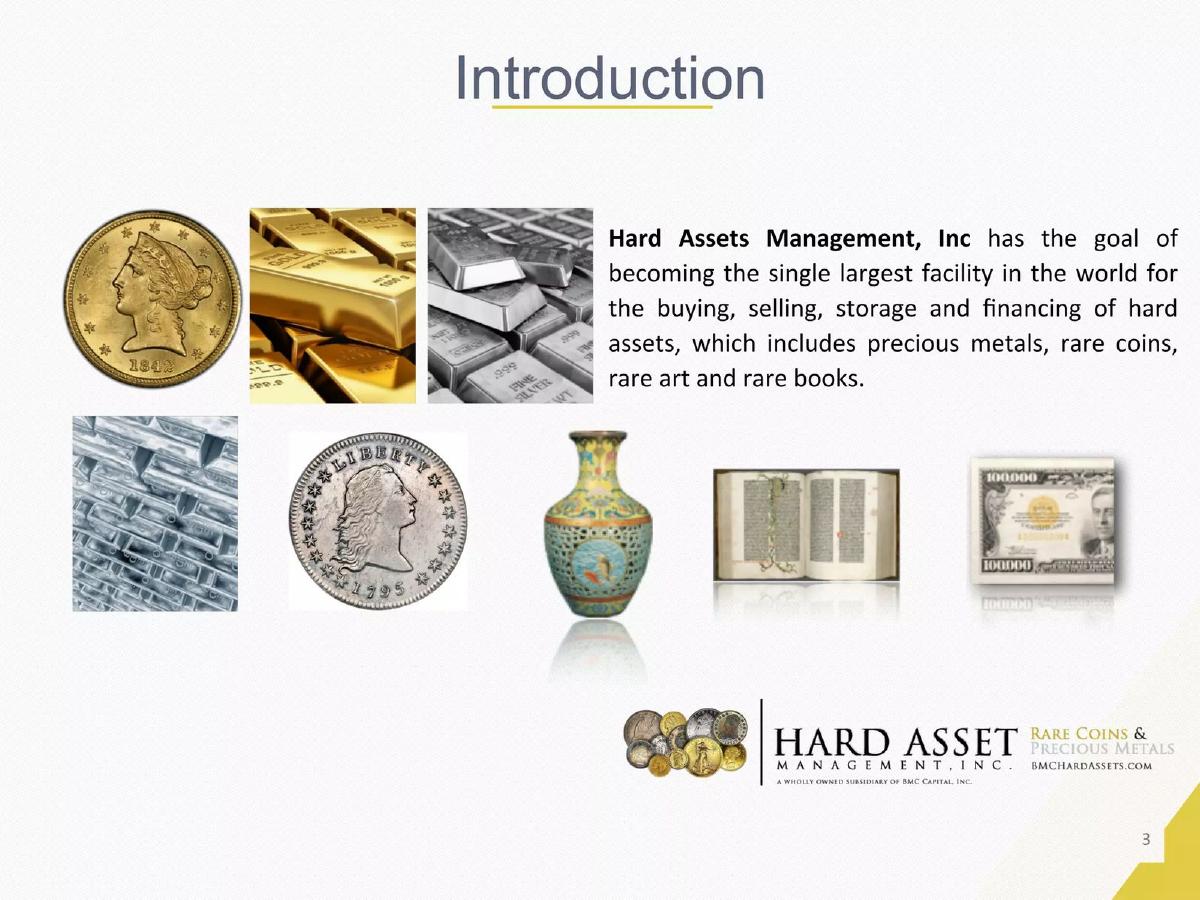
Slide 3 defines the company's objective: to become the "single largest facility in the world" for the lifecycle of hard assets. This includes buying, selling, storage, and financing. The scope of assets mentioned extends beyond metals and coins to include rare art and rare books, though the subsequent slides focus almost exclusively on numismatics and bullion. The visual aids show gold bars, silver ingots, a rare vase, and an ancient manuscript to illustrate the breadth of their target asset classes.
Slide 5: Key Facts and Regulatory Status
This slide serves as the primary "traction" indicator for the company. Rather than focusing on user growth or historical revenue, it highlights regulatory milestones. It notes an updated S-1 filing from September 27, 2016, and SEC comments received as recently as January 25, 2017. This dates the deck to early 2017. The slide also provides a snapshot of the capital structure: 178.011 million shares outstanding, a float of approximately 10.5 million, and a high concentration of inside ownership at 85%. The mention of audited financial statements by Turner & Stone is intended to provide a layer of institutional credibility.
Slide 7: Management and Governance
The deck features Herschel Walker as a "Pending-Board of Director." The slide focuses heavily on his athletic achievements (Heisman Trophy, Dallas Cowboys) but also notes his experience owning and operating food service and hotel businesses. While Walker is a high-profile name, the slide notably lacks details on the executive team's specific experience in precious metals or financial lending, other than a brief mention of the CEO on the final contact slide.
Slide 9: Investment Highlights
This slide summarizes the value proposition for investors. Key points include:
A $2.5 billion to $3 billion market opportunity. · A 4% corporate tax rate, which is a significant competitive advantage for a capital-intensive business. · Ownership of real estate and storage facilities, providing physical collateral for the business itself. · Revenue projections of $3-6 million in the first year, notably stating this is possible "without capital raise."
Slide 11: The Operational Process
Slide 11 is the most informative regarding the actual business mechanics. It outlines a five-step process: 1. Client Acquisition: Users browse the website and fill out financing documents. 2. Account Setup: Funds are wired to a segregated client account at Banco Popular. HAM takes a 1% commission on the purchase. 3. Order Execution: HAM issues a purchase order for the gold. 4. Storage: The physical asset arrives at the HAM storage facility in San Juan. 5. Financing: HAM provides a loan of up to 50% on precious metals or 40% on rare coins. The client pays interest every 30 days at a rate of 6-9%.
Slide 13: The Solution
This slide reiterates the service offering for family offices and wealthy individuals. It highlights a "Universal credit line" for client liquidity needs and mentions "Call Centers generating thousands of leads." The inclusion of a "secure server farm" suggests an emphasis on the digital infrastructure required to manage physical trades, though no technical details are provided.
Slide 15: Near-Term Plan of Action
The roadmap for the company involves marketing to an existing database of investors and launching a global sales effort. The most critical piece of information here is the ask: an "Initial capital raise of $5m." The slide specifies that these funds will be used to build out the storage facility and build an inventory of rare coins. This indicates that while the company has a process, it requires a capital infusion to scale the physical infrastructure and liquidity necessary to act as a market maker.
Slide 17: Contact Information
The final slide provides contact details for CEO Christian Briggs and Investor Relations via RedChip Companies Inc. RedChip is a known firm specializing in small-cap and micro-cap investor relations, further suggesting that the company was positioning itself for the public markets or a significant private placement at the time.
What Works in This Deck
The clarity of the business model on Slide 11 is the deck's strongest point. By breaking down the commission structure (1%) and the lending terms (6-9% interest on 40-50% LTV), the founders show exactly how the company generates revenue. This transparency is vital for a financial services startup. Furthermore, the emphasis on the 4% tax rate is a compelling hook for investors, as it directly impacts the net margin and the company's ability to reinvest capital.
What Is Missing
The most glaring omission is a comprehensive team slide. While Herschel Walker is a notable figure, his role is "pending," and the deck provides no background on the CEO or the operational staff who will manage the complexities of physical asset storage, security, and regulatory compliance. Additionally, there is no detailed breakdown of the $2.5-$3 billion market opportunity—investors are left to take that figure at face value without seeing the underlying data or competitive landscape. Finally, the deck lacks a clear exit strategy or a timeline for the S-1 filing mentioned on Slide 5, which is a critical piece of information for a company highlighting its regulatory progress.
Founder Takeaways
Founders should look at Slide 11 as a template for explaining a complex service flow. Using a numbered, visual timeline to explain how money and assets move through a system is far more effective than a wall of text. However, founders should also learn from the omissions here: never rely solely on a "celebrity" board member to carry the credibility of the team. Investors need to see the "doers"—the people with the specific industry expertise to execute the plan. Lastly, if you are citing a specific tax advantage, be prepared to explain the legal and geographic basis for it, as HAM does by implying its Puerto Rico connection.
Frequently asked questions
- What is the primary business model of Hard Assets Management?
- The company operates as a full-service facility for buying, selling, storing, and financing hard assets. According to Slide 11, they charge a 1% commission on purchases and offer financing where clients can borrow up to 50% against precious metals or 40% against rare coins at interest rates between 6% and 9%.
- How much money is the company raising and for what purpose?
- Slide 15 specifies an initial capital raise of $5 million. The funds are earmarked for two primary objectives: building out a physical storage facility and building an inventory of rare coins to facilitate trading.
- What is the significance of the SEC filings mentioned in the deck?
- Slide 5 lists multiple SEC milestones, including an S-1 filing and subsequent rounds of comments in early 2017. This suggests the company was pursuing a public listing or a registered offering at the time the deck was produced, using regulatory progress to signal institutional readiness.
- Who is involved in the management and oversight of the company?
- The deck highlights Christian Briggs as CEO (Slide 17) and lists former athlete and businessman Herschel Walker as a pending Board of Director member (Slide 7). Financial statements for 2014 and 2015 were audited by Turner & Stone, a CPA firm in Dallas (Slide 5).
- What market size and revenue projections does the deck provide?
- The company identifies a market opportunity of $2.5 billion to $3 billion on Slide 9. On the same slide, they project generating $3 million to $6 million in revenue within the first 12 months, stating this is achievable even without the requested capital raise.