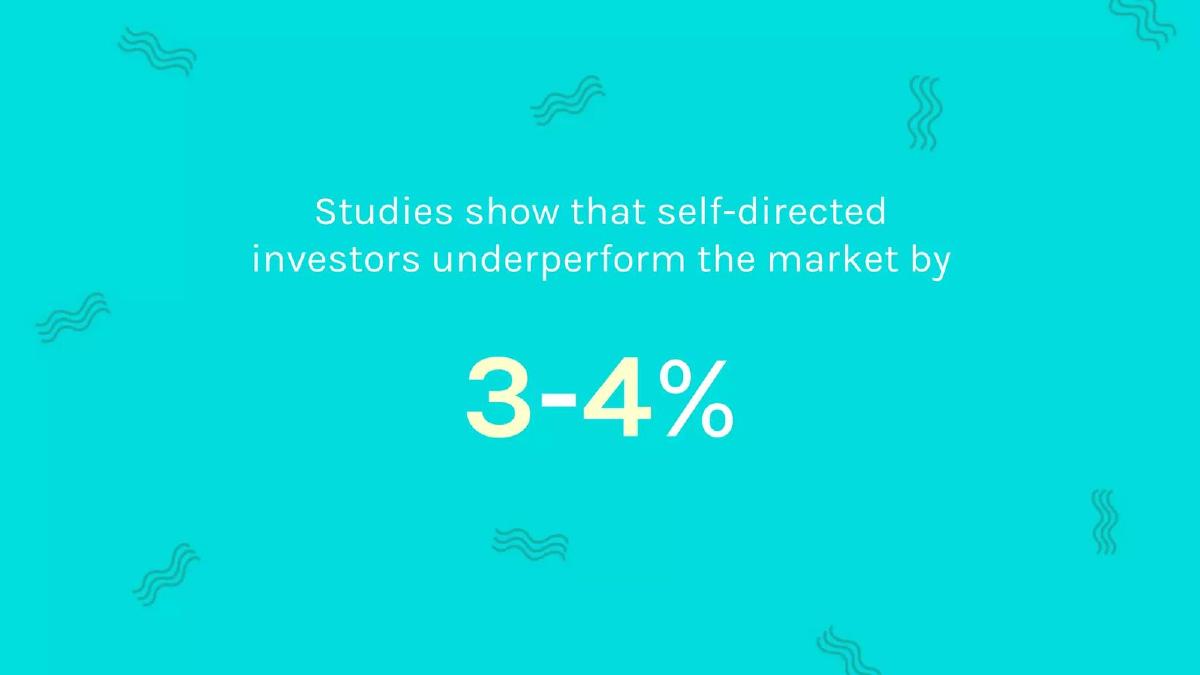
Hardbacon is a Canadian fintech startup positioning itself as a 'common man’s family office.' The pitch deck highlights a significant market gap where self-directed investors underperform the market by 3-4% (Slide 2). By offering a suite of tools including portfolio analysis across nine factors (Slide 3) and a financial literacy booster (Slide 4), Hardbacon aims to capture a share of the $335 billion managed by 6 million self-directed investors in Canada (Slide 7). The deck is notable for its dual value proposition, pitching the app as a productivity and stress-reduction tool for employers (S…
Key takeaways
- Self-directed investors are the primary target, cited as underperforming the market by 3-4% on Slide 2.
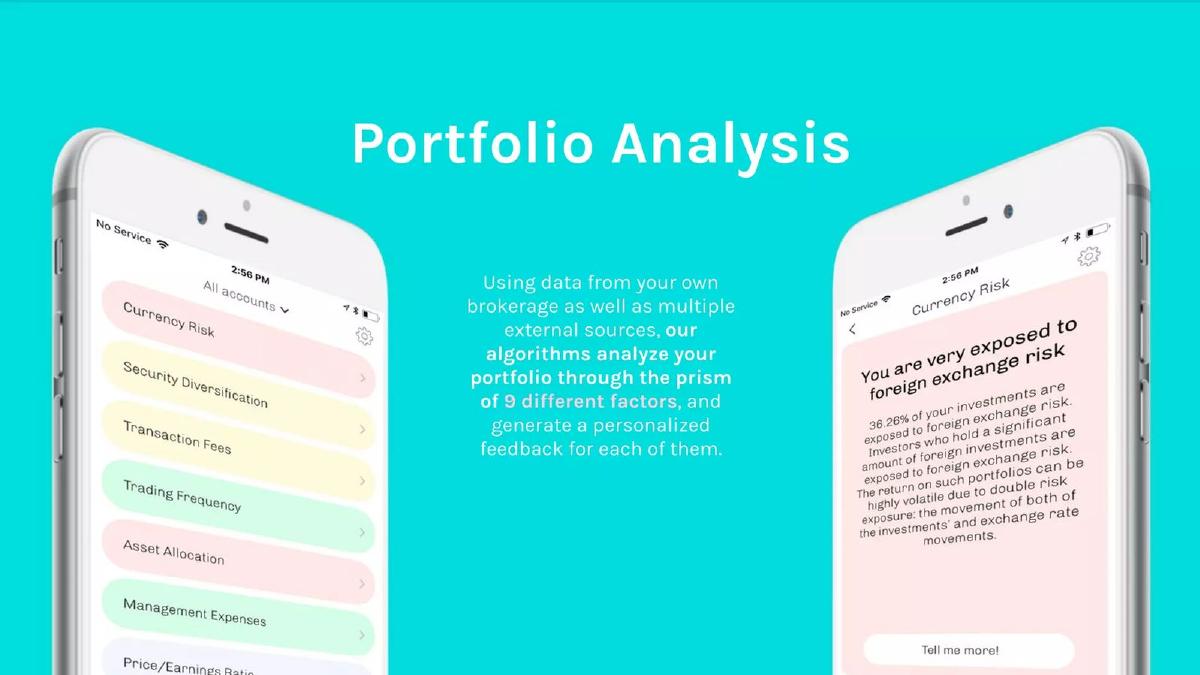
- The product analyzes portfolios across 9 different factors using brokerage and external data as shown on Slide 3.
- A unique 'Financial Literacy Booster' uses adaptive definitions and vertical videos to educate users (Slide 4).
- The Canadian market opportunity is quantified at 6 million self-directed investors managing $335 billion (Slide 7).
- The 'Beach Head Strategy' focuses initially on investors with less than $250,000 in financial assets (Slide 8).
- Hardbacon differentiates from competitors like Wealthsimple and Mint by offering a 'Chabot' and education for $1.99/month (Slide 12).
- The team includes a former business journalist as CEO and a former software architect from JP Morgan as CTO (Slide 13).
- The funding ask is a range between $150k and $550k, with 41% allocated to product development (Slide 14).
Introduction and Problem Statement
Hardbacon opens its deck with a clear, aspirational tagline: "Invest like a pro." The cover (Slide 1) features the CEO's contact information and high-quality app mockups, immediately establishing a mobile-first brand identity. The problem is introduced on Slide 2 with a single, punchy statistic: self-directed investors underperform the market by 3-4%. This sets the stage for a solution that provides the data and education necessary to close that performance gap.
The Solution: Portfolio Analysis and Literacy
Slides 3 and 4 detail the product's core features. The portfolio analysis tool (Slide 3) connects to brokerages to analyze holdings through "9 different factors," including currency risk and transaction fees. This is a technical value add that moves the app beyond simple tracking into actionable intelligence. Slide 4 introduces the "Financial Literacy Booster," which uses a scoring system, vertical videos, and adaptive definitions to educate users. This feature is positioned as a way to increase user engagement and retention by providing value that evolves with the user's knowledge level.
Security and Trust
In fintech, trust is the primary barrier to entry. Slide 5 addresses this head-on by listing 256-bit SSL encryption, AWS hosting, and a strict policy against selling personal information. By mentioning that employees cannot access individual account data, Hardbacon attempts to mitigate the privacy concerns inherent in linking personal brokerage accounts to a third-party app.
Market Opportunity and Strategy
The deck shifts to market validation on Slides 6 and 7. Slide 6 uses a donut chart to show that 13.3% of Canadian financial assets are held by those in the $0-$250k bracket, which represents the company's initial target. Slide 7 quantifies the total addressable market in Canada: 6 million self-directed investors managing $335 billion. The slide also notes that robo-advisors have a "negligible market-share," suggesting a large, untapped audience that prefers to manage their own money rather than delegating it to an algorithm.
The Beachhead Strategy
Slide 8 outlines a three-step growth plan. Step 1 is a "laser-focus" on investors with less than $250,000 in assets. Step 2 involves expanding to users of human and robo-advisors. Step 3 focuses on top-of-funnel acquisition by offering financial planning tools to people before they even start investing. This logical progression shows the founders are thinking about customer acquisition costs and long-term lifecycle value.
Dual Value Proposition
One of the most interesting aspects of this deck is the split value proposition. Slide 10 lists five benefits for consumers, including centralizing assets and achieving goals faster. Slide 11, however, pivots to an employer-facing pitch. It argues that financial stress is a "huge source of distraction at work" (citing that 33% of employees are distracted by personal finance issues) and that Hardbacon can reduce HR inquiries and boost productivity. This B2B2C angle provides a secondary path to scale that many consumer fintech apps overlook.
Competitive Landscape and Pricing
Slide 12 is a standard competitive matrix comparing Hardbacon to Wealthica, Mint, Simply Wall St, Morningstar, and Wealthsimple. Hardbacon claims to be the only one offering a combination of complete account coverage, portfolio analysis, financial planning, a chatbot, and education. The pricing is set at a disruptive $1.99/month, significantly lower than Simply Wall St ($10/month) or Morningstar ($199/year). Notably, it positions itself as a tool for those who do not want their money managed for them, unlike Wealthsimple.
Team and Execution
The team slide (Slide 13) highlights a diverse set of backgrounds. CEO Julien Brault brings a unique angle as a former business journalist and growth marketer for a fintech VC, suggesting he understands both the narrative and the distribution side of the business. CTO Henri Tremblay provides the necessary technical weight with experience at JP Morgan and BNP Paribas. The inclusion of a dedicated marketing strategist and a financial data specialist rounds out the core competencies needed for a data-heavy consumer app.
The Ask and Future Vision
Slide 14 presents the funding ask as a range: $150k to $550k. The allocation is transparent, with 41% for product and 37% for marketing. This is a relatively small seed round, likely intended to prove out the acquisition model in the Canadian market before a larger Series A. Finally, Slide 15 and 16 close with the long-term vision and social proof. The vision is to become a "common man’s family office," expanding into taxes, insurance, and cell phone plans. The press slide (Slide 16) features quotes from major Canadian outlets like Les Affaires and The Gazette, validating the company's presence in its home market.
What Works Well in This Deck
Specific Market Sizing: Instead of using vague global numbers, the deck uses specific Canadian data points (Slide 7) that make the opportunity feel tangible and attainable. Clear Differentiation: The competitive matrix (Slide 12) clearly identifies the gaps in the current market, particularly the lack of education and chatbots in competing products. The Employer Angle: Including a value proposition for employers (Slide 11) shows a sophisticated understanding of distribution and multiple revenue streams.
What Is Missing from the Deck
Unit Economics: While the pricing is mentioned ($1.99/month), there is no mention of Customer Acquisition Cost (CAC) or Lifetime Value (LTV). For a consumer app, these are critical metrics. Traction Data: The deck is heavy on features and vision but light on current user numbers, growth rates, or retention stats. It is unclear if the app has 100 users or 100,000. Revenue Projections: There are no financial forecasts or milestones showing how the $150k-$550k investment will lead to a specific revenue target or user count.
Founder's Playbook: What to Copy
The 'Problem' Slide: Slide 2 is a masterclass in simplicity. One stat, one problem. It forces the investor to agree with the premise before moving forward. Feature-Benefit Mapping: Slides 10 and 11 don't just list features; they list benefits. "Centralize all your assets" is the feature; "so you don't need to log-in to many websites" is the benefit. Visual Consistency: The use of a consistent color palette and high-quality mockups makes the product feel 'finished' and professional, which is vital for a financial services company.
Frequently asked questions
- What is the core problem Hardbacon is trying to solve?
- According to Slide 2, the core problem is that self-directed investors underperform the market by 3-4%. Hardbacon aims to bridge this gap by providing professional-grade portfolio analysis tools and financial education that were previously unavailable or too expensive for the average retail investor.
- How does Hardbacon plan to generate revenue?
- Slide 12 indicates a direct-to-consumer subscription model priced at $1.99 per month. Additionally, Slide 11 suggests a B2B2C play where employers pay for the service to reduce employee financial stress and improve participation in stock purchase plans, though specific B2B pricing is not listed.
- What is the specific market focus for Hardbacon?
- The deck focuses exclusively on the Canadian market. Slide 6 breaks down financial assets by wealth bracket in Canada, and Slide 7 notes that 20% of Canadian adults are self-directed investors. The strategy starts with those holding less than $250k in assets (Slide 8).
- How does the product handle user data and security?
- Slide 5 outlines three pillars: Secure (256-bit SSL encryption and AWS hosting), Convenient (Face ID/Touch ID), and Confidential. Crucially, it states that no Hardbacon employee has access to individual account data and the company will never sell personal information.
- What is the long-term vision for the company?
- As stated on Slide 15, the long-term goal is to become the 'common man’s family office.' This involves expanding beyond stock investing to help users with insurance policies, cell phone plans, tax filing, and comprehensive financial planning.