Hard Assets Management (HAM) positions itself as a comprehensive facility for buying, selling, storing, and financing 'hard assets' like precious metals, rare coins, art, and books. The deck, dated around early 2017 based on internal milestones, reveals a company in the late stages of a public listing process, having filed an updated S-1 in September 2016. The business model relies on a 1% commission on purchases and a 6-9% interest rate on asset-backed loans, where they lend up to 50% of the value of precious metals. With 85% inside ownership and a projected $3-6M in first-year revenue witho…
Key takeaways
- The company filed an updated S-1 on September 27th, 2016, and received SEC comments as recently as January 25th, 2017 (Slide 5).
- Inside ownership is high at 85%, with 178.011 million shares outstanding and an estimated float of 10.5 million (Slide 5).
- The business model includes a 1% commission on asset purchases and lending at 6-9% interest rates (Slide 11).
- Loan-to-value ratios are capped at 50% for precious metals and 40% for rare coins (Slide 11).
- The company claims a significant tax advantage with a low corporate tax rate of 4% (Slide 9).
- Management projects $3-6M in revenue for the first 12 months even without a capital raise (Slide 9).
- The 'Near-Term Plan of Action' includes an initial capital raise of $5M specifically for storage facilities and rare coin inventory (Slide 17).
- The deck identifies a $2.5 billion to $3 billion market opportunity for their specific hard asset services (Slide 9).
Hard Assets Management: A Deep Dive into the Investor Presentation
The Hard Assets Management (HAM) investor deck is a focused document targeting a specific class of investor: those interested in alternative assets and companies on the verge of public listing. The deck is structured to provide regulatory transparency while emphasizing a high-margin lending and commission model. Unlike typical venture decks that focus on 'disruption,' this presentation focuses on institutional-grade infrastructure for assets that are traditionally difficult to finance.
Slide 1: Title and Branding
The cover slide establishes the company's identity as a subsidiary of BMC Capital, Inc. It clearly defines the niche: 'Rare Coins & Precious Metals.' The background imagery of a coastal city and a modern high-rise, combined with the mention of a website (BMCHardAssets.com), suggests a professional, established corporate presence rather than a scrappy startup. The visual of various coins provides immediate context for the 'Hard Asset' name.
Slide 3: Introduction and Vision
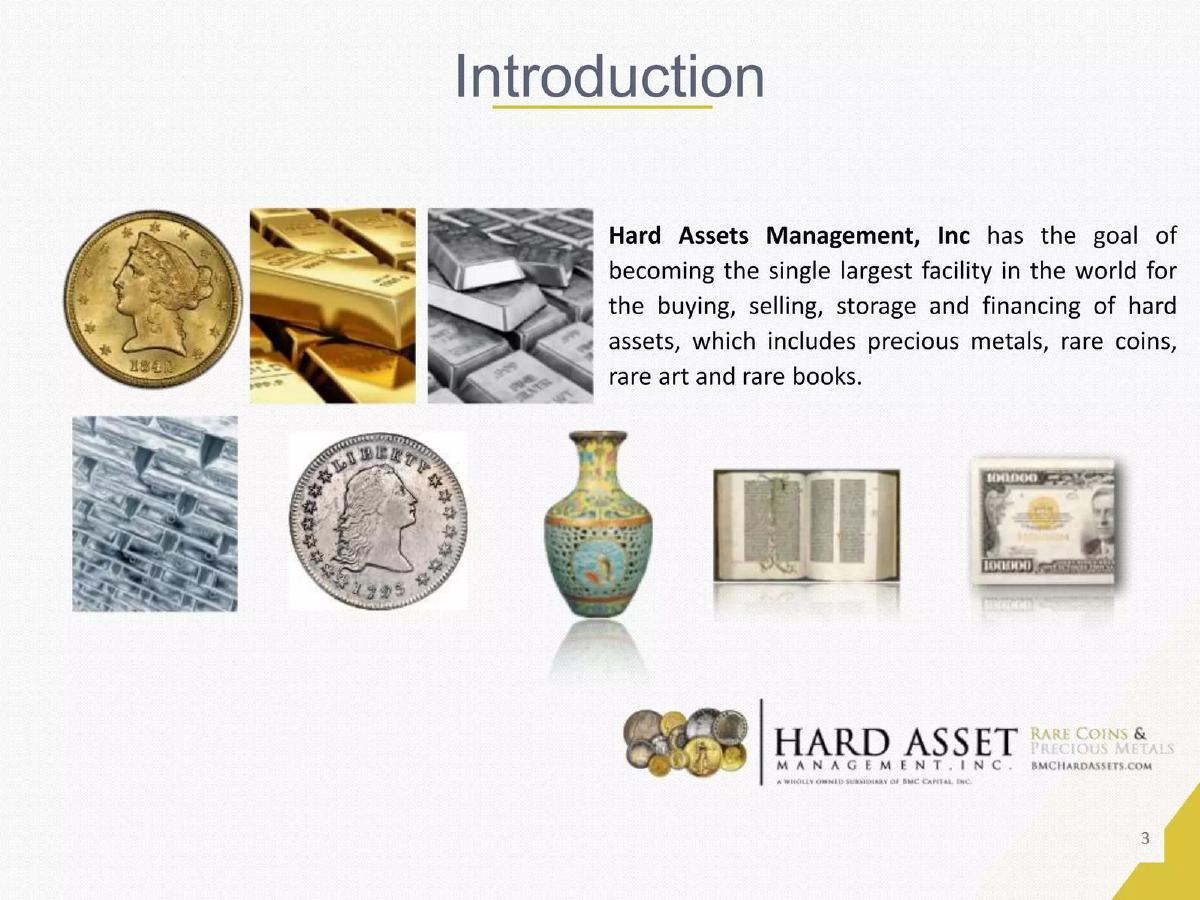
Slide 3 serves as the mission statement. The company aims to become the 'single largest facility in the world' for the buying, selling, storage, and financing of hard assets. Notably, the scope extends beyond just coins and metals to include 'rare art and rare books.' This indicates a broad horizontal ambition within the collectibles and alternative investment space. The slide uses a grid of images—gold bars, silver ingots, rare coins, a vase, and a rare book—to visually reinforce the diversity of their target asset classes.
Slide 5: Key Facts and Regulatory Status
This is arguably the most important slide for a sophisticated investor. It moves away from vision and into hard regulatory data. The slide lists specific dates for S-1 filings and SEC comment rounds (September 2016 and January 2017). It also provides the capital structure: 178.011 million shares outstanding with a relatively tight float of 10.5 million shares. The 85% inside ownership is a strong signal of founder alignment, though it also suggests limited liquidity for new investors until the float expands. The mention of audited financial statements by Turner & Stone adds a layer of institutional credibility.
Slide 7: Experienced Management Team
The deck chooses to highlight a single high-profile individual rather than a full team roster. Herschel Walker is listed as 'Pending-Board of Directors.' The bio focuses on his athletic achievements (Heisman Trophy, NFL, MMA) but concludes by noting he 'owns and operates a successful food service and hotel business.' This is a classic 'celebrity board' play, intended to provide brand recognition and a sense of scale, though the 'Pending' status indicates the arrangement was not yet finalized at the time of the presentation.
Slide 9: Investment Highlights
This slide summarizes the value proposition. Key points include a '$2.5 billion-$3 billion Market Opportunity' and a 'Tax Advantage with low corporate tax rate of 4%.' The projection of '$3-6M revenue first 12 months without capital raise' is a bold claim, suggesting the business is already operational and cash-flow positive or near-positive. The mention of 'ownership of real estate' and 'company owned storage facilities' suggests a heavy asset base, which contrasts with the 'asset-light' models favored by many modern tech startups.
Slide 11: HAM – The Process
Slide 11 provides the operational mechanics of the business. It outlines a five-step process for clients: 1) Online browsing and documentation, 2) Account setup and 50% wire transfer to a segregated account at Banco Popular, 3) HAM issues a purchase order, 4) Assets arrive at the San Juan storage facility, and 5) Ongoing interest payments. The specifics are crucial here: a 1% commission on the purchase and a 6-9% interest rate on loans. The LTV (Loan-to-Value) limits of 50% for metals and 40% for coins indicate a conservative risk profile for the company's lending arm.
Slide 13: Our Solution
This slide reiterates the service offerings but adds a few new details. It mentions a 'Universal credit line' for client liquidity and 'Secure server farm for online buying/selling.' Interestingly, it mentions 'Call Centers generating thousands of leads,' which reveals that their customer acquisition strategy relies heavily on outbound or inbound telemarketing rather than just organic digital growth. This is consistent with the traditional rare coin and precious metals industry.
Slide 17: Near-Term Plan of Action
The 'Ask' is buried toward the end of the deck. The company is seeking an 'Initial capital raise of $5m.' The use of proceeds is specific: building out the storage facility and building an inventory of rare coins. This suggests that while they can operate without the raise (as per Slide 9), the capital is the catalyst for scaling their internal liquidity and physical infrastructure. The plan also includes a 'global market effort to increase sales,' indicating an expansion beyond their current footprint.
Slide 18: Contact Us
The final slide provides direct contact information for CEO Christian Briggs and their Investor Relations firm, RedChip Companies Inc. The inclusion of a professional IR firm further supports the narrative that this company is positioning itself for the public markets and institutional scrutiny.
What Works in This Deck
Regulatory Transparency: By including specific SEC filing dates and audit firm names, the company differentiates itself from the many 'grey market' alternative asset firms. This builds immediate trust with professional investors.
Clear Unit Economics: Slide 11 is excellent. It doesn't hide behind vague 'platform fees.' It explicitly states the 1% commission and the 6-9% interest rates. Investors can easily model the potential revenue based on transaction volume.
Specific Use of Proceeds: The $5M ask is tied to tangible assets (inventory and facilities). Investors generally prefer funding growth and infrastructure over 'general corporate purposes' or 'burn.'
What Is Missing or Weak
Full Management Team: While Herschel Walker is a notable name, he is a 'pending' board member, not the operator. The deck lacks bios for the CEO, Christian Briggs, and other key executives who handle the day-to-day logistics of precious metals trading and secure storage.
Competitive Landscape: The deck operates in a vacuum. There is no mention of other precious metal dealers, vaulting services, or specialized lenders. A 'Competitor Matrix' would have helped define their moat.
Historical Performance: While the deck mentions audited statements for 2014 and 2015, it doesn't actually show the numbers. A summary table of past revenue and asset growth would have substantiated the $3-6M forward-looking projection.
What a Founder Should Copy
The 'Process' Slide: Any founder building a fintech or service-heavy business should emulate Slide 11. It breaks down a complex transaction into five simple, numbered steps with clear financial terms attached to each step.
Highlighting Structural Advantages: If your company has a unique tax advantage (like the 4% rate mentioned here) or a specific regulatory status, make it a headline. These are 'unfair advantages' that are difficult for competitors to replicate.
Direct Ask: The 'Near-Term Plan of Action' is a great way to frame a capital raise. It places the funding request within the context of a larger strategic roadmap, making the investment feel like a necessary step in a pre-determined journey rather than a desperate plea for cash.
Frequently asked questions
- What is the primary business model of Hard Assets Management?
- The company operates as a full-service facility for hard assets. According to Slide 11, they generate revenue through a 1% commission on asset purchases and by providing financing. They offer loans against precious metals (up to 50% LTV) and rare coins (up to 40% LTV) at interest rates ranging from 6% to 9%.
- What is the status of the company's public listing according to the deck?
- Slide 5 indicates the company is deep in the SEC registration process. It notes an updated S-1 filing from September 2016 and subsequent rounds of SEC comments in January 2017. This suggests the deck was intended for investors interested in a company transitioning to public markets.
- Who is involved in the management and oversight of the company?
- Slide 7 highlights Herschel Walker as a 'Pending-Board of Directors' member, leaning heavily on his reputation as a Heisman Trophy winner and successful business owner. Slide 18 identifies Christian Briggs as the CEO and lists RedChip Companies Inc. as the investor relations contact.
- How does the company plan to use the $5M capital raise?
- As stated on Slide 17, the $5M is earmarked for two primary purposes: building out physical storage facilities for the assets and building an inventory of rare coins to facilitate quicker trading and liquidity for their clients.
- What geographical or tax advantages does the company claim?
- Slide 9 mentions a low corporate tax rate of 4%. While the slide doesn't explicitly name the jurisdiction for this rate, Slide 11 shows that the company uses Banco Popular and has a storage facility in San Juan, suggesting operations are based in Puerto Rico to leverage specific tax incentives.