Hatch is a student-focused peer learning platform that aims to disrupt the traditional tutoring market by facilitating mutual knowledge exchanges for a nominal fee of $0.99 per month. The deck, likely originating from a design or business program at the California College of the Arts (CCA), emphasizes early user research and 'experiments' over polished financial projections. It identifies a massive potential market of 60.2 million U.S. students using academic services but focuses its initial strategy on a Serviceable Obtainable Market (SOM) of 636,800. The presentation is notable for its tran…
Key takeaways
- The company targets a market of 60.2 million U.S. students, calculated as 78% of the total 77.2 million student population (Slide 5).
- Hatch positions itself as a 'Mutual Learning' platform, contrasting with 'One-Sided Learning' competitors like Coursera, edX, and Tutorfly (Slide 3).
- The projected annual operating cost is exactly $603,748, with $467,000 allocated to salaries for seven employees (Slide 4).
- Founders are budgeted at a salary of $60,000 each, while a Lead Developer is budgeted at $110,000 (Slide 4).
- The business model relies on a $0.99/month subscription fee, significantly lower than the $75-$100/hour charged by traditional tutors (Slide 8).
- Early growth experiments yielded an average weekly growth rate of 53% during the startup phase (Slide 7).
- User acquisition targets are set at 223,960 users by the end of the first year, based on an 80% realization of an 'ideal' growth formula (Slide 7).
- The deck includes qualitative feedback from experiments, noting that initial interactions can be 'awkward' and require facilitation (Slide 10).
Introduction and Brand Identity
Slide 1: Title Slide
The deck opens with a minimalist title slide featuring the company name 'hatch' in a hand-drawn, charcoal-style lowercase font against a pale yellow background. There is no tagline, date, or presenter information on this slide. The aesthetic suggests a focus on creativity and a 'student-made' feel, which aligns with the peer-to-peer nature of the product.
Slide 2: Contextual Imagery
This slide shows a first-person view of someone using a MacBook Pro in front of what appear to be school lockers. The screen displays a Gmail inbox with a Google Form titled 'FUNCTION Practice.' This slide serves to ground the pitch in the daily life of a student, showing the current, manual way students might be attempting to organize study groups or peer learning via email and basic forms.
Market Positioning and Competition
Slide 3: Competitive Landscape
Hatch uses a standard four-quadrant matrix to define the market. The Y-axis ranges from 'Digital Connection' to 'Physical Connection,' and the X-axis ranges from 'One-Sided Learning (Tutoring, MOOC, etc)' to 'Mutual Learning (Learning exchanges).' Hatch places itself in the 'Digital Connection' and 'Mutual Learning' quadrant. Competitors like Coursera and edX are positioned as digital but one-sided. Tutorfly is positioned as physical and one-sided. Simbi and Tandem are listed as the closest competitors in the mutual learning space, though they are placed closer to the physical connection axis.
Financial Projections and Operating Costs
Slide 4: Annual Costs
This slide provides a highly detailed breakdown of the company's projected annual burn, totaling $603,748 . This budget is based on reaching a Serviceable Obtainable Market (SOM) of 636,800 users. The costs are categorized as follows:
Salaries ($467,000): Covers 7 employees. This includes 4 Founders at $60,000 each, a Lead Dev at $110,000, a Data Scientist at $75,000, and Customer Support at $42,000. · Fees ($6,600): Allocated to Legal ($4,200) and Accounting ($2,400). · Office Supplies & Logistics ($5,400): A relatively small allocation for physical operations. · Marketing ($124,748): Explicitly stated as 20% of the total cost.
The slide cites Glassdoor and a marketing budget blog as sources for these figures.
Market Opportunity
Slide 5: Why Now?
The founders cite the National Center for Education Statistics to justify the market size. They state that 78% of U.S. students are using academic services. Applying this percentage to the total U.S. student population of 77.2 million results in a target market of 60.2 million students. This slide establishes the 'Total Addressable Market' (TAM) using top-down logic.
User Validation and Growth
Slide 6: Qualitative Feedback
This slide features a photo of a poster with a handwritten comment: 'LUV dis project, Everyone share thy knowledge and we'll live in a better world.' It attributes this to an 'Anonymous Commenter on our poster.' This is intended to show early community resonance and the 'social good' aspect of the platform.
Slide 7: Growth Rate and Projections
Hatch presents a detailed spreadsheet of their 'start-up phase' growth. Over a five-week period, they tracked growth rates of 312%, 112%, 43%, 1%, and 6.25%. They calculate an average weekly growth rate of 53% . Using a geometric growth formula, they project an 'ideal' first-year user acquisition of 279,950. However, they apply a 20% discount for 'marketing unsuccessfully,' resulting in a year-one goal of 223,960 users . The slide notes that 'Onsite recruitment is the most efficient way.'
Product and Business Model
Slide 8: Competitors VS. Hatch
A direct comparison table highlights the Hatch business model. While a traditional 'Tutor' costs $75-$100/h and lacks mutuality or common experiences, Hatch is priced at $0.99/month . The slide claims Hatch offers 'Mutual/Equal' status, 'Common Experiences,' and 'Flexibility.' A testimonial from Brooke Hessler, Director of Learning Resources at CCA, supports the idea that Hatch changes the convention of asking for help into a benefit for others.
Slide 9: Digital MVP
This slide shows the user interface of the 'Hatch' app. It features a mobile lock screen notification ('Jieying is your new connection!') and a success screen showing two users, Joan and Jieying, connected to exchange 'English writing' for 'Arduino coding.' The visual metaphor of 'hatching' is reinforced with egg-shaped icons for the users.
Slide 10: Experiments and User Research
The final slide in this selection addresses the 'Experiments' phase. It identifies a key friction point: 'Initial interactions can be awkward; comfort level is important.' It includes quotes from users named Yao and Brandon regarding the need for natural conversation and clear boundaries. The slide poses a 'How Might We' (HMW) question: 'Facilitate the interactions so both parties can be comfortable with one another?'
What Hatch Does Well
Hatch excels at transparency regarding early-stage experimentation . Unlike many decks that hide the messy reality of early growth, Slide 7 shows the volatility of weekly growth rates (from 312% down to 1%) and identifies which channels actually worked (onsite recruitment). This level of honesty builds trust with investors who understand that early growth is rarely a smooth curve.
The cost breakdown on Slide 4 is also exceptionally detailed for a pre-seed or seed-stage deck. By listing specific roles and salaries, the founders demonstrate that they have thought through the operational requirements of the business rather than just picking a round number for their 'ask.'
Finally, the pricing strategy is a bold differentiator. By shifting from an hourly service to a micro-subscription ($0.99/month), Hatch moves the product from a 'luxury' academic service to a 'utility' for the mass student market.
What is Missing from the Hatch Deck
The most glaring omission in this 10-slide selection is a clear 'Ask' slide . While the costs are detailed, the deck does not state how much capital they are currently raising or what milestones that capital will achieve. We see the annual burn, but not the funding requirement.
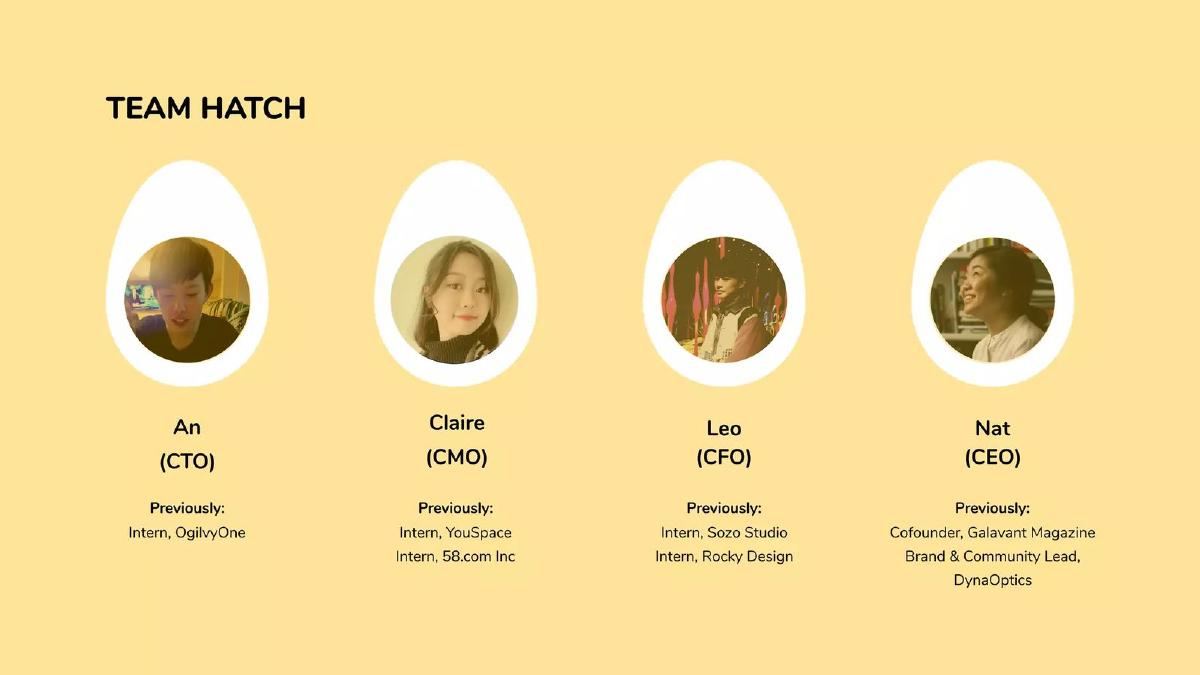
There is also a lack of a Team Slide in this selection. While Slide 4 mentions '4 Founders,' it does not provide their names, backgrounds, or relevant expertise. In early-stage investing, the team is often more important than the idea itself, and this deck fails to sell the 'why us' factor.
The long-term monetization strategy is also thin. A $0.99/month subscription requires massive scale to support a $600k+ annual burn. The deck does not address how they will handle churn, or if there are higher-tier revenue streams (e.g., university partnerships or data insights) to supplement the consumer subscription.
Founder Takeaways: What to Copy
1. Use a 'Bottom-Up' Growth Log: Slide 7 is a masterclass in showing 'work in progress.' Instead of just showing a hockey stick graph, show the raw data of your first few weeks. It proves you are tracking metrics and learning from failures.
2. Define Your Quadrants Carefully: Slide 3 does a great job of picking axes that make the company look unique. By choosing 'Mutual Learning' as a key differentiator, they immediately separate themselves from the 'Red Ocean' of MOOCs and traditional tutoring platforms.
3. Be Specific with Salaries: If you are raising money to hire, don't just say 'Team Expansion.' Use the format on Slide 4 to show exactly which roles you are hiring for and what the market rate is for those roles. It shows you have a hiring plan, not just a spending plan.
4. Address the 'Social Friction': Slide 10 shows that the founders aren't just thinking about the technology, but the human experience. Acknowledging that your product might be 'awkward' to use and showing how you plan to fix it is a sign of product maturity.
5. Use Real Testimonials: The quote from a Director of Learning Resources (Slide 8) adds significant institutional credibility to what might otherwise look like a simple student project. If you have an advisor or an industry expert who likes your product, put their name and title front and center.
Frequently asked questions
- What is the core value proposition of Hatch?
- Hatch aims to democratize academic support by moving away from expensive, one-way tutoring. By facilitating 'mutual learning' exchanges, students can trade skills (e.g., English writing for Arduino coding) for a low monthly fee of $0.99. This model focuses on common experiences and flexibility, which the founders argue traditional tutoring services lack.
- How does Hatch plan to acquire users?
- The deck outlines a grassroots, community-focused acquisition strategy. Early experiments included QR codes on posters, Instagram, Facebook groups, Reddit, and WeChat. The founders concluded that 'onsite recruitment'—physical presence and table recruitments—is the most efficient way to build the initial user base, achieving a 53% average weekly growth rate during their test period.
- What are the primary costs associated with running Hatch?
- The founders have projected a very specific annual budget of $603,748. The bulk of this ($467,000) goes to a seven-person team. Marketing is the second-largest expense at $124,748 (calculated as 20% of total costs). Other expenses include legal fees ($4,200), accounting ($2,400), and office supplies/logistics ($5,400).
- Who are the main competitors identified by Hatch?
- Hatch categorizes competitors along two axes: Physical vs. Digital connection and One-Sided vs. Mutual learning. Key competitors mentioned include Tutorfly, Coursera, edX, Studyblue, Simbi, and Tandem. Hatch differentiates itself by being both digital and mutual, whereas most established players focus on one-sided instruction.
- What stage of development is the Hatch product in?
- Based on the slides, Hatch is in the 'Digital MVP' and 'Experiment' stage. The deck shows mobile notifications and a simple connection interface where users are matched based on skills. The founders are still conducting user research to address social friction, such as the 'awkwardness' of initial interactions between student peers.