Headset's 2019 Series A deck is a masterclass in positioning a startup as an essential infrastructure layer within a high-growth, volatile industry. Rather than selling cannabis products, Headset sells the data intelligence required to navigate the market. The deck successfully highlights a massive market opportunity, projecting legal sales to reach up to $272B by 2028 under full global legalization (Slide 7). Crucially, the founders lean heavily on their 'industry pedigree' as the original team behind Leafly, providing a level of execution certainty that is rare in the cannabis sector. While…
Key takeaways
- The deck projects a massive market expansion, with Scenario 4 estimating global legal sales at $272B by 2028 (Slide 7).
- Headset positions itself as a 'retail foundation' using operational, market, and retailer direct data (Slide 10).
- The product suite is clearly segmented into three core offerings: Insights, Retailer, and Bridge (Slide 16).
- Revenue is generated through a SaaS-based subscription model including freemium and per-location pricing (Slide 16).
- The founding team highlights their 'industry pedigree' as the creators of Leafly and their successful exit with Privateer Holdings (Slide 20).
- A competitive landscape matrix places Headset in the premium quadrant for both SKU-level data and sales transaction integration (Slide 22).
- The company emphasizes its role as a primary data source through direct Point of Sale (POS) integration (Slide 22).
- Future growth is tied to predictive analytics and open data access to make businesses 'even smarter' (Slide 24).
The Infrastructure Play in a Green Rush
In 2019, the cannabis industry was transitioning from a speculative 'green rush' into a more mature, data-driven market. Headset’s Series A deck, which helped secure $12M, reflects this shift. Instead of focusing on the plant itself, Headset focused on the bits and bytes. This teardown examines how the company positioned itself as the indispensable data layer for the global cannabis trade.
Introduction and Market Context
Slide 1: Title Slide The deck opens with a clean logo and the tagline: "Cannabis Data Intelligence." It is a direct, no-nonsense introduction that immediately establishes the company's category.
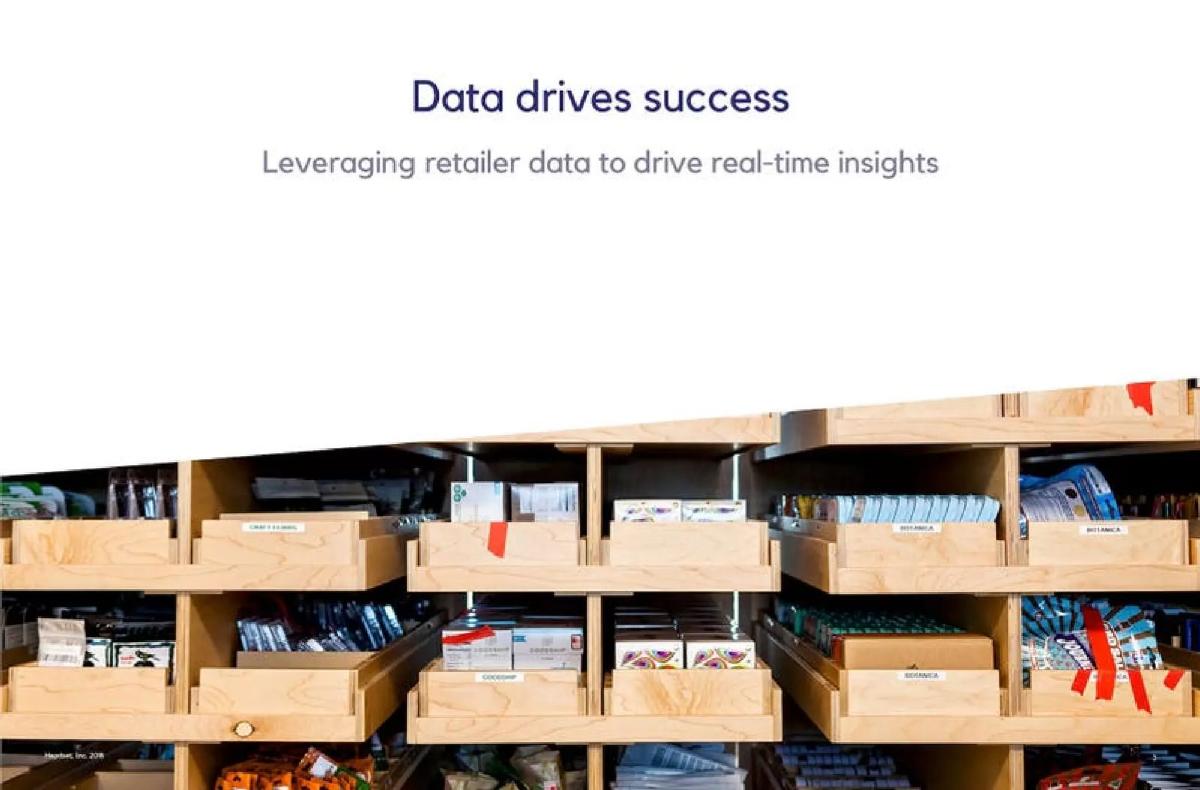
Slide 3: Data Drives Success This slide uses a high-quality image of organized retail shelves to ground the abstract concept of "data" in the physical reality of retail. The sub-headline, "Leveraging retailer data to drive real-time insights," defines the core mechanism of their business model.
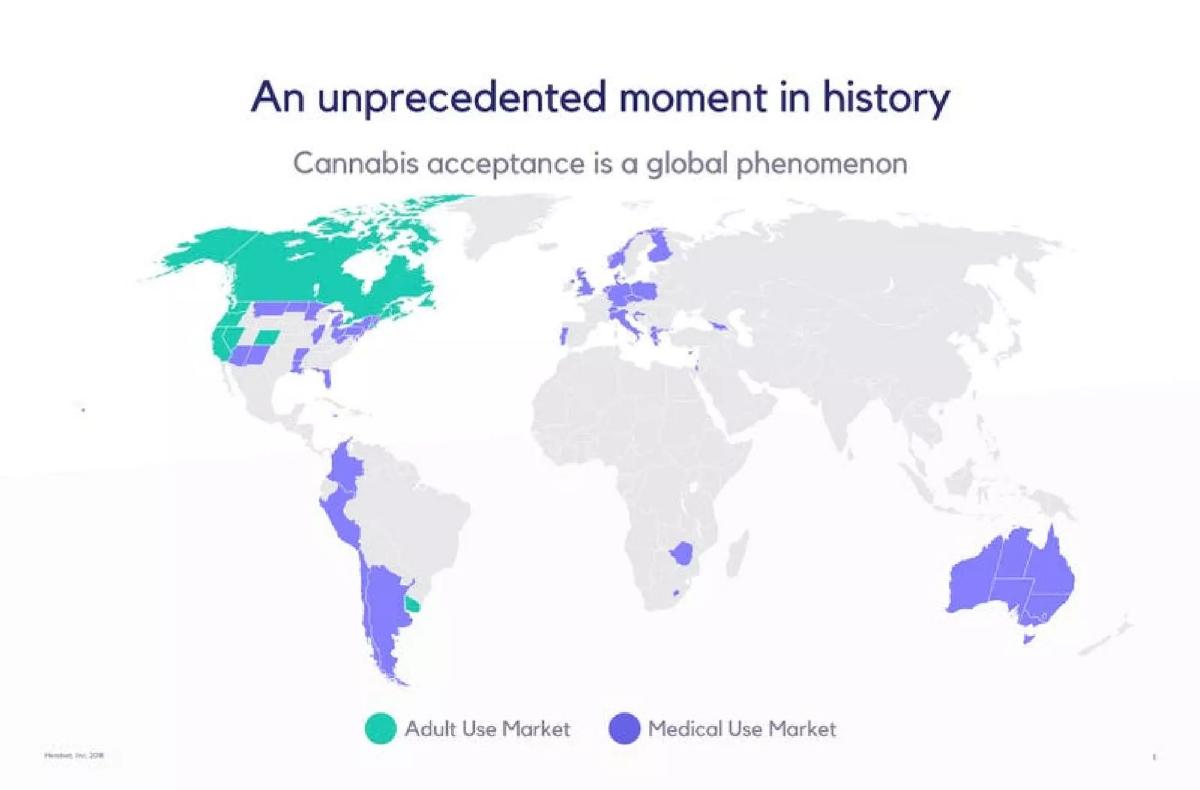
Slide 5: An Unprecedented Moment in History Headset uses a global map to visualize the "global phenomenon" of cannabis acceptance. By highlighting adult-use and medical markets across North America, South America, Europe, and Australia, they signal that their TAM (Total Addressable Market) is not limited by geography, but rather grows with every new jurisdiction that legalizes.
Market Opportunity and Product Architecture
Slide 7: A Massive Market Opportunity This is a critical slide for a Series A. Headset breaks down the market into four distinct legislative scenarios. The most conservative scenario (Scenario 1) projects a $40B market by 2028, while the most aggressive (Scenario 4) projects $272B. By providing these ranges, they show investors they understand the regulatory risks while still painting a picture of massive upside. The use of specific figures like "$185B" for 2018 Scenario 4 legal sales provides a concrete baseline for their projections.
Slide 10: Services with a Retail Foundation This slide explains the data flow. Headset sits on top of physical retail locations, pulling operational, market, and retailer direct data. They translate this into four value-adds: Dashboards, Real-Time monitoring, Time Series Trend Analysis, and Data Connectivity. The iconography is simple and reinforces the "infrastructure" narrative.
Slide 12: Headset Retailer Here, the deck shows the actual product interface. The slide lists key features: understanding customers, sales performance across stores, inventory optimization, and benchmarking against industry averages. The inclusion of a dashboard screenshot is vital—it proves the product is built and functional, moving beyond the conceptual phase.
Slide 14: Headset Insights This slide focuses on market intelligence. It highlights their ability to "define the cannabis taxonomy" and provide competitive insights. For brands looking to enter new markets, this is the core value proposition: seeing what is selling, where, and at what price point.
Business Model and Traction
Slide 16: Generating Revenue Headset clearly outlines its three-pronged SaaS model. "Insights" handles category/market subscriptions; "Retailer" uses a freemium model with per-location pricing; and "Bridge" uses a per-retailer pricing model. They also mention "Additional Revenue Sources" like custom analytics and syndicated reports. This transparency regarding pricing structures is excellent for building investor trust.
Slide 18: Consistent Sales Growth This slide shows a bar chart of sales growth. While the Y-axis values are blurred in this version of the deck, the visual trend is clearly up and to the right. The caption "Consistent sales growth" summarizes the intended takeaway without needing to disclose exact revenue figures in a public-facing deck.
Team and Competition
Slide 20: The Journey is Just Starting This is arguably the strongest slide in the deck. It states: "Same founding team that started Leafly." For investors, this is a massive de-risking signal. They cite a "Successful exit with Privateer Holdings" and "8+ years in cannabis." In a nascent industry, having a team that has already built and sold a major player is a significant competitive advantage.
Slide 22: Competitive Landscape Headset uses a standard 2x2 matrix, plotting themselves against competitors like MJ Freeway, Brightfield, and BDS Analytics. They differentiate based on "SKU-Level Data" and "Sales Transactions." Their listed advantages—Primary data source (POS), Real-time measurement, and Industry pedigree—directly address the weaknesses of older, survey-based market research firms.
Future Vision and Conclusion
Slide 24: Making Businesses Even Smarter This slide looks forward to predictive analytics and open data access. It suggests that Headset isn't just a reporting tool, but an evolving AI/ML platform that will eventually tell businesses what will happen, not just what did happen.
Slide 26: Building on the Rails A conceptual diagram showing the interconnectedness of retail locations and distribution nodes. It reinforces the idea that Headset is the "rails" upon which the industry's data travels.
Slide 28: Thank You A standard contact slide with the CEO's email and the company's social handle. It is clean and professional, matching the aesthetic of the rest of the deck.
What Works in This Deck
The Pedigree: Highlighting the Leafly connection (Slide 20) is the deck's strongest asset. It proves the team can execute in this specific, difficult vertical. · Market Segmentation: The four-scenario market projection (Slide 7) is a sophisticated way to handle regulatory uncertainty. It shows the founders are realistic about the pace of legalization. · Product Clarity: The division of the product into Insights, Retailer, and Bridge (Slide 16) makes a complex data business easy to understand. · Data Source Emphasis: By repeatedly mentioning POS integration (Slide 22), they highlight a technical moat that survey-based competitors cannot easily replicate.
What is Missing
Unit Economics: In this 14-slide sample, there is no mention of Customer Acquisition Cost (CAC), Lifetime Value (LTV), or churn rates. For a Series A, these are usually expected. · Specific Financials: While the growth chart (Slide 18) shows a positive trend, the lack of hard revenue numbers or burn rate information makes it difficult to assess the company's efficiency. · The Ask: The deck does not explicitly state how much they are raising or how the funds will be allocated (though the catalogue listing confirms a $12M raise).
Founder Takeaways: What to Copy
Use Scenarios for Volatile Markets: If you are in a highly regulated or emerging industry, don't just give one TAM number. Use a scenario-based approach like Slide 7 to show you've thought through different regulatory futures. · Lead with Your Wins: If your team has a previous exit or relevant industry history, don't bury it at the end. Headset placed their team slide (Slide 20) near the end, but the information was powerful enough to be a primary hook. · Visual Consistency: The deck uses a consistent color palette (purples, oranges, and teals) and clean iconography. This professional polish is essential when asking for $12M. · Define the 'Rails': Position your startup not just as a tool, but as the infrastructure. Slide 26 does this perfectly by visualizing the network effect of their data collection.
Frequently asked questions
- What is Headset's primary value proposition?
- Headset provides cannabis data intelligence by leveraging real-time retailer data. As shown on slide 10, they collect operational and market data directly from retailers to provide dashboards, time-series trend analysis, and data connectivity. Their goal is to turn raw transaction data into actionable business intelligence for retailers and brands.
- How does Headset generate revenue?
- According to slide 16, Headset uses a SaaS-based subscription model. This includes 'Insights' for category and market subscriptions, a 'Retailer' platform with a freemium model and per-location pricing, and 'Bridge' which uses a per-retailer pricing model. They also offer custom analytics and syndicated reports.
- Who is the team behind Headset?
- Slide 20 reveals that Headset was started by the same founding team that created Leafly. They emphasize their 8+ years of experience in the cannabis industry and a successful prior exit with Privateer Holdings, positioning themselves as seasoned operators in a relatively new market.
- What market scenarios does Headset project?
- Slide 7 outlines four scenarios for 2028. Scenario 1 (current frameworks) projects $40B; Scenario 2 (Full medical EU) projects $43B; Scenario 3 (US Federal legal) projects $55B; and Scenario 4 (Full global legal) projects a massive $272B in total legal sales.
- How does Headset differentiate itself from competitors?
- Slide 22 highlights their competitive advantages: being a primary data source via POS integration, offering real-time measurement, providing an interconnected suite of products, and their 'industry pedigree.' They position themselves against competitors like MJ Freeway and BDS Analytics by focusing on SKU-level data and transaction depth.