Cannabis Competition Slides: 7 Real Pitch Deck Examples
How cannabis and CBD startups show competition in a pitch deck: valuation tables, positioning grids, market counts, the illicit market and no-rival claims.
Cannabis Competition Slide: Show Investors Who You Really Compete With
Cannabis startups face a competitor most industries don't have: the illicit market, which sells the same plant without tax, testing or licence costs. They also compete inside rules that change by state and country, with licence caps that can keep rivals out or keep the startup out. Banking, advertising and interstate shipping are restricted, so the usual ways of beating a rival, such as spending more on marketing or selling nationwide, are often closed. A good cannabis competition slide has to show investors who the startup really competes with, where it sits among them, and why its position holds up under those rules. The seven slides below, from a CBD brand, a data company, a public cannabis holding company, a supply marketplace, a dispensary marketing service, a rollup fund and a grower, show very different answers.
TL;DR
Name the rivals a buyer in your licensed market would actually consider, including the illicit market where it is the real price competitor, place your company among them on one or two measures that matter, and give something an investor could check. Headset places four named data companies on a two-by-two grid of sales-transaction data versus product-level data, and puts itself nowhere on the grid, which is the slide's main gap. B GREAT shows revenue and market value for three CBD brands, but uses them to argue that values are high rather than to show where it fits. mCig names the illicit market as its biggest risk. Monarch Farms lists seven advantages without naming a single rival.
Cannabis competition slides from real pitch decks
Each example shows the exact stored slide above its analysis and links to the full teardown. The slides that explain the company's position come first; weaker ones follow for contrast. Claims are as shown on the slides; comments are ours.
Headset competition slide — slide 21
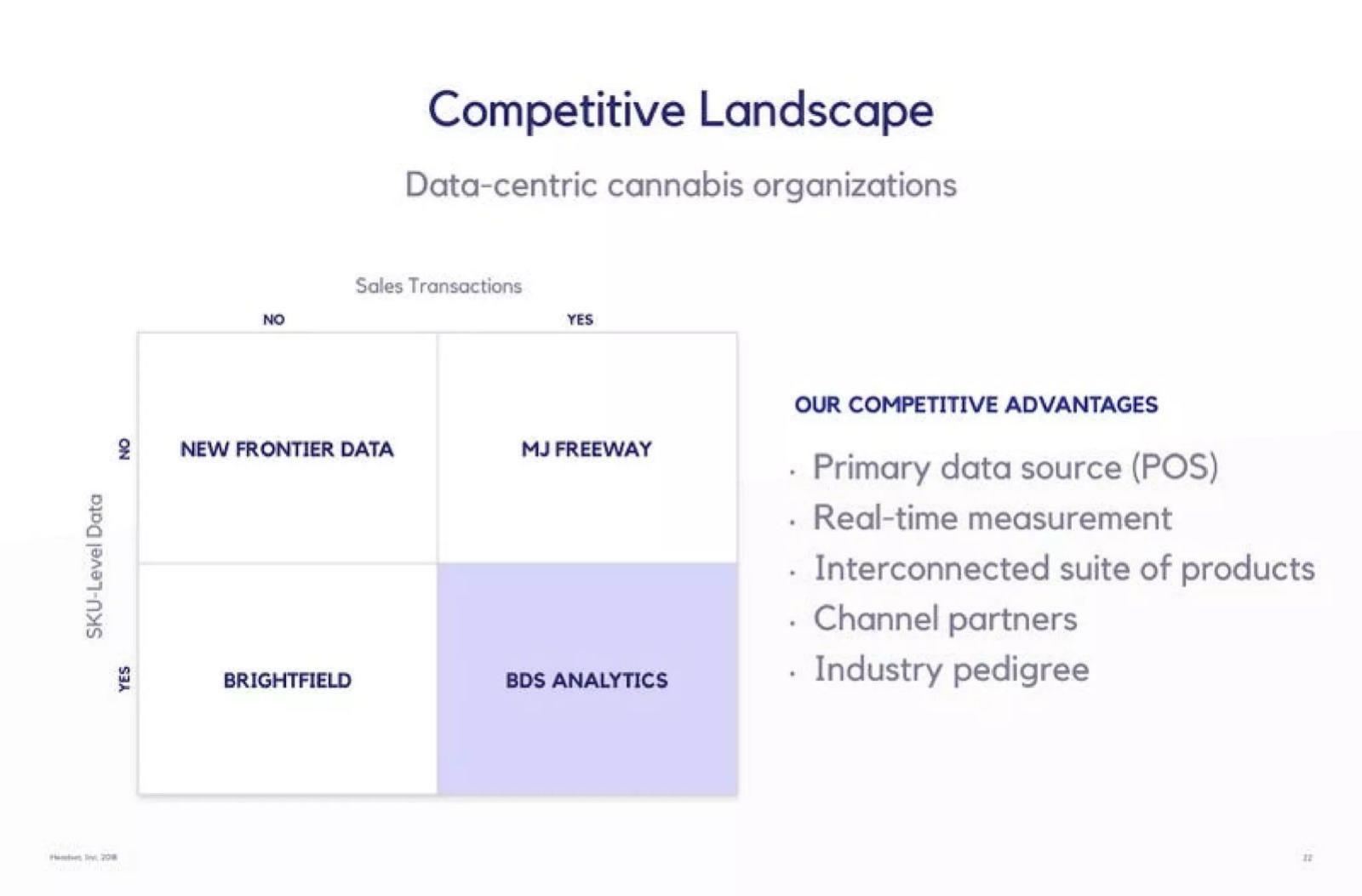
Seattle cannabis retail data and analytics company, 2018 deck. Slide titled "Competitive Landscape", subtitle "Data-centric cannabis organizations".
Headset deck, slide 21. Exact stored slide matched to this analysis.
Our analysis: It argues that only one rival has both sales and product-level data, and that Headset's direct feed from store tills gives it an edge there.
Evidence and limitation: Claimed; no figures. Headset closed a $12.1M Series A in January 2019, according to its Business Wire release, which says it was launched in 2015 by the three co-founders of Leafly.
What a founder can adapt: Put Headset's own logo in the shaded corner beside BDS Analytics, and add one line, with a figure, on how its data is faster or broader.
Supporting analysis
What the deck claims: A two-by-two grid. Horizontal axis "Sales Transactions" (No, Yes); vertical axis "SKU-Level Data" (No, Yes). New Frontier Data (no, no), MJ Freeway (sales yes, SKU no), Brightfield (sales no, SKU yes), BDS Analytics (yes, yes, shaded). "Our Competitive Advantages": "Primary data source (POS)", "Real-time measurement", "Interconnected suite of products", "Channel partners", "Industry pedigree".
Presentation choice: The axes are the measures a cannabis retailer or brand cares about when buying data, and every rival named was a real, known company.
When it does not fit: Leaving your own company off your own grid; the reader has to guess where you sit.
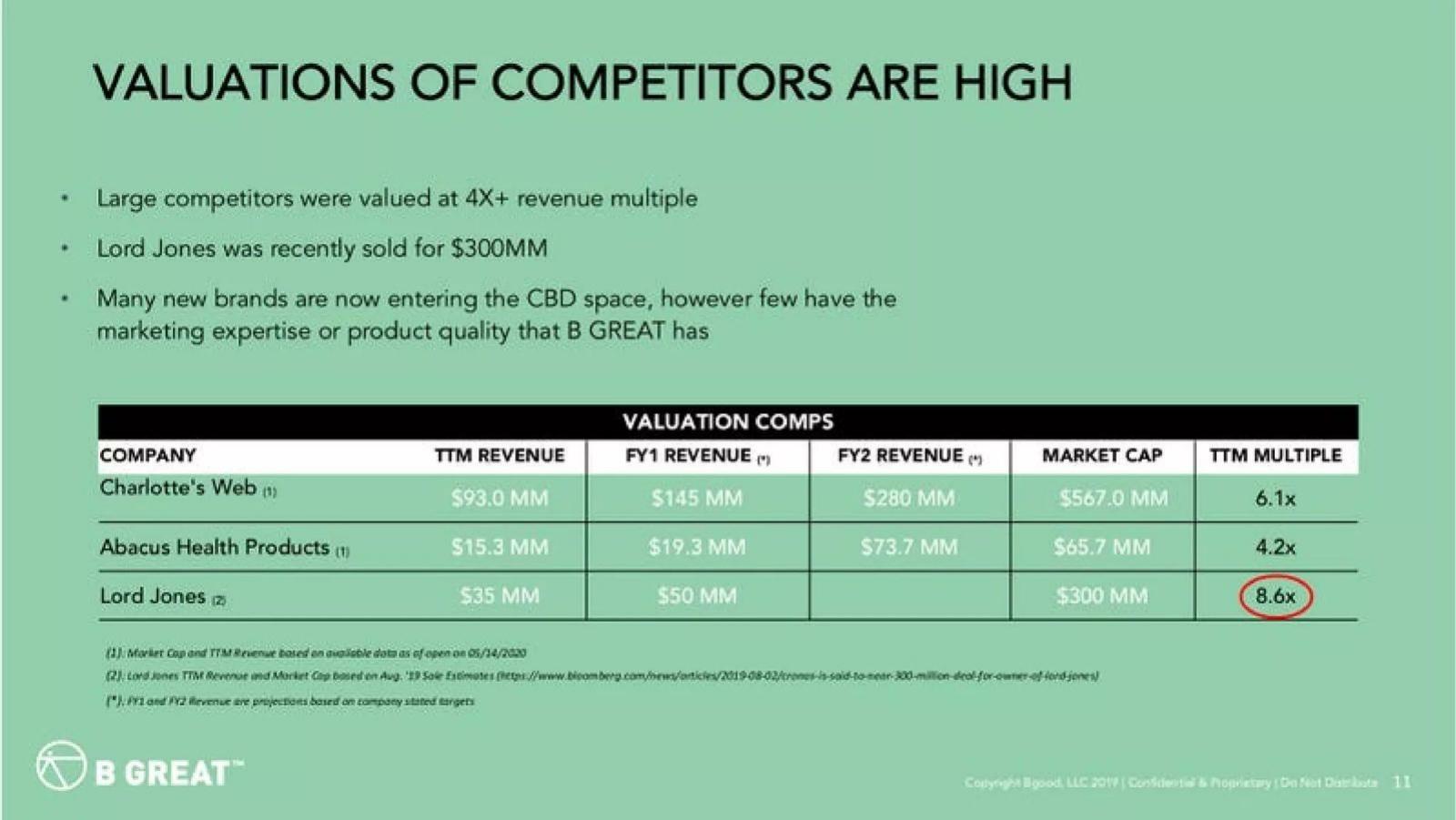
New York CBD brand run by Bgood LLC; the slide's footnotes date its figures to May 2020. Slide titled "Valuations of Competitors Are High".
B GREAT (Bgood) deck, slide 11. Exact stored slide matched to this analysis.
Our analysis: It argues that CBD brands have sold or traded at high multiples of revenue, so a well-marketed brand like B GREAT could be worth a lot.
Evidence and limitation: Figures footnoted on the slide, partly to company targets and a press report. Cronos Group closed its purchase of the companies behind Lord Jones in September 2019, but its release gives no price, so we treat $300MM as reported, not confirmed. B GREAT's outcome is unknown; we found no recent public record.
What a founder can adapt: Add a row for B GREAT with its own revenue and growth, and a second slide or panel comparing its products, prices and stores with these brands.
Supporting analysis
What the deck claims: "Large competitors were valued at 4X+ revenue multiple". "Lord Jones was recently sold for $300MM". "Many new brands are now entering the CBD space, however few have the marketing expertise or product quality that B GREAT has". A "Valuation Comps" table: Charlotte's Web ($93.0MM TTM revenue, $567.0MM market cap, 6.1x), Abacus Health Products ($15.3MM, $65.7MM, 4.2x), Lord Jones ($35MM, $300MM, 8.6x, circled), with projected FY1 and FY2 revenue and footnotes citing data sources.
Presentation choice: It is the only slide here with figures for named rivals, and it footnotes where the numbers came from.
When it does not fit: Using a valuation table as the whole competition slide; it shows what rivals are worth, not how you beat them.
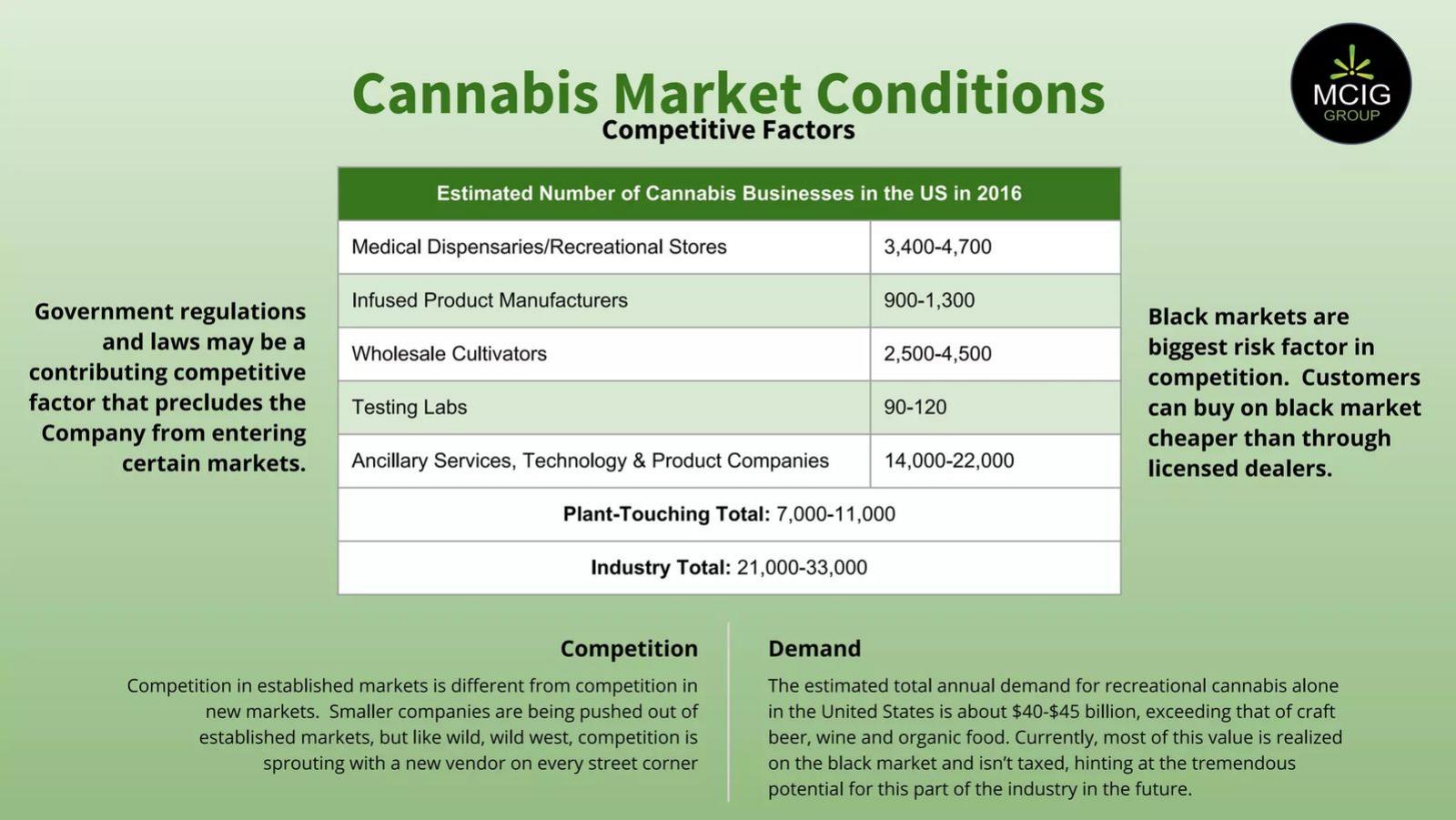
Public cannabis holding company with construction, supply and product businesses. Slide titled "Cannabis Market Conditions", subtitle "Competitive Factors".
mCig deck, slide 15. Exact stored slide matched to this analysis.
Our analysis: It argues that the market is crowded and fragmented, that rules can block entry, and that the cheapest rival is the illicit market.
Evidence and limitation: Business counts unsourced on the slide. mCig traded over the counter and settled lawsuits in Nevada in 2019; we have not checked its later trading status.
What a founder can adapt: Cite the source of the counts, name the three or four companies mCig actually competes with in each of its businesses, and say how it wins buyers from the illicit market.
Supporting analysis
What the deck claims: Table "Estimated Number of Cannabis Businesses in the US in 2016": dispensaries and stores 3,400-4,700; infused product manufacturers 900-1,300; wholesale cultivators 2,500-4,500; testing labs 90-120; ancillary services, technology and product companies 14,000-22,000; plant-touching total 7,000-11,000; industry total 21,000-33,000. "Black markets are biggest risk factor in competition. Customers can buy on black market cheaper than through licensed dealers." "Government regulations and laws may be a contributing competitive factor that precludes the Company from entering certain markets."
Presentation choice: Naming the illicit market and regulation as competitive forces is honest and specific to cannabis.
When it does not fit: Market counts with no named rivals; a reader learns how crowded the field is, but not who you beat.
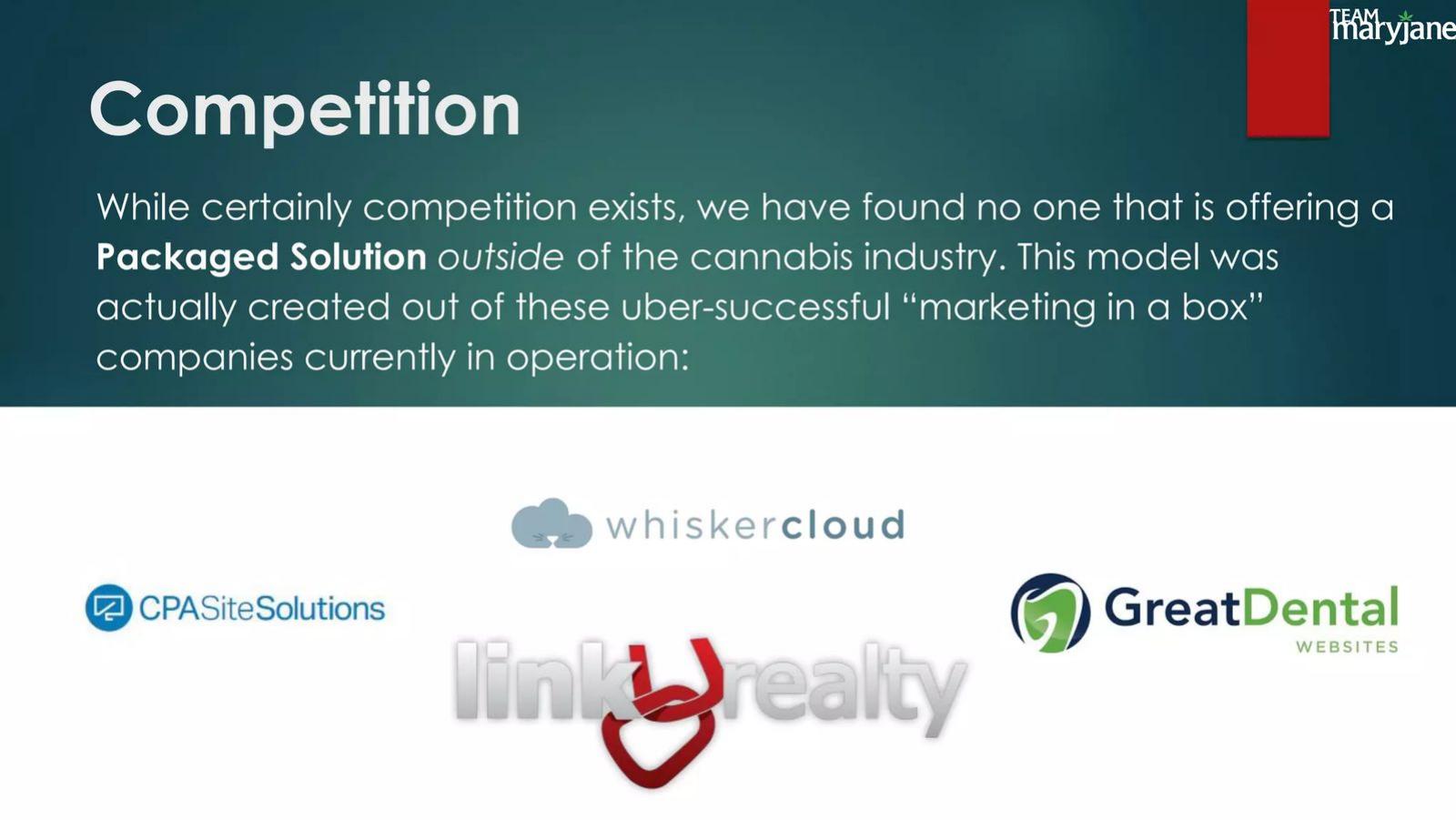
Marketing service for dispensaries offering websites and digital marketing for a flat monthly fee, around 2017. Slide titled "Competition".
TMJ (Team Maryjane) deck, slide 22. Exact stored slide matched to this analysis.
Our analysis: It argues that packaged marketing for one industry has worked for accountants, vets, estate agents and dentists, so it can work for dispensaries.
Evidence and limitation: Claimed; no figures for the named companies. Outcome unknown; we found no public record after the deck.
What a founder can adapt: Keep the outside-industry logos, then name the cannabis marketing agencies and website builders a dispensary would otherwise hire, with their prices.
Supporting analysis
What the deck claims: "While certainly competition exists, we have found no one that is offering a Packaged Solution outside of the cannabis industry. This model was actually created out of these uber-successful 'marketing in a box' companies currently in operation:" Logos: CPASiteSolutions, whiskercloud, linkurealty, Great Dental Websites.
Presentation choice: The outside-industry companies are real and checkable, which gives investors evidence that the model works.
When it does not fit: Admitting that competition exists without naming any of it.
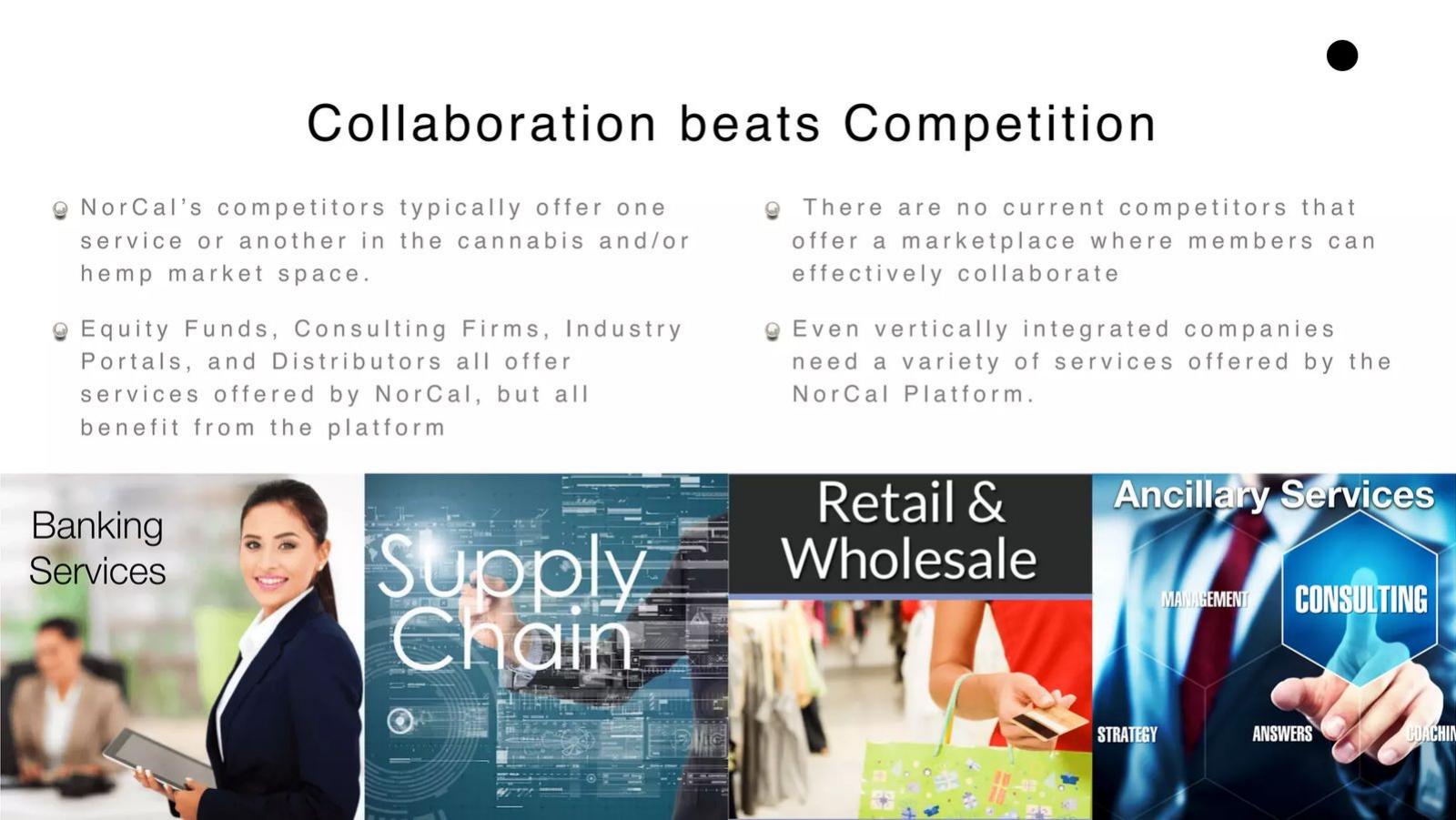
Supply-chain marketplace and banking platform for hemp and cannabis businesses. Slide titled "Collaboration beats Competition".
NorCal deck, slide 7. Exact stored slide matched to this analysis.
Our analysis: It argues that rivals each do one thing, while NorCal combines them, so rivals become users rather than threats.
Evidence and limitation: Claimed; no rivals named and no figures. Outcome unknown.
What a founder can adapt: Name two or three rivals in each category, show which services each offers in a simple table, and give one example of a rival that joined the platform.
Supporting analysis
What the deck claims: "NorCal's competitors typically offer one service or another in the cannabis and/or hemp market space." "Equity Funds, Consulting Firms, Industry Portals, and Distributors all offer services offered by NorCal, but all benefit from the platform". "There are no current competitors that offer a marketplace where members can effectively collaborate". "Even vertically integrated companies need a variety of services offered by the NorCal Platform." Photo tiles: Banking Services, Supply Chain, Retail & Wholesale, Ancillary Services.
Presentation choice: Shown for contrast: the idea of turning rivals into members is interesting, but without names or figures a reader can't test it.
When it does not fit: Categories of rivals without names; investors will look them up and decide for themselves.
Los Angeles company combining cannabinoid research with a plan to buy and combine dispensaries. Slide titled "Competition", subtitle "Competition in Cannabis Industry".
Cannabinoid Biosciences (CBDX Fund) deck, slide 6. Exact stored slide matched to this analysis.
Our analysis: It argues that no other fund is buying dispensaries to combine them, so it faces no competition.
Evidence and limitation: Claimed; licence figures unsourced on the slide. An October 2019 Newswire release says the company was working to combine 10 dispensaries and list them on a stock exchange. We found no record that this happened.
What a founder can adapt: Name the companies already buying dispensaries in California and say why sellers would choose this fund over them.
Supporting analysis
What the deck claims: "Right now there is no fund focused on rollup of existing high-margin dispensaries California and across the U.S. marketplace. In California for example, with 358 licensed recreational marijuana stores, the state's three licensing authorities have issued over 5,000 commercial cannabis licenses. So competition is not an issue now." Two further paragraphs on positive investor sentiment and public acceptance of cannabinoid research.
Presentation choice: Shown as a warning: public multi-state operators were already buying dispensaries, and the licence count it quotes describes the market, not rival buyers.
When it does not fit: "Competition is not an issue"; investors read it as a sign the founders haven't looked.
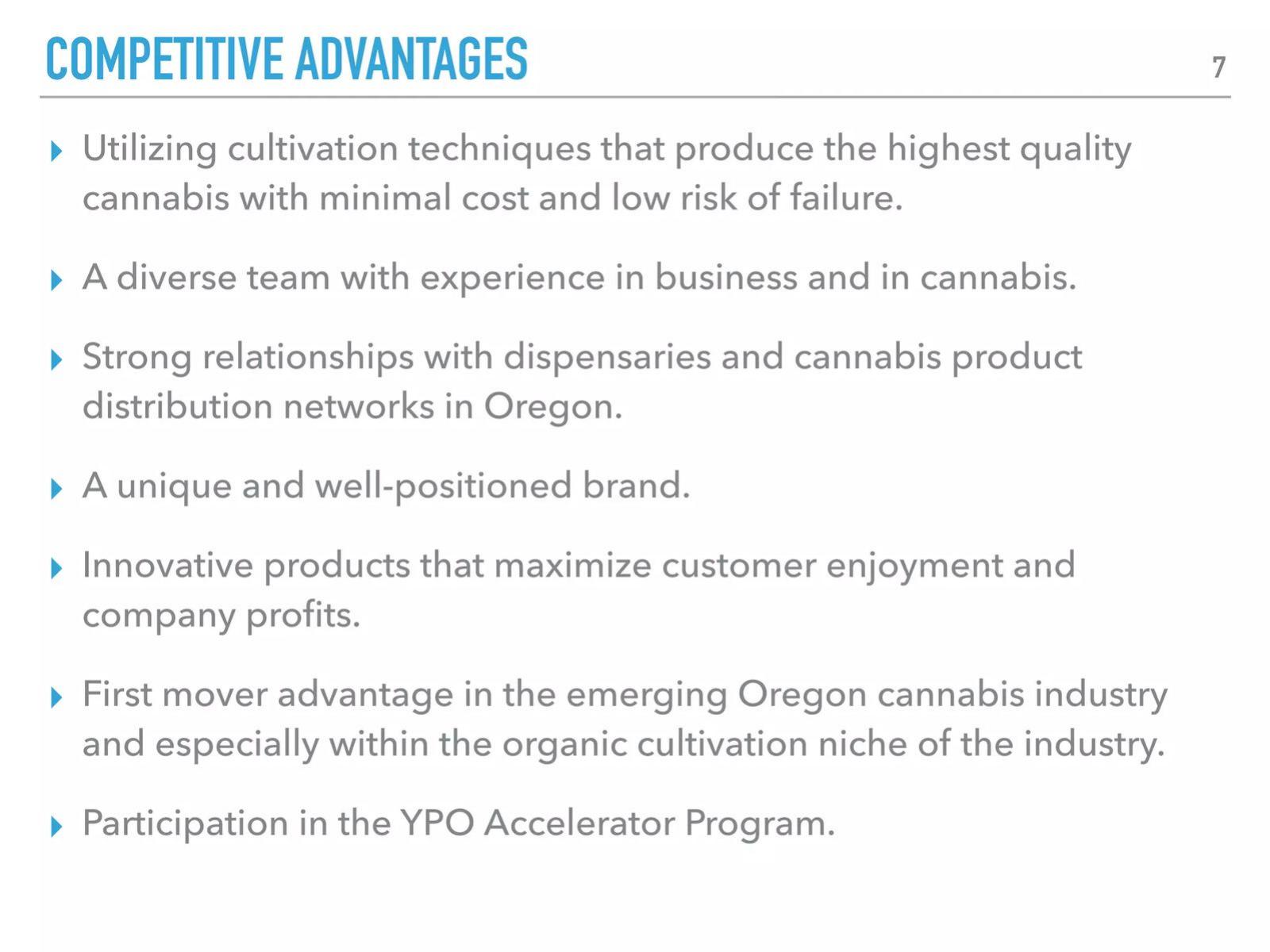
Oregon cannabis grower near Grants Pass seeking a $1.3M seed round in 2016. Slide titled "Competitive Advantages".
Monarch Farms deck, slide 8. Exact stored slide matched to this analysis.
Our analysis: It argues that quality, team, local relationships and an early start in organic growing will set it apart.
Evidence and limitation: Claimed; no rivals named and no figures. Outcome unknown; we found no public record after the deck.
What a founder can adapt: Name the Oregon growers selling organic flower to the same dispensaries, and compare price per pound and yield per square foot.
Supporting analysis
What the deck claims: Seven bullets: "Utilizing cultivation techniques that produce the highest quality cannabis with minimal cost and low risk of failure"; "A diverse team with experience in business and in cannabis"; "Strong relationships with dispensaries and cannabis product distribution networks in Oregon"; "A unique and well-positioned brand"; "Innovative products that maximize customer enjoyment and company profits"; "First mover advantage in the emerging Oregon cannabis industry and especially within the organic cultivation niche of the industry"; "Participation in the YPO Accelerator Program".
Presentation choice: Shown for contrast: the Oregon relationships and organic niche are real angles, but with no rivals named, a reader can't judge them.
When it does not fit: "First mover" in a market where hundreds of growers were applying for licences at the same time.
Whether each slide names rivals, shows the company's own position, and gives something a reader could check.
Example
Rivals named
Own position shown
Checkable basis
Headset
Yes (four)
Partly (advantages beside grid)
Partly (named rivals, no figures)
B GREAT
Yes (three)
No
Yes (footnoted figures)
mCig
No (counts and illicit market)
No
Partly (counts, unsourced)
TMJ
Outside industry only
Partly (model borrowed)
Partly (named companies)
NorCal
No (categories only)
Partly (claim)
No
CBDX Fund
No
No
No
Monarch Farms
No
Partly (advantages listed)
No
Key Takeaways
Name the illicit market when it sets the price buyers compare against.
Place your own company on any grid or table you show.
Separate rivals in your licensed market from companies elsewhere.
Treat valuation comparisons as context, not as competition.
A claim of no direct rival needs the nearest alternative named.
Build your cannabis competition slide
Start from the licensed market you can actually sell in.
Market. Which states or countries can you legally sell in, and under which licence?
Buyer. Who buys from you: consumers, dispensaries, growers, brands?
Alternatives. What do they use today, including the illicit market or a general-purpose supplier?
Rivals. Which licensed companies in that market sell something similar?
Proof. Can you show price, quality, speed or cost against a named rival, from real sales?
Copyable framework: In [state or country], [buyer] buys [product] from [rivals] or the illicit market at about [price]. We [difference], and over [period] [measure] reached [figure] against [rival's figure].
Illustrative example 1 — written by us
Before: Competitive advantages: highest quality, strong relationships, first mover.
After: In southern Oregon, dispensaries buy organic flower from about a dozen local growers at $1,200 to $1,500 a pound. We grow outdoors with a year-round water source, so our cost per pound is lower, and 4 dispensaries have agreed to stock our first harvest.
What improved: Our illustrative rewrite; figures are invented for the example. It names the market, the rival set and the price, and gives one commitment a reader could ask about.
What this guide adds
The general competition slide guide covers any kind of business. Cannabis adds problems of its own. Every US state that allows cannabis runs its own licensing system, so a dispensary in Oregon does not compete with one in California, and a brand licensed in one state usually can't ship into another. Licence caps can make the market small and protected, or flood it with growers, as happened in Oregon after 2016. The illicit market sells the same product with no tax or testing costs, and in many places it still serves a large share of buyers. Large multi-state operators and public companies sit alongside small local businesses, and many ancillary companies, such as software, data, packaging and marketing firms, sell to all of them.
The cannabis market, problem and solution guides cover how these decks size the market and describe the pain and the product. Here we look only at how each deck handles rivals: who it names, how it compares itself, where it places itself and what a reader could check.
How we read each slide
We quote the text on the stored slide images, read at full size. We have not checked any rival's revenue, value, features or market position as shown on the slides. "Claimed" means the company states something on the slide without a source. Where we checked what happened to a company after its deck, we say what we found and where; where we found nothing, we say the outcome is unknown.
These decks span roughly 2016 to 2020, a period when US state laws, the 2018 Farm Bill rules for hemp and CBD, and investor appetite for cannabis all changed quickly. Several rivals named on these slides have since merged, been acquired or shrunk, and the market figures they quote are now out of date. Readers should judge each slide against its own time and market.
Six formats, and what each one shows
A valuation table (B GREAT) shows revenue and market value for named rivals, which helps an investor think about exit value, but it does not show how the startup's product differs. A positioning grid (Headset) groups rivals by two measures and can make a clear point, if the company places itself on it. A market count (mCig) shows how many businesses of each type exist, which explains crowding but names no rival. Prose arguments (NorCal, the CBDX fund) explain why the company thinks rivals don't matter, without a comparison a reader can test. An outside-industry comparison (TMJ) borrows a proven model from another sector. An advantages list (Monarch Farms) describes the company's strengths without naming who it is stronger than.
Whichever format you pick, a reader needs three things: who the rivals are, where you sit among them, and what that position is based on. Four of the seven slides name rivals, though only two name direct ones in the startup's own business. Only B GREAT gives figures for named companies, and none of the seven places itself on a comparison with a measured result.
The illicit market as a real rival
mCig's slide makes a point most cannabis decks avoid: "Black markets are biggest risk factor in competition. Customers can buy on black market cheaper than through licensed dealers." The same slide says most of the estimated $40 to $45 billion annual US recreational demand is "realized on the black market and isn't taxed". For a licensed grower, brand or store, that is the price a buyer often compares against. Naming it is honest, and it shows investors the founders understand why legal sales can grow more slowly than legalisation suggests.
The slide stops short of the next step: saying how a licensed business wins those buyers. Possible answers include testing and safety, convenience, product range, delivery where allowed, or simply price once taxes fall. A founder who names the illicit market should add one line on how the company will compete with it, and ideally one figure, such as the price gap per gram in its own state.
Grids and tables: put yourself on them
Headset's grid is the clearest picture of the competitive field among these slides. It splits "data-centric cannabis organizations" by whether they have sales transactions and whether they have product-level (SKU-level) data: New Frontier Data has neither, MJ Freeway has sales data, Brightfield has product data, and BDS Analytics has both, shaded in the corner. The axes are the right ones for a retail data company, because transaction-level data is what buyers pay for.
But Headset itself does not appear on the grid. The shaded corner holds BDS Analytics, a rival, and Headset's advantages are listed beside the grid instead: "Primary data source (POS)", "Real-time measurement", "Interconnected suite of products", "Channel partners" and "Industry pedigree". A reader is left to infer that Headset belongs in the same corner as BDS Analytics and then has to work out why it is better. Placing the company's own logo in the top-right corner, with one line on what separates it from BDS Analytics, would turn a good grid into a persuasive one.
B GREAT's table has a similar gap. It lists Charlotte's Web, Abacus Health Products and Lord Jones with revenue, projected revenue, market value and revenue multiple, but B GREAT has no row of its own. The table is useful for showing what large CBD brands have been worth, but it says little about how B GREAT competes with them for shelf space or customers.
When the slide claims there is no rival
Three slides argue that direct rivals don't exist. NorCal says "There are no current competitors that offer a marketplace where members can effectively collaborate." TMJ says "we have found no one that is offering a Packaged Solution" and then names marketing companies from other industries. The CBDX fund says "Right now there is no fund focused on rollup of existing high-margin dispensaries" and concludes "So competition is not an issue now."
Investors read these claims with caution. Even if no one offers exactly the same thing, buyers have alternatives: a dispensary can hire a local web agency instead of TMJ, a grower can sell through a distributor instead of joining NorCal, and an investor can buy shares in a public multi-state operator instead of a rollup fund. Each slide would be stronger if it named the nearest alternative and said why buyers would switch. TMJ's slide is the most useful of the three, because the outside-industry companies it names show that the model has worked elsewhere, which is evidence a reader can check.
Questions investors ask about a cannabis competition slide
Which licensed market are you in? Rivals in another state may be irrelevant if neither of you can sell across the border. Say which states or countries the comparison covers.
How do you compete with the illicit market? If buyers can get the product cheaper without a licence, explain why they will pay more for yours.
What happens when large operators arrive? Multi-state operators and public companies can outspend a startup. Investors want one sentence on why the company's position survives that.
What changes if the law changes? Federal rescheduling, new licences or tax changes can open a market to new rivals. A slide that shows awareness of that risk reads as more credible.
Mistakes cannabis slides make most often
The most common gap is self-placement. Headset leaves itself off its own grid, and B GREAT leaves itself off its own valuation table. In both cases the comparison is careful, and in both cases the reader has to guess where the company fits.
The second gap is evidence. No slide here compares a measured result, such as price per gram, cost per customer, time to deliver data or yield per square foot, with a named rival. Monarch Farms claims "the highest quality cannabis with minimal cost and low risk of failure" with no figure; the CBDX fund's "competition is not an issue" rests on a licence count. One real figure would make any of these slides more believable.
The third gap is checking quoted figures. B GREAT's slide says "Lord Jones was recently sold for $300MM" and footnotes a press report of a deal near that amount. Cronos Group did buy the companies behind Lord Jones in 2019, but its closing announcement gave no price. A founder quoting a deal price should say whether it is reported or confirmed and cite the source on the slide, as B GREAT partly does.
Common mistakes
Leaving yourself off. Headset and B GREAT omit themselves from their own comparisons.
Ignoring the illicit market. Only mCig names it, and it doesn't say how it will win those buyers.
"No competition". The CBDX fund says competition is not an issue.
Categories, not names. NorCal lists types of rivals but names none.
Unconfirmed deal prices. Say whether a quoted sale price is reported or confirmed.
Advantages with no rivals. Monarch Farms lists strengths without saying who it beats.
Diagnostic checklist
Says which licensed market the comparison covers.
Names direct rivals in that market.
Names the illicit market where it sets the price.
Puts your company on the grid or table.
Compares on a buyer result: price, quality, speed or cost.
Cites a source for every figure about a rival.
Includes at least one area where a rival is stronger.
Frequently asked questions
Should a cannabis startup list the illicit market as a competitor?
Yes, if buyers in your market can get the product cheaper without a licence. mCig calls it the biggest competitive risk. Add one line on how you will win those buyers.
Is a valuation table a good cannabis competition slide?
It is useful context for exit value, but not a substitute for comparing products. B GREAT's table footnotes its figures but leaves B GREAT itself off the table.
Can I say I have no competitors?
Investors rarely believe it. Name the nearest alternative a buyer would use instead, as TMJ partly does by naming similar companies in other industries.
Should I include rivals from other states?
Only if you can sell into their market or compete for the same buyers. State licensing usually means your real rivals are local.
How we chose these examples
Corpus: published pitch deck teardowns on StartupFundraising.com. Founder-uploaded private decks are excluded.
Selection (2026-10-01): we searched extracted slide text across the full corpus for competition and competitor wording near cannabis, CBD, hemp and dispensary terms. Nine candidates were viewed at full size; seven cannabis competition slides that no other guide uses were kept.
Not used: Pilgrim Soul p24 (illegible at full size); B GREAT p20 (packaging, not competition).
Status checks (2026-10-01): Business Wire release for Headset; Cronos Group release for Lord Jones; company and court records for mCig; Newswire release for Cannabinoid Biosciences. No public outcome was found for B GREAT, TMJ, NorCal or Monarch Farms.
Review: stored slide text and images were checked on 2026-10-01 against company, deck and slide number (editorial model review). No person has yet completed an editorial review of this page. We make no claim that any slide caused a fundraising outcome.