Cannabinoid Biosciences (CBDZ) presents a pitch deck centered on a massive $125 million capital raise intended to fund a biopharmaceutical R&D arm alongside a retail rollup of at least 10 cannabis dispensaries. The core thesis relies on a valuation arbitrage play: acquiring private cannabis businesses at roughly 2x revenue and rolling them into a public entity that the company claims could be valued at over 100x revenue based on then-current market peers like Aurora Cannabis and Cronos Group. While the deck provides specific financial targets for 20 acquisition candidates, it lacks a formal t…
Key takeaways
- The company is seeking a total of $125 million, split between a $50 million Regulation A+ offering and a $75 million Regulation D 506(c) offering (Slide 7).
- The investment vehicle is a Secured Convertible Note paying 12% annual interest, convertible into shares at $10 per share (Slide 7).
- A core business pillar is 'Professional Services,' offering SEC reporting, GAAP/IFRS conversion, and 280E tax services to other cannabis businesses (Slide 3).
- The deck identifies 20 specific acquisition targets with a combined revenue of $96,389,230 and net profit of $30,356,123 (Slide 11).
- Management projects a post-consolidation valuation of $7.19 billion based on a weighted average of industry multiples (Slide 11).
- The strategy relies on the '2018 Farm Bill' and subsequent federal clarifications to stabilize the regulatory environment for CBD (Slide 5).
- The company intends to pay 50% of profits back to investors as dividends while retaining the other 50% for growth (Slide 9).
- The biopharmaceutical arm claims to focus on novel therapeutics from cannabinoids for a broad range of disease areas, though specific compounds are not listed (Slide 3).
Executive Summary: The Arbitrage Play
Cannabinoid Biosciences presents a deck that is less about product innovation and more about financial engineering within the cannabis sector. The pitch rests on the premise that private cannabis assets are undervalued due to regulatory friction, while public cannabis stocks trade at massive premiums. By raising $125 million through a combination of Regulation A+ and Regulation D offerings, the company intends to bridge this gap through a massive rollup of dispensaries and cultivation centers.
Slide 1: Title and Positioning
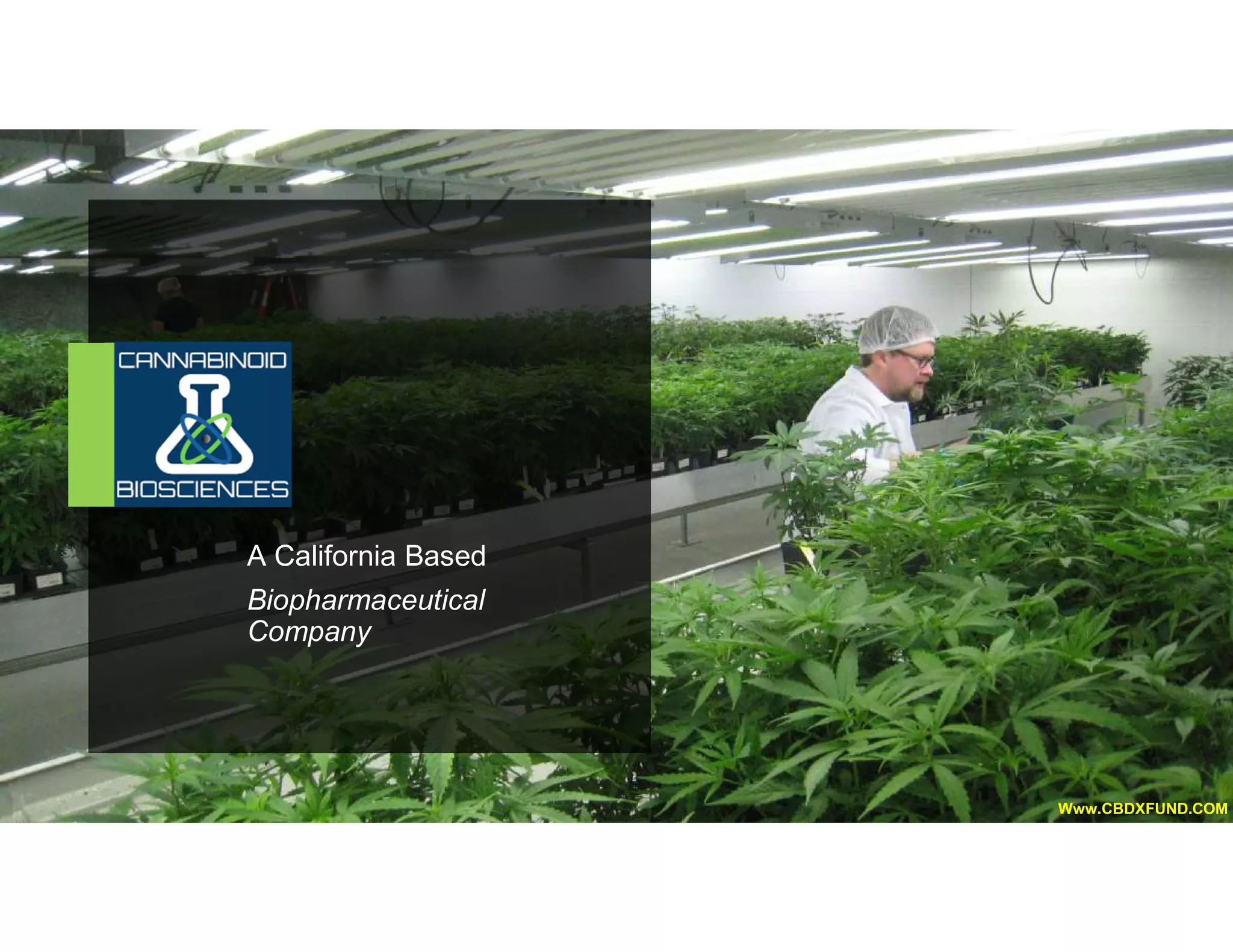
The cover slide establishes the company as a "California Based Biopharmaceutical Company." The branding uses a laboratory flask icon, signaling a focus on science and medical-grade production. The URL provided is CBDXFUND.COM, suggesting a fund-like structure for the investment vehicle.
Slide 3: Our Business Pillars
This slide breaks the company into four distinct quadrants. Research & Development focuses on cannabinoid therapeutics. Investments & Consolidation targets legal cannabis businesses for IPO events in the US or Canada. Financial Products offers asset-backed loans and mortgages to cannabis businesses that are often shut out of traditional banking. Finally, Professional Services provides the back-office infrastructure (SEC reporting, 280E tax compliance) necessary to take these businesses public. This indicates the company views itself as a full-stack platform for cannabis commercialization.
Slide 5: Regulatory Landscape
The deck addresses the legal hurdles of the industry by citing the 2018 Farm Bill (H.R. 2). It specifically highlights the lifting of the ban on hemp and the authorization of hemp production and research. The slide notes that on December 12, 2018, U.S. Congress approved a bill to make CBD federally legal, which serves as the foundational legal justification for their business model.
Slide 7: The $125 Million Ask
This is the core of the financial pitch. The company seeks $125 million: $50 million via Reg A+ and $75 million via Reg D 506(c). The terms are specific: a Secured Convertible Note paying 12% interest. The conversion price is set at $10 per share. The slide explicitly states the goal is to "rollup 10 dispensaries with $54 million in annual revenue" and list them on major exchanges like NASDAQ or NYSE. The slide argues that while they buy at $2 for every $1 of revenue, the market pays $131-$215 for every $1 of revenue for public companies.
Slide 9: Rollup & Consolidation Strategy
This slide reiterates the $75 million requirement to acquire the first 10 dispensaries. It introduces a dividend policy, stating the company plans to "pay 50% back to our investors as dividends." It also sets a bold valuation target, projecting the rollup could be worth $4.6 billion on the stock exchange based on current industry multiples.
Slide 11: The Value Proposition Spreadsheet
This is the most data-dense slide in the deck. It lists 20 specific targets (anonymized as Target 1 through Target 20) with their required investment, revenue, net profit, and employee counts. The totals show a path to $96.3 million in revenue and $30.3 million in net profit. Below this, it compares these figures to "Industry Peers" like Aurora Cannabis, General Cannabis Corp, and Cronos Group. The slide calculates a "Targeted Value after consolidation" of $7.19 billion, using a weighted average of sales and profit multiples.
Slide 13: Investment Terms and Legalities
This slide serves as a transition to the legal disclosures. It mentions the Private Placement Memorandum (PPM) and Articles of Incorporation. It uses a chemical diagram of CBD as a background, maintaining the biopharmaceutical aesthetic despite the heavy focus on retail consolidation in the previous slides.
Slide 15: Conclusion and Contact
The final slide repeats the cover imagery but adds a "Thank You" and identifies Frank I. Igwealor as the Sr. Vice President and CFO. His extensive list of professional designations (CPA, JD, MBA, etc.) is used to establish financial and legal credibility for the complex rollup strategy.
What Cannabinoid Biosciences Does Well
The deck is exceptionally specific about its financial goals. Unlike many startup decks that use vague "use of funds" charts, CBDZ provides a line-item list of 20 acquisition targets with their corresponding revenues and profits (Slide 11). This level of transparency regarding the pipeline gives investors a clear picture of exactly what their capital is buying.
Furthermore, the deck identifies a very specific market inefficiency: the valuation gap between private cannabis retail and public cannabis stocks. By framing the investment as an arbitrage opportunity rather than just a "growth" play, they appeal to a more sophisticated, math-oriented investor class.
Omissions and Weaknesses
The most glaring omission is a dedicated Team slide. While the CFO is listed on the final slide, there is no mention of a CEO, a Chief Scientific Officer (essential for a "Biopharmaceutical" company), or a Board of Directors. For a $125 million raise, the lack of a deep bench of leadership is a significant red flag.
Additionally, the "Biopharmaceutical" claim is thin on details. There are no slides detailing clinical trial phases, specific proprietary compounds, or patent filings. The deck spends 80% of its time on the retail rollup and financial arbitrage, making the "Biopharmaceutical" branding feel like a secondary or even tertiary focus despite being the primary descriptor on the cover slide.
Finally, the reliance on 100x+ revenue multiples from peers like Aurora Cannabis (Slide 11) is a high-risk assumption. Market multiples for cannabis stocks have historically been volatile, and pegging a $7 billion valuation to these outliers without a "downside scenario" analysis is aggressive.
Founder Takeaways
Quantify your pipeline: If your business model involves acquisitions, listing the revenue and profit of your targets (even if anonymized) is far more persuasive than general market size stats. · Address the 'Why Now': CBDZ effectively uses the 2018 Farm Bill to create a sense of urgency and legal clarity (Slide 5). · Match the instrument to the ask: For a high-yield, asset-heavy rollup, a 12% Secured Convertible Note is a logical instrument that offers investors immediate yield while they wait for the IPO liquidity event. · Don't hide the team: If you are raising nine figures, your management team's history in M&A and operations is just as important as the financial model.
Frequently asked questions
- What is the primary investment instrument being offered?
- According to slide 7, Cannabinoid Biosciences is offering a Secured Convertible Note. The note pays a 12% annual interest rate. A $1,000 note is convertible into 125 shares of CBDZ Common Stock. The company notes that these shares are being registered with the SEC under Regulation A+ to be sold at a price of $10 per share.
- How does the company justify its multi-billion dollar valuation projection?
- The company uses a 'Multiple to Sales' arbitrage argument. Slide 11 shows they intend to acquire targets at an average multiple of 1.32x sales. They then compare this to public peers like Aurora Cannabis (98x) and Canopy Growth (106x), which averaged 115x sales at the time. They project a $7.19 billion weighted average valuation after listing on the NASDAQ or NYSE.
- What are the four main pillars of the CBDZ business model?
- As detailed on slide 3, the business consists of Research & Development (novel therapeutics), Investments & Consolidation (cannabis business rollups), Financial Products (asset-backed loans and mortgages for cannabis firms), and Professional Services (accounting, SEC reporting, and tax services specialized for the 280E tax code).
- What specific acquisition targets has the company identified?
- Slide 11 provides a line-item list of 20 targets, ranging from 'Cultivation and Dispensary' to 'Recreational Medical Cannabis.' The targets have individual revenues ranging from $720,000 to over $13.7 million. The total investment required for these 20 targets is estimated at $113 million to capture $96.3 million in revenue.
- Who is leading the company according to the deck?
- The deck is notably missing a dedicated 'Team' slide showcasing the full board or management. However, the final slide (Slide 15) identifies Frank I. Igwealor as the Sr. Vice President and CFO. His credentials listed include CPA, JD, MBA, CMA, CFM, and MSRM. No other personnel are mentioned in the provided slides.