G gate presents a localized marketing solution for Singaporean merchants, aiming to bridge the gap between physical retail and digital engagement. The deck outlines a B2B2C model that leverages geo-location and machine learning to drive foot traffic and customer retention. With a target of acquiring 2% of local merchants in their first year, the team seeks $250,000 to move from prototype to beta launch. While the deck provides a comprehensive Business Model Canvas for both merchants and consumers, it lacks specific unit economics and a detailed product roadmap. The competitive analysis positi…
Key takeaways
- The company identifies three core problems: expensive marketing platforms, lack of precision targeting, and low customer retention (Slide 3).
- G gate utilizes a B2B2C model to allow local store owners to market to nearby customers without high upfront costs (Slide 2).
- The revenue model is diversified across four streams: marketing subscription fees, platform setup fees, transactional fees, and in-app purchases (Slide 7).
- Market sizing for Singapore targets a first-year acquisition of 0.6 million SGD from 2% of local merchants and 1.3 million users (Slide 8).
- Customer acquisition strategies are split between direct B2B sales for merchants and referral programs for users (Slide 9).
- The competitive landscape identifies Fave and Shopee as rivals, with G gate claiming a niche in precise, reward-inclusive marketing (Slide 10).
- The founding team brings over 16 combined years of experience in business development, game development, and operations (Slide 11).
- The funding ask is $250,000, allocated toward product development, new hires, and operational costs to reach a beta launch (Slide 12).
G gate Pitch Deck Analysis
G gate is a Singapore-based startup aiming to revolutionize how local merchants interact with their surrounding customer base. By positioning itself as a B2B2C gateway, the company seeks to solve the common retail pain points of high marketing costs and low customer retention. The deck, consisting of 13 slides, provides a structured look at their business model, market opportunity, and the team behind the project.
Slide 1: Title Slide
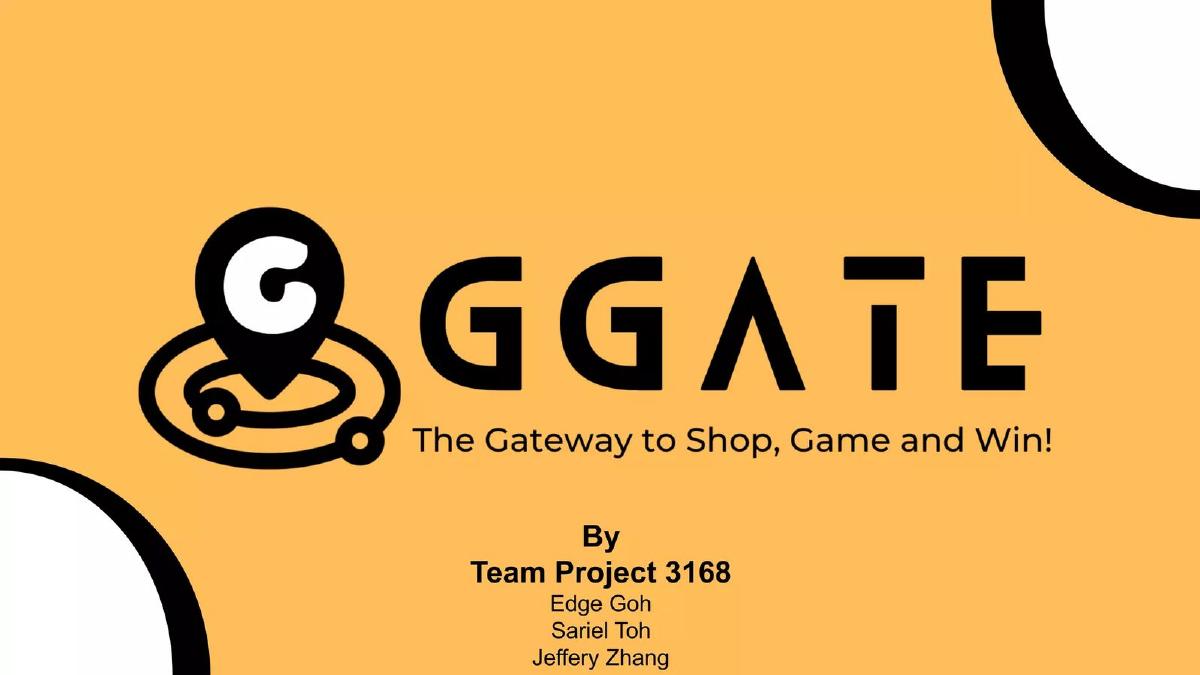
The opening slide introduces the brand name 'GGATE' with the tagline 'The Gateway to Shop, Game and Win!' It lists the three team members: Edge Goh, Sariel Toh, and Jeffery Zhang, under the designation 'Team Project 3168'. The visual identity uses a location pin icon integrated with a circular path, suggesting a focus on movement and geo-location.
Slide 2: Summary
Slide 2 defines G gate as a B2B2C platform. The core mission is to empower local store owners to market to and engage nearby customers without incurring 'hefty' costs. Three pillars of the technology are highlighted: Low Cost Platform, Geo-Location, and Machine Learning. This slide also includes headshots of the CEO, CTO, and COO, providing an immediate face to the leadership team.
Slide 3: The Problem
The problem statement focuses on the inefficiencies of current marketing methods. Slide 3 identifies three specific issues: Expensive marketing platforms , a lack of precision targeting , and low customer retention rates . By framing the problem this way, G gate sets the stage for a solution that is both cost-effective and data-driven.
Slide 4: The Solution
The solution is presented as the 'GGate Mobile App'. It repeats the three technological pillars from the summary slide (Low Cost, Geo-Location, Machine Learning) and includes a placeholder for a prototype demo. The slide describes the app as an 'alternate gateway' for brand marketing and customer engagement, though it does not detail specific app features here.
Slide 5: Business Model Canvas (B2B)
This slide provides a deep dive into the B2B side of the business using the standard Business Model Canvas format. Key partners include digital solution providers (POS, CRM) and mall management. Key activities involve a B2B sales force and merchant onboarding. The revenue streams for this segment are listed as marketing advertisement subscription fees, transactional fees, and platform setup fees. The cost structure highlights solution development, hosting, and employee salaries.
Slide 6: Business Model Canvas (B2C)
The B2C canvas focuses on the consumer experience. The value proposition includes a 'Meta-loyalty program with simple gaming mechanics' and 'attractive promotions based on geo-location'. Revenue on the consumer side is expected to come from in-app subscriptions and in-app purchase transaction fees. Channels for acquisition include user referral programs, the App Store, and social media marketing.
Slide 7: Business Model
Slide 7 simplifies the revenue model into four main sources: Marketing Subscription Fees , Platform Setup Fees , Transactional Fees , and In-App Purchase . This visual helps clarify how the different components of the B2B and B2C canvases translate into actual income for the company.
Slide 8: The Market (Singapore)
G gate provides specific market data for Singapore, citing 'Singstats for 2020'. They identify approximately 48,000 local merchants. Their first-year target is to acquire 2% of these merchants, estimated at $0.6M per annum. On the consumer side, they aim for 1.3 million users out of a total population of 5.7 million. This slide is effective because it uses reputable data sources to ground their growth projections.
Slide 9: Customer Acquisition
The acquisition strategy is split into two channels. For merchants, they plan to use direct B2B sales, partner referrals, and tech exhibitions. For users, the focus is on referrals, leveraging merchant databases, and standard marketing channels. This dual-track approach acknowledges the difficulty of building a two-sided marketplace.
Slide 10: Competition
The competitive landscape is mapped on a four-quadrant graph. The axes are 'Random Marketing' vs. 'Precise Marketing' and 'CashBack Reward Only' vs. 'CashBack and other App Inclusive rewards'. G gate places itself in the top-right quadrant (Precise Marketing + Inclusive Rewards). Competitors like Fave and Shopee are placed in lower quadrants, suggesting G gate offers more targeted engagement than these larger platforms.
Slide 11: Team
The team slide provides professional backgrounds for the founders. Edge Goh (CEO) has 3+ years in business development and project management. Sariel Toh (CTO) has 8 years of experience as a software architect and game developer, plus 5 years in robotics process automation. Jeffery Zhang (COO) has 4+ years in operations and UI/UX design. The technical depth of the CTO is a notable highlight for a software-based startup.
Slide 12: The Ask
G gate is seeking $250,000 . The funds are intended to 'finish development of our product, release a beta, launch new offices, and hire key staff'. The slide uses icons to represent Product Development, New Hires, and Other Operation Costs, but lacks a granular breakdown of how the $250k will be split between these categories.
Slide 13: Thank You
The final slide provides contact information for Edge Goh, including a Gmail address. It repeats the company logo and tagline, maintaining brand consistency throughout the deck.
What Works in the G gate Deck
Market Specificity: Citing Singstats data for the Singaporean market (Slide 8) gives the projections a level of credibility often missing in early-stage decks. · Dual-Sided Strategy: By providing separate Business Model Canvases for B2B and B2C (Slides 5 and 6), the founders show they understand the distinct needs and acquisition paths for both merchants and consumers. · Clear Revenue Streams: Slide 7 clearly articulates how the company intends to make money, moving beyond a simple 'subscription' model to include transactional and setup fees. · Technical Leadership: The CTO's 8 years of experience in software architecture and game development (Slide 11) is a strong signal for a platform that promises machine learning and gaming mechanics.
What is Missing from the G gate Deck
Traction Data: There is no mention of current user numbers, pilot programs, or signed LOIs from merchants. The deck feels very much like a 'pre-seed' or 'concept' pitch. · Unit Economics: While revenue streams are listed, there is no information on Customer Acquisition Cost (CAC) or Lifetime Value (LTV), which are critical for evaluating a B2B2C marketing platform. · Product Roadmap: The deck mentions 'finishing development' (Slide 12), but doesn't show what the product actually looks like beyond a logo on a phone screen. A few UI/UX screenshots would have been beneficial. · Exit Strategy: There is no mention of potential acquirers or how investors might eventually realize a return on their $250,000.
Founder Takeaways
Ground Your TAM/SAM/SOM: If you are targeting a specific geographic region, use local government statistics like G gate did on Slide 8. It makes your 'bottom-up' market sizing much more believable. · Address Both Sides of the Market: If your business relies on two different user groups (merchants and consumers), you must show a distinct value proposition and acquisition plan for each. The Business Model Canvas is a good tool for this. · Be Specific with 'The Ask': While G gate stated their total ask ($250,000), they could have improved the slide by providing a percentage breakdown (e.g., 50% R&D, 30% Marketing, 20% Ops) and a timeline for when these funds would be exhausted. · Define Your Competitive Edge: The quadrant graph on Slide 10 is a classic way to show how you differ from incumbents. Ensure your axes represent the most important factors for your target customers.
Frequently asked questions
- What is G gate's primary value proposition for merchants?
- G gate offers local store owners a low-cost platform to engage nearby customers using geo-location and machine learning. According to Slide 5, the value proposition includes converting physical traffic into digital traffic, increasing retention through active engagement, and stimulating buying behavior via targeted campaigns. This allows small businesses to compete with larger brands without the 'hefty sum' typically associated with digital marketing.
- How does G gate plan to generate revenue from its platform?
- The company outlines four distinct revenue sources on Slide 7: Marketing Subscription Fees, Platform Setup Fees, Transactional Fees, and In-App Purchases. This multi-pronged approach targets both the B2B side (merchants paying for access and setup) and the B2C side (users making purchases or interacting with premium features), providing a diversified income stream for the startup.
- What are the specific market targets for G gate's first year in Singapore?
- Slide 8 defines the target market as 2% of the approximately 48,000 local merchants in Singapore, which they estimate will yield $0.6M per annum. On the consumer side, they are targeting 1.3 million users, which represents roughly 23% of the total Singaporean population of 5.7 million. These figures serve as their 'first year user acquisition target'.
- Who are the key members of the G gate founding team?
- The team consists of three members: Edge Goh (CEO), who has over 3 years in business development and project management; Sariel Toh (CTO), a software architect and game developer with 8 years of experience; and Jeffery Zhang (COO), who has over 4 years of experience in operations and UI/UX design. Their combined technical and operational backgrounds are highlighted on Slide 11.
- What is the intended use of the $250,000 investment?
- As stated on Slide 12, the $250,000 will be used to finish product development, release a beta version, launch new offices, and hire key staff. The slide categorizes these expenditures into Product Development, New Hires, and Other Operation Costs, though it does not provide a specific percentage breakdown for each category.