GiftStarter raised $850,000 in 2014 with a deck that functions more like a product demo than a traditional investment pitch. The 11-slide deck follows a single 'True Story' of a group-funded bicycle, meticulously detailing the UI/UX from campaign creation to the physical delivery of a handmade card. While the emotional resonance and product clarity are high, the deck is professionally incomplete by modern standards. It contains zero slides on market size (TAM), competitive landscape, unit economics, or revenue models. It doesn't even include a formal 'Ask' slide or a team background slide, de…
Key takeaways
- The deck uses a single narrative arc—replacing a stolen bike—to explain the entire product lifecycle (Slide 3).
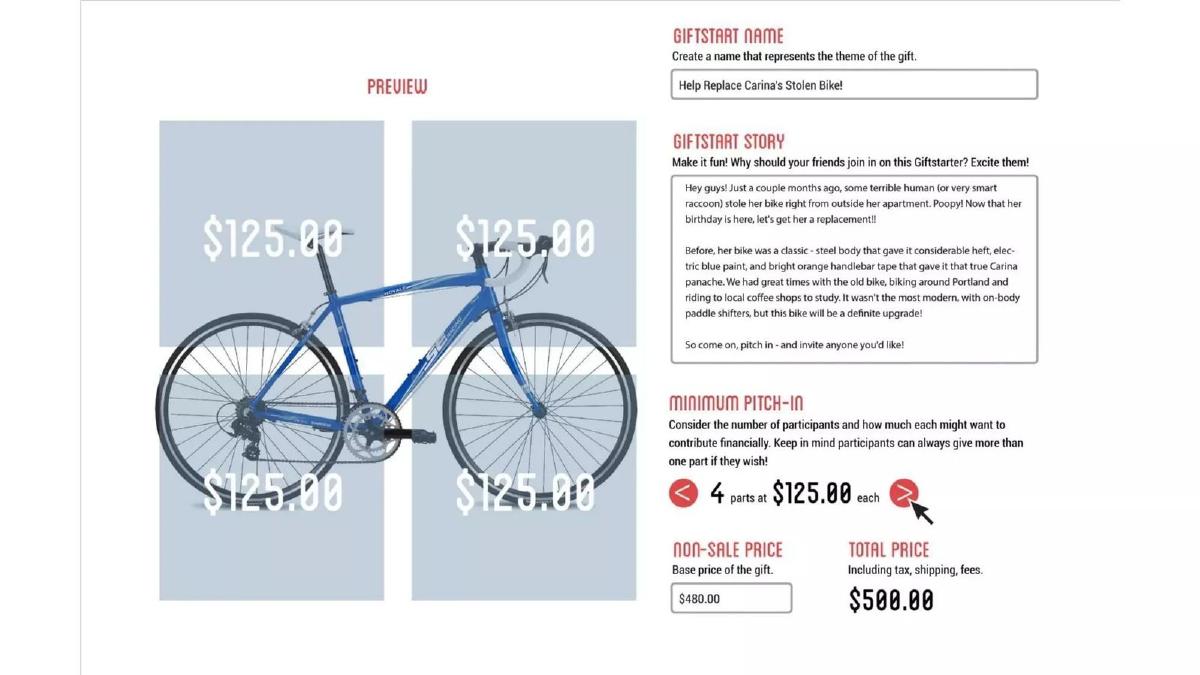
- Product functionality is demonstrated through UI mockups showing how a $500 gift is split into four $125 'tiles' (Slide 4).
- Social integration is highlighted as a core growth lever, featuring Facebook, Twitter, and Google+ icons (Slide 5).
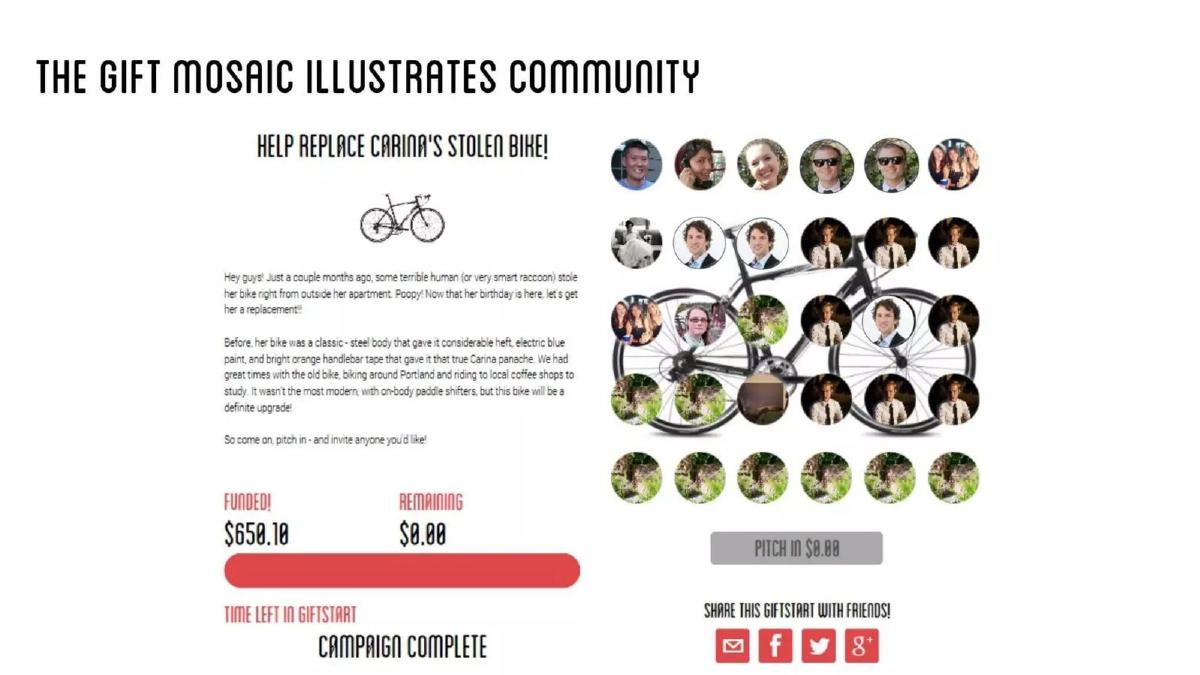
- The 'Gift Mosaic' concept (Slide 6) visualizes community contribution by replacing image tiles with donor avatars.
- Physical fulfillment is a key differentiator, shown through a 'handcrafted card experience' that includes printed messages from all donors (Slide 9).
- There is no mention of a revenue model or how the company takes a cut of the $500 total price shown on Slide 4.
- The deck completely omits a market slide, leaving the scale of the group-gifting industry unaddressed.
- The team is listed by name only on Slide 1, with no bios, past successes, or roles defined.
The Narrative-First Seed Deck
GiftStarter’s 2014 seed deck is an anomaly in the world of fundraising. While most decks strive for a balance between product, market, and finance, GiftStarter leans 100% into the product experience. The deck is structured as a linear story, following a single user journey from the moment a gift is conceived to the moment it is delivered. This approach is highly effective for explaining a new consumer behavior—group gifting—but leaves massive gaps in the business case. According to catalogue facts, the company successfully raised $850,000 with this presentation, proving that in 2014, a compelling vision and a polished UI could still command significant capital.
The Hook and the Mission
Slide 1: Title Slide The deck opens with a clean, geometric background and the tagline: "Group gifting made easy. GIVE BETTER, TOGETHER, WITH GIFTSTARTER." It lists five team members—Arry Yu, Gina Cuff, Christie Gettler, Jon Peck, and Roy Shin—at the bottom right. Notably, there are no titles or bios. This is the only mention of the team in the entire 11-slide deck.
Slide 2: The Transition A simple red slide with the text "TRUE STORY." This serves as a narrative bridge, signaling to the investor that the following slides are not hypothetical wireframes but a walkthrough of a real-world use case.
The Product Walkthrough: From Need to Campaign
Slide 3: Gifting Mission The problem and persona are introduced simultaneously. The "Gifting Mission" is a "Birthday Bike," and the recipient is a young woman named Carina. By using a specific person and a specific object, GiftStarter avoids the trap of abstract problem statements.
Slide 4: The Campaign Creation UI This slide is the most information-dense in the deck. It shows the "Giftstart Name" (Help Replace Carina's Stolen Bike!) and the "Giftstart Story." Crucially, it introduces the mechanics of the platform: the ability to set a "Minimum Pitch-In." The example shows a $500.00 total price divided into 4 parts at $125.00 each. This slide explains the business logic without using a single bullet point of text.
Slide 5: Social Distribution The deck emphasizes the viral nature of the product. A grid of 25 tiles, each priced at $23.95, covers the bike image. To the left, icons for Facebook, Twitter, Google+, and Email are displayed under the header "SHARE THIS GIFTSTART WITH FRIENDS!" This illustrates how the platform intends to acquire users: through the social networks of the campaign creator.
Community and Fulfillment
Slide 6: The Gift Mosaic As the campaign progresses, the gray tiles are replaced by the avatars of friends who have contributed. The slide shows a "Funded!" status of $650.10 (which exceeds the original $500 goal, though the deck doesn't explain how overfunding is handled) and a progress bar. The header states, "THE GIFT MOSAIC ILLUSTRATES COMMUNITY," highlighting the emotional value of seeing who pitched in.
Slide 7 & 8: Personalization These slides focus on the "Group Card." Slide 7 shows a list of messages from donors like Amy Lassen and Tanya Chan. Slide 8 zooms in on a specific message: "I'm buying you the crank because you spin me right 'round, baby, right 'round!" This emphasizes that the platform isn't just a payment processor; it’s a communication tool that attaches specific meaning to parts of the gift.
Slide 9: The Physical Touchpoint GiftStarter differentiates itself from digital-only platforms like GoFundMe by providing a "handcrafted card experience." Six photos show the recipient opening a physical, red-ribboned card that contains the printed mosaic of photos and messages. This is a critical slide because it explains the operational complexity and the premium nature of the service.
The Outcome and Social Proof
Slide 10: The Result A simple "SHE GETS THE BIKE, TOO!" slide shows the recipient with the actual bicycle. This completes the narrative arc started on Slide 3. It proves the logistics work: money was raised, the card was delivered, and the physical product reached the recipient.
Slide 11: Final Testimonial The deck ends with a Facebook post from a customer: "Honestly SO BLESSED to have the friends that I have! When I got home, I had a GIFTSTARTER GIFT waiting for me..." This serves as the only form of validation or traction in the deck. There are no charts showing month-over-month growth, user retention, or total volume processed.
What Works in the GiftStarter Deck
The primary strength of this deck is its unwavering focus on the user experience . By the end of Slide 11, an investor knows exactly what the product does, how it looks, and how it feels for both the giver and the receiver. In a crowded "social payment" space, GiftStarter successfully carved out a niche for "meaningful gifting" rather than just "splitting a bill."
The visual storytelling is also top-tier. The use of a real story (the stolen bike) makes the utility of the product immediately obvious. It bypasses the need for a "Problem" slide because the problem is self-evident: high-ticket items are hard for one person to buy, but easy for a group to buy together. The UI mockups are clean and professional, suggesting a high level of design competency within the founding team.
What is Missing from the GiftStarter Deck
While the deck is a great product demo, it is a poor business document. The following omissions are glaring:
Market Size (TAM/SAM/SOM): There is no indication of how large the gifting market is or what percentage of it is moving toward group-funding models. · Business Model: We see a "Total Price" of $500, but we don't know if GiftStarter charges the user a fee, takes a commission from the retailer, or both. · Traction Metrics: Beyond one Facebook testimonial, there is no data. How many campaigns have been started? What is the average gift value? What is the conversion rate from a 'share' to a 'contribution'? · Competition: In 2014, platforms like Tilt (formerly Crowdtilt) and GoFundMe were already active. GiftStarter does not explain why it will win against these incumbents. · The Team: Listing names is not enough. Investors need to know why this team is the one to build a logistics-heavy gifting platform. · The Ask: The deck ends without a request for capital. While we know from catalogue facts they raised $850,000, the deck itself doesn't state the amount being raised or the milestones that capital will achieve.
What a Founder Should Copy
Founders should emulate the linear narrative structure . If your product is difficult to explain, walking through a single, relatable "True Story" is the most efficient way to achieve clarity. The way GiftStarter uses Slide 4 to explain complex features (splitting, tiles, fees, stories) within a single UI screenshot is a masterclass in "show, don't tell."
Additionally, the focus on the 'Last Mile' (Slide 9) is excellent. Many software startups forget that the real value often happens offline. By highlighting the physical card, GiftStarter proved they understood the emotional 'aha' moment of their product, which is a powerful way to build investor excitement.
However, founders must treat this as half of a deck . To be successful today, this narrative must be followed by a second half that addresses the hard numbers: the unit economics, the acquisition channels, and the competitive moat. GiftStarter relied on the novelty of social gifting in 2014; in a more mature market, the lack of financial data would be a deal-breaker.
Frequently asked questions
- How does GiftStarter make money according to the deck?
- The deck does not explicitly state its revenue model. Slide 4 shows a 'Total Price' of $500.00 which includes 'tax, shipping, fees,' but it does not break down what percentage GiftStarter retains as a service fee versus what goes to the merchant or logistics.
- What is the 'tile' concept mentioned in the description?
- Slide 4 and Slide 5 illustrate this. A high-ticket item is divided into equal monetary segments. In the example, a $500 bike is divided into 4 parts of $125 each or 20+ tiles of $23.95. This lowers the barrier to entry for individual gift contributors.
- Does the deck address competition like GoFundMe or Tilt?
- No. The deck contains zero competitive analysis. It focuses entirely on its own unique 'handcrafted card' and 'gift mosaic' features to differentiate itself, rather than comparing its features or fees to existing crowdfunding or gifting platforms.
- What stage of development was the product in during this pitch?
- The product appears to be fully functional or in late-stage beta. Slides 6 through 11 show actual campaign completions, physical cards being opened, and a recipient with the final product, suggesting the end-to-end logistics were already operational.
- Why is the lack of a team slide significant?
- For a seed round, investors are primarily betting on the team's ability to execute. While Slide 1 lists Arry Yu, Gina Cuff, Christie Gettler, Jon Peck, and Roy Shin, it provides no context on their expertise. This forces investors to do external due diligence to understand if the founders have the technical or retail background to scale the business.