Giddy’s 2022 seed deck is a masterclass in brevity, utilizing only seven content slides to secure $8 million in funding. Operating in the complex Decentralized Finance (DeFi) sector, the company avoids technical jargon in favor of a clear 'Custodial vs. Non-Custodial' comparison. By highlighting the massive yield gap—0.1% to 8% in traditional systems versus 10% to 200% in DeFi—Giddy creates a compelling economic narrative. The deck relies heavily on the 'problem' of DeFi's high barrier to entry, visualizing a convoluted 8-step user journey that their mobile app aims to collapse. While it lack…
Key takeaways
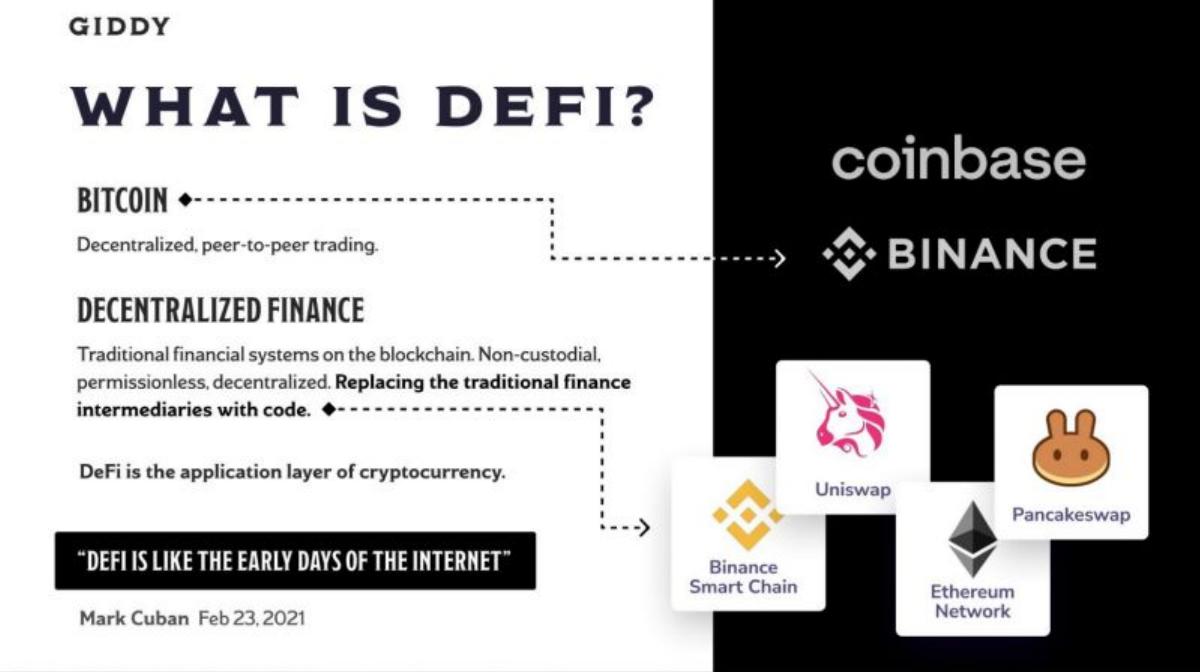
- The deck defines DeFi as the 'application layer of cryptocurrency' to simplify the concept for investors (Slide 2).
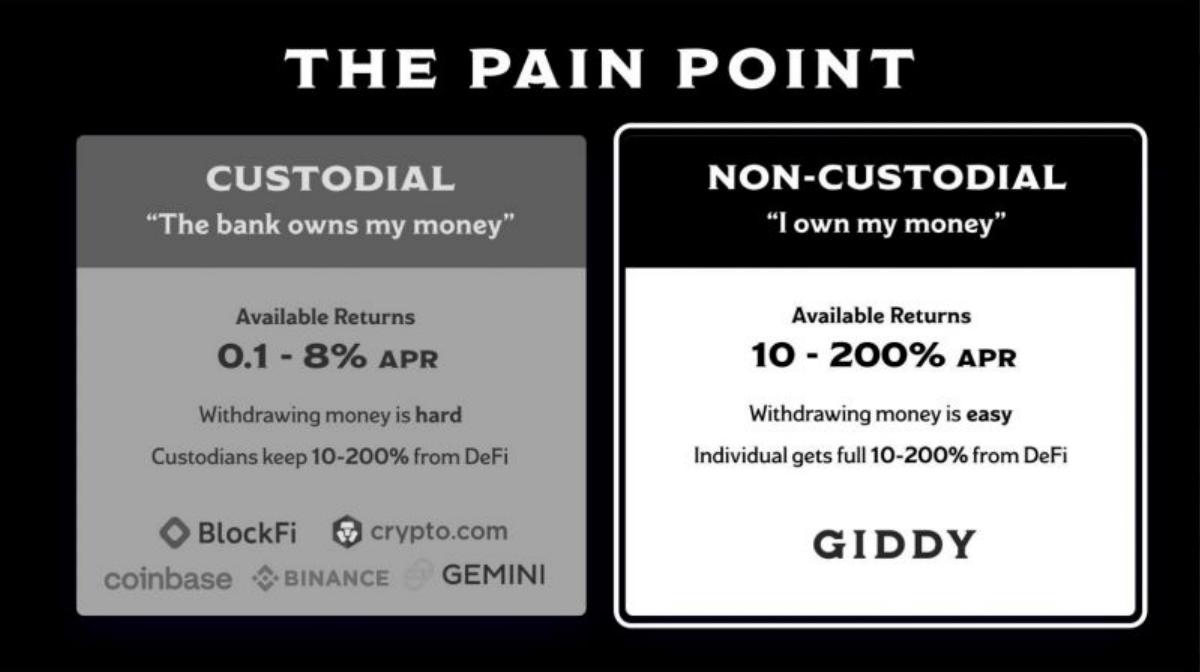
- Giddy claims a massive yield advantage, citing available returns of 10-200% APR compared to 0.1-8% for custodial banks (Slide 3).
- The 'Pain Point' slide explicitly names competitors like Coinbase, Binance, and BlockFi as 'Custodial' entities where 'The bank owns my money' (Slide 3).
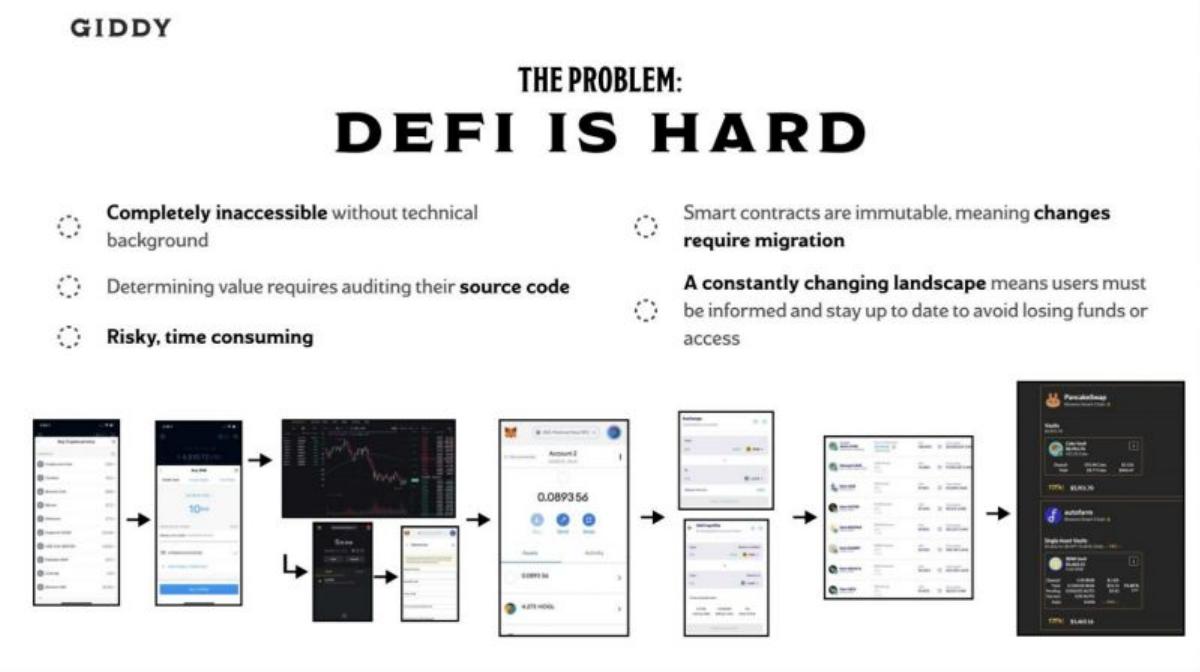
- A visual flow of eight screenshots illustrates that current DeFi processes are 'completely inaccessible without technical background' (Slide 4).
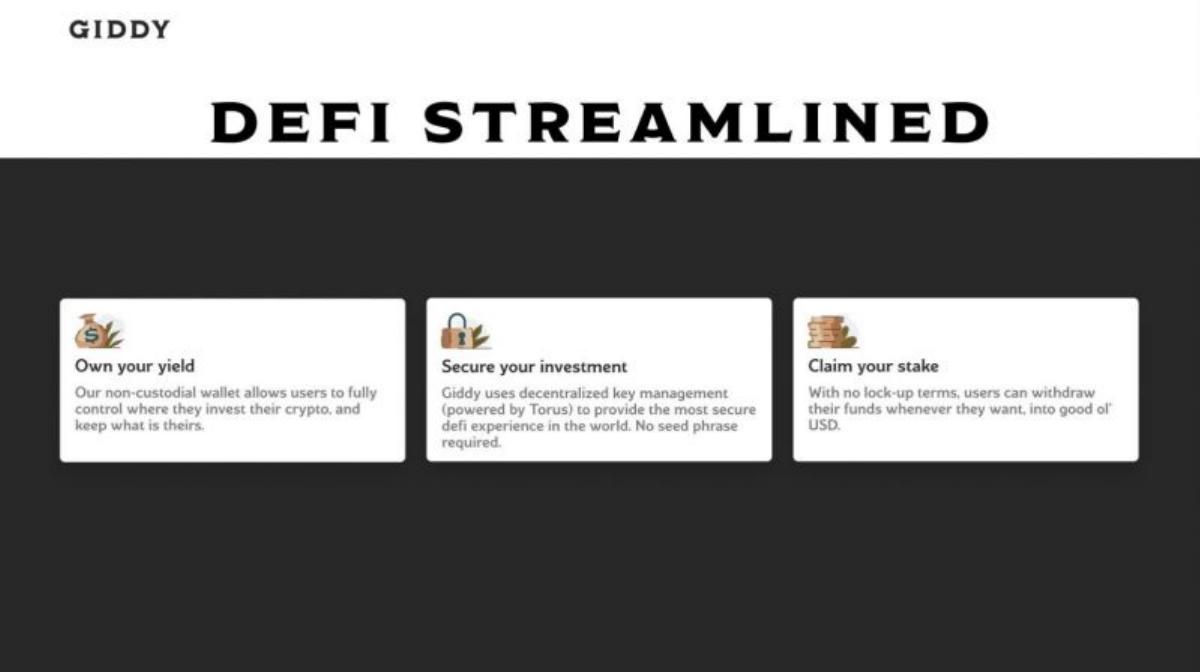
- The solution uses decentralized key management powered by Torus to eliminate the need for seed phrases (Slide 5).
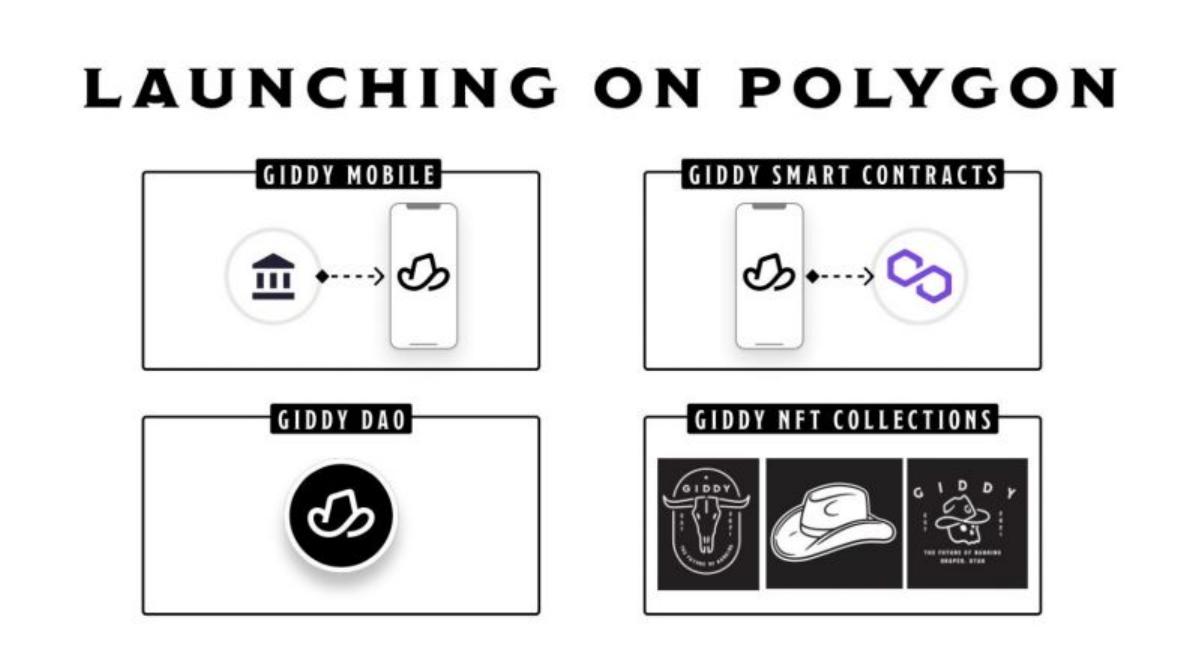
- Giddy identifies its initial technical infrastructure as 'Launching on Polygon' to handle smart contracts and mobile transactions (Slide 6).
- The deck mentions a 'Giddy DAO' and 'Giddy NFT Collections' as part of its ecosystem expansion (Slide 6).
- The presentation concludes with a value proposition for users centered on 'Easy Passive Income' and beating inflation (Slide 7).
The 7-Slide Seed Deck: Giddy’s $8M Narrative
In the world of venture capital, there is a persistent myth that a pitch deck must be a 20-page exhaustive tome covering every possible metric. Giddy’s 2022 seed deck, which helped secure $8 million, stands as a stark counter-example. With only seven slides of content, the deck focuses almost entirely on the 'Why Now' and the 'Problem/Solution' fit. It is a document designed for a specific moment in time—the height of the DeFi (Decentralized Finance) interest—where the primary hurdle was not proving that DeFi existed, but proving that it could be made usable for the average person.
Slide 1: Title and Branding
The cover slide is minimalist, featuring the Giddy logo—a stylized cowboy hat—and the tagline "EASY DEFI INVESTING." This immediately establishes the company’s value proposition. In a sector known for high technical complexity, Giddy chooses to lead with the word 'Easy.' There are no mentions of protocols, liquidity pools, or sharding here; just a brand identity that feels approachable and consumer-facing.
Slide 2: Market Education
Slide 2, titled "WHAT IS DEFI?" , serves to ground the investor. It distinguishes Bitcoin (peer-to-peer trading) from Decentralized Finance (traditional financial systems on the blockchain). The slide uses a powerful quote from Mark Cuban: "DEFI IS LIKE THE EARLY DAYS OF THE INTERNET." By citing a well-known billionaire investor, Giddy validates the sector before they even pitch their specific product. The slide also visually separates 'Centralized' players like Coinbase and Binance from 'Decentralized' protocols like Uniswap and PancakeSwap, positioning DeFi as the 'application layer' that replaces intermediaries with code.
Slide 3: The Pain Point and Economic Incentive
This is arguably the most important slide in the deck. Titled "THE PAIN POINT," it sets up a binary choice between 'Custodial' and 'Non-Custodial' finance. On the left, it lists incumbents like BlockFi, Coinbase, and Gemini, claiming they offer "0.1 - 8% APR" because "The bank owns my money." On the right, it places Giddy, claiming "10 - 200% APR" because "I own my money." The slide makes a bold claim that custodians keep the majority of DeFi returns for themselves. This creates a clear 'villain' (the custodial bank) and a 'hero' (Giddy), using high-yield percentages as the primary motivator for the shift.
Slide 4: The UX Barrier
If Slide 3 explains why people want DeFi, Slide 4 explains why they can't have it yet. Titled "THE PROBLEM: DEFI IS HARD," it lists several friction points: it is 'completely inaccessible without technical background,' 'risky,' and 'time consuming.' The bottom of the slide features a sequence of eight screenshots showing a convoluted user journey involving MetaMask, swapping tokens, and auditing source code. This visual 'mess' is the perfect setup for the solution slide, as it makes the current state of the art look untenable for a mass-market audience.
Slide 5: The Solution
Slide 5, "DEFI STREAMLINED," presents the Giddy solution in three pillars. First, "Own your yield," emphasizing the non-custodial nature of the wallet. Second, "Secure your investment," which mentions a key technical partnership: "Giddy uses decentralized key management (powered by Torus)... No seed phrase required." This is a critical detail, as seed phrases are one of the biggest drop-off points in crypto onboarding. Third, "Claim your stake," promising no lock-up terms and the ability to withdraw into "good ol' USD."
Slide 6: Technical Roadmap and Ecosystem
Titled "LAUNCHING ON POLYGON," this slide outlines the four components of the Giddy launch. It shows the connection between a traditional bank (the icon of a building) and the Giddy mobile app, and then the app's connection to the Polygon network. It also introduces the "Giddy DAO" and "Giddy NFT Collections." This slide signals that Giddy is not just a wallet, but a broader ecosystem intended to participate in the various trends of the 2022 crypto market.
Slide 7: User Impact
The final content slide, "IMPACT ON USERS," summarizes the benefits: "BEAT INFLATION," "EARN HIGH INTEREST," "SAFEST DEFI INVESTING," and "EASY PASSIVE INCOME." It uses desert-themed imagery (consistent with the cowboy hat logo) to maintain brand cohesion. This slide acts as a closing summary of the emotional and financial benefits for the end user.
What Giddy’s Deck Does Well
Clarity of the 'Enemy': Giddy does an excellent job of positioning itself against the 'Custodial' giants. By framing the 10-200% yield as something that already exists but is being 'stolen' or 'kept' by banks and centralized exchanges, they create a compelling reason for their product to exist. They aren't just building a tool; they are 'liberating' yield for the user.
Visualizing Friction: The 8-step screenshot flow on Slide 4 is a classic 'before' picture. It effectively communicates the pain of the current user experience without needing a single word of explanation. Any investor who has ever tried to use a hardware wallet or a decentralized exchange would immediately recognize that pain.
Removing Technical Hurdles: By explicitly mentioning that "No seed phrase [is] required" on Slide 5, Giddy addresses the single biggest usability issue in the non-custodial crypto space. This shows they have thought deeply about the 'retail' experience rather than just the 'crypto-native' experience.
What is Missing from the Giddy Pitch Deck
The Team Slide: This is the most glaring omission. In a seed round, investors are primarily betting on the founders' ability to execute. There is no mention of the founders' backgrounds, previous exits, or technical expertise. While the catalogue facts state they raised $8M, this deck alone does not explain who is building the technology.
Traction and Metrics: There are no numbers regarding waitlists, beta users, or transaction volume. The deck is purely a vision-and-problem document. While this is common in very early pre-seed rounds, for an $8M seed round, one would typically expect to see some evidence of early product-market fit or at least a community size.
The Ask and Use of Funds: The deck does not state how much money is being raised or how it will be spent. There is no roadmap for hiring, marketing, or product development beyond the mention of 'Launching on Polygon.'
Business Model: While the deck explains how users make money (the 10-200% APR), it never explains how Giddy makes money. Does the company take a spread? A SaaS fee? A withdrawal fee? The revenue model is entirely absent.
What Other Founders Should Copy
The 'Comparison' Framework: Founders should look at Slide 3 as a template for how to compare their startup to incumbents. Don't just list features; list the economic outcomes for the customer. Giddy’s comparison of 0.1% vs. 10% is a much more powerful argument than a checklist of technical specs.
The 'Why Now' Context: Using a quote from a high-profile figure like Mark Cuban (Slide 2) is a shortcut to credibility. If you are operating in a nascent or misunderstood industry, find a 'validator' who has already done the work of explaining the market's potential to the public.
Minimalist Design: Giddy’s deck is aesthetically consistent. The cowboy theme is subtle but present, and the slides are not overcrowded with text. This allows the investor to listen to the presenter rather than squinting to read small bullet points. It forces the narrative to be simple enough to be understood in seconds.
Final Thoughts
Giddy’s deck is a product of its era—a time when the promise of DeFi yield was the primary driver of fintech investment. While the lack of a team slide and financial projections would be a deal-breaker for many traditional VCs, the deck succeeds because it identifies a massive, undeniable friction point (DeFi complexity) and offers a plausible, high-reward solution. It is a 'narrative-first' deck that prioritizes the 'What' and 'Why' over the 'Who' and 'How.'
Frequently asked questions
- How much did Giddy raise with this deck?
- According to the catalogue facts, Giddy raised $8 million in a seed funding round in 2022. This is a high figure for a deck that contains only seven slides of actual content and lacks a team or traction slide.
- What is Giddy's core product according to the slides?
- Giddy is a mobile app designed for 'Easy DeFi Investing.' Its core features include a non-custodial wallet with decentralized key management, no seed phrase requirements, and the ability to withdraw funds into USD without lock-up terms.
- Which blockchain does Giddy use?
- Slide 6 explicitly states that Giddy is 'Launching on Polygon.' This choice was likely made to take advantage of Polygon's lower transaction fees and faster speeds compared to the Ethereum mainnet, which supports the 'Easy DeFi' narrative.
- Who are Giddy's main competitors?
- Slide 3 identifies two types of competitors. Custodial competitors include BlockFi, crypto.com, Coinbase, Binance, and Gemini. On the decentralized side, Slide 2 mentions Uniswap and PancakeSwap as the complex protocols Giddy aims to simplify.
- What is the primary 'hook' used in the deck?
- The primary hook is the yield disparity. Slide 3 contrasts the 0.1-8% APR of traditional custodial institutions with the 10-200% APR available in DeFi, positioning Giddy as the tool that lets individuals keep the full return.