The Giordano Bruno Institute deck, presented by David Siegel, outlines a mission to decouple personal data from large tech vendors like Google and Facebook. The proposal centers on a four-part app architecture: a personal data locker, a digital assistant, a marketplace for these assistants, and an ad-free 'world of offers.' Siegel leverages his background as a Silicon Valley veteran and founder of the Pillar Project to argue for a non-profit structure that prevents corporate acquisition. The deck highlights alarming statistics regarding screen time and data monetization to justify the need fo…
Key takeaways
- The average teen spends 7 hours and 22 minutes on their phone daily, a metric used to establish the scale of digital dependency (Slide 2).
- Google and Facebook generate $182 and $158 respectively from the average user annually, highlighting the current monetization of personal data (Slide 2).
- The solution architecture consists of four components: a Personal Data Locker, Personal Digital Assistant, World of Offers, and Digital Assistant Marketplace (Slide 4).
- The institute intends to operate as a non-profit specifically to ensure that 'Mark Zuckerberg can never buy it' (Slide 5).
- Founder David Siegel previously raised $21 million via an ICO for the Pillar Project but left to pursue this vision without the constraints of token price management (Slide 6).
- The project aims to reduce global ad spend by at least 20 percent by enabling data-driven transactions without traditional advertising (Slide 4).
- The fundraising goal is split into two phases: $2 million by the end of 2020 and $100 million by the end of 2021 (Slide 7).
- The deck omits a formal team slide, stating that the founder is currently 'putting my team together now' (Slide 7).
Executive Summary: A Philosophical Approach to Data Privacy
The Giordano Bruno Institute deck is less a traditional startup pitch and more a manifesto for a new digital social contract. Named after the 16th-century friar and philosopher, the institute positions itself as a defender of 'Truth and Individual Freedom.' The deck identifies a systemic failure in the way personal data is harvested by a handful of global corporations and proposes a decentralized, non-profit alternative. By focusing on the 'Data Locker' and 'Digital Assistant' concepts, the deck attempts to bridge the gap between high-level privacy concerns and functional consumer technology.
Slide 1: Title and Hook
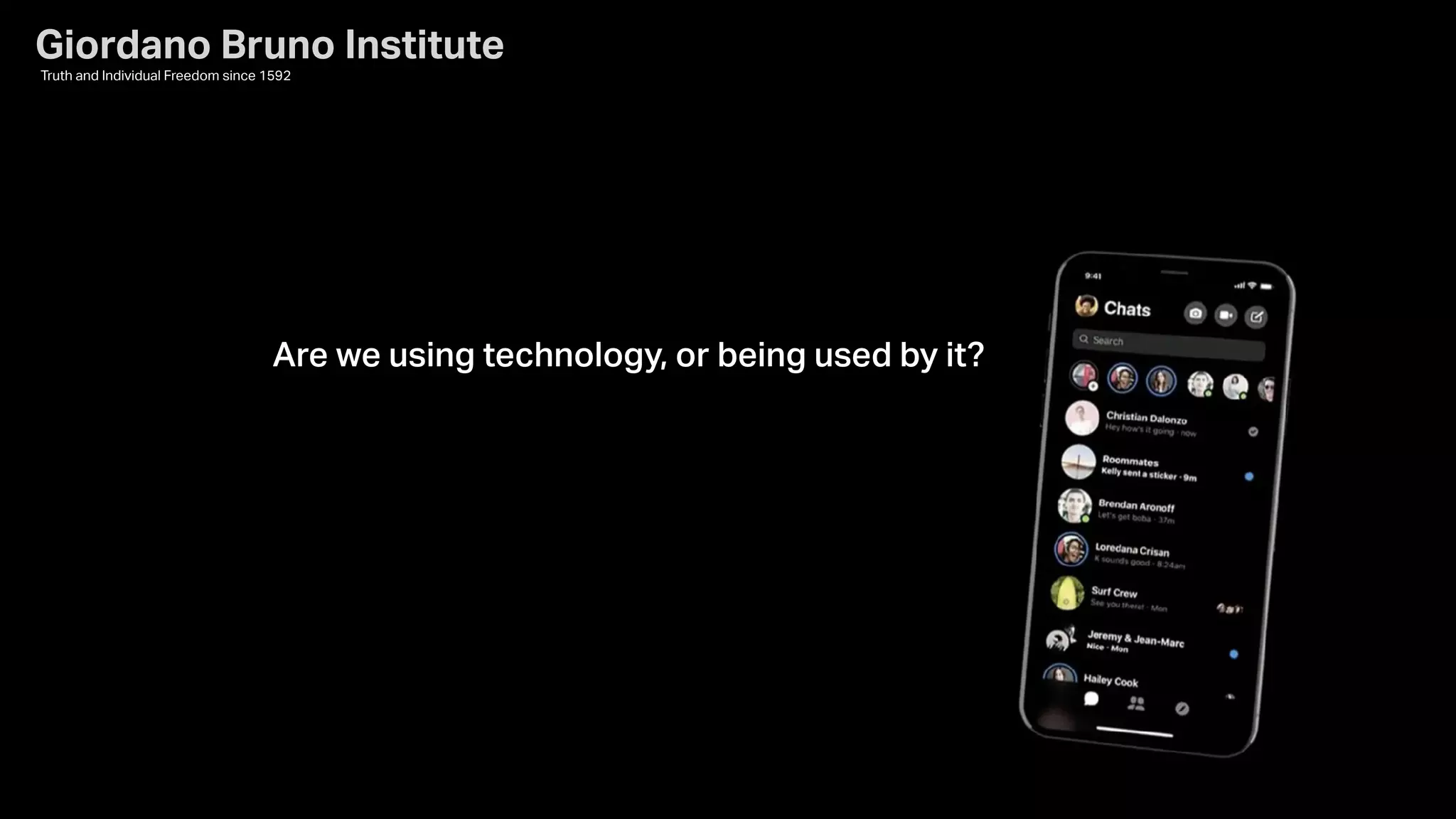
The deck opens with a stark black background and a central question: "Are we using technology, or being used by it?" This immediately sets a philosophical and slightly adversarial tone toward the current tech landscape. The branding includes the tagline "Truth and Individual Freedom since 1592," referencing the historical Giordano Bruno. A smartphone mockup showing a chat interface is positioned to the right, grounding the abstract question in a familiar daily object.
Slide 2: The Quantitative Case for Change
Slide 2, titled "Things are Out of Control..." , uses five key metrics to establish the urgency of the problem. It states that the average teen spends 7 hours and 22 minutes on their phone per day and that the average user interacts with their device 2,617 times per day . It then shifts to the economics of data, noting that a user is worth $182 to Google and $158 to Facebook annually. Finally, it notes that fewer than 100 large companies hold all consumer data and that in-app advertising will exceed $200 billion in 2021 . This slide effectively moves the conversation from 'feelings' about privacy to the hard reality of time and money.
Slide 3: The Problem of Centralization
This slide visualizes the current state of the internet. It displays logos for Apple, Amazon, Google, Walmart, Pfizer, and Facebook , each surrounded by a node-and-spoke diagram. The text "You have an account with every vendor" highlights the fragmentation of identity. The bottom caption, "All your data and payment details live on their servers," serves as the primary pain point the institute intends to solve. It frames the current internet architecture as a series of corporate silos where the user is a guest rather than an owner.
Slide 4: The Four-Component Solution
The solution is presented as an app with four distinct pillars. 1. Personal data locker: Secure cloud storage in standard formats. 2. Personal digital assistant: An AI bot that works with user data to perform tasks like booking hotels or managing calendars. 3. The world of offers: A request-based system where offers come to the user without advertising, compared to "Kayak... for everything." 4. Digital assistant marketplace: A competitive space where users can hire and fire different bots. A significant claim at the bottom suggests this model could "cut the global ad spend down by at least 20 percent."
Slide 5: The Two Big Ideas and Non-Profit Status
This slide distills the vision into two points: separating data from devices/vendors and creating a marketplace for assistants. The most notable element is the footer: "Plus, it will be nonprofit, so Mark Zuckerberg can never buy it." This is a clear signal to potential donors that the project is mission-driven and seeks to avoid the 'exit to a giant' path that many privacy startups eventually take. It emphasizes that users will pay for bots rather than being the product themselves.
Slide 6: Founder Pedigree and Lessons Learned
Founder David Siegel introduces himself, citing a Stanford master's degree and a history of starting over a dozen companies. He highlights his 2010 book on data lockers and his 2017 project, Pillar Project , which raised $21 million via an ICO . Crucially, he offers a post-mortem on that project, stating that the pressure to increase token price made it difficult to build the actual product. This honesty is intended to build trust, showing that he has learned from the 'crypto-hype' era and is returning to a 'pure' vision of the personal data locker.
Slide 7: The Ask and Call to Action
The final slide, "Can We Talk?" , reveals the current stage of the project. Siegel admits he is still "putting my team together now." He is seeking donors for $2 million by the end of 2020 and a massive $100 million by the end of 2021 . The slide provides a website (giordano.institute) and a direct email address. It frames the project not as a finished product, but as a collaborative effort seeking suggestions and world-class talent to build a "trusted consumer brand."
What Works in This Deck
Strong Narrative Arc: The deck moves logically from a philosophical hook to alarming statistics, then to a clear architectural solution and a credible founder story. · Economic Justification: By citing the specific dollar value of a user to Google and Facebook, the deck makes the 'cost' of the current system tangible. · Founder Honesty: Admitting the failures of a previous $21M project due to tokenomics is a rare and effective way to demonstrate maturity and focus. · Clear Differentiation: The 'non-profit' stance and the 'Zuckerberg' comment clearly define the project's values against the status quo.
What is Missing from This Deck
Technical Feasibility: While the 'Data Locker' sounds good, there is no explanation of how it will interface with existing proprietary APIs of the very companies (Google, Amazon) it seeks to bypass. · Team: The deck explicitly states the team is not yet assembled. For a $2M (and eventually $100M) ask, the lack of a technical co-founder or engineering lead is a significant gap. · Revenue Model for the Marketplace: While users 'pay for bots,' the deck doesn't explain how the Institute sustains itself or how the marketplace facilitates these transactions without becoming another centralized gatekeeper. · Roadmap: There are no milestones between 'raising money' and 'cutting global ad spend by 20%.' A phased rollout plan is missing.
Founder's Guide: What to Copy
The 'Problem' Slide Layout: Slide 2 is a masterclass in using varied, high-impact statistics to make a problem feel insurmountable and urgent. · The 'Solution' Quadrant: Breaking a complex app into four distinct, color-coded value propositions (Slide 4) makes a high-tech concept easy for a non-technical donor to grasp. · The 'Lessons Learned' Approach: If you are a repeat founder, don't just list your successes. Explaining why a previous venture didn't reach its full potential—and how this new one fixes those mistakes—is incredibly persuasive.
Frequently asked questions
- What is the primary problem the Giordano Bruno Institute aims to solve?
- The institute targets the centralization of personal data. Slide 3 illustrates that users currently have accounts with every vendor (Apple, Amazon, Google, Walmart, Pfizer, Facebook), meaning all data and payment details live on corporate servers. The deck argues this leads to a lack of control, excessive screen time, and the exploitation of user data for advertising revenue, which is projected to exceed $200 billion in 2021.
- How does the proposed 'Personal Data Locker' function?
- According to Slide 4, the Personal Data Locker is a secure cloud storage system for all user data in standard formats. It is designed to interact with providers while giving the user freedom of choice through a single dashboard. The goal is to separate identity and data from specific devices and vendors, allowing users to remain secure and only identify themselves when they choose.
- Why is the Giordano Bruno Institute structured as a non-profit?
- Slide 5 explicitly states that the project will be a non-profit so that 'Mark Zuckerberg can never buy it.' This structure is intended to protect the institute's mission of individual freedom and truth from being compromised by corporate acquisition or the profit motives that the founder suggests have ruined current technology ecosystems.
- What is the founder's track record in this space?
- David Siegel identifies as a Silicon Valley leader with a Stanford master's degree. Slide 6 notes he started one of the world's first digital agencies and wrote a book on personal data lockers in 2010. Most notably, he created the Pillar Project in 2017, raising $21 million through an ICO. He admits that managing the token price made building the product difficult, leading him to return to his original vision.
- What are the specific financial asks and milestones mentioned in the deck?
- Slide 7 outlines a two-stage fundraising plan. The founder is looking for donors to provide $2 million by the end of 2020 to hire a team, build initial use cases, and develop the brand. Following this, the goal is to raise $100 million by the end of 2021. The deck does not specify the exact allocation of the $100 million beyond general scaling and brand development.