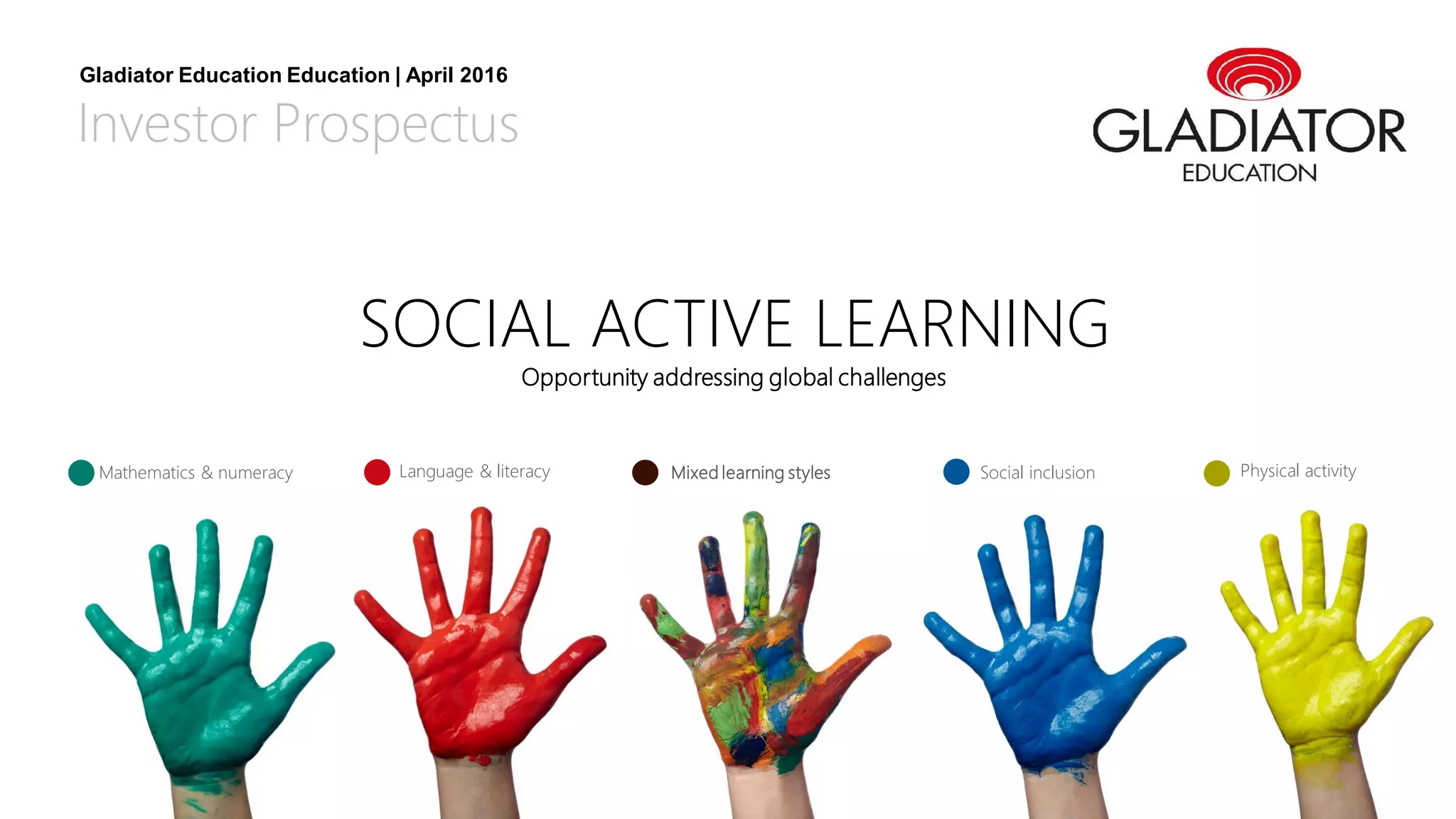
Gladiator Education, founded in 2006, seeks to disrupt traditional education by targeting the 15% of students who are kinesthetic learners. Their primary tool, the Aball1 product series, combines physical activity with academic subjects like mathematics and language. The deck claims to have already reached 150,000 children through partnerships with organizations like Innovation Norway and the Norwegian Football Association. While the vision is ambitious—targeting 5 million children in 5 years—the provided slides lack a specific capital ask, detailed unit economics, or a clear breakdown of the…
Key takeaways
- The company defines its core methodology as Social Active Learning, focusing on visual, auditory, and kinesthetic learning styles (Slide 3).
- Aball1 is the primary product series, developed in 2009 after cooperation with the Norwegian department of education (Slide 4).
- The founders, Tor Sandnes and Glenn Andersen, have been active since 2006 and were finalists for the Ferd social entrepreneur of the year in 2010 (Slide 4).
- Gladiator Education estimates the US K-12 kinesthetic market alone at $100 billion per year (Slide 6).
- Growth plans for 2016 and 2017 include entering five specific international markets through distribution agreements (Slide 7).
- The company targets a 20% EBITDA for projects and distribution agreements (Slide 7).
- Strategic partnerships include UDi for asylum reception centers and the Norwegian Football Association (Slide 9).
- The deck identifies four specific exercise types for their educational balls: Social inclusion, Mathematics, Language, and Physical exercise (Slide 10).
Gladiator Education: A Deep Dive into Social Active Learning
Gladiator Education's investor prospectus, dated April 2016, positions the company as a social entrepreneurship venture focused on 'Social Active Learning.' The deck is structured to move from a broad social vision to specific product applications, utilizing the Aball1 series as the primary vehicle for impact. The following teardown examines the 10 provided slides from the 30-slide deck.
Slide 1: Title and Core Pillars
The cover slide introduces the company name and the date (April 2016). It establishes five core pillars of their educational approach: Mathematics & numeracy, Language & literacy, Mixed learning styles, Social inclusion, and Physical activity. The use of painted hands in different colors serves as a visual metaphor for diversity and hands-on learning, though it does not provide immediate technical or business data.
Slide 2: Vision and Scope
Slide 2 defines the company's 'North Star' metric: reaching 5 million children in 5 dedicated areas within 5 years. It explicitly lists the social problems the company intends to solve: Obesity/Inactivity, Social Inclusion, and Motivation for learning. The slide introduces the Aball1 product series, describing it as an 'arena' for active participation and mastery. This slide is high on mission but low on the mechanics of how that scale will be achieved.
Slide 3: The Science of Learning Styles
This slide attempts to validate the market need by citing Toprankblog.com. It claims that 30% of consumers are visual, 25% are auditory, and 15% are kinesthetic learners. The company positions itself as a solution for the kinesthetic group, which it describes as 'notorious for on-the-go learning.' The slide argues that few course programs encompass these facts as effectively as Gladiator Education.
Slide 4: The Innovative Social Entrepreneurs
This slide introduces founders Tor Sandnes and Glenn Andersen. It provides a timeline of the company's history, noting its founding in 2006 and the invention of Aball1 in 2009. Key traction metrics are included here: 150,000 children reached (estimated by Vista) and several awards, including being a finalist for the Ferd social entrepreneur of the year in 2010 and winning the Connect start-up prize in 2014. The photo of the founders with balls on their heads emphasizes the 'fun' aspect of the brand but may be perceived as less formal than typical investor decks.
Slide 5: Product and Service Benefits
Slide 5 focuses on qualitative validation. It features a quote from Ms. Pluckrose, an Assistant Head Teacher in the UK, praising the 'unique, kinesthetic approach.' The slide also provides a definition of Kinesthetic Learning (or Tactiles Learning) and references the Fleming VAK/VARK model. This slide serves to educate the investor on the pedagogical theory behind the business.
Slide 6: The Educational Market Space
The company presents a size example for the US market. It values the total US educational market at $1.3 trillion, broken down into Early Childhood ($70B), K-12 ($670B), Higher Education ($475B), and Adult Learning ($55B). By applying their 15% kinesthetic learner figure to the K-12 space, they calculate a specific target market of $100 billion per year. This is a classic top-down market sizing approach.
Slide 7: Growth Plans 2016 and 2017
This slide outlines the immediate business strategy. The goal was to have sales in five countries (Scandinavia, UK, US, Germany, and Spain) by 2017 through distribution agreements. Financial targets include doubling sales in 2016 and 2017, a 10% long-term growth rate, and a 20% EBITDA target. The slide lacks the baseline figures (current sales) necessary to evaluate the significance of 'doubling.'
Slide 8: Learning Philosophy
This slide lists the criteria for 'engaging learning,' including repeatability, expandability, and a social dimension. It contrasts their 'active' alternative with traditional learning that is 'not always associated with high activity.' It reinforces the brand's commitment to 'fun and energizing' basics.
Slide 9: Partners & Projects
Slide 9 is a 'trust' slide, listing several high-profile partners and funders. These include Innovation Norway, the Norwegian Football Association (NFF), and UDi (asylum reception centers). It also mentions the Scheiblers Foundation and Grønt Punkt. A small diagram in the corner shows a hand pointing toward a growth trajectory from 'Academic Research' to 'Go Public,' though this diagram is generic and not specific to Gladiator's actual financials.
Slide 10: Exercise Types – Educational Balls
The final slide in the provided set details the practical application of the Aball1 product. It breaks down exercises into four categories: Social Inclusion, Mathematics, Language, and Physical Exercise. For each, it answers 'Why?', 'Where?', and 'How?'. For example, it notes that Mathematics exercises can be done in 'traditional ways' or moved to 'other indoor spaces as well as outdoors' using their products.
What Works in This Deck
Clear Niche Identification: The deck does an excellent job of identifying a specific segment of the market—kinesthetic learners—and explaining why current educational systems fail them. By focusing on this 15%, they avoid the trap of trying to be everything to everyone.
Established Traction: Citing 150,000 children reached and naming specific government-linked partners like Innovation Norway and UDi provides significant credibility. It proves the product is not just a concept but has been deployed in real-world settings.
Mission-Driven Narrative: The vision of reaching 5 million children and addressing obesity creates a compelling 'social impact' story that would appeal to ESG (Environmental, Social, and Governance) investors or social venture capitalists.
What Is Missing from This Deck
The Ask: In the 10 slides provided, there is no mention of how much capital the company is seeking, the valuation, or the specific use of funds. While this might be in the remaining 20 slides, its absence in the core prospectus summary is a notable gap.
Unit Economics: While a 20% EBITDA target is mentioned, there is no data on the cost to manufacture the Aball1 products, the price point for schools, or the customer acquisition cost (CAC). Without these, the 20% target is just a projection.
Competitive Landscape: The deck assumes that the only competition is 'traditional learning.' It does not account for other ed-tech companies, physical education equipment providers, or other active learning startups that might be vying for the same school budgets.
Baseline Financials: The deck promises to 'double sales,' but never states what the sales were in 2015. Doubling $10,000 is very different from doubling $1,000,000.
Founder Takeaways
Leverage Third-Party Estimates: Gladiator Education uses an external firm (Vista) to estimate their impact (150,000 children). Using third-party validation for impact metrics is much more persuasive than internal estimates.
Segment Your Market: Rather than claiming to improve education for all students, the founders specifically targeted the 15% who are kinesthetic learners. This makes the market sizing (Slide 6) feel more grounded and attainable.
Show, Don't Just Tell: The inclusion of specific exercise types (Slide 10) helps investors visualize exactly how the product is used in a classroom. This bridges the gap between high-level pedagogy and practical business application.
Use a Navigation Bar: The deck uses a consistent navigation bar at the top (Social Investing, People, Financials, etc.). This helps investors understand where they are in the presentation and makes the deck feel organized and professional. Address Social Impact Directly: For startups in the education or health space, explicitly listing the 'Social Problems' you solve (as seen on Slide 2) is a powerful way to align with the values of modern investment funds. Highlight Strategic Partnerships: The partnership slide (Slide 9) is one of the strongest in the deck. Listing government bodies and national associations (like the NFF) suggests a level of vetting that individual investors find reassuring.
Frequently asked questions
- What is the primary product offered by Gladiator Education?
- The primary product is the Aball1 series, which consists of educational balls designed for physical activity and learning. According to Slide 4, it was invented in late 2009. The balls are used to facilitate exercises in mathematics, language, and social inclusion, aiming to engage students who struggle with traditional, sedentary classroom methods.
- Who are the founders and what is their track record?
- The company was founded in 2006 by Tor Sandnes and Glenn Andersen. Slide 4 notes they were finalists for the Ferd social entrepreneur of the year in 2010 and received the Connect start-up prize in Oslo in 2014. They have a history of cooperating with the department of education in Norway.
- How does the company define its market opportunity?
- Gladiator Education targets the 'kinesthetic learner' segment, which they claim represents 15% of the market. Slide 6 values the total US educational market at $1.3 trillion, suggesting a $100 billion annual opportunity within the US K-12 space specifically for kinesthetic-focused products and services.
- What are the company's financial goals for 2016-2017?
- As stated on Slide 7, the company aimed to double its sales in both 2016 and 2017. They set a long-term growth potential estimate of 10% yearly and established a target EBITDA of 20% for their projects and distribution agreements.
- What social impact goals does the deck outline?
- The company's vision is to reach 5 million children within 5 years (Slide 2). They focus on three main social problems: obesity/inactivity, social inclusion, and motivation for learning. Their work includes contracts with asylum reception centers (UDi) to promote social interaction among refugees (Slide 9).