Bloom Community’s 14-slide pitch deck successfully secured $2.5M in Seed funding by positioning the app as a necessary alternative to mainstream social platforms that often marginalize queer and non-monogamous users. The narrative centers on a 'community-first' model, drawing a historical parallel between modern niche communities and traditional religious institutions. By focusing on event-based discovery rather than the standard 'swipe' mechanics of dating apps, Bloom demonstrates a clear growth flywheel where event organizers act as unpaid acquisition channels. The deck features strong earl…
Key takeaways
- Bloom positions itself as a 'community-first social app' rather than a traditional dating platform (Slide 1).
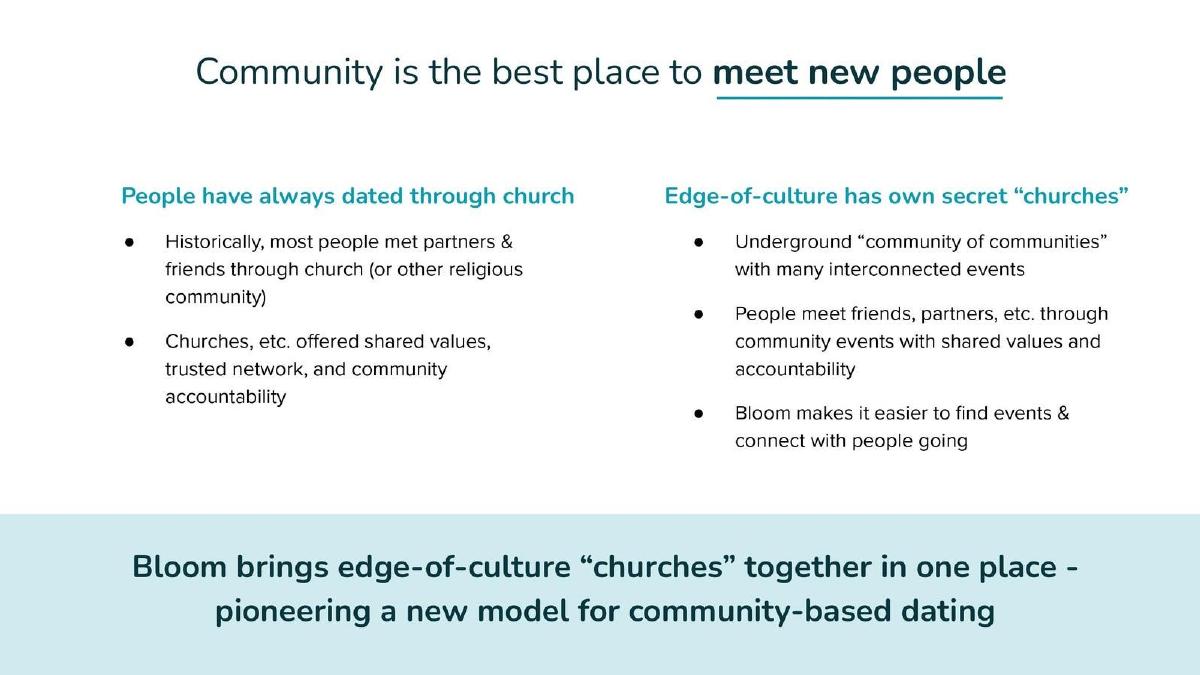
- The company uses a historical analogy, comparing 'edge-of-culture' communities to traditional churches to explain the need for shared values and accountability (Slide 2).
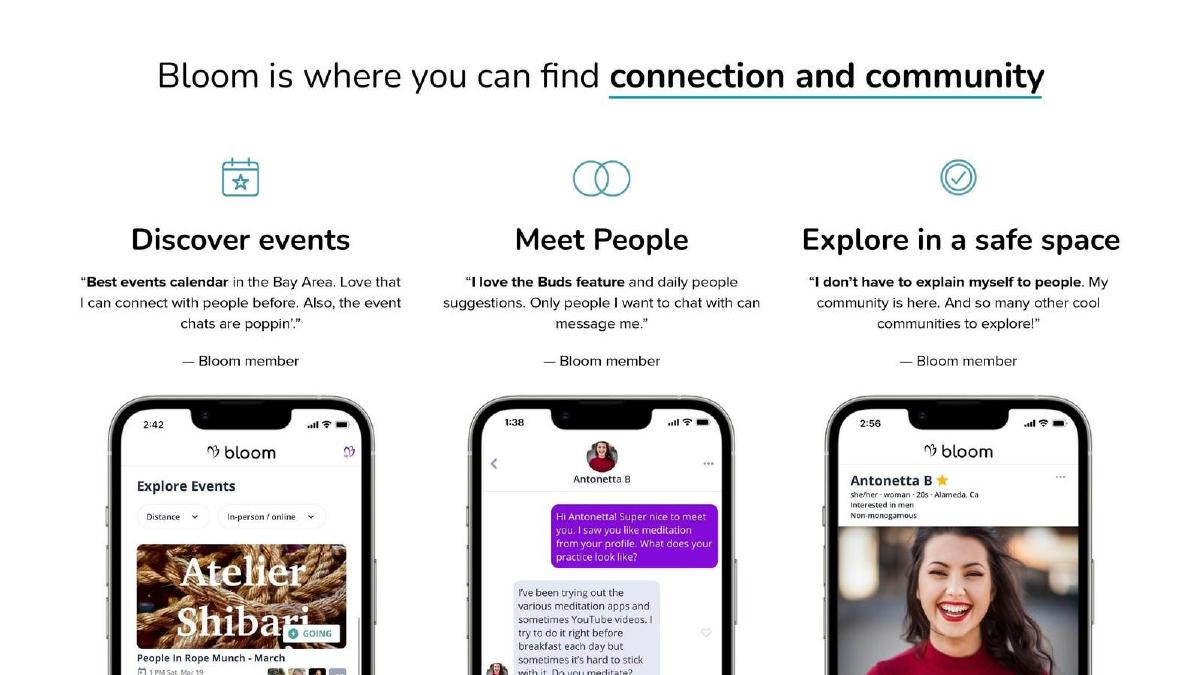
- Product features focus on three pillars: event discovery, meeting people via a 'Buds' feature, and providing a safe space for marginalized identities (Slide 3).
- A three-step growth flywheel illustrates how event organizers cross-promote Bloom to sell more tickets, creating a 'win-win' acquisition loop (Slide 4).
- The deck reports 25% month-over-month growth in monthly active users between January and May 2022 (Slide 5).
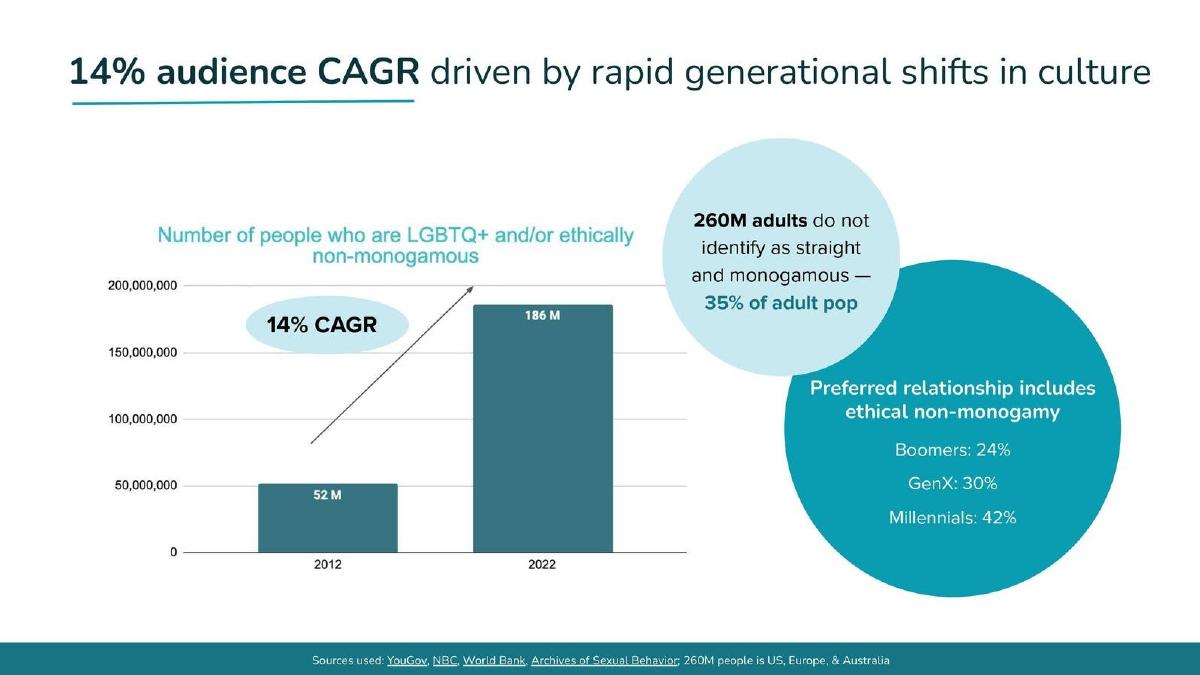
- The startup highlights a generational shift, noting that 21% of Gen Z identifies as LGBTQ+ compared to only 3% of Boomers (Slide 6).
- Market research cited on Slide 6 shows that 42% of people under 41 believe an ideal relationship includes consensual non-monogamy.
- Mainstream platforms like Facebook and TikTok are criticized for 'downranking' or 'shadow-banning' content from these underserved communities (Slide 7).
Bloom Community: Reimagining Social Connection for Underserved Markets
Bloom Community’s pitch deck is a masterclass in niche positioning. In a crowded market of social and dating apps, Bloom successfully raised $2.5M by arguing that the 'generalist' approach of giants like Match Group or Meta fails to serve the specific safety and community needs of queer and non-monogamous people. The deck, consisting of 14 slides, focuses heavily on cultural shifts and a unique acquisition flywheel that bypasses expensive performance marketing.
Slide 1: The Vision Statement
The deck opens with a clean, minimalist title slide. The tagline 'Community-first social app' is a deliberate choice. By leading with 'community' rather than 'dating,' Bloom distances itself from the 'swipe fatigue' associated with Tinder or Bumble. This positioning is critical for their target demographic, where social safety and shared values are often higher priorities than high-volume matching.
Slide 2: The Church Analogy
Slide 2 provides the philosophical foundation for the business. It compares 'edge-of-culture' communities to historical religious institutions. The slide argues that people have always dated through 'church' because it offered 'shared values, trusted network, and community accountability.' Bloom positions itself as the digital infrastructure for modern, secular 'secret churches'—underground communities that are currently fragmented across various platforms. This slide effectively communicates that Bloom isn't just an app; it's a replacement for a fundamental social structure that has gone missing in the digital age.
Slide 3: Product and Social Proof
This slide breaks the product down into three core functions: Discover events, Meet People, and Explore in a safe space. The inclusion of the 'Buds' feature is notable, as it suggests a more platonic or 'connection-first' approach to networking. Each feature is paired with a member testimonial. For example, one member notes, 'I don't have to explain myself to people. My community is here.' These quotes serve as qualitative evidence that the app is solving a specific pain point: the exhaustion of explaining one's identity on mainstream platforms.
Slide 4: The Growth Flywheel
Slide 4 is perhaps the most important for an investor. It outlines a three-step 'win-win' marketing cycle. 1) Organizers add events and cross-promote Bloom. 2) The organizer's audience joins Bloom to connect with other attendees. 3) Bloom features the event, selling more tickets and growing the organizer's business. This is a classic B2B2C strategy that allows Bloom to acquire users at a very low cost (CAC) because the event organizers are incentivized to do the marketing for them.
Slide 5: Traction and Growth Metrics
Traction is presented clearly on Slide 5. The company reports 25% month-over-month (MoM) growth in monthly active users. The chart shows a significant inflection point starting around March 2022. The text notes that they have an 'established launch playbook in Bay Area' and have recently expanded to LA, San Diego, and NYC. This tells investors that the model is repeatable and that the growth is accelerating as they enter larger markets.
Slide 6: The Generational Shift
Slide 6 uses data to prove the 'Why Now?' Bloom cites Gallup and YouGov data to show a massive demographic shift. The percentage of people identifying as LGBTQ+ jumps from 3% in Boomers to 21% in Gen Z. Similarly, 42% of Gen Z and Millennials say their ideal relationship includes consensual non-monogamy. By presenting these figures, Bloom frames their 'niche' as a rapidly expanding market that will soon be the new mainstream.
Slide 7: The Competitive Gap
Slide 7 addresses why incumbents can't simply build a 'Bloom mode.' It claims that mainstream tech (FB/IG/TikTok) 'downranks' and 'shadow-bans' this type of content due to strict advertising and community guidelines. It also critiques existing dating apps for relegating gender-diverse people to 'other' categories. This slide defines Bloom’s 'moat' as a combination of specialized moderation, community-first features, and a brand that mainstream platforms are too risk-averse to emulate.
What Works in This Deck
Strong Narrative Arc: The deck moves logically from a high-level cultural problem (the loss of community) to a specific market opportunity (the rise of queer/ENM identities) to a scalable solution (the event flywheel). It feels like a cohesive story rather than a collection of disparate facts.
Zero-Cost Acquisition Strategy: Investors love to see growth that isn't dependent on Facebook or Google ads. By showing that event organizers are their primary acquisition channel, Bloom demonstrates a path to high margins and viral growth.
Demographic Tailwinds: The use of Slide 6 to show the 7x increase in LGBTQ+ identification across generations is a powerful way to turn a 'niche' play into a 'massive market' play. It suggests that Bloom is catching a wave that is only just beginning to peak.
What Is Missing from This Deck
Monetization Specifics: While the deck mentions 'growing organizer's business,' it does not explicitly state how Bloom makes money. Are they taking a cut of ticket sales? Is there a subscription model? For a Seed round, investors usually want to see at least a hypothesis for revenue.
Unit Economics: There is no mention of Customer Acquisition Cost (CAC) or Lifetime Value (LTV). While the flywheel suggests low CAC, providing hard numbers would have strengthened the case for the business's efficiency.
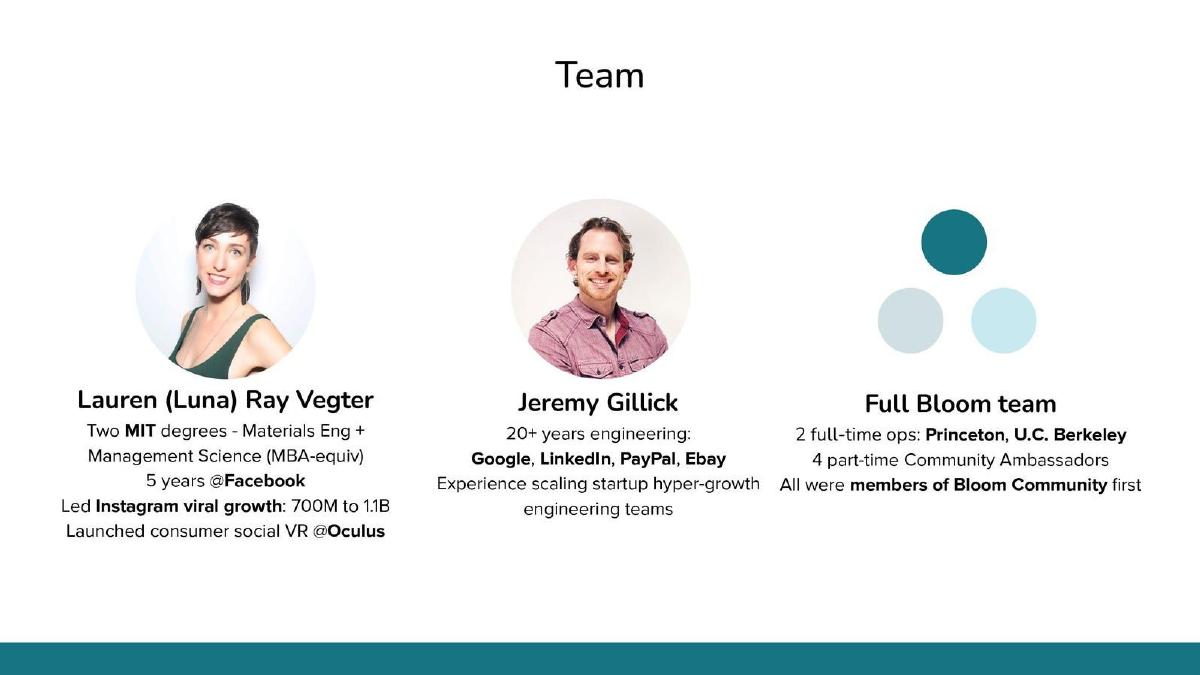
Detailed Team Slide: The provided materials do not include a slide detailing the founders' backgrounds. In a community-focused startup, the 'founder-market fit' is essential. Investors need to know that the team has the cultural competency to lead this specific community.
Founder Takeaways
Use Analogies to Explain Complex Markets: If you are building for a community that investors might not understand, use a familiar analogy like 'church' to bridge the gap. It helps them understand the utility of the product even if they aren't the target user.
Show, Don't Just Tell, Your Flywheel: The circular diagram on Slide 4 is a great way to visualize how your business grows. If you can show that your growth is a byproduct of your users' or partners' success, you have a much more attractive pitch.
Lead with Traction: Bloom puts their 25% MoM growth front and center. If you have a 'hockey stick' graph, don't bury it at the end of the deck. Use it to validate the problem you described in the first few slides.
Focus on 'Why Now': Every pitch needs to answer why your company couldn't have existed five years ago. Bloom’s use of generational data is a perfect example of how to answer this question using external, macro-economic trends.
Frequently asked questions
- What is Bloom Community's primary growth strategy?
- Bloom utilizes a B2B2C flywheel centered on event organizers. Organizers add their events to the Bloom calendar and cross-promote the app to their attendees. This drives new users to the platform who then connect with other attendees, while Bloom helps the organizers sell more tickets, creating a self-sustaining growth loop.
- How does Bloom differentiate itself from mainstream dating apps?
- According to the deck, mainstream apps often relegate gender-diverse people to 'other' categories and focus primarily on hookups. Bloom emphasizes 'community accountability' and shared values, allowing users to form connections that can be platonic, romantic, or sexual without the stigma or shadow-banning found on larger social networks.
- What specific metrics did Bloom use to show traction?
- The deck highlights a 25% month-over-month growth rate in Monthly Active Users (MAU). It also includes a growth chart showing a sharp upward trajectory from January 1, 2022, to May 1, 2022, coinciding with their launch in the Bay Area, Los Angeles, San Diego, and New York City.
- What demographic trends is Bloom betting on?
- Bloom is targeting the significant increase in LGBTQ+ identification and non-monogamous relationship preferences among younger generations. They cite data showing that Gen Z is seven times more likely to identify as LGBTQ+ than Boomers and that nearly half of Millennials and Gen Z view non-monogamy as an ideal relationship structure.
- Is there a monetization plan included in the deck?
- The provided slides do not explicitly detail a monetization strategy or revenue model. However, the mention of helping event organizers 'sell more tickets' suggests potential future revenue streams through ticketing fees, premium memberships, or featured event placements.